
AP ENVIRONMENTAL SCIENCE · PLAN YOUR PRACTICE
APES Score Calculator
2027 Exam Guide
Estimate your score from MCQ and three FRQ results. Explore the calculation, then plan your next practice session with detailed scoring guidance.
Regular exam: 13 May 2027 · Session 2

PLAN YOUR NEXT PRACTICE SESSION
AP Environmental Science score calculator
Enter your raw scores using the sliders or number fields. MCQ means answers correct; each FRQ entry is rubric points earned out of 10.
The model uses the published 60% MCQ and 40% FRQ weights. The 130-point display and AP 1–5 boundaries are independent planning conventions. This tool does not claim official 2027 cut scores or infer them from past score distributions.
Show the calculation for these inputs
MCQ contribution
FRQ combined contribution
The three free-response rubric scores are added before the FRQ contribution is calculated.
Estimated AP score 1. Composite 0 out of 130. Practice model, not an official score.
Estimated APES score bands: planning chart
Use these boundaries to compare practice scenarios. They are illustrative NUM8ERS settings, not verified conversions for the May 2027 exam. The default boundaries retain this tool’s earlier planning targets; you can adjust them above if your teacher supplies another model.
Planning boundaries: AP 2 at 50, AP 3 at 68, AP 4 at 77, AP 5 at 96 composite points.
| Composite points | Estimated AP score | AP recommendation |
|---|---|---|
| 96–130 | 5 | Extremely well qualified |
| 77 to less than 96 | 4 | Very well qualified |
| 68 to less than 77 | 3 | Qualified |
| 50 to less than 68 | 2 | Possibly qualified |
| 0 to less than 50 | 1 | No recommendation |
Official conversions can differ from a practice model. Use a preparation margin and several scored practice sets. The tool compares full-precision values; rounding a displayed total does not move a result into another band.
How the APES score estimate works
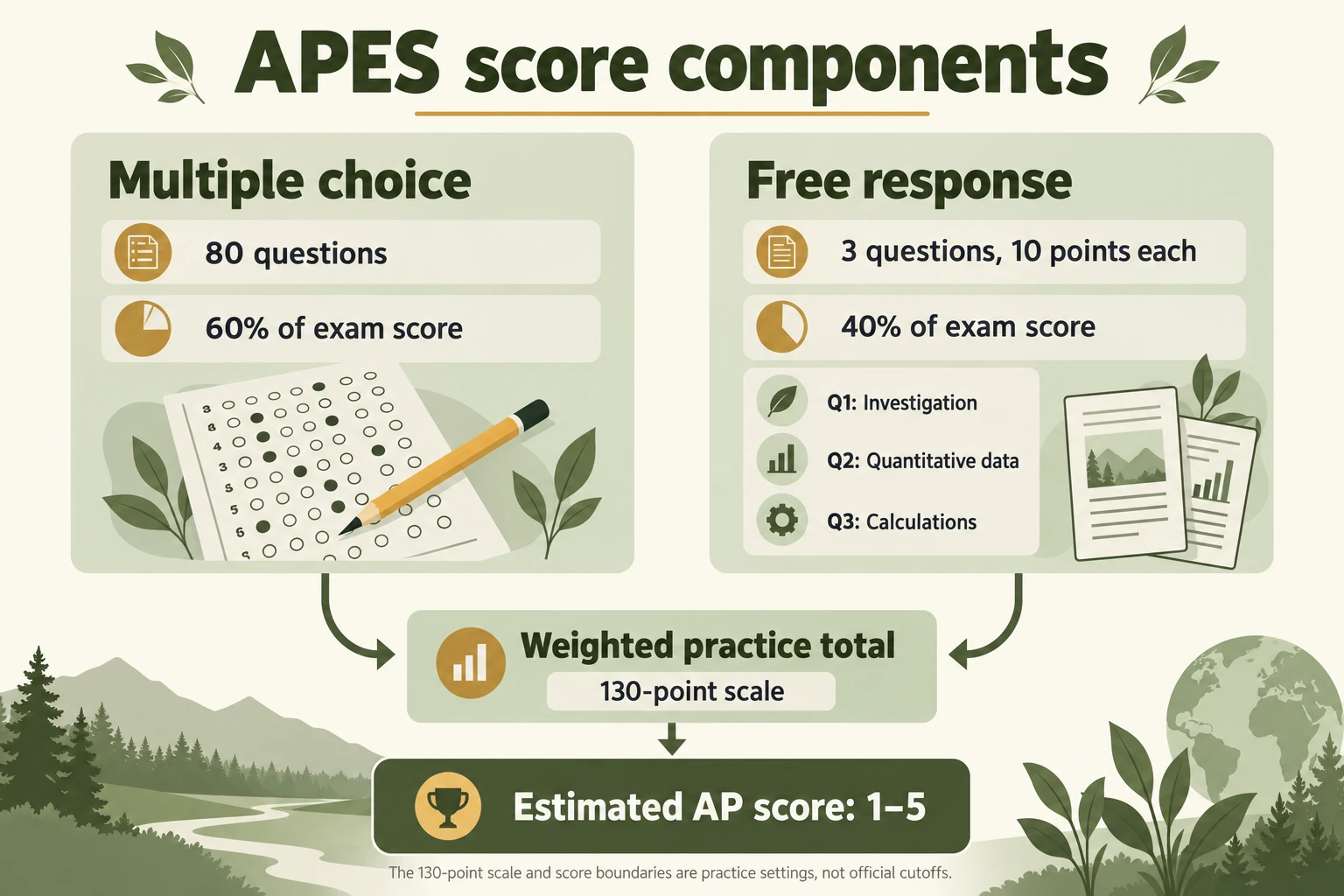
Your correct MCQ total and three free-response rubric scores become a weighted practice total. Multiple choice carries 60% and free response 40%. On this tool’s 130-point scale, that gives a maximum of 78 MCQ points and 52 FRQ points.
- M: multiple-choice answers correct, from 0 to 80.
- F: the sum of all three FRQ rubric scores, from 0 to 30.
The raw maximum is 110 points across both sections, but simply adding raw points would give the wrong weighting. Scaling preserves the published section shares. The 130-point display is a practice convention; it is not a claim that every official exam form uses that exact composite maximum.
Worked example
Suppose you earn MCQ, on Q1, on Q2 and on Q3. The FRQ sum is 18 out of 30:
The total is 89.70 of 130, which reaches AP 4 under the default model. Select “Load worked example” to reproduce it. The calculator retains full precision until display, avoiding the distortion caused by rounding the two section contributions before adding them.
Why past distributions do not reveal a future cutoff
A distribution reports the percentage of students receiving each AP score. It does not show which raw-score combinations produced those results. Updating the latest statistics does not justify inventing a calibrated cutoff. College Board uses evidence about college-level performance and comparability to set score standards, rather than assigning a fixed quota of 5s.
See College Board’s score-setting explanation. A calculator can model supplied points; it cannot evaluate written responses or reproduce an unpublished official conversion.
Official APES score distributions: 2026–2022
The latest published 2026 figures are rounded to whole percentages: 69% earned 3 or higher and 13% earned a 5. The current AP Students series does not yet list the 2026 mean or test-taker total. The historical 2025–2022 figures remain available for comparison.
| Official Year | 5 | 4 | 3 | 2 | 1 | 3+ | Test Takers | Mean Score |
|---|---|---|---|---|---|---|---|---|
| 2026 | 13% | 29% | 27% | 15% | 16% | 69% | Not yet listed | Not yet listed |
| 2025 | 12.6% | 27.8% | 28.8% | 15.0% | 15.8% | 69.2% | 245,371 | 3.06 |
| 2024 | 9.2% | 27.5% | 17.4% | 25.8% | 20.1% | 54.1% | 236,579 | 2.80 |
| 2023 | 8.3% | 28.4% | 17.0% | 26.4% | 19.9% | 53.7% | 209,757 | 2.79 |
| 2022 | 8.9% | 27.4% | 17.5% | 25.9% | 20.3% | 53.8% | 179,957 | 2.79 |
Sources: 2026 AP score distributions and the College Board historical APES series, checked 21 October 2026. Rounding can affect totals.
The 2025 mean was 3.06, with 245,371 test takers and 69.2% at 3 or higher. The lower qualifying shares in 2022–2024 describe those past cohorts; they do not determine your individual probability of a score. Distributions and practice score boundaries serve different purposes.
2027 AP Environmental Science exam format
The regular exam is Thursday, 13 May 2027 · Session 2. APES is fully digital in Bluebook, including typed free responses, and has 2 hours 40 minutes of testing time.
| Section | Time | Questions | Weight |
|---|---|---|---|
| Multiple choice | 90 minutes | 80 individual and set-based questions | 60% |
| Free response | 70 minutes | 3 questions, 10 rubric points each | 40% |
Multiple choice: content, sources and data
Expect questions about ecosystems, pollution, resources, energy and environmental decisions. Sets can include quantitative data, models, maps or text sources. Read scales and units carefully, and check wording such as “NOT” and “EXCEPT.” The overall pace is a little over a minute per question; difficult items may take longer. Correct answers earn credit without a deduction for wrong answers, so make a reasoned choice rather than leaving an item blank.
Free response: three clarified task titles
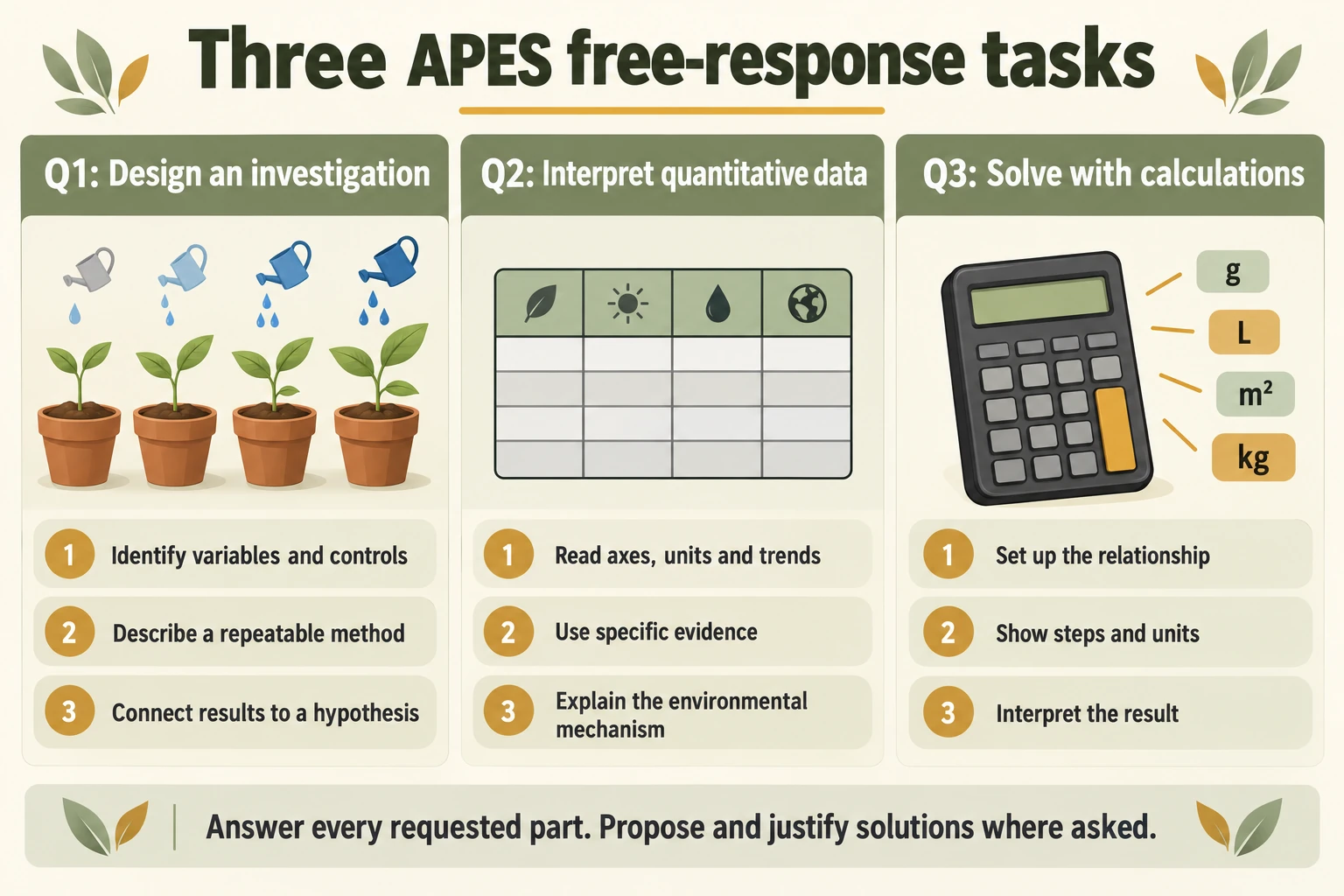
- Q1: Design an investigation. Work from an environmental scenario with a model or visual representation, using scientific investigation and environmental reasoning.
- Q2: Analyze and interpret quantitative data. Use a table, chart or graph to interpret the scenario and address environmental problems or solutions.
- Q3: Analyze an environmental problem doing calculations. Apply quantitative methods to the scenario and propose solutions where asked.
Budget roughly 23 minutes per question, allowing time to review. These 2026–2027 clarifications refine wording and alignment; College Board states that the course content is not changing. Reference information is available in Bluebook.
Verify the official exam overview and 2026–2027 clarifications. Session clock times vary by location; confirm your reporting time with your AP coordinator.
Detailed scoring breakdown
Each MCQ answer is one raw point, while each free-response question offers up to 10 rubric points. The model weights sections before estimating an AP score.
| Component | Raw maximum | Practice maximum | Practice points per raw point |
|---|---|---|---|
| MCQ | 80 | 78 | 0.975 |
| Q1 · Investigation | 10 | About 17.33 | About 1.73 |
| Q2 · Quantitative data | 10 | About 17.33 | About 1.73 |
| Q3 · Calculations | 10 | About 17.33 | About 1.73 |
| FRQs combined | 30 | 52 | About 1.73 |
| Total raw / weighted maxima | 110 | 130 | Different scales |
One additional FRQ rubric point adds practice points, while one additional MCQ adds . A single FRQ point has a larger practice contribution, but that does not mean every FRQ point takes less effort to earn. Prioritize recurring errors and improvements that are realistic for you.
Useful practice scenarios
| Scenario | MCQ | Q1 | Q2 | Q3 | Total | Default estimate |
|---|---|---|---|---|---|---|
| Strong balanced set | 100.53 | 5 | ||||
| Worked example | 89.70 | 4 | ||||
| Developing accuracy | 69.55 | 3 |
These are examples, not minimum required section scores or guaranteed exam results. Score each response against its question-specific guidelines; the calculator cannot decide whether an explanation earns a rubric point.
How to improve APES free-response answers
Answer each labeled part directly and follow its command verb. “Identify” asks you to name something; “describe” needs relevant characteristics; “explain” needs a relationship or mechanism; “justify” needs a defensible reason.
Q1: Make an investigation repeatable
Identify the manipulated and measured variables, specify what is kept constant, and describe suitable comparison groups where requested. Explain how measurements address the question. Replication strengthens confidence in results, while a control group is not the same thing as a controlled variable. Avoid claiming causation from an observational association alone.
Q2: Connect evidence to a mechanism
Describe the trend shown, including any important change in direction or interval. Use a specific value or comparison when asked and retain its units. Then explain the environmental process behind the pattern without adding unsupported causes. A proposed solution should address the stated problem and include the justification or tradeoff requested.
Q3: Show a traceable calculation
Write the relationship, substitute the supplied values, show conversions and report the result with suitable units. Use readable notation when typing in Bluebook and check powers of ten. A correct setup may earn credit even when a later arithmetic step is wrong, depending on that question’s rubric; partial credit is not automatic or guaranteed.
Use the released questions, scoring guidelines and scored examples to check your work. The 2026 scoring guidelines confirm three 10-point responses; use the appropriate year’s prompt when practicing.
APES course content: all nine units
Use the full course to prepare. The percentages below describe the multiple-choice section, not the whole exam. They are published ranges rather than fixed quotas. Unit 9 has the largest single range; the earlier units remain important for explaining processes across the course.
Unit 1: The Living World: Ecosystems
6%–8% of MCQ
Ecosystem structure, food webs, trophic levels, primary productivity and the carbon, nitrogen, phosphorus and water cycles. Explain why energy flow differs from nutrient cycling.
Unit 2: The Living World: Biodiversity
6%–8% of MCQ
Biodiversity, ecosystem services, island biogeography, ecological tolerance, adaptations and succession. Explain how disturbances and habitat changes affect populations and communities.
Unit 3: Populations
10%–15% of MCQ
Carrying capacity, exponential and logistic growth, age-structure diagrams and population pyramids, demographic transition and human population dynamics. Interpret changing growth rates and doubling-time estimates.
Unit 4: Earth Systems and Resources
10%–15% of MCQ
Plate tectonics, the rock cycle, soil formation and properties, the atmosphere, watersheds, climate patterns and Earth’s resources. Connect weathering, erosion and material cycling with ecosystem conditions.
Unit 5: Land and Water Use
10%–15% of MCQ
Agriculture, irrigation, forestry, mining, fishing and urbanization. Compare resource demands, habitat effects, runoff and strategies for more sustainable use.
Unit 6: Energy Resources and Consumption
10%–15% of MCQ
Fossil fuels, nuclear energy and renewable sources. Compare energy generation, efficiency, emissions, resource availability and environmental tradeoffs.
Unit 7: Atmospheric Pollution
7%–10% of MCQ
Air pollutants, photochemical smog, acid deposition, indoor air pollution and control measures. Connect sources to chemical processes, exposures and impacts.
Unit 8: Aquatic and Terrestrial Pollution
7%–10% of MCQ
Water and soil pollution, eutrophication, waste, toxicology, bioaccumulation and biomagnification. Link pollutant pathways to organisms and ecosystems.
Unit 9: Global Change
15%–20% of MCQ
Ozone depletion, climate change, ocean acidification, invasive species and biodiversity loss. Evaluate environmental responses and solutions at different scales.
Connect the grouped themes
Units 1–2 develop the living-world foundations: energy transfer, ecosystems and biodiversity. Units 3–4 connect populations with Earth systems. Units 5–9 apply those foundations to land and water use, energy, pollution and global change. Biogeochemical cycles connect these groups; learn reservoirs, transfers and human impacts together.
Practice explaining concepts, interpreting visuals and text, evaluating experiments, analyzing data, using mathematical routines and justifying environmental solutions. Return to the APES study hub for unit notes, flashcards and quizzes.
Unit ranges checked against the official APES course framework.
College credit and placement for APES
A qualifying APES score may earn introductory environmental science, elective or general-education credit, placement, or both. The receiving college sets the policy; course equivalencies, credit hours and laboratory requirements vary by institution, program and entry year.
- 5: Check the precise award, including whether it fulfills a science requirement. A 5 does not universally waive a laboratory course.
- 4: May meet a college’s credit or placement threshold. Confirm any restrictions for your intended major.
- 3: The AP “Qualified” recommendation; some institutions award credit while others require a higher score.
Award examples such as 3–4 credit hours are possible institutional policies, not guaranteed benefits. Use the AP Credit Policy Search and verify details directly with the college. A score prediction is not an admissions or credit decision.
Study tips to prepare for a 5 on APES
- 1. Master Biogeochemical Cycles: The carbon, nitrogen, phosphorus, and water cycles are foundational to nearly every APES topic. Create detailed diagrams showing reservoirs, fluxes, and human impacts. Understanding these cycles connects questions across multiple units.
- 2. Connect Concepts Across Units: APES is interdisciplinary. For example, deforestation (Unit 5) affects biodiversity (Unit 2), accelerates soil erosion (Unit 4), disrupts the carbon cycle (Unit 9), and impacts local populations (Unit 3). Practice explaining these connections in writing.
- 3. Practise dimensional analysis: Set up conversion factors so units cancel. For dilute aqueous solutions, converting concentration in parts per million to requires an appropriate density approximation; do not assume the equivalence for every substance or medium. Practice energy calculations and the Rule of 70, and show units throughout.
- 4. Know environmental legislation: Understand the purpose and scope of the Clean Air Act, Clean Water Act, Endangered Species Act, CERCLA (Superfund), NEPA and the Montreal Protocol. The Montreal Protocol is an international agreement. Name a law only when relevant and explain how it addresses the problem; citing a name alone does not ensure full credit.
- 5. Read Data Like a Scientist: Practice identifying independent/dependent variables, interpreting trends, recognising outliers, and drawing conclusions from graphs and tables. Pay attention to axis labels, scales, and units.
- 6. Master all three FRQ tasks: Design a defensible investigation, analyze and interpret quantitative data, and solve environmental problems using calculations. For each, propose and justify solutions when requested and explain tradeoffs in context.
- 7. Study real-world case studies: Use Deepwater Horizon, Chernobyl, Love Canal and the Dust Bowl to practice linking causes, environmental consequences and responses. These are useful applications, not a prediction that a specific case will appear on your exam.
- 8. Take timed practice exams: Build up to full-length practice under the current 2-hour-40-minute format. Completing three well-reviewed sets can be a useful goal when time permits, but careful review matters more than meeting a fixed number. Diagnose errors and repeat targeted practice.
Enter honestly marked rubric points, test a realistic improvement and choose a study task that addresses that weakness. Maintain balanced MCQ and FRQ preparation rather than treating an estimated boundary as a guarantee.
APES math: properly worked practice examples
These invented examples demonstrate the setup and units. They are separate from the score-prediction model and are not copied exam questions.
Percentage change
If water use falls from 500 liters to 400 liters, compare the change with the original amount:
This is a 20% decrease. A negative percentage change indicates a decline; a 20% increase from the new amount would not restore the original amount.
Doubling time: the Rule of 70
For a population growing at approximately 2% each year, the doubling-time estimate is:
Enter the annual growth rate as the percent number, 2, for this shortcut. It assumes a roughly constant positive growth rate; it is not suitable for zero, declining or strongly changing growth rates.
Energy and unit conversion
A 2-kilowatt device operating for 3 hours uses:
Power is a rate of energy use; energy depends on both power and elapsed time. Include the conversion factor and cancel matching units before calculating.
2027 exam-day calculator policy
For AP Environmental Science, calculators are allowed in both multiple choice and free response. Bluebook includes a Desmos scientific calculator. The current policy also permits a four-function calculator with square root or a nongraphing scientific calculator, subject to the stated restrictions.
For 2027, handheld calculators with storage capabilities such as graphing calculators are not allowed. Check your particular device against the current policy before exam day. The online NUM8ERS score predictor is a study tool, separate from the calculators permitted during the exam.
Source: College Board AP Exams Calculator Policy, checked 21 October 2026.
APES score calculator FAQs
Is there a guessing penalty on APES multiple choice?
No. Correct answers earn credit and incorrect answers do not lose points. Use elimination and select an answer for every question.
How accurate is this APES score calculator for 2027?
It consistently computes its stated practice model, but its AP 1–5 boundaries are illustrative. It does not score written work or reproduce a verified official 2027 conversion.
Should I show my work on FRQ calculations?
Yes. Show the setup, substitutions, conversions and units. Credit depends on the specific scoring guideline; a sound setup can sometimes earn credit despite a later arithmetic error.
When is the 2027 AP Environmental Science exam?
The regular exam is Thursday, 13 May 2027, Session 2. Confirm your local reporting time with your AP coordinator; session clock times vary by location.
What is the latest APES qualifying rate?
The current rounded 2026 distribution lists 69% earning 3 or higher. The 2025 figure was 69.2%, with a mean of 3.06. These statistics describe cohorts and do not determine raw-score cutoffs.
Can I use a calculator on both APES sections?
Yes. The current policy allows calculators on both sections, including the built-in Desmos scientific calculator. Permitted handheld options are subject to the official policy; graphing and storage-capable handheld calculators are not allowed for 2027.
Which APES units carry the most weight?
Unit 9, Global Change, has the largest single published MCQ range at 15%–20%. The course has nine units with published ranges; prepare across all of them rather than treating grouped percentages as a guaranteed question allocation.
What resources help with APES preparation?
Use the current course framework, AP Classroom through your teacher, Bluebook previews, released FRQs and scoring guidelines, and the NUM8ERS unit resources. Barron’s, Bozeman Science, Khan Academy and EPA or NOAA materials can supplement learning; check their coverage and current exam alignment.
How should I structure an APES free response?
Label each part, answer its command verb, and support explanations with specific environmental mechanisms or data. Show calculations with units and justify proposed solutions where requested. A law’s name alone is not a complete explanation.
Why are the score bands estimates?
The 130-point scale and boundaries are independent planning settings. Past distributions do not reveal a future exam’s raw-score conversion. No official 2027 cutoff is claimed.
Why can results differ slightly from an older version?
This version retains full precision when scaling sections and compares the unrounded total with the boundaries. It rounds only the displayed values, avoiding separate early rounding of MCQ and FRQ contributions.
2 Responses