
AP U.S. HISTORY · PLAN YOUR PRACTICE
APUSH Score Calculator
2027 Exam Guide
Estimate your APUSH score from MCQ, SAQ, DBQ and LEQ points, then use detailed scoring guidance to plan your next study session.
Regular exam: 7 May 2027 · Session 1

PLAN YOUR NEXT PRACTICE SESSION
APUSH score calculator
Enter whole-number raw scores using the sliders or number fields. Add each SAQ’s rubric score separately; essay inputs are rubric points, not percentages.
The question format and component weights are verified. The AP score estimate uses NUM8ERS planning boundaries; 2027 official score cutoffs are not available. Score-distribution percentages are descriptive data and do not determine an individual cutoff.
Show the calculation for these inputs
Multiple choice
Short answers combined
DBQ
LEQ
Contributions are measured in this calculator’s 150-point composite scale.
Estimated AP score 1. Composite 0 out of 150. Practice model, not an official score.
Composite score to AP score: planning chart
Use this 150-point planning chart to compare practice scenarios. These are illustrative NUM8ERS settings, not College Board’s official 2027 score conversions. Adjust them above to explore uncertainty or a teacher’s practice model.
Planning boundaries: AP 2 at 50, AP 3 at 73, AP 4 at 98, AP 5 at 114 composite points.
| Composite points | Estimated AP score | AP recommendation |
|---|---|---|
| 114–150 | 5 | Extremely well qualified |
| 98 to less than 114 | 4 | Very well qualified |
| 73 to less than 98 | 3 | Qualified |
| 50 to less than 73 | 2 | Possibly qualified |
| 0 to less than 50 | 1 | No recommendation |
The calculator compares the unrounded composite with the active boundaries. A value displayed as 73.00 can still be fractionally below 73; work from the full calculation when close to a boundary. Leave a preparation margin rather than aiming at an assumed exact cutoff.
How the APUSH score calculation works
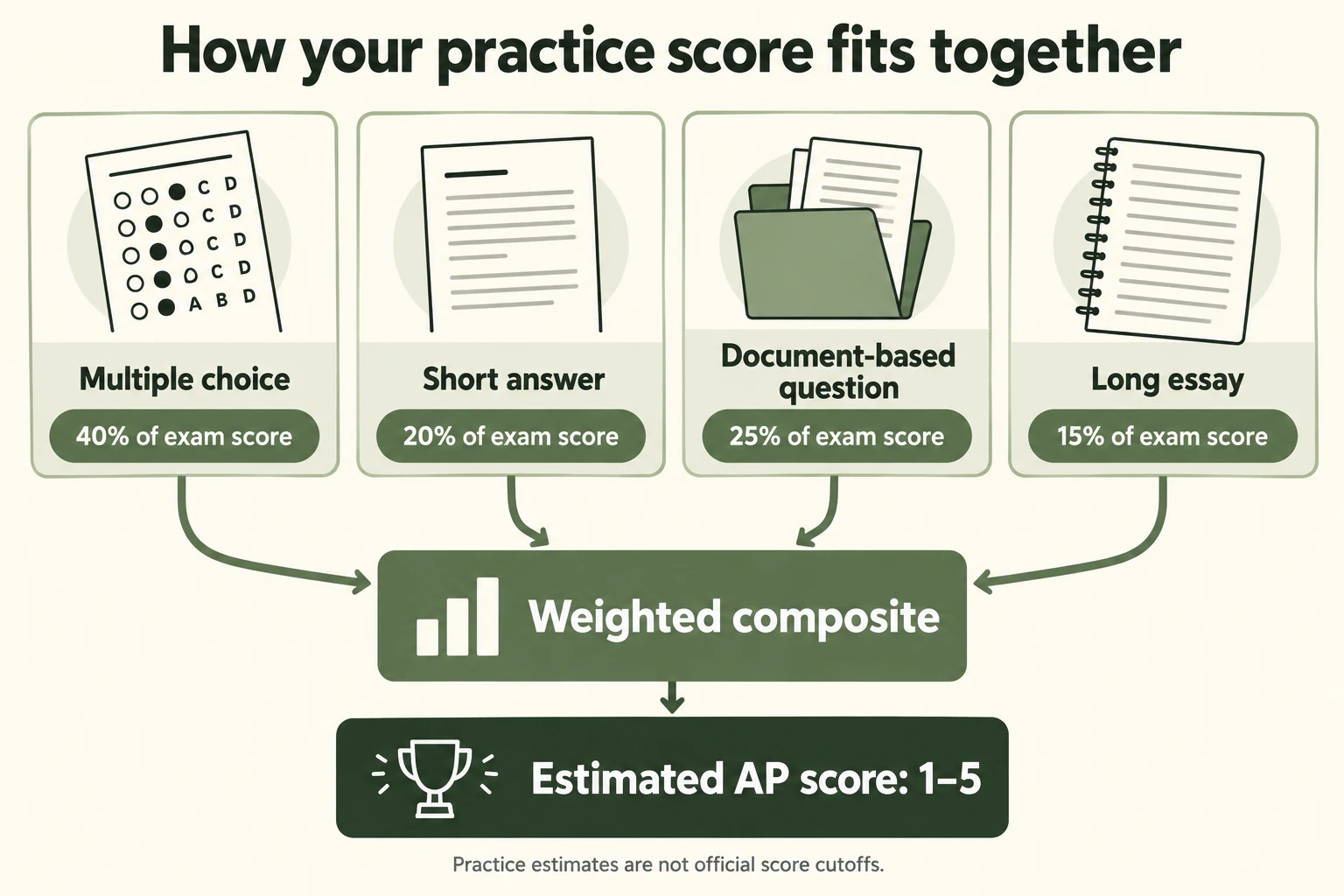
The exam’s weights are 40% multiple choice, 20% short answer, 25% DBQ and 15% long essay. This tool expresses the weighted result on a convenient 150-point scale. The scale is a practice convention; it is not a claim that every official APUSH form has exactly 150 composite points.
- M: correct multiple-choice answers, from 0 to 55.
- S: total points across all three SAQs, from 0 to 9.
- D: DBQ rubric points, from 0 to 7.
- L: LEQ rubric points, from 0 to 6.
| Component | Raw maximum | Composite maximum | Exam weight |
|---|---|---|---|
| MCQ | 55 | 60 | 40% |
| SAQ combined | 9 | 30 | 20% |
| DBQ | 7 | 37.5 | 25% |
| LEQ | 6 | 22.5 | 15% |
Worked scoring example
Suppose your practice results are MCQ, SAQ, DBQ and LEQ. Enter the seven SAQ points as 3, 2 and 2, or any valid combination totaling seven.
MCQ contribution
SAQ contribution
DBQ contribution
LEQ contribution
The unrounded contributions sum to approximately 108.76 composite points. That places the scenario in AP 4 under the default model; it does not guarantee an official 4. Summing rounded component displays can differ by a hundredth from the unrounded total.
Compare where another rubric point helps
One additional raw point has a different effect in each component. Use this to identify practical opportunities, while remembering that earning an essay point requires meeting a rubric criterion.
| Component | Calculation | Approximate gain |
|---|---|---|
| MCQ | 1.09 composite points | |
| SAQ | 3.33 composite points | |
| DBQ | 5.36 composite points | |
| LEQ | 3.75 composite points |
APUSH score distributions: 2026 and recent years
College Board’s AP Students table currently reports 74% earning 3 or above in 2026. The latest column is rounded to whole percentages. Historical columns are preserved below for comparison using the same AP Students series.
| AP score | 2026 | 2025 | 2024 | 2023 |
|---|---|---|---|---|
| 5 | 14% | 14.2% | 12.8% | 10.6% |
| 4 | 37% | 36.2% | 33.3% | 14.8% |
| 3 | 23% | 23.3% | 26.0% | 22.1% |
| 2 | 18% | 18.4% | 19.4% | 22.7% |
| 1 | 8% | 8.0% | 8.4% | 29.8% |
| Statistic | 2026 | 2025 | 2024 | 2023 |
|---|---|---|---|---|
| 3 or higher | 74% | 73.7% | 72.2% | 47.5% |
| Test takers | Not listed yet | 516,738 | 488,688 | 467,975 |
| Mean AP score | Not listed yet | 3.30 | 3.23 | 2.54 |
The 2025 mean of 3.30 is historical, not a published 2026 mean. The 2025 share earning 4 or 5 was 50.4%; the rounded 2026 columns total 51% for those two scores.
These figures describe a cohort’s awarded AP scores. They cannot tell you which raw or composite score earned a 3, 4 or 5 on your practice test, and they are not used to reverse-engineer the calculator’s boundaries.
2027 AP U.S. History exam format
The regular APUSH exam is Friday, 7 May 2027, Session 1. It is fully digital in Bluebook and lasts 3 hours 15 minutes of testing. Confirm local start time and reporting instructions with your school; for UAE UTC+4, Session 1 is scheduled for 11 a.m. local time.
| Section | Task | Time | Weight |
|---|---|---|---|
| I A | 55 multiple-choice questions | 55 minutes | 40% |
| I B | 3 required short-answer questions | 40 minutes | 20% |
| II · DBQ | 1 required question using 7 documents | 60 minutes recommended, including 15 minutes reading | 25% |
| II · LEQ | 1 required broad long-essay prompt | 40 minutes recommended | 15% |
All three SAQs include sources and are required. The LEQ is one required broad prompt with choice within the task; there are no longer three separate LEQ prompts to choose from. Course content, historical skills and free-response scoring rubrics remain unchanged.
Multiple choice: read the stimulus in context
Questions commonly appear in source-based sets. Practise with speeches, letters, legislation, court opinions and diaries; historians’ arguments; political cartoons, propaganda, election maps, demographic charts and economic data. The exam does not publish a fixed percentage split among those source categories.
- Primary sources: Consider the author, audience, purpose, point of view and situation. The Gettysburg Address, Federalist essays, fireside chats and civil-rights writing are useful practice examples, not a promised exam reading list.
- Secondary sources: Distinguish a historian’s interpretation from the evidence offered for it. Compare competing explanations and identify evidence that supports or qualifies a claim.
- Visual and quantitative sources: Read titles, dates, scales, categories and symbols before connecting the source to a development. Cartoons by Thomas Nast and wartime cartoons can support visual-analysis practice.
Answer every MCQ: incorrect answers do not carry a guessing penalty. The section averages one minute per question, but use time across a set sensibly. Date the source and identify its period before using outside knowledge. Avoid confusing the two Great Awakenings, amendments from different eras or a later development with a cause of an earlier event.
Short answer: three source-based questions
Each SAQ has three separately scored parts, worth one point each. The section totals nine raw points. Question 1 uses secondary text source(s), Question 2 a primary text source, and Question 3 a primary or secondary non-text source. All three are required; the old SAQ 3-or-4 choice no longer applies.
Read each command verb and answer its specific task directly. Identify or describe accurately, then explain a relationship when asked. Use concrete historical support and the requested time frame. Do not assume every SAQ asks for the same sequence of context, purpose and connection.
DBQ: documents in an argument
The DBQ presents seven documents and focuses on developments from 1754 to 1980. The recommended 60 minutes includes a 15-minute reading period. Read all documents, group relevant evidence, establish a line of reasoning and leave time to connect sources and outside knowledge to that argument.
A source-analysis checklist such as historical situation, intended audience, purpose and point of view can help, but simply labeling a category does not earn the sourcing point. Explain how or why that feature matters to your argument.
LEQ: a focused argument within a broad task
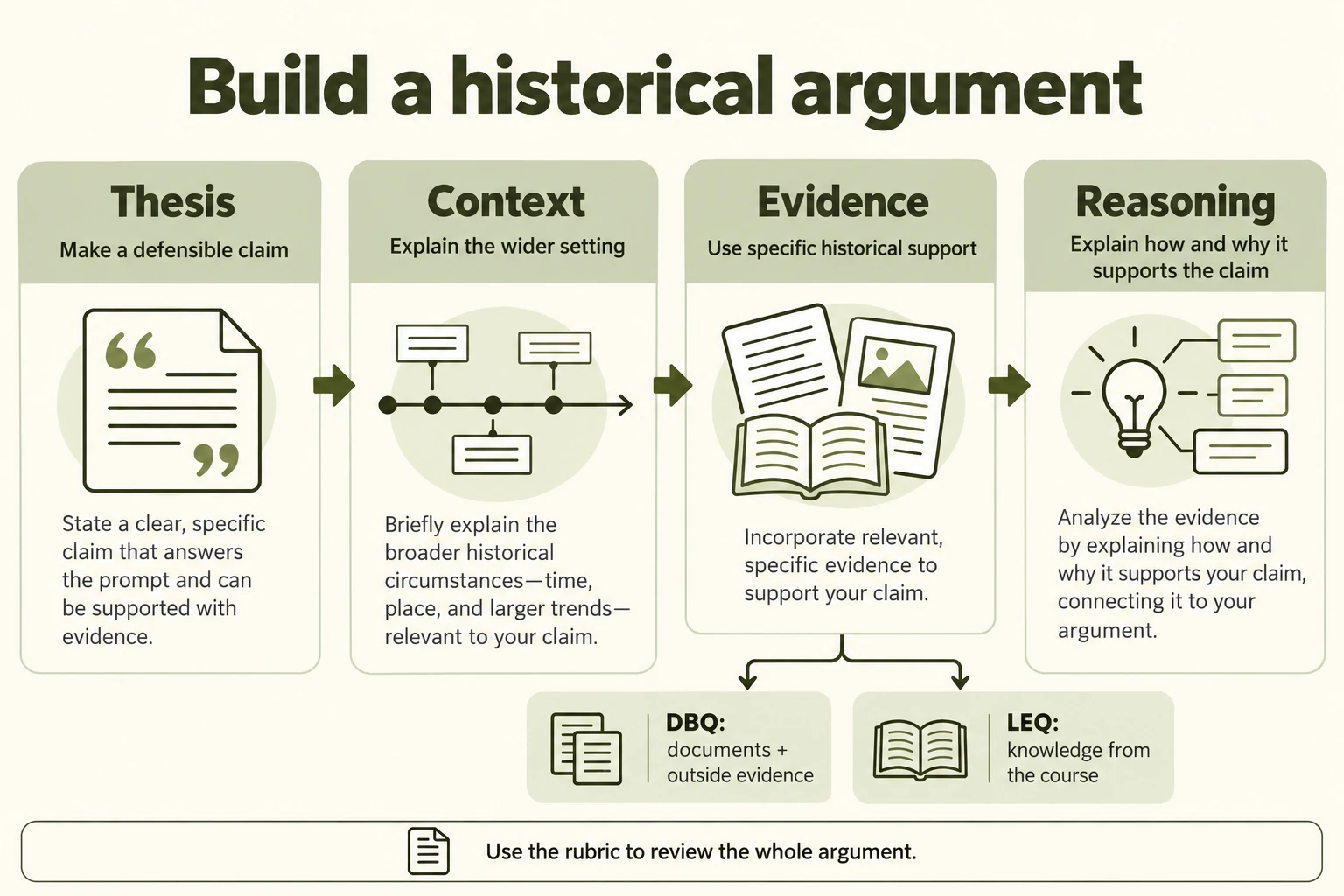
The required 2027 prompt spans a broad chronological range and permits focus on one or more developments within the task. You are not expected to cover every year or event in the prompt’s entire span. Select relevant examples you understand well, develop a defensible thesis, establish context and explain how specific evidence supports your reasoning.
The two essays share a 100-minute section. The 60-minute DBQ and 40-minute LEQ allocations are recommendations, so practise managing the combined time.
DBQ and LEQ rubric guidance
| Category | DBQ maximum | LEQ maximum |
|---|---|---|
| Thesis or claim | 1 | 1 |
| Contextualization | 1 | 1 |
| Evidence | 3 | 2 |
| Analysis and reasoning | 2 | 2 |
| Total | 7 | 6 |
DBQ: understand the seven available points
- Thesis: Make a historically defensible claim that responds to the task and establishes a line of reasoning. A topic restatement is not enough.
- Context: Describe a broader historical setting relevant to the argument. A passing phrase or an unrelated fact does not establish context.
- Document evidence: Using the content of at least three documents to address the topic can earn one point; supporting an argument using at least four documents can earn two. These are levels within the document-evidence category, not three cumulative points.
- Outside evidence: Use a specific relevant example beyond the documents to support an argument. It must be developed beyond a name or passing reference and different from evidence used for contextualization.
- Sourcing: For at least two documents, explain how or why purpose, audience, point of view or historical situation is relevant to the argument.
- Complex understanding: Develop a nuanced argument or use evidence effectively to show relationships, qualification or multiple perspectives. No single stock phrase automatically earns the point.
Read all seven documents, but apply the evidence and analysis criteria rather than treating a document count as a substitute for an argument. Sourcing and outside evidence are separate from the two available document-evidence points.
LEQ: understand the six available points
The six-point rubric awards up to one point for thesis, one for context, two for evidence and two for analysis and reasoning. Support the argument with at least two specific, relevant historical examples, and explain their relationship to the claim. Develop the historical reasoning demanded by the prompt and pursue a complex understanding through the argument or effective evidence.
Make the writing concrete
For a prompt about the New Deal and federal power, “The New Deal changed America” is too general to establish a useful line of reasoning. A more defensible direction might argue that New Deal regulation and social programs expanded federal economic responsibility while their uneven benefits limited change for some groups. Whether a response earns credit depends on the actual prompt and the argument developed.
For context, connect relevant earlier developments such as the 1920s economy and the onset of the Depression to the task. Do not use a later event as if it had caused an earlier one. Outside evidence might include a relevant law, court decision, movement or institutional change that is not already supplied in the documents.
APUSH: nine periods and eight recurring themes
APUSH covers 9 time periods and is organized around 8 recurring themes that connect developments across the full course. Use chronology and themes together to explain relationships across the course.
Detailed Period Breakdown with Exam Weighting
Period 1 (1491-1607): Contact & Colonisation | 4-6% of MCQ weighting
Diverse Native societies and regional adaptations, including Pueblo communities and Iroquoian-speaking peoples; Cahokia as an earlier Mississippian example. Columbian Exchange: biological transfers (smallpox, horses, crops). Spanish colonisation (encomienda, mission system, Bartolomé de las Casas). French and Dutch exploration preceded later trading settlements discussed in Period 2. Key concept: Epidemics caused major population losses alongside violence, displacement and forced labor; effects differed by region.Period 2 (1607-1754): Colonial America | 6-8% of MCQ weighting
Jamestown (1607), Plymouth (1620), Massachusetts Bay (1630). Chesapeake vs. New England colonial models. Transatlantic trade & mercantilism. Growth of slavery and racial hierarchy; Bacon’s Rebellion was one development within a broader change in labor systems, not a single cause of that change. Great Awakening. Salutary neglect. French & Indian War origins. Key concept: Colonial identity emerged through religious diversity, economic autonomy, and distance from British control.Period 3 (1754-1800): Revolution & New Nation | 10-17% of MCQ weighting
French & Indian War (1754-1763) & new British taxation. Stamp Act, Boston Massacre, Tea Party. Declaration of Independence (1776). Revolutionary War & French alliance. Articles of Confederation's failures. Constitutional Convention (1787): federalism, Great Compromise, Three-Fifths Compromise. Federalists vs. Anti-Federalists. Washington's precedents. Hamilton vs. Jefferson. Alien & Sedition Acts. Key concept: Republican ideals clashed with practical governance needs — this tension defines American politics.Period 4 (1800-1848): Expansion & Reform | 10-17% of MCQ weighting
Jefferson's presidency & Louisiana Purchase (1803). War of 1812. Era of Good Feelings & Monroe Doctrine. Market Revolution (canals, railroads, factories). Jacksonian democracy & Indian Removal Act (1830). Second Great Awakening. Abolitionism (Garrison, Douglass), women's rights (Seneca Falls 1848), temperance. Manifest Destiny & Mexican-American War. Key concept: Expansion and reform were intertwined — territorial growth raised questions about slavery's extension.Period 5 (1844-1877): Civil War & Reconstruction | 10-17% of MCQ weighting
Compromise of 1850, Kansas-Nebraska Act, Dred Scott decision. Lincoln-Douglas debates. Secession & Fort Sumter. Civil War: Emancipation Proclamation, Gettysburg, Union strategy and destructive campaigns against Confederate infrastructure. 13th-14th-15th Amendments. Reconstruction: Freedmen's Bureau, Black Codes, Radical Republicans, impeachment of Andrew Johnson. the disputed 1877 settlement, withdrawal of remaining federal troops and the retreat of Reconstruction. Key concept: The Civil War settled the question of union and slavery, but Reconstruction’s retreat left enduring racial violence, disenfranchisement and exclusion, alongside continuing Black organizing and resistance.Period 6 (1865-1898): Gilded Age | 10-17% of MCQ weighting
Transcontinental Railroad (1869), industrialisation (Carnegie, Rockefeller, Morgan). Immigration waves (Southern/Eastern Europe, China). Urbanisation & tenements. Labour movements (Knights of Labour, AFL, Pullman Strike). Populism (William Jennings Bryan, "Cross of Gold"). Jim Crow laws & Plessy v. Ferguson (1896). Western expansion & Plains Indian Wars. Key concept: Rapid industrialisation created enormous wealth AND enormous inequality — the roots of Progressive reform.Period 7 (1890-1945): Imperialism to WWII | 10-17% of MCQ weighting
Spanish-American War (1898). Progressive Era (TR, Wilson, muckrakers, 16th-19th Amendments). WWI & Wilson's Fourteen Points. 1920s: Jazz Age, Harlem Renaissance, Red Scare, Prohibition, consumer culture. Great Depression & New Deal (Social Security, SEC, TVA, Wagner Act). WWII: Pearl Harbor, D-Day, atomic bombs, the incarceration of Japanese Americans, Rosie the Riveter. Key concept: New Deal institutions expanded federal economic and social responsibilities while debate over their reach continued.Period 8 (1945-1980): Cold War & Civil Rights | 10-17% of MCQ weighting
Cold War: Truman Doctrine, Marshall Plan, NATO, Korean War, McCarthyism, Cuban Missile Crisis, Vietnam. Civil Rights: Brown v. Board (1954), Montgomery Bus Boycott, sit-ins, March on Washington, Civil Rights Act (1964), Voting Rights Act (1965), Black Power. Great Society (Medicare, Medicaid, Head Start). Counterculture & antiwar movement. Watergate & Nixon resignation. Key concept: The tension between Cold War containment abroad and expanding rights at home defined this era.Period 9 (1980-Present): Modern America | 4-6% of MCQ weighting
Reagan Revolution (tax cuts, deregulation, Cold War escalation). Fall of the Berlin Wall (1989) & Soviet collapse. Clinton era (NAFTA, welfare reform). 11 September 2001 attacks & War on Terror (Afghanistan, Iraq). Obama presidency (ACA). Technology & globalisation. Political polarisation. Key concept: Debates over government's role, immigration, and America's global position continue to shape modern politics.The 8 APUSH Themes
These themes connect developments across all 9 periods — the exam rewards students who can trace them through American history:
- American & National Identity (NAT): How Americans defined themselves — from colonial identity to national identity to debates over immigration and multiculturalism
- Work, Exchange & Technology (WXT): Economic systems from mercantilism to capitalism, labour movements, technological innovation
- Geography & Environment (GEO): Westward expansion, environmental impact, regional differences
- Migration & Settlement (MIG): Immigration waves, internal migration (Great Migration), suburbanisation
- Politics & Power (PCE): Democracy, political parties, federal vs. state power, social movements
- America in the World (WOR): Foreign policy from neutrality and nonintervention debates to expanding global power, while trade and diplomacy continued
- American & Regional Culture (ARC): Religious movements, arts, intellectual traditions
- Social Structures (SOC): Race, class, gender, ethnicity — hierarchies and challenges to them
Period ranges overlap because developments cross unit boundaries. Quebec (1608) and New Netherland’s major settlements belong in the colonial-era discussion rather than the pre-1607 period. Return to the APUSH study hub for detailed notes, flashcards and quizzes for every unit.
College credit, placement and the value of APUSH
Credit and placement rules depend on the institution, degree program and entry year. APUSH is equivalent to a two-semester introductory college course, but that does not guarantee a fixed number of credit hours, exemption from a general-education requirement or entry to an advanced seminar.
| Score | What to check |
|---|---|
| 5 | Whether credit, placement or both are awarded; which survey courses are recognized; any degree restrictions. |
| 4 | Whether this reaches the institution’s qualifying score, and whether the award differs from a 5. |
| 3 | Many institutions award qualifying credit or placement, while others require a higher score. Verify the relevant rule. |
| 1 or 2 | Usually does not qualify for credit, but the institution makes its own decision. Use the result to plan further study. |
Credit awards such as 3–8 semester hours are examples of possible institutional policies, not universal rules. Check the college’s current AP policy, the course equivalency, maximum exam-credit limits and whether any award counts toward your intended program. Selective colleges may have different credit and placement rules; a particular score does not guarantee an admissions outcome.
Why APUSH matters beyond credit
- Analytical writing: Thesis development, specific support and explanation strengthen evidence-based college writing.
- Document analysis: Evaluating authorship, perspective, purpose and reliability supports work in history, law, journalism, business and other fields.
- Civic knowledge: Studying the development of U.S. institutions helps explain debates over citizenship, rights and public policy.
- Historical thinking: Comparison, causation, and continuity and change help structure explanations across the social sciences.
- Academic preparation: The course can demonstrate engagement with demanding reading and writing, but colleges consider an application in context.
APUSH and the wider AP pathway
- AP World History and APUSH: Global developments such as the Enlightenment, imperialism and Cold War provide context for U.S. history. Course sequence varies by school.
- AP European History: The Reformation, Enlightenment and French Revolution offer useful comparisons and connections; APUSH is not a prerequisite.
- AP U.S. Government: Constitutional development, political parties, civil rights and Supreme Court precedents connect historical change with the study of institutions.
- AP English Language: Rhetorical and source analysis can support clear argumentation, though APUSH essays must meet their own historical rubric.
APUSH is often offered during later secondary-school years. Choose a schedule that matches your school’s offerings, workload and interests rather than treating a particular course pairing or grade-level sequence as compulsory.
What is a good APUSH score?
A useful target depends on your learning goals and the policy of any college where you hope to receive credit or placement.
| AP score | Recommendation | Planning perspective |
|---|---|---|
| 5 | Extremely well qualified | A strong result; it can support favorable credit or placement where policy allows. |
| 4 | Very well qualified | A strong qualifying result at many institutions; verify the actual requirement. |
| 3 | Qualified | A qualifying recommendation for college-level work; credit policies differ. |
| 2 | Possibly qualified | Use the feedback to plan further learning; credit is uncommon. |
| 1 | No recommendation | The result does not define your interest or future ability; identify areas to strengthen. |
In the rounded 2026 distribution, 14% earned a 5 and 51% earned a 4 or 5 combined. Those are cohort percentages, not an individual student’s probability of achieving a result.
What is the average APUSH score?
The current AP Students series has not yet listed a 2026 mean. Its 2025 historical mean is 3.30, with 73.7% earning 3 or higher. The course still requires a wide range of content knowledge, sustained writing practice and careful source analysis. A higher recent qualifying share does not remove those demands.
How AP score setting works
Students often call the score conversion a “curve,” but AP Exams are not graded to a fixed proportion of the class. College Board sets performance standards using evidence about college-level work and comparability; a student’s score is not determined by a quota of available 5s.
- Exam forms and difficulty: Different sources and prompts can require different raw-score conversions. A practice boundary should not be assumed to apply unchanged to every official form.
- Standards and comparability: College-level expectations inform the score standards rather than a rule that a fixed percentage must pass.
- Rubric-based reading: Trained AP readers apply scoring guidelines to written work. A calculator cannot assess the quality of an essay on its own.
What this tool does and does not model
It converts your supplied section points into weighted contributions and applies the active planning bands. It does not score prose, estimate your percentile, use cohort percentages to determine a cutoff or reproduce College Board’s form-specific equating. Use teacher-marked essays and scored practice responses for reliable inputs.
Official component weights, rubric maxima and exam tasks are verified data. The 150-point display and illustrative AP-score boundaries are modeling choices. No official May 2027 cut scores are claimed.
How to work toward a 5 in APUSH
Under this tool’s default model, the AP 5 band begins at 114 of 150 composite points. That is a planning boundary, not an official requirement for earning a 5. There are many combinations of MCQ and rubric points that can reach a target.
1. Master all nine periods through connections
Use the detailed period notes above to organize key events, movements and debates. Build a theme matrix with periods as rows and themes as columns. Put two or three specific examples in each relevant cell, then explain what changed, what continued and why. Prioritize gaps while revisiting earlier material through spaced retrieval.
Periods 3–8 each have a published MCQ weighting range of 10%–17%; Period 1 and Period 9 each have 4%–6%, and Period 2 has 6%–8%. Those ranges guide preparation without making the lighter periods optional. Use the unit notes, flashcards and quizzes to combine recall with application.
2. Make DBQ practice a rubric review
Use the reading period to identify the task, read all seven documents and group evidence that serves a line of reasoning. Practise the thesis and context, then use document content, outside evidence and sourcing to support the argument. Explain relationships rather than dropping source labels into a paragraph.
After writing, mark each rubric criterion with a teacher or a reliable scoring guide. Distinguish the two document-evidence levels, the separate outside-evidence point and the analysis points. Develop nuance throughout the argument instead of appending an unsupported counterclaim at the end.
3. Prepare for the required 2027 LEQ
There is one broad required prompt. Choose relevant developments within that task and develop the examples you know best; do not wait for three alternative prompts. Write a clear thesis, establish relevant context, name specific evidence and explain how it supports the argument. A connected comparison or qualified explanation is more useful than a list of facts.
4. Test a balanced target scenario
The corrected examples below reach the indicated bands under the default model. They are sample combinations, not minimum scores required in every component, and do not update when you choose custom boundaries.
| Estimated AP band | MCQ | SAQ total | DBQ | LEQ | Composite |
|---|---|---|---|---|---|
| 5 | 114.21 | ||||
| 4 | 98.50 | ||||
| 3 | 74.06 |
Try the calculator to compare alternatives. An additional DBQ rubric point changes the composite more than one additional MCQ, but it may require a different kind of preparation. Balance content review, source interpretation, short answers and essays, and aim above a single modeled boundary.
Why use this APUSH score calculator?
- Immediate practice feedback: Compare weighted contributions as you change MCQ, SAQ and essay scores.
- Clear goal setting: Explore the distance to the next planning band without pretending an estimated cutoff is official.
- Balanced preparation: See that the DBQ contributes 25% and identify where better rubric performance could help.
- More informed practice: Load the worked example, test a perfect score, reset or explore alternate boundaries.
- Updated context: Read the verified 2027 exam structure alongside the latest published 2026 distributions.
Recall dates and names, but also explain causes, compare developments and trace continuity and change. Understanding how evidence supports an argument is central to APUSH.
APUSH score calculator FAQs
Is there a guessing penalty on the APUSH exam?
No. Incorrect multiple-choice answers do not carry a guessing penalty, so answer every question. Eliminate implausible options and use the source and chronology to select the best-supported answer.
How is the DBQ scored?
It uses a seven-point rubric: thesis 1, context 1, evidence up to 3, and analysis and reasoning up to 2. Document evidence can earn one point using at least three documents to address the topic, or two supporting an argument with at least four. Outside evidence, relevant sourcing and complex understanding have distinct criteria; document counts alone are not enough.
Do I still choose between SAQ 3 and SAQ 4 in 2027?
No. Starting with May 2027, there are three required source-based SAQs. Question 1 uses secondary text source(s), Question 2 primary text and Question 3 a primary or secondary non-text source. The former SAQ 3-or-4 choice has ended.
How long should my DBQ and LEQ be?
There is no fixed word or paragraph count that earns credit. Develop the thesis, context, evidence and reasoning required by the task and rubric within the available time. A multi-paragraph structure can organize your argument, but length alone is not a scoring criterion.
What historical thinking skills are tested?
The framework identifies six skills: developments and processes; sourcing and situation; claims and evidence in sources; contextualization; making connections; and argumentation. Comparison, causation, and continuity and change are historical reasoning processes used to make connections.
How accurate is this APUSH score calculator?
The component weights and raw-score maxima follow the verified exam structure. The estimated AP band comes from an illustrative planning model and may differ from an official result. It does not infer cutoffs from score distributions, and no official 2027 cut scores are claimed.
Do colleges give credit for AP U.S. History?
Many institutions offer credit, placement or both for qualifying AP scores. Each decides its required score, course equivalency, credit hours and degree restrictions. Check the current policy for your institution and program instead of assuming a fixed award for a 3, 4 or 5.
When is the 2027 AP U.S. History exam?
The regular exam is Friday, 7 May 2027, Session 1. It lasts 3 hours 15 minutes and is fully digital in Bluebook. Local start times vary; confirm your assigned school or test center’s reporting instructions.
Can a displayed total round up into the next AP band?
No. The estimate uses the unrounded composite. The displayed value is rounded to two decimal places, so a value very close to a boundary can look equal to it while remaining fractionally below. The planning chart uses lower-inclusive boundaries and upper-exclusive boundaries, apart from the maximum of 150.
Are the 2026 score distribution and the 2027 cutoffs the same thing?
No. A distribution reports how many students received each AP score in a past administration. It does not reveal the raw-score conversion for a future exam or supply a personal score probability.