
Early Solutions to the 2026 AP Comparative Government and Politics FRQs | Step by Step
Complete conceptual, quantitative, comparative, and argument-essay responses, with country-specific evidence and every step preserved from the uploaded solution guide.
Guide Overview: How to Earn the Points
Use the command verb, evidence, and reasoning structure below before reading the model responses.
| Question | Skill | Recommended time | What this guide provides |
|---|---|---|---|
| 1 | Conceptual analysis | 10 minutes | Four point-ready responses with causal explanations |
| 2 | Quantitative analysis | 20 minutes | Graph reading, trend language, and data-based conclusions |
| 3 | Comparative analysis | 20 minutes | Two-country comparison with clear policy-to-effect links |
| 4 | Argument essay | 40 minutes | Thesis plan, evidence bank, full essay, and rubric check |
Command words
| Command | What the reader is looking for | Reliable sentence pattern |
|---|---|---|
| Describe | An accurate characteristic or relationship; no lengthy causal chain required. | “X is... One defining feature is...” |
| Explain | A cause-and-effect link or mechanism, not merely two facts placed together. | “Because X..., Y happens..., which leads to Z...” |
| Draw a conclusion | A claim grounded in the data plus relevant course knowledge. | “The data indicate... This is consistent with...” |
| Develop an argument | A defensible thesis, specific country evidence, reasoning, and a rebuttal/concession. | “Although..., on balance... because...” |
Working point map
| Question | Likely point structure | Self-check |
|---|---|---|
| 1 | 4 points: A, B, C, and D are 1 point each | Did every part answer the exact verb? |
| 2 | 5 points: A-F are 1 point each | Did the data answer use direction, dates, and meaning? |
| 3 | 5 points: A = 1; B = 2; C = 2 | Did you give one policy and one effect for each country? |
| 4 | 5 points: thesis 1; evidence 2; reasoning 1; alternate perspective 1 | Did you explain why the evidence proves the thesis? |
Fast response formulas
- Conceptual part: Define the concept in one complete sentence. Add a distinct characteristic if the prompt says “describe.”
- Explanation part: Name the cause, state the mechanism, and finish with the political consequence.
- Graph part: Read the legend and scale first. State the direction and approximate magnitude; do not invent exact values.
- Country example: Name the country and a specific institution, policy, event, or movement. Generic statements do not secure evidence points.
- Argument essay: Write the thesis first, then build each body paragraph as evidence → course concept → why it supports the claim.
FRQ 4: Argument Essay - Legislative Independence and Corruption
Position taken in this model: an independent legislature generally discourages corruption.
Step 1: Decode the argument
| Prompt element | What to do |
|---|---|
| Independent legislature | Treat independence as the ability to exercise legislative and oversight powers without control by the executive or another institution.[2] |
| Corruption | Focus on misuse of public office or resources for private or political benefit. |
| Separation of powers | Explain how a separate institution can check executive officials and spending. |
| Transparency | Explain how hearings, public records, audits, and debate expose decisions and transactions. |
| Accountability | Explain how exposure can lead to questioning, electoral costs, removal, sanction, or policy correction. |
Step 2: Write a defensible thesis
- Take a side: “An independent legislature generally discourages corruption.”
- Name the mechanism: It separates oversight from the officials being monitored.
- Use course concepts: Independent investigation and debate increase transparency and accountability.
- Qualify intelligently: Independence works best when elections, audits, courts, and public reporting are credible.
Step 3: Select specific evidence
| Country evidence | Specific fact | Concept link |
|---|---|---|
| Mexico | The Superior Audit of the Federation (ASF), connected to the Chamber of Deputies, has legal autonomy to audit federal revenue, spending, debt, and program performance and report findings for oversight.[6] | Transparency and accountability: spending is reviewed by an institution outside the executive agency that spent the money. |
| United Kingdom | During Prime Minister’s Questions and parliamentary committee inquiries, MPs can publicly question the prime minister and ministers.[2] | Accountability and transparency: officials must justify decisions on the public record. |
| Russia (contrast) | Dominant-party rules and limits on opposition access weaken the State Duma’s independence from the ruling executive network.[2] | Weak separation of powers: fewer incentives and opportunities to investigate executive allies. |
Step 4: Build the reasoning chain
- Independent power: The legislature can demand information, review budgets, question ministers, investigate, or publicize misconduct.
- Higher probability of detection: Officials cannot fully control the institution examining their conduct.
- Higher expected cost: Exposure may produce legal sanctions, removal, electoral loss, reputational damage, or policy reversal.
- Behavioral effect: Because corrupt behavior is more likely to be exposed and punished, officials have stronger incentives to avoid it.
High-scoring outline
| Paragraph | Core content |
|---|---|
| 1. Thesis | Independence discourages corruption through separation of powers, transparency, and accountability; add a qualification. |
| 2. Mexico | ASF audits federal finances → independent information → exposure and sanctions become more likely. |
| 3. United Kingdom | Question Time/committees → public questioning → political accountability and deterrence. |
| 4. Russia contrast | Dominant-party Duma → weak scrutiny → lower risk that executive misconduct is exposed. |
| 5. Alternate perspective | Independent legislatures can themselves be bribed or use patronage; concede risk, then rebut with transparent procedures and external enforcement. |
Full Model Argument Essay
An independent legislative branch generally discourages corruption because separation of powers gives a body outside the executive the authority to investigate spending and official conduct. Public oversight makes government decisions more transparent and makes officeholders more accountable, increasing the likelihood that corrupt behavior will be discovered and punished. Legislative independence is not sufficient by itself, but when it is combined with credible elections, audits, and enforcement, it raises the cost of corruption.
Mexico illustrates how legislative oversight can discourage corruption. The Superior Audit of the Federation has technical and management autonomy to audit federal revenue, expenditures, debt, and the performance of government programs, and its findings support congressional oversight. This arrangement separates the officials who spend public money from the institution that reviews how it was used. Because audit findings can expose irregularities and inform legislative budget and accountability processes, executive officials face a greater risk that misuse of funds will become public and lead to sanctions or political costs. The mechanism therefore increases both transparency and accountability.
The United Kingdom provides another form of legislative oversight. During Prime Minister’s Questions and parliamentary committee hearings, members of Parliament, including the opposition, can question ministers publicly. These proceedings require the executive to justify decisions on the record and allow the media and voters to evaluate the answers. Even though the British executive is formed from the parliamentary majority, these oversight functions create accountability by raising the reputational and electoral cost of favoritism, concealment, or misuse of office.
Russia shows the opposite pattern. Rules that favor the dominant party and restrict opposition candidates and media access reduce the State Duma’s independence from the ruling executive network. When most legislators depend on the same political leadership and opposition voices have limited influence, the legislature has fewer incentives and less capacity to investigate executive allies. Weak separation of powers therefore reduces transparency and lowers the probability that corrupt conduct will be exposed.
An alternate perspective is that an independent legislature can create additional opportunities for corruption because lawmakers may demand bribes, trade votes, or direct public funds toward supporters. This is a genuine risk, so legislative independence must be paired with open committee procedures, public audit reports, competitive elections, enforceable ethics rules, and independent courts. However, the possibility that legislators may also be corrupt does not justify executive control of the legislature. A dependent legislature removes an entire source of oversight, while an independent one can still expose and sanction misconduct in other branches. On balance, legislative independence discourages corruption more than it promotes it.
Why the model can earn all 5 points
The labels below are for study only; do not label the paragraphs on the exam.
| Rubric row | Where it is earned | Why it satisfies the row |
|---|---|---|
| A. Claim / thesis (1) | Opening paragraph | Takes a defensible position and establishes a mechanism using separation of powers, transparency, and accountability. |
| B. Evidence (2) | Mexico + United Kingdom; Russia adds a third example | Uses specific institutions and practices, not generic country labels. |
| C. Reasoning (1) | Each body paragraph | Explains how independent review raises detection and sanction, which changes officials’ incentives. |
| D. Alternate perspective (1) | Final paragraph | Describes the bribery/patronage objection, concedes its validity, and rebuts it by distinguishing independence from lack of oversight. |
Sentence-by-sentence reasoning test
- Evidence sentence: “The ASF audits federal revenue, expenditures, debt, and program performance.”
- Concept sentence: “That separates the spender from the reviewer and makes financial decisions more transparent.”
- Reasoning sentence: “Because irregularities are more likely to be exposed and sanctioned, officials have stronger incentives not to divert public resources.”
- Alternate-perspective sentence: “Although a legislature can itself be corrupt, transparent procedures and electoral/judicial enforcement address that risk without eliminating an independent check on the executive.”
Common mistakes that lose points
| Mistake | Why it is weak | Fix |
|---|---|---|
| “Independent legislatures stop corruption.” | Restates the claim without a line of reasoning. | Add the oversight → transparency → accountability mechanism. |
| “Russia is corrupt.” | Country name without specific evidence. | Name dominant-party control, opposition restrictions, and weakened Duma scrutiny. |
| Two facts, no explanation | Evidence points may be earned, but reasoning is missing. | After each fact, write “This matters because...” and connect it to a course concept. |
| “Some disagree.” | Identifies no real alternate perspective and provides no response. | Describe a plausible bribery/patronage argument, then concede or rebut it. |
| Absolute claim | Independence does not guarantee clean government. | Qualify: it generally discourages corruption when paired with transparency and enforcement. |
Rapid Review: Condensed Answer Key and Flexible Evidence Bank
Use this page for final recall; use the earlier sections to learn the reasoning.
Condensed answer key
| Part | Core answer |
|---|---|
| 1A | Lifelong acquisition of political beliefs, values, attitudes, and orientations. |
| 1B | Socialization shapes the ideology through which citizens understand power and policy. |
| 1C | State curriculum/media/censorship can repeatedly transmit preferred beliefs and limit alternatives. |
| 1D | Authoritarian regimes seek conformity, legitimacy, and opposition control; democracies permit more pluralism. |
| 2A | Iran. |
| 2B | Russia rises sharply overall; Iran stays in a narrow band and falls in 2024. |
| 2C | Number and relative strength of parties able to compete for power. |
| 2D | Nigeria improves modestly but remains highly fragile. |
| 2E | No simple relationship: one-party China is least fragile; multiparty Nigeria most fragile. |
| 3A | Large, sustained collective effort for broad social or political change. |
| 3B | UK protects expression/assembly; Iran restricts them through censorship and repression. |
| 3C | Protection facilitates open mobilization; restriction raises risk and disrupts sustained organization. |
| 4 | Independent legislatures usually discourage corruption through oversight, transparency, and accountability; independence must be paired with enforcement. |
Other valid country examples for Question 3
| Country | Civil-liberties policy | Possible movement effect/example |
|---|---|---|
| China | Censorship, surveillance, limits on independent association and protest. | Raises coordination costs and makes independent national movements difficult to sustain. |
| Mexico | Democratic protections for association and plural civil society, alongside uneven enforcement. | Creates space for indigenous, feminist, and anticorruption mobilization; Zapatistas pressured the state over inequality and indigenous rights. |
| Nigeria | Constitutional rights coexist with police restrictions and coercive responses to protest. | Movements such as MOSOP/MEND or anticorruption protests can organize, but repression can radicalize or fragment activism. |
| Russia | Restrictions on media, assembly, NGOs, and opposition activity. | Reduces open mobilization and raises the personal cost of protest. |
Five final checks before submitting
References and Verification Notes
The model exam responses themselves do not require citations; these references document the study guide’s factual basis.
- College Board. 2026 AP Comparative Government and Politics Free-Response Questions. Uploaded question paper; especially pages 3-6 and the Fragile States Index graph on page 4.
- College Board. AP Comparative Government and Politics Course and Exam Description. Relevant sections include political socialization, civil liberties, political party systems, social movements, independent legislatures, and the sample scoring guidelines.
- College Board. AP Comparative Government & Politics Exam Questions page. As accessed July 15, 2026, the 2026 section linked the free-response questions but not a scoring-guidelines PDF.
- College Board. 2025 AP Comparative Government and Politics Scoring Guidelines, Set 1. Used only to align the familiar 4/5/5/5 point structure and argument-essay rows.
- United Kingdom. Human Rights Act 1998, Schedule 1, Article 10 (freedom of expression) and Article 11 (freedom of assembly and association).
- Organisation for Economic Co-operation and Development. Facilitating the Implementation of the Mexican Supreme Audit Institution’s Mandate (2022), and Mexico’s National Auditing System. These sources describe the ASF’s audit powers, autonomy, and relationship to legislative oversight.
Verified NUM8ERS resources
These internal links were checked against the supplied sitemap.xml:
Recommended SEO fields
SEO title: 2026 AP Comparative Government FRQ Solutions | Step-by-Step
Meta description: Study early, unofficial 2026 AP Comparative Government FRQ solutions with complete conceptual, quantitative, comparative, and argument responses.
Slug: ap-comparative-government-frq-2026-solutions
FRQ 2: Quantitative Analysis - Fragile States Index
Read the direction carefully: lower score = less fragility and greater stability.
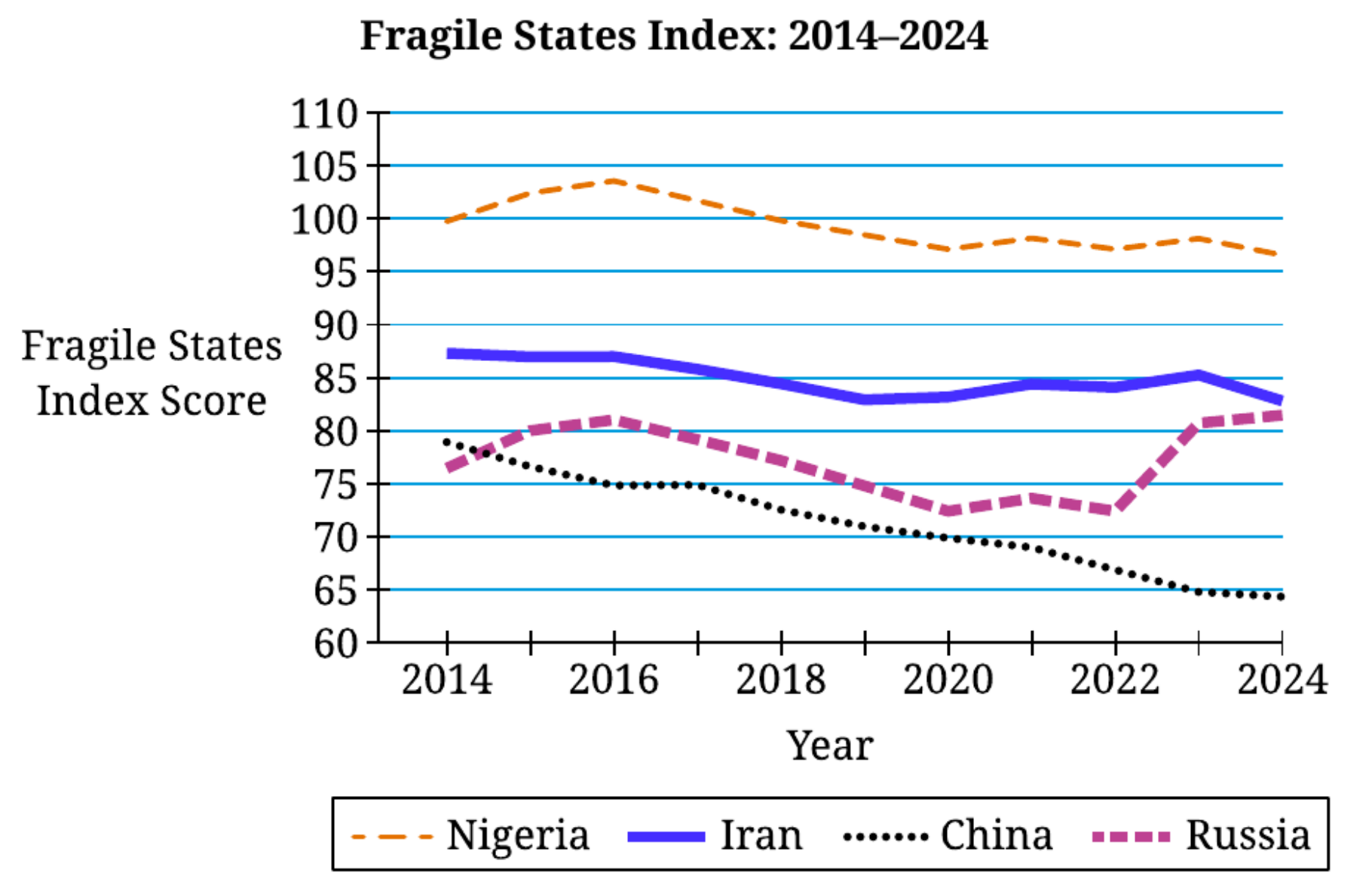
Part A: Identify the second most fragile country in 2016
- Locate 2016: Use the vertical position of each country’s line at the 2016 year.
- Rank from highest to lowest: Nigeria is highest at about 103-104; Iran is next at about 87; Russia is near 81; China is near 75.
- Answer only the requested rank: The second most fragile country is Iran.
Part B: Compare Russia and Iran, 2020-2024
- State Russia’s direction: Russia rises overall from roughly 72-73 in 2020 to about 81 in 2024, with a sharp increase after 2022.
- State Iran’s direction: Iran stays in a narrow low-to-mid-80s range, rises slightly through 2023, and then drops in 2024.
- Name the difference: Russia changes much more and becomes more fragile; Iran is comparatively stable and ends near or slightly below its 2020 score.
Part C: Describe a characteristic of a political party system
- Identify the organizing feature: Party systems differ in the number and relative strength of parties able to compete for governing power.
- Give recognized categories: One-party, dominant-party, two-party, and multiparty systems.
- Avoid defining a party: The prompt asks about the system of competition, not what one political party does.
Part D: Draw a conclusion about Nigeria’s stability, 2014-2024
- State the overall trend: Nigeria’s score rises to a peak around 2016, then generally declines from about 100 in 2014 to about 96 in 2024.
- Translate the index: The net decline indicates modest improvement in political stability.
- Add comparative meaning: Nigeria nevertheless remains the most fragile of the four countries throughout the period.
- Connect course knowledge: Persistent ethnic and religious cleavages, Boko Haram, Niger Delta conflict, corruption, and uneven state capacity help explain continuing fragility.
- It interprets the numerical direction correctly.
- It qualifies the conclusion: modest improvement, but continuing high fragility.
- It uses relevant Nigeria course knowledge without claiming that the graph alone proves causation.
Part E: Explain the relationship between party system and FSI score
- Compare unlike systems: China has a one-party system and the lowest score; Nigeria has a multiparty system and the highest score.
- Add intermediate cases: Russia’s dominant-party system and Iran’s loosely organized party alliances have scores between those extremes.
- Make a careful inference: The graph does not establish a simple or universal party-system-to-stability relationship.
- Explain why: Conflict, state capacity, legitimacy, corruption, economic conditions, and security also shape fragility.
Complete exam-ready response to Question 2
A. Iran was the second most fragile country in 2016.
B. Russia’s score increased substantially from 2020 to 2024, especially after 2022, indicating greater fragility. Iran’s score remained within a much narrower range, rose slightly through 2023, and then declined in 2024.
C. A political party system is characterized by the number and relative strength of parties that can realistically compete for governing power, such as one-party, dominant-party, two-party, or multiparty systems.
D. Nigeria became modestly more politically stable overall because its score declined from about 100 in 2014 to about 96 in 2024. However, it remained the most fragile of the four countries, consistent with persistent security threats, social cleavages, corruption, and uneven state capacity.
E. The graph shows no simple relationship between party-system type and fragility. One-party China has the lowest score, multiparty Nigeria the highest, and the other systems fall between them, so additional political and social conditions must influence stability.
FRQ 1: Conceptual Analysis - Political Socialization
Target: four concise, accurate, point-ready responses.
Part A: Describe political socialization
- Identify the process: This is not a single lesson or event; it develops throughout a person’s life.
- Name what is acquired: Political beliefs, values, attitudes, norms, and orientations toward the political system.
- Optional precision: Agents include family, schools, peers, religious organizations, media, civic groups, and government.[2]
- It identifies political socialization as a lifelong process.
- It states what people acquire: beliefs, values, attitudes, and orientations.
Part B: Describe the relationship between socialization and ideology
- Define the connection: Political socialization supplies the messages and experiences from which ideology develops.
- Clarify ideology: An ideology is an organized set of beliefs about political order, rights, equality, markets, and the proper role of the state.
- State direction: Different agents and experiences can lead citizens toward different ideological positions.
Part C: Explain how the state can influence socialization
The explanation must show a mechanism: state action → citizen exposure → political attitudes or behavior.
- Choose a state tool: School curriculum, state media, censorship, public ceremonies, youth organizations, laws, or official civic education.
- Explain repetition and access: The state can repeatedly present preferred messages and reduce citizens’ exposure to competing viewpoints.
- Connect to an outcome: Citizens may internalize regime-supporting values, national identity, or preferred views of authority.
- It names concrete state instruments: curriculum and media.
- It explains the causal mechanism - repeated official messages and fewer alternatives shape attitudes.
Part D: Explain why authoritarian regimes are more involved
- Start with regime incentives: Authoritarian leaders face opposition but do not rely on genuinely competitive elections for continued rule.
- Explain the need for conformity: They seek legitimacy, obedience, and reduced dissent by narrowing the range of acceptable ideas.
- Contrast democracy: Democracies generally permit pluralistic schools, media, parties, and civil society to transmit competing beliefs.
Complete exam-ready response to Question 1
A. Political socialization is the lifelong process through which individuals acquire political beliefs, values, attitudes, and orientations toward government and the political system.
B. Political socialization helps form political ideology because the beliefs and values learned from family, school, media, religion, peers, and the state shape a person’s broader views about how government should exercise power and what policies it should pursue.
C. The state can influence political socialization by controlling school curricula and major media. When official institutions repeatedly present regime-supporting messages and limit competing viewpoints, citizens are more likely to internalize the state’s preferred political values.
D. Authoritarian regimes are often more involved because they seek conformity, legitimacy, and protection from opposition without depending on genuinely competitive elections. Democracies generally permit more independent media, parties, and civic groups, so the state does not monopolize the formation of political beliefs.
FRQ 3: Comparative Analysis - Civil Liberties and Social Movements
Model comparison: the United Kingdom and Iran.
Part A: Describe a characteristic of a social movement
- Identify collective action: A social movement involves many people, groups, or networks.
- Identify the goal: Participants seek broad political or social change rather than a single private benefit.
- Optional distinction: Movements may be less formally organized than interest groups and often operate through grassroots mobilization.[2]
Part B: Describe one government policy for each country
| Country | Protection or restriction | Specific policy/institution |
|---|---|---|
| United Kingdom | Protection | The Human Rights Act protects freedom of expression and peaceful assembly and association, subject to lawful public-order limits.[5] |
| Iran | Restriction | The state restricts speech and assembly through censorship, limits on demonstrations, internet controls, arrests, and coercive policing of opposition activity.[2] |
- It names two different course countries.
- It describes one concrete civil-liberties approach for each country.
- It avoids unsupported absolutes: rights in the UK are protected but legally qualified; Iran’s restrictions are described through mechanisms.
Part C: Explain the effect in the United Kingdom
Use the causal chain: policy → cost or opportunity of organizing → movement outcome.
- Policy: Legal protections for speech, assembly, and association.
- Immediate effect: Lower legal and physical risks for meeting, protesting, recruiting, and publicizing a cause.
- Movement outcome: Environmental, labor, racial-justice, and other movements can mobilize visibly and pressure Parliament and public opinion.
- Specific example: Environmental movements such as Extinction Rebellion have used public demonstrations to gain attention and demand policy change.
Part C: Explain the effect in Iran
- Policy: Censorship, limits on assembly, arrests, surveillance, and communication controls.
- Immediate effect: Higher risk of participation and difficulty coordinating across regions.
- Movement outcome: Movements may be dispersed, driven underground, shortened, or prevented from building a durable national organization.
- Specific example: The 2009 Green Movement protested the presidential election, but repression and communication restrictions made sustained mobilization more difficult.[2]
Complete exam-ready response to Question 3
A. A social movement is a sustained collective effort by large groups of people seeking broad political or social change, often through grassroots activity outside formal government institutions.
B. In the United Kingdom, the Human Rights Act protects freedom of expression and peaceful assembly and association, allowing citizens to organize and protest lawfully. In Iran, the government restricts expression and assembly through censorship, limits on demonstrations and communication, and arrests of opposition activists.
C. In the United Kingdom, those protections lower the risk of organizing and allow movements such as environmental campaigns to demonstrate publicly, gain media attention, recruit supporters, and pressure Parliament. In Iran, restrictions raise the risk of participation and disrupt communication. During the 2009 Green Movement, repression and censorship made sustained nationwide mobilization more difficult and reduced the movement’s immediate ability to influence the regime.