
Period 8 · 1945–1980
APUSH Unit 8
Study Notes
Cold War, civil rights and a changing America.
Study the Cold War, civil rights, Vietnam and social change through detailed notes, comparisons and visual guides.
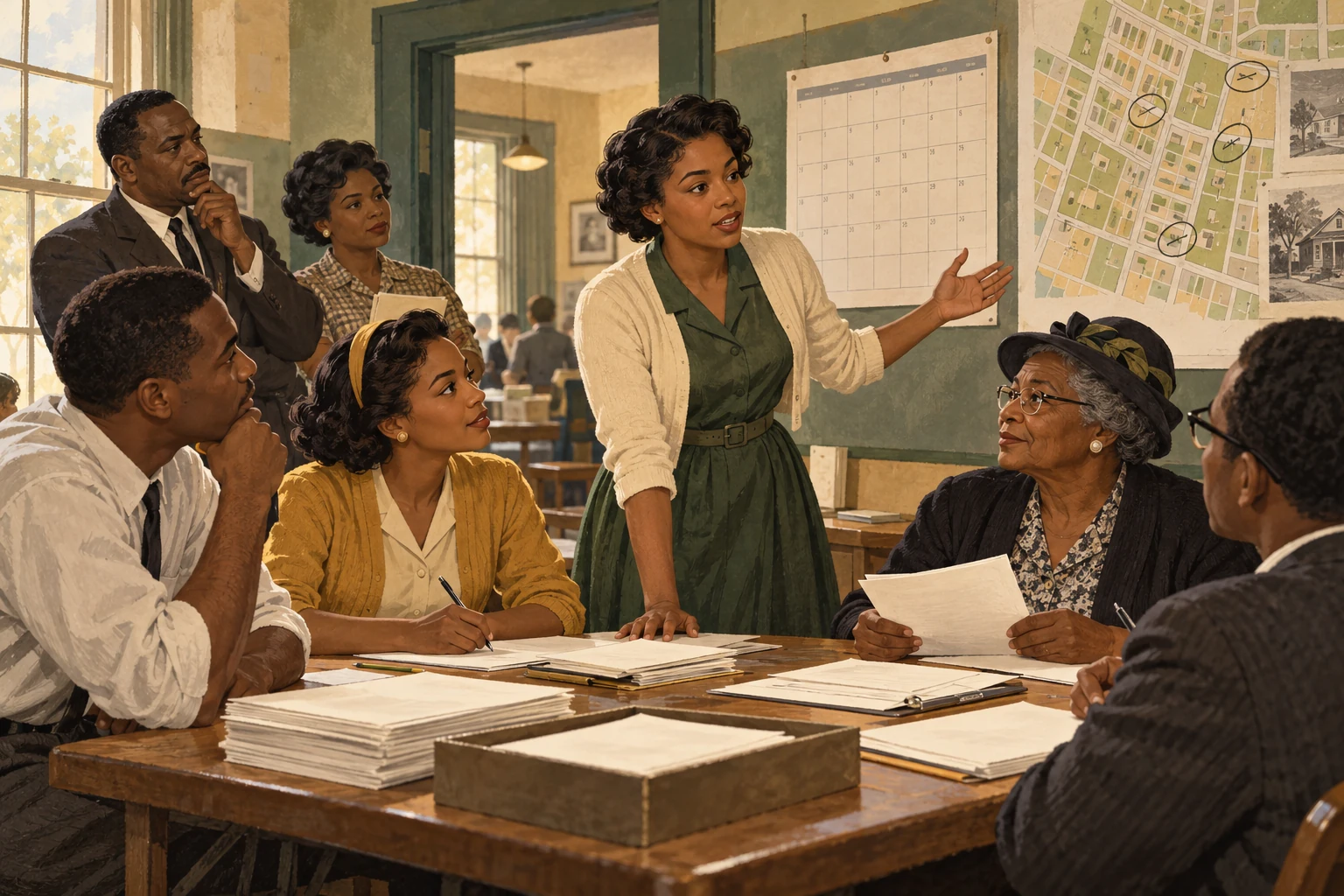
Modern AI-generated teaching illustration of community organizing, not a specific historical event or an archival photograph.
8.1 Contextualizing Period 8
The central tension: power, prosperity and unequal freedom
From 1945 to 1980, the United States combined enormous international influence and rising living standards with intense conflicts over citizenship, economic opportunity and governmental authority. The wartime alliance with the Soviet Union gave way to the Cold War. At home, expanding education, homeownership and consumption encouraged confidence in the American system, while segregation and unequal access exposed the limits of that confidence. Civil rights organizing, feminism, Native sovereignty campaigns and other movements challenged institutions rather than simply asking for a share of consumer abundance.
The period begins with the end of World War II and ends near Ronald Reagan's election in 1980, a useful marker of conservative political strength. These boundaries organize historical study; they did not instantly start or end the processes involved. The Cold War continued after 1980, civil rights activism had roots before 1945, and New Deal institutions survived the conservative resurgence.
Connections to earlier periods
- World War II: Industrial mobilization, scientific research, the atomic bomb and a greatly enlarged federal government established resources for superpower leadership. European devastation and decolonization changed the international balance.
- The New Deal: Social Security, financial regulation and expectations of federal responsibility for economic security shaped postwar liberalism. Conservatives continued to contest taxation, regulation and organized labor.
- Long civil rights struggles: The NAACP, Black churches, labor organizing, the Great Migration and the wartime Double V campaign supplied networks and arguments for the later mass movement.
- Earlier expansion and intervention: Overseas bases, commercial interests and intervention in Latin America predated containment. The Cold War added a powerful anticommunist rationale to existing patterns of influence.
American leaders associated national security with both military strength and a prosperous capitalist economy. They also faced a contradiction: racial discrimination weakened claims to represent freedom in a world where newly independent nations were evaluating rival political systems. This international pressure helped civil rights advocates, but it did not substitute for their sustained organizing.
| Question to investigate | Evidence across the unit | Qualification |
|---|---|---|
| How did federal authority grow? | Containment, defense spending, civil rights enforcement, Medicare and environmental regulation | Federal officials disagreed, states resisted, and implementation was uneven. |
| Who benefited from postwar prosperity? | Veterans' education, suburban housing, union wages and expanding service work | Racial exclusion, gender barriers and regional poverty limited access. |
| Why did confidence in government weaken? | Vietnam, Watergate, inflation and disputes over social change | Distrust did not mean that all Americans rejected every federal program. |
Historical reasoning: Explain a relationship, not just a sequence. For example, defense contracts and highways helped shift population toward the Sun Belt; that migration later altered political representation and the geography of conservative organizing. A strong explanation connects policy, economic opportunity and political consequences.
8.2 The Cold War from 1945 to 1980
Origins and containment
The United States and Soviet Union emerged from World War II with incompatible political economies, mutual suspicions and conflicting security goals. Soviet domination of Eastern Europe alarmed Americans; Soviet leaders feared renewed invasion and American economic and nuclear power. Disputes over Germany, Eastern Europe and the shape of the postwar order turned cooperation into rivalry. Neither side's official explanation fully captures the motives of the other.
Containment sought to prevent the expansion of Soviet influence rather than immediately overthrow communist governments everywhere. George Kennan's Long Telegram in 1946 and his published argument in 1947 emphasized patient resistance. Policymakers applied containment more broadly and militarily than Kennan favored. The Truman Doctrine, 1947, justified aid to Greece and Turkey through a broad commitment to resisting coercion. The Marshall Plan, beginning in 1948, supported European recovery, trade and political stability. Economic aid served humanitarian, commercial and strategic purposes together.
The Soviet blockade of land access to West Berlin in 1948–1949 prompted a sustained American and British airlift. The blockade ended without a direct superpower war, while Germany's division hardened. NATO, founded in 1949, established a collective defense alliance linking the United States to Western European security. The Soviet atomic test and communist victory in China that year intensified American fears. NSC-68 in 1950 recommended a major buildup of military capacity.
Korea and the danger of a wider war
Following Japan's defeat, Korea was divided into Soviet and American occupation zones near the 38th parallel; rival states emerged in 1948. North Korea invaded South Korea in June 1950. Truman committed forces under a United Nations command. After the Inchon landing reversed early North Korean gains, UN forces advanced northward. Chinese intervention produced a costly stalemate. Truman dismissed General Douglas MacArthur in 1951 after conflicts over strategy and public challenges to civilian authority.
The 1953 armistice stopped major fighting and established a demilitarized zone near the prewar dividing line; it was not a peace treaty or Korean reunification. Korea demonstrated the global reach of containment, the costs of limited war and presidential willingness to fight without a formal congressional declaration of war.
Nuclear competition, crisis and negotiation
Eisenhower and Secretary of State John Foster Dulles emphasized massive retaliation and nuclear deterrence to discourage aggression while controlling defense costs. Brinkmanship involved accepting the risk of escalation to pressure an opponent. Both governments developed increasingly destructive weapons and delivery systems. Mutual vulnerability could discourage a deliberate attack, yet accidents, miscalculation and crises remained dangerous.
The failed Bay of Pigs invasion in 1961, carried out by CIA-trained Cuban exiles, strengthened Fidel Castro's position and embarrassed Kennedy. During the Cuban Missile Crisis in October 1962, Kennedy imposed a naval quarantine after discovery of Soviet nuclear missiles in Cuba. A negotiated settlement combined Soviet missile removal with an American public noninvasion assurance and a private agreement to remove American Jupiter missiles from Turkey. The crisis encouraged a direct communications link and the 1963 Limited Test Ban Treaty, which restricted tests in the atmosphere, outer space and underwater, not underground testing.
Détente in the 1970s sought to manage competition through diplomacy. Nixon's 1972 visit to China used the Sino-Soviet split to alter the balance among the three powers. SALT I produced an Anti-Ballistic Missile Treaty and an interim agreement limiting certain strategic offensive launchers. It did not abolish nuclear arsenals or halt all weapons improvements. The Helsinki Final Act of 1975 addressed security, cooperation and human rights without ending superpower rivalry. Soviet intervention in Afghanistan in 1979 helped undermine détente; Carter's response included sanctions and an announced boycott of the 1980 Moscow Olympics.
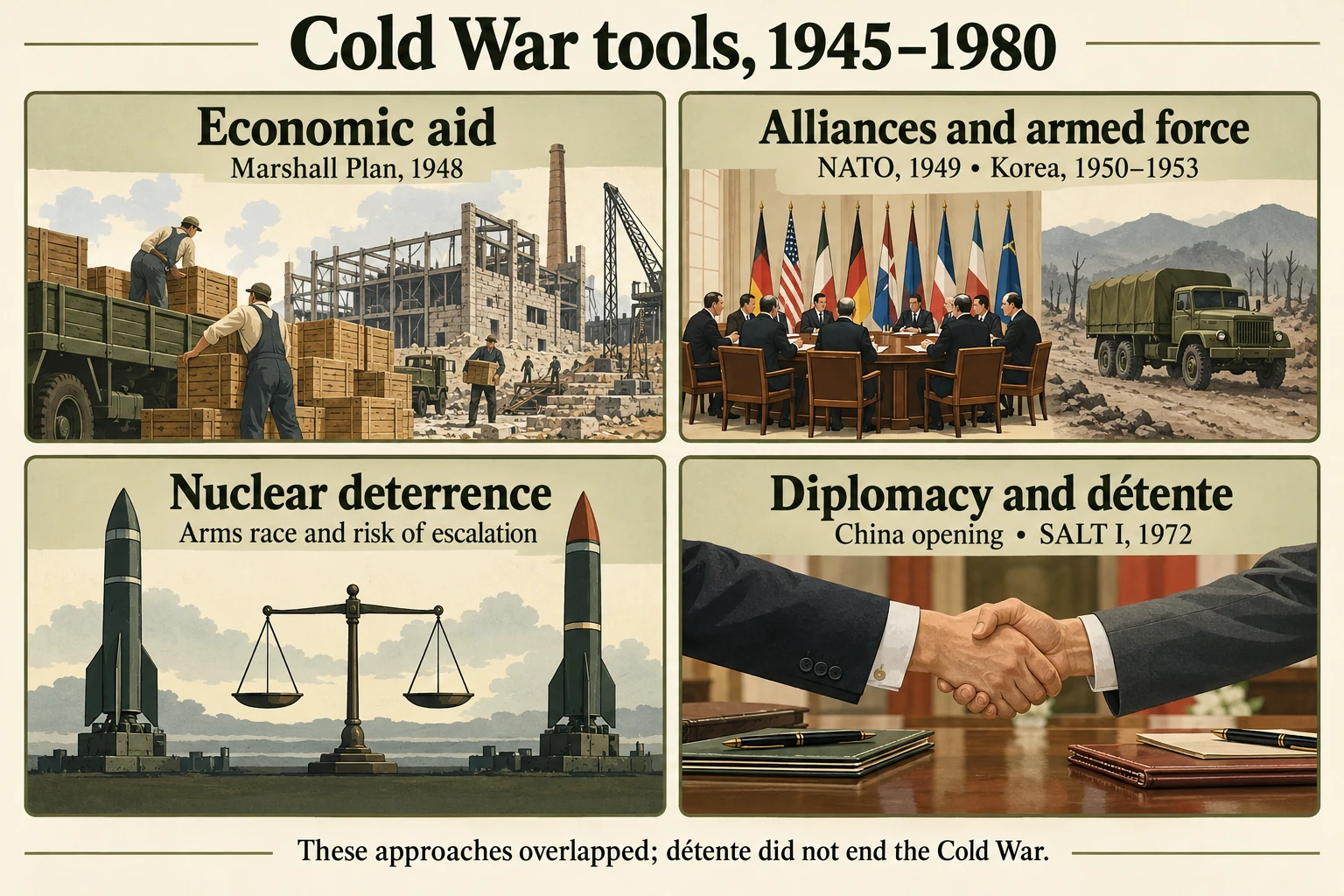
Avoid a misleading timeline: Aid, alliances, covert operations, military intervention and diplomacy overlapped. Détente modified the management of the Cold War; it did not replace every earlier instrument or end containment.
8.3 The Red Scare
Anticommunism and national identity
The Second Red Scare grew from Cold War tensions, genuine espionage, partisan competition and fears about loyalty. Soviet control in Eastern Europe, the 1949 Soviet atomic test, the communist victory in China and the Korean War made threats appear urgent. Officials and private employers often blurred distinctions among espionage, Communist Party membership, left-wing politics and unpopular opinion. Accusations could destroy careers even without proof of criminal conduct.
Truman's 1947 federal loyalty program screened government workers for disloyalty. Its procedures and reliance on association raised due-process concerns. The House Un-American Activities Committee, or HUAC, investigated alleged communist influence, including in the entertainment industry. The Hollywood Ten were cited for contempt of Congress after refusing to answer questions in 1947. Employers' blacklists extended punishment outside the courtroom, encouraging self-censorship and narrowing acceptable political debate.
The Lavender Scare overlapped with anticommunism: officials portrayed gay and lesbian employees as security risks and removed them from federal employment. These policies combined prejudice with claims about vulnerability to blackmail. The association of heterosexual family life, religious faith and political loyalty shaped the cultural boundaries of postwar citizenship.
Espionage cases and McCarthyism
Former State Department official Alger Hiss was convicted of perjury in 1950, rather than tried and convicted of espionage. Julius and Ethel Rosenberg were convicted of conspiracy to commit espionage in 1951 and executed in 1953. Later evidence established Julius's involvement in Soviet espionage; the nature of Ethel's role, the prosecution's conduct and the severity of the punishment have remained subjects of historical debate. Real espionage does not establish the validity of every accusation made during the Red Scare.
Senator Joseph McCarthy gained national attention in 1950 by alleging communist infiltration of the State Department. He used shifting allegations, insinuation and aggressive investigations to portray critics as disloyal. His influence depended on political support and publicity, not simply on his personality. The televised Army–McCarthy hearings in 1954 exposed his methods to a broad audience. Later that year, the Senate censured him, diminishing his influence; it did not expel him.
McCarthyism refers more broadly to reckless allegations, intimidation and guilt by association. McCarthy did not create the entire Red Scare, did not lead HUAC and was not responsible for every blacklist. HUAC was a House committee; McCarthy was a senator. Anticommunist investigations, employment restrictions and surveillance continued after his political decline.
| Earlier comparison | Continuity | Difference after World War II |
|---|---|---|
| First Red Scare, 1919–1920 | Fear of radicalism, repression and suspicion of dissent | A lasting superpower rivalry and nuclear danger reinforced federal security institutions. |
| Wartime restrictions on speech | Officials defended restrictions in the name of national survival. | Many sanctions occurred through peacetime employment and private blacklisting, alongside government action. |
Source analysis: For an anticommunist speech, distinguish an accusation from corroborated evidence. Consider the speaker's office, audience and political purpose. A speech is strong evidence of the claims being made and the climate of fear; it is not, by itself, proof that the named people committed espionage.
8.4 Economy after 1945
Why prosperity expanded
Postwar growth rested on productive capacity built during World War II, pent-up consumer demand, savings, new technologies, expanding education, union bargaining and federal spending. American firms benefited from a strong position in world manufacturing while many competitors rebuilt. Defense contracts and research spending supported aerospace, electronics and other industries. Broadly rising living standards helped sustain confidence that regulated capitalism could deliver both growth and security, although prosperity was never equally distributed.
The GI Bill of 1944 offered eligible veterans educational and training benefits, loan guarantees and other assistance. It expanded college attendance and homeownership rather than creating an American middle class from nothing. Black veterans encountered segregation in colleges, discrimination in lending and housing, and unequal local administration. Women veterans also faced barriers, while many nonveterans were outside the program. A formally broad benefit could produce unequal outcomes through the institutions delivering it.
Strong industrial unions negotiated wages, pensions and health benefits for many workers. The Taft–Hartley Act, 1947, restricted union practices and allowed state right-to-work laws, revealing limits to labor's power even during prosperity. Agricultural mechanization reduced farm labor demand and encouraged migration. Service, managerial and professional employment grew, while poverty persisted in rural areas and many urban neighborhoods.
Suburbs, migration and unequal opportunity
The baby boom, 1946–1964, increased demand for housing, schools and consumer goods. Developers such as those behind Levittown used standardized construction to supply suburban homes. Federal mortgage insurance and veterans' loan guarantees encouraged ownership, and the Federal-Aid Highway Act of 1956 supported an interstate highway system. Automobiles linked homes, workplaces and shopping centers, increasing mobility while encouraging sprawl and fossil-fuel dependence.
Housing opportunity was racially structured. Restrictive covenants, discriminatory real-estate practices, redlining and lending policies limited where Black families and other minorities could buy homes. Shelley v. Kraemer in 1948 prohibited judicial enforcement of racially restrictive covenants, but private discrimination continued. Suburban exclusion restricted access to appreciating property and well-funded schools, contributing to durable wealth gaps. Highway construction and urban renewal also displaced established communities, often communities of color.
White flight contributed to metropolitan segregation and strained city tax bases, but suburbanization cannot be reduced to a single racial motive. Housing costs, family expectations, public subsidies and employment geography also mattered. The Sun Belt grew through defense employment, air conditioning, retirement migration and expanding industries. Movement toward the South and West changed congressional representation and the political balance, while the Great Migration continued to reshape northern and western cities.
From growth to stagflation
By the 1970s, Americans faced slower productivity growth, intensified international competition, manufacturing job losses, inflation and periods of high unemployment. Deindustrialization involved automation, plant closures, relocation within the country and movement abroad. Its effects were concentrated in industrial communities and cannot be explained solely by overseas competition.
Stagflation combined inflation with weak growth and unemployment, challenging assumptions that policymakers could easily trade a little inflation for lower unemployment. Oil shocks were important accelerants, alongside monetary and fiscal choices and broader structural pressures. In 1973–1974, an Arab oil embargo associated with OAPEC and wider producer price increases disrupted supply and raised costs. A second shock followed upheaval in Iran in 1979. In 1971, Nixon suspended the dollar's convertibility into gold for foreign official holders; by 1973 major currencies were moving toward floating exchange rates. This was the unraveling of the Bretton Woods monetary system, not the end of all American gold-related policies at one instant.
Reading economic evidence: A larger dollar income does not automatically mean greater purchasing power. Compare nominal values with prices, identify the years and units, and avoid treating a national average as every household's experience. The worked example in 8.14 uses properly typeset calculations to show the distinction.
8.5 Culture after 1945
Consumer culture and the ideal of conformity
Television, advertising, automobiles and suburban development created widely shared images of the good life. Family sitcoms often centered on a white, middle-class household with a male breadwinner and female homemaker. Shopping centers, appliances and installment credit encouraged consumption. These images expressed influential expectations; they were not a representative account of every American family. Many households relied on women's earnings, and racial minorities frequently appeared only marginally or stereotypically in mass entertainment.
Corporations and large bureaucracies appeared to reward cooperation and loyalty. David Riesman's The Lonely Crowd and William H. Whyte's The Organization Man questioned social pressures to conform. Critics worried that comfort and corporate employment discouraged independent judgment. Their arguments belong in a wider debate about autonomy in a society of large institutions, rather than proving that everyone behaved alike.
Religious observance and public expressions of faith helped define national identity against officially atheist communism. Congress added “under God” to the Pledge of Allegiance in 1954 and adopted “In God We Trust” as the national motto in 1956. Evangelist Billy Graham reached large audiences. The period also included religious diversity and people outside organized religion; public religiosity should not be mistaken for a uniform national belief system.
Gender, youth markets and dissent
Popular culture elevated domestic motherhood, yet more women entered or remained in paid employment, often in clerical, teaching, nursing and service jobs. Wage discrimination and restricted advancement persisted. Betty Friedan's The Feminine Mystique, published in 1963, later challenged the assumption that homemaking alone satisfied all women. Its emphasis on educated suburban women did not encompass the experiences of all working-class women or women of color.
The growth of teenage spending power encouraged a distinct youth market in music, clothing and entertainment. Rock and roll drew on African American rhythm and blues, gospel, country and other traditions. Chuck Berry, Little Richard, Elvis Presley and other performers helped bring it to mass audiences. Music crossed racial boundaries while the industry still practiced segregation, unequal promotion and appropriation. Cultural exchange could challenge racial conventions without eliminating discrimination.
Beat writers, including Jack Kerouac and Allen Ginsberg, criticized materialism, conventional morality and restrictive social expectations. Their experimentation anticipated some themes of the 1960s counterculture, but the Beats and later student political organizations were not interchangeable. Cultural dissent, civil rights organizing and conservative activism all existed during the supposedly placid 1950s.
Use a cultural source carefully: A suburban appliance advertisement reveals what advertisers hoped to sell and the family roles they promoted. It cannot show by itself how many families owned the product, how women actually divided their time or whether viewers accepted the message. Pair representations with evidence of employment, income and access.
8.6 Early Steps in the Civil Rights Movement: 1940s and 1950s
A movement with deep roots
Postwar civil rights activism built on decades of local organizing, legal challenges and resistance. Wartime service, the Double V campaign, Black migration and labor activism strengthened demands for equal citizenship. Returning veterans challenged the contradiction between fighting fascism abroad and encountering segregation at home. Black women, teachers, ministers, lawyers, students and union members supplied organizational labor that accounts centered only on presidents or national leaders can obscure.
Truman's Executive Order 9981, 1948, called for equality of treatment and opportunity in the armed forces. Implementation took time and military desegregation did not end civilian discrimination. His civil rights position also exposed divisions within the Democratic coalition, including the segregationist Dixiecrat challenge in the 1948 election. Federal action mattered, but electoral incentives and movement pressure shaped its timing and scope.
Litigation: Brown and its limits
The NAACP and its legal allies challenged unequal schooling through a sustained litigation strategy. Lawyers including Thurgood Marshall built on earlier cases attacking inequalities in higher education. In Brown v. Board of Education, 1954, the Supreme Court unanimously held state-mandated racial segregation in public schools unconstitutional under the Fourteenth Amendment's equal protection guarantee. It rejected the application of “separate but equal” to public education.
The decision was a constitutional turning point, not immediate nationwide integration. Brown II in 1955 directed implementation with a flexible timetable that segregationist officials exploited. Massive resistance included legal obstruction, school closures, intimidation and economic retaliation. White Citizens' Councils and the Ku Klux Klan used different organizational forms but both defended white supremacy. The murder of Emmett Till in 1955 and the public response to it highlighted the violence sustaining racial hierarchy.
At Little Rock Central High School in 1957, Arkansas governor Orval Faubus used the National Guard to block nine Black students. Eisenhower federalized the Guard and sent federal troops to enforce the court order. The episode demonstrated federal supremacy in enforcing constitutional decisions, while the threats and abuse faced by the students revealed the personal costs of integration. The Civil Rights Act of 1957 created new federal civil rights machinery but had limited immediate enforcement power.
Montgomery: direct action and legal action together
Rosa Parks, an experienced activist, was arrested in December 1955 after refusing to surrender her bus seat. Local organizers, including the Women's Political Council and Jo Ann Robinson, helped turn the arrest into the Montgomery bus boycott, 1955–1956. Participants walked, organized carpools, raised money and endured intimidation. Martin Luther King Jr. became a prominent spokesperson through the Montgomery Improvement Association.
The boycott combined economic pressure, local organization, religious networks and litigation. Browder v. Gayle, brought by other Black women challenging bus segregation, resulted in a federal ruling that was affirmed by the Supreme Court. Montgomery therefore illustrates cooperation among strategies rather than a victory by one individual or one tactic alone. The Southern Christian Leadership Conference, established in 1957, helped coordinate later nonviolent campaigns.
Important correction: Montgomery was a major mass campaign, not the first Black protest in American history. Similarly, Brown invalidated segregated public schooling; subsequent legislation, litigation and activism addressed other institutions. Preserve the distinction between a legal ruling, implementation and lived equality.
8.7 America as a World Power
Decolonization and the global reach of American influence
Independence movements in Asia, Africa and the Middle East transformed international politics. American leaders often interpreted regional struggles through the Cold War, but nationalism, colonial legacies, land distribution and local political rivalries also shaped them. Newly independent states had their own priorities; some pursued nonalignment rather than choosing a permanent superpower camp. Calling every nationalist reform communist concealed these differences.
The United States used aid, trade, alliances, bases, intelligence operations and military intervention to pursue security and influence. The Eisenhower Doctrine, 1957, promised support to Middle Eastern countries resisting communist aggression. NATO, SEATO and the Baghdad Pact's successor CENTO reflected alliance-building, but they had different memberships, structures and effectiveness. They were not a seamless geographic wall or identical collective defense systems.
CIA participation in the 1953 overthrow of Iran's prime minister Mohammad Mossadegh and the 1954 overthrow of Guatemala's Jacobo Árbenz illustrates covert intervention. Anticommunism intersected with oil, land reform, corporate interests and local political conflict. These operations strengthened governments aligned with Washington while contributing to repression and long-term resentment. Supporting an anticommunist government did not necessarily mean supporting democratic practices.
Aid, intervention and competing definitions of freedom
Kennedy's Alliance for Progress sought development and reform in Latin America, while the Peace Corps, 1961, sent volunteers abroad for educational and developmental work. These initiatives expressed idealism and strategic competition simultaneously. In 1965, Johnson sent troops to the Dominican Republic amid a civil conflict, citing fears of another communist government in the Caribbean. Such interventions invited debate over sovereignty and whether security goals justified limiting self-determination.
The United States supported Israel and cultivated relationships with Arab governments, making Middle Eastern policy more complex than a simple two-sided alliance. The 1973 Arab–Israeli War, American support for Israel and the ensuing Arab oil embargo linked foreign policy to household energy costs. Carter's human rights emphasis sometimes challenged friendly authoritarian regimes, although strategic interests continued to constrain its application.
Science, the space race and the national security state
The Soviet launch of Sputnik in 1957 raised fears that American education and missile technology were falling behind. Congress created NASA in 1958 and passed the National Defense Education Act to support strategically important education. The Apollo 11 Moon landing in 1969 demonstrated scientific and organizational capacity and carried major propaganda significance. It also prompted debate about the allocation of public resources while poverty persisted.
Military spending, research universities, contractors and federal laboratories became closely connected. In his 1961 farewell address, Eisenhower warned about the influence of the military-industrial complex. Defense production supported jobs and technological innovation while creating incentives for continuing expenditure. Nuclear testing and arms competition also generated health, environmental and moral concerns. The influence of military institutions should be analyzed alongside civilian choices and public debate rather than treated as an explanation that makes politics irrelevant.
Comparison: The Marshall Plan and a covert coup were both tools used in a Cold War setting, but they involved different methods, partners and consequences. Explain how an example worked and whose priorities it served before grouping all overseas activity under “containment.”
8.8 The Vietnam War
From colonial war to American escalation
Vietnam's conflict grew from French colonialism, nationalist independence struggles, communist organization and Cold War intervention. Ho Chi Minh led a communist movement that also claimed national liberation. After French defeat at Dien Bien Phu in 1954, the Geneva settlement temporarily divided Vietnam near the 17th parallel and anticipated reunification elections that were not held. American policymakers supported a noncommunist South Vietnam, including Ngo Dinh Diem's authoritarian government, to prevent a perceived regional communist advance.
Eisenhower supplied assistance and Kennedy greatly expanded the advisory presence. American officials feared the domino theory and damage to American credibility, while the South Vietnamese government faced an insurgency, contested legitimacy and instability. Rural displacement, repression and the failed strategic hamlet program complicated efforts to win popular support. A 1963 military coup, accepted by American officials, overthrew Diem; his killing did not resolve these political problems.
The Gulf of Tonkin Resolution, August 1964, gave Johnson broad authority to use force. North Vietnamese boats had attacked the USS Maddox on August 2; the reported second attack on August 4 did not occur as initially claimed. The administration used the reported incidents to secure congressional support. In 1965, sustained bombing and deployment of American ground combat forces marked a major escalation. More than half a million American troops were in Vietnam by the late 1960s.
Warfare, dissent and the credibility gap
American commanders pursued attrition through firepower, search-and-destroy operations and body counts. Communist forces used guerrilla tactics, conventional formations, supply routes through neighboring countries and a willingness to sustain enormous losses. Civilian casualties, displacement, destruction and the use of chemical defoliants imposed lasting costs. Counting enemy casualties did not reliably measure political legitimacy or the ability to build a stable South Vietnamese state.
The Tet Offensive, 1968, involved North Vietnamese and Viet Cong attacks across South Vietnam. Communist forces suffered heavy military losses and did not achieve a general uprising, but the offensive contradicted optimistic American claims of imminent success. It widened the credibility gap between official statements and public perceptions. Tet did not mechanically prove an abstract proposition that no outcome was possible; it changed the political assessment of the costs and prospects of continuing the existing strategy.
Opposition included students, clergy, civil rights activists, veterans and some elected officials. Protesters differed: some opposed all war, others objected to this war's conduct, draft inequities or its strategic rationale. Deferments and unequal access to them made the draft controversial. Many Americans continued to support the war or disapproved of antiwar tactics. The My Lai massacre, 1968, in which American soldiers killed hundreds of Vietnamese civilians, became publicly known in 1969. The Pentagon Papers, published in 1971, revealed a longer history of official doubts and misleading public accounts.
Vietnamization, withdrawal and consequences
Nixon's Vietnamization sought to reduce American ground commitments while strengthening South Vietnamese forces. At the same time, bombing and operations in Cambodia and Laos expanded the geographic reach of the war. The announced Cambodian incursion in 1970 intensified campus protests. National Guardsmen killed four students at Kent State; police killed two students at Jackson State shortly afterward. These were distinct incidents and symbols of a broader crisis of authority.
The Paris Peace Accords, 1973, provided for a ceasefire, American withdrawal and prisoner returns, but did not secure a lasting peace between the Vietnamese sides. North Vietnamese forces captured Saigon in 1975, ending South Vietnam's government. The war killed more than 58,000 American service members and millions of Vietnamese, with wider devastation in Cambodia and Laos. Refugee movements, veterans' experiences and unexploded ordnance extended the consequences beyond the war's end.
The War Powers Resolution, 1973, sought to reassert congressional involvement through consultation, reporting and limits on unauthorized deployments. Presidents disputed aspects of its constitutionality and application. The war encouraged caution about intervention and distrust of official claims, yet did not end American overseas commitments or presidential power.
Build a causal chain: Explain how credibility concerns encouraged escalation, how the gap between military measures and political objectives complicated success, and how the resulting costs affected domestic reform and trust. Include Vietnamese agency rather than presenting Vietnam only as an American policy problem.
8.9 The Great Society
Liberal reform and the War on Poverty
Lyndon Johnson assumed the presidency after Kennedy's assassination in November 1963 and won a large electoral victory in 1964. His Great Society sought to reduce poverty, dismantle racial barriers, expand educational opportunity and improve the quality of American life. It built on New Deal expectations of federal responsibility but addressed problems that prosperity alone had not solved. Congressional liberal strength, presidential legislative skill and pressure from social movements helped turn proposals into laws.
The Economic Opportunity Act of 1964 established the Office of Economic Opportunity to coordinate the War on Poverty. Programs included Job Corps training, VISTA volunteers and community action initiatives. Community action sought participation by people experiencing poverty, which sometimes brought local activists into conflict with established city officials. Head Start, launched in 1965, combined early childhood education with other services for low-income families. These programs did not all use the same approach: some supplied services, some encouraged local participation, and others addressed income or access.
| Policy area | Important measures | Purpose and distinction |
|---|---|---|
| Health care | Medicare and Medicaid, 1965 | Medicare initially insured people age 65 and older; Medicaid supported qualifying low-income groups through a joint federal–state program. They were not one universal insurance plan. |
| Schools and college | Elementary and Secondary Education Act and Higher Education Act, 1965 | Expanded federal educational support, including aid aimed at disadvantaged schoolchildren and assistance for higher education. |
| Housing and food | HUD, 1965; Food Stamp Act, 1964 | Expanded federal involvement in urban housing and nutrition, with implementation and eligibility limits. |
| Culture and media | National Endowments for the Arts and Humanities, 1965; Public Broadcasting Act, 1967 | Supported cultural activity and noncommercial broadcasting. PBS and NPR developed afterward, rather than both being created directly as operating networks in 1967. |
| Immigration | Immigration and Nationality Act, 1965 | Ended the national-origins quota system and emphasized family ties and occupational skills, while retaining numerical limits and other restrictions. |
Immigration and the meaning of inclusion
The 1965 immigration law rejected an openly discriminatory national-origins framework associated with the 1920s. Its effects unfolded over decades as migration from Asia and Latin America increased and family sponsorship sustained new networks. It did not remove all immigration controls; new hemispheric and later country limits also reshaped legal opportunities. Meanwhile, the Bracero Program ended in 1964, altering the context for Mexican migrant labor. Refugees, family migration, employment opportunities and unauthorized migration followed different legal and social pathways.
Changes in immigration interacted with civil rights arguments about equal treatment and with employers' demand for workers. The resulting demographic changes helped transform cities, suburbs, religion, culture and electoral politics. Avoid assuming that lawmakers accurately anticipated every long-term effect or that all immigrants experienced the same reception.
Achievements, limits and controversy
Federal programs expanded health coverage, educational access, nutrition assistance and legal protections. Poverty declined during the 1960s, but assigning the entire change to a single program ignores economic growth, employment, demographics and other public policies. Racial wealth gaps, regional disadvantage and unequal schools persisted. Medicare and Medicaid created durable institutions even as politicians debated their financing and administration.
Conservatives criticized the programs' expense, bureaucracy and possible effects on incentives. Some critics on the left argued that reforms did too little to redistribute power or address structural inequality. Describe “dependency” as a political criticism to evaluate, not as an established explanation for all poverty. Vietnam absorbed money and political attention, intensified inflationary pressures and fractured the coalition supporting liberal reform. The Great Society was constrained and contested, but it was not simply abolished by the war or the next administration.
New Deal comparison: Both eras expanded federal responsibility. The New Deal responded to economic collapse through relief, recovery and reform; the Great Society sought to use an affluent economy to reduce remaining poverty, discrimination and unequal access. Their purposes overlapped, but their immediate economic contexts differed.
8.10 The African American Civil Rights Movement: 1960s
Direct action and grassroots power
In 1960, four Black college students began the Greensboro lunch-counter sit-in, helping inspire a wider wave of sit-ins. Student activists formed the Student Nonviolent Coordinating Committee, SNCC, which emphasized local leadership and sustained organizing. The Congress of Racial Equality, CORE, initiated the Freedom Rides in 1961 to challenge segregation in interstate bus travel and terminals. Riders faced mob violence, arrests and uneven protection; further activism and federal intervention helped secure enforcement of desegregation rules.
The Birmingham campaign, 1963, confronted segregation through boycotts and demonstrations. Police commissioner Eugene “Bull” Connor's use of dogs and fire hoses, including against young demonstrators, brought national and international attention to repression. King's Letter from Birmingham Jail defended direct action and criticized demands that Black Americans indefinitely postpone freedom. Activists' purpose was to confront unjust institutions and force negotiation, rather than to cause violence themselves.
The March on Washington for Jobs and Freedom, August 1963, connected civil rights with economic justice. A. Philip Randolph and Bayard Rustin played major organizing roles, while King's speech became its best-known moment. Freedom Summer, 1964, expanded Mississippi voter registration and education efforts despite lethal intimidation. The Mississippi Freedom Democratic Party challenged the exclusion of Black voters from the state's regular Democratic delegation; Fannie Lou Hamer publicized the violence and political exclusion underlying that challenge.
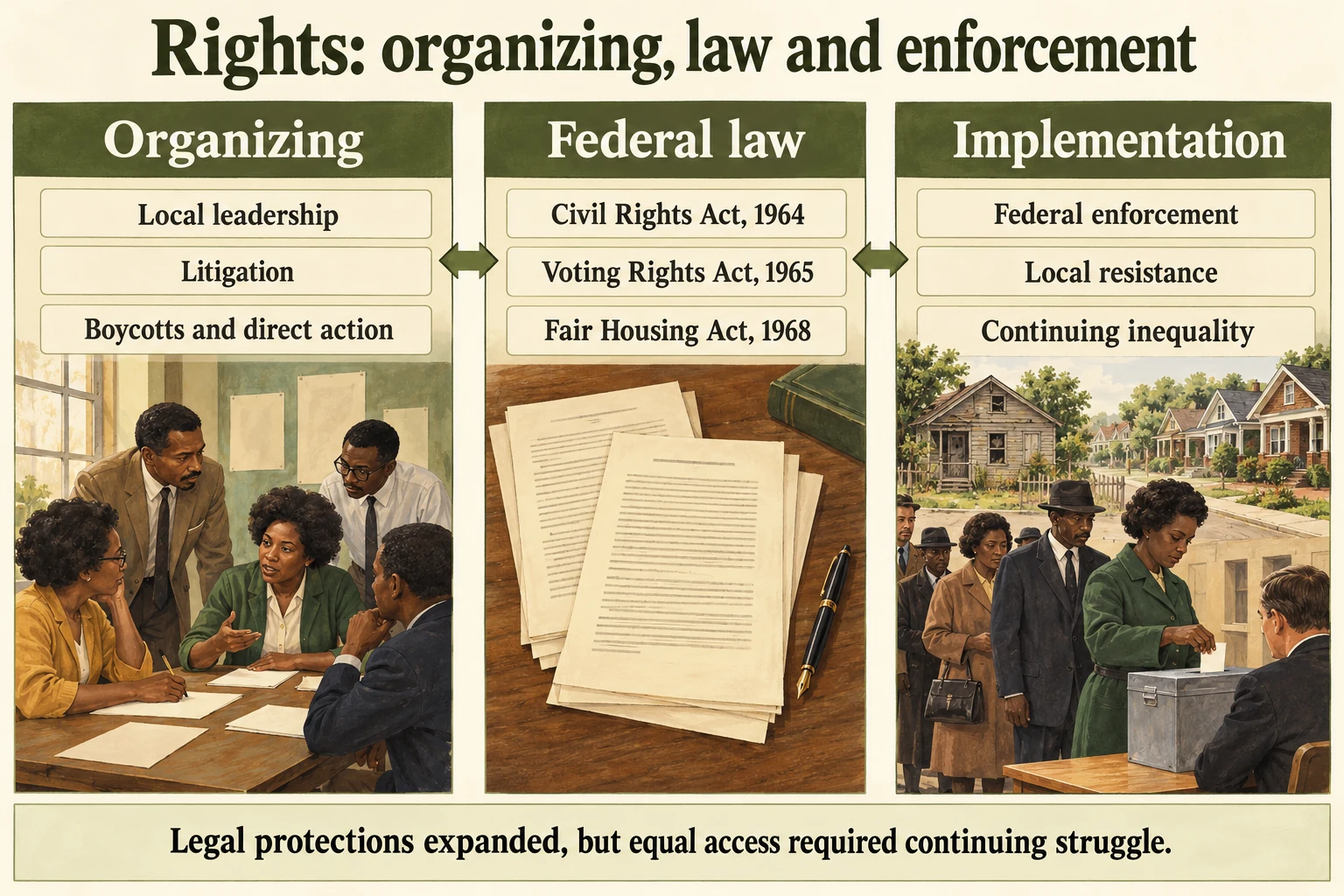
| Measure | What changed | What it did not automatically accomplish |
|---|---|---|
| Civil Rights Act, 1964 | Prohibited discrimination in covered public accommodations and employment; strengthened federal tools against segregation and discrimination. | It did not itself eliminate residential segregation, all voting barriers or racial wealth inequality. |
| Voting Rights Act, 1965 | Targeted discriminatory voting tests and enabled federal intervention; certain jurisdictions faced federal review of voting changes. | Its passage was distinct from the Twenty-Fourth Amendment's ban on poll taxes in federal elections in 1964 and the Supreme Court's rejection of state-election poll taxes in Harper in 1966. |
| Fair Housing Act, 1968 | Prohibited specified discrimination in housing transactions. | Legal protection did not immediately reverse exclusionary practices, accumulated wealth differences or neighborhood segregation. |
The violence against marchers at Selma on Bloody Sunday in March 1965 strengthened support for voting rights legislation. These federal laws depended on movement pressure, legislative coalitions, executive action and continuing enforcement. Courts and Congress supplied different legal tools; no single branch or president produced the movement's achievements alone.
Black Power, economic justice and repression
The movement contained debates over integration, self-determination, nonviolence, armed self-defense, electoral participation and economic change. Malcolm X promoted Black pride and criticized white supremacy, first through the Nation of Islam and later through independent organizations and a changing international outlook. He was assassinated in 1965. Stokely Carmichael, later Kwame Ture, popularized Black Power in 1966. The term had varied meanings, including community control, cultural pride and independent political power; it did not mean that every supporter shared one strategy.
The Black Panther Party, founded by Huey Newton and Bobby Seale in 1966, combined armed monitoring of police with community programs such as free breakfasts and health services. Federal and local surveillance, prosecution and violence constrained radical organizations; the FBI's COINTELPRO targeted civil rights and other activists. Internal disputes and strategic differences also affected organizations. Repression belongs in the explanation alongside debates within the movement.
Urban uprisings in Watts in Los Angeles, 1965, and Newark and Detroit, 1967, reflected anger over policing, segregation, unemployment and unequal opportunity. Watts was in the West, not a northern city. The Kerner Commission in 1968 emphasized racism and structural division. King increasingly addressed northern housing discrimination, economic inequality and the Vietnam War, and helped plan the Poor People's Campaign before his assassination in April 1968. These priorities complicate a simple contrast between an exclusively legal early movement and an exclusively economic later one.
Continuity and change: Legal gains broadened political participation, while economic inequality and policing remained contested. Nonviolent activism continued alongside Black Power; one did not simply replace the other. Use specific organizations, goals and dates instead of describing an entire population as moving through identical stages.
8.11 The Civil Rights Movement Expands
Women's movements: equality, autonomy and disagreement
Women's activism drew on older suffrage and labor struggles as well as experience in civil rights and student organizations. Betty Friedan's The Feminine Mystique, 1963, challenged restrictive domestic expectations, and the National Organization for Women, founded in 1966, pursued legal equality and enforcement against discrimination. Other feminists emphasized consciousness-raising, reproductive autonomy, violence against women and changes in family and workplace power. Black, Latina and working-class feminists stressed that race, class and gender shaped opportunity together.
The Equal Pay Act, 1963, addressed sex-based wage discrimination for equal work under specified conditions. Title VII of the 1964 Civil Rights Act prohibited sex discrimination in covered employment. Title IX, 1972, prohibited sex discrimination in federally funded education, with important effects extending beyond athletics. Congress submitted the Equal Rights Amendment in 1972; it had not reached the required number of state ratifications by the original 1979 deadline, later extended to 1982. Opposition led by Phyllis Schlafly helped mobilize conservative women who disputed feminists' goals.
In the historical context of this unit, Roe v. Wade, 1973, recognized constitutional protection for abortion subject to a trimester framework and state interests. It became a focal point for both reproductive-rights and antiabortion organizing. This describes the ruling's historical significance, not current law: the Court overturned Roe in 2022.
Mexican American, Latino and farmworker activism
The Chicano movement addressed educational inequality, political exclusion, cultural identity, land claims and labor conditions. School walkouts in East Los Angeles in 1968 demanded changes in schools and treatment of Mexican American students. The Brown Berets promoted community protection and political activism; La Raza Unida pursued independent electoral organization. Latino communities were diverse, and the history of Mexican American activism should not stand in for every Puerto Rican, Cuban or other Latino experience.
César Chávez and Dolores Huerta organized farmworkers through strikes, consumer boycotts and negotiation. Filipino organizers including Larry Itliong were essential to the Delano grape strike begun in 1965. The coalition that became the United Farm Workers connected workplace bargaining to wider demands for dignity. Farmworker activism crossed ethnic lines and depended on workers' participation, union networks, religious allies and consumers, rather than one charismatic leader alone.
Native sovereignty and self-determination
Native activism challenged treaty violations, poverty, discrimination and federal termination and relocation policies. Termination sought to end the federal relationship with particular tribes, while relocation programs encouraged movement to cities. Urban networks later helped sustain organizing. Native nations' demands involved collective sovereignty and treaty rights, not only individual integration into existing institutions.
Indians of All Tribes organized the Alcatraz occupation of 1969–1971; it should not simply be attributed to AIM. The American Indian Movement, founded in 1968, challenged police abuse and participated in major protests. AIM members and local Oglala Lakota activists occupied Wounded Knee in 1973 in a conflict involving tribal leadership, federal policy and treaty demands. The Indian Self-Determination and Education Assistance Act, 1975, expanded opportunities for tribes to administer federally funded programs. These changes did not settle all land claims or eliminate federal authority.
Gay liberation and disability rights
Organizations such as the Mattachine Society and Daughters of Bilitis advocated for gay and lesbian people before the 1960s. The Stonewall uprising in New York in 1969, following a police raid, became a powerful catalyst for more visible gay liberation and later pride marches; it was not the beginning of all gay rights activism. Activists sought an end to criminalization, discrimination, police harassment and exclusion. Successes were uneven and prompted organized opposition.
Disability activists also pressed for access, autonomy and equal participation. Section 504 of the Rehabilitation Act, 1973, prohibited disability discrimination in federally supported programs. The 1977 sit-ins helped secure implementing regulations. This example reinforces a central theme: enacting a protection and making institutions implement it were separate political struggles.
Compare without flattening differences: These movements shared organizing tactics and arguments about rights, but their goals were not identical. Workplace equality, tribal sovereignty, reproductive autonomy and freedom from police harassment involved different institutions and legal claims. Explain both exchanges among movements and their independent histories.
8.12 Youth Culture of the 1960s
The New Left and participatory democracy
The baby boom, expanding universities and growing affluence created a large population of young people with access to education, media and new forms of association. The New Left criticized racial injustice, Cold War militarism, corporate power and impersonal institutions. Students for a Democratic Society, SDS, articulated a vision of participatory democracy in its 1962 Port Huron Statement. Activists wanted people to exercise meaningful influence over decisions affecting their lives, not simply vote periodically or accept expert management.
The Free Speech Movement at Berkeley in 1964 challenged restrictions on political activity on campus. Civil rights volunteering, teach-ins, antiwar marches, draft resistance and campus occupations connected student concerns with national and international issues. Different organizations disagreed about tactics, revolutionary politics and relations with other movements. The later fragmentation of SDS does not mean that student activism as a whole ended or that all participants endorsed violence.
Counterculture, music and changing social norms
The counterculture challenged consumer materialism, conventional authority, restrictive sexual expectations and standardized lifestyles. Some participants explored communal living, back-to-the-land communities, alternative spirituality or psychedelic drugs. Folk and rock music circulated protest themes and experiments in identity. The Woodstock festival, 1969, became a prominent symbol, although a music gathering did not represent the political views of an entire generation.
The birth control pill, approved in 1960, helped separate sexual activity from the expectation of immediate childbearing for many users. Changes in sexual norms also depended on activism, law, access and social circumstances; technology alone did not cause a single uniform “sexual revolution.” Griswold v. Connecticut in 1965 recognized a constitutional privacy protection concerning married couples' access to contraception. Feminists questioned both traditional domestic roles and sexism within movements that claimed to be liberating.
Drug use was one visible element of the counterculture, not a defining activity of every young person or protester. New Left politics and countercultural experimentation overlapped but were distinct. An organizer focused on voting rights, a student opposing the draft and a person joining a rural commune might have different goals, relationships to institutions and understandings of freedom.
Generational conflict was not universal
Parents and young adults sometimes clashed over patriotism, religion, dress, sexuality and the war. Television amplified striking examples, making conflict seem universal. Many young Americans remained conventional, supported military service or organized for conservatism. Young Americans for Freedom, founded in 1960, promoted anticommunism and limited government. Students' experiences differed by class, race, religion, gender and whether they attended college or entered work and military service.
The Twenty-Sixth Amendment, 1971, lowered the voting age to 18. Arguments that people old enough to be drafted should be able to vote linked youth citizenship with military obligation. The amendment expanded formal participation but did not ensure a unified youth electorate or end arguments over authority. Cultural changes outlasted the most visible countercultural organizations, while conservative organizing also contributed to the political developments of the 1970s.
Comparison: A New Left manifesto and a young conservative statement may both criticize complacency and call for action, yet propose very different roles for government. Identify shared generational opportunities before explaining ideological disagreement. Avoid treating “young,” “antiwar,” “hippie” and “radical” as synonyms.
8.13 The Environment and Natural Resources, 1968–1980
From conservation to pollution and ecological limits
Postwar production, suburban expansion, automobile use and chemical technologies improved many people's living standards while generating pollution and resource pressures. Environmental activism built on earlier conservation traditions but increasingly focused on human health, ecosystems and the costs of industrial consumption. Rachel Carson's Silent Spring, 1962, questioned indiscriminate pesticide use and helped make ecological interdependence a public issue. Its influence preceded this topic's date range and provides necessary context.
The 1969 Santa Barbara oil spill and the 1969 Cuyahoga River fire became powerful symbols of environmental damage. The Cuyahoga had burned before; its significance lay partly in the wider public and political response to pollution. The first Earth Day, April 22, 1970, brought together students, local groups and other participants in a broad demonstration of concern. Scientific research, mass media and grassroots mobilization all helped convert problems into political demands.
| Development | Function | Why the distinction matters |
|---|---|---|
| National Environmental Policy Act, signed 1970 | Required environmental review for major federal actions significantly affecting the environment. | Environmental assessment is a decision-making process, not a blanket ban on development. |
| Environmental Protection Agency, 1970 | Consolidated federal environmental responsibilities, including regulation, research and enforcement. | The EPA is an agency, not the name of every environmental statute. |
| Clean Air Act amendments, 1970 | Strengthened national air-quality and emissions regulation. | Federal standards interacted with state implementation and industry compliance. |
| Clean Water Act, 1972 | Expanded federal regulation of water pollution and support for treatment. | Its passage over Nixon's veto shows that environmental politics involved conflict within broad support. |
| Endangered Species Act, 1973 | Protected listed species and their habitats through federal mechanisms. | Protection could conflict with construction, resource use and private economic interests. |
| Superfund legislation, 1980 | Established a federal framework for hazardous-waste cleanup and liability. | It addressed contaminated sites, not simply ordinary household recycling. |
Energy dependence and competing priorities
The 1973–1974 oil crisis linked Middle Eastern conflict, an Arab oil embargo and producer price increases with American dependence on petroleum. Distinguish OAPEC, the Arab petroleum-exporting organization associated with the embargo, from the broader OPEC producer group. Not all OPEC members participated in the embargo. The 1979 Iranian Revolution contributed to a second oil shock. Higher energy costs affected transportation, manufacturing and household budgets and worsened inflation.
Policy responses included a national 55-mile-per-hour speed limit in 1974, fuel-economy standards, the Strategic Petroleum Reserve and efforts to conserve energy and develop alternatives. Carter created the Department of Energy in 1977 and urged conservation. Business groups, workers and consumers debated the costs, effectiveness and distribution of these policies. Some supported expanded drilling or nuclear energy as solutions, while others emphasized conservation, renewables or the environmental risks of supply expansion.
The Three Mile Island nuclear accident, 1979, intensified safety concerns. Love Canal, widely publicized in 1978, drew attention to toxic waste, housing and community health. Pollution burdens were unequal: low-income communities, workers and communities of color often faced concentrated exposure. These histories contributed to later environmental justice organizing, even when participants did not yet use that label.
Historical complexity: Environmental regulation gained support across party lines, including under Nixon, while generating disputes about jobs, prices, property and federal power. A conservative president could support new regulatory institutions; ideological labels alone do not predict every policy choice.
8.14 Society in Transition
Liberalism, the courts and the conservative resurgence
Disputes over racial change, gender, religion, crime, taxation and the Vietnam War reshaped political coalitions. Barry Goldwater's 1964 presidential campaign lost decisively but strengthened conservative networks. Activists, donors, media organizations, business groups and religious communities continued organizing afterward. Nixon appealed to a “silent majority” and used law-and-order language to criticize disorder and antiwar protest. His Southern Strategy sought white southern support partly through opposition to federally enforced racial change. Regional realignment unfolded over decades and included economic, religious and demographic factors as well as race.
The Warren Court expanded protections for defendants and addressed representation and church–state issues. Gideon v. Wainwright in 1963 required appointed counsel for indigent defendants in state felony cases; Miranda v. Arizona in 1966 required safeguards for custodial interrogation. Baker v. Carr in 1962 opened legislative apportionment disputes to federal judicial review, and Reynolds v. Sims in 1964 applied population-based representation requirements to state legislative districts. Critics argued that courts intruded on local authority or weakened law enforcement; supporters saw necessary protection of constitutional rights.
Nixon's policies combined conservative appeals with pragmatic federal action. He promoted New Federalism and revenue sharing while accepting or expanding some regulatory and social programs. Affirmative action, including the Philadelphia Plan, sought to address discrimination through hiring goals in federal contracting. In Regents of the University of California v. Bakke in 1978, the Court rejected the particular medical-school quota while allowing race to be considered in admissions under the approach then adopted. This is the historical ruling, rather than a statement of present admissions law.
Religious conservatives mobilized over abortion, feminism, school policy, sexuality, secularization and disputes about federal authority, including policy toward segregated private schools. Phyllis Schlafly's anti-ERA activism and the Moral Majority, founded in 1979, illustrate the organizing that helped build a new conservative coalition. No single controversy explains every participant's involvement.
Watergate and institutional checks
The 1972 break-in at Democratic National Committee offices in the Watergate complex led to investigations of a larger pattern of political misconduct and obstruction. The cover-up, misuse of executive agencies and attempts to obstruct investigation became central issues. Journalism, courts, congressional hearings and officials within government helped expose the scandal. During the Saturday Night Massacre, October 1973, Nixon's attempt to remove special prosecutor Archibald Cox led to senior Justice Department resignations.
In United States v. Nixon, 1974, the Supreme Court rejected an absolute claim of executive privilege against a criminal subpoena and required production of recordings. Facing likely impeachment and removal, Nixon resigned on August 9, 1974, before the full House voted on impeachment. Gerald Ford became president and pardoned Nixon, a decision that provoked controversy. Post-Watergate campaign finance reforms and congressional investigations of intelligence abuses reflected efforts to constrain executive misconduct. The 1973 War Powers Resolution also arose from the Vietnam-era struggle over presidential authority; it should not be explained solely as a response to Watergate.
Carter, economic strain and the election of 1980
Jimmy Carter won in 1976 as an outsider promising honesty and reform. He emphasized human rights and helped negotiate the Camp David Accords in 1978, frameworks that led to an Egyptian–Israeli peace treaty in 1979. The accords themselves were not the final treaty and did not resolve all Middle Eastern disputes. The Panama Canal treaties of 1977 provided for eventual transfer of canal control, generating domestic debate over American power.
Inflation, energy costs and economic uncertainty damaged confidence in Carter. The Iranian Revolution and the Iran hostage crisis, beginning in November 1979, created a prolonged international confrontation; the hostages were released in January 1981. Soviet intervention in Afghanistan further strained relations. Carter appointed Paul Volcker as Federal Reserve chair in 1979; the turn toward monetary restraint contributed to the later struggle to reduce inflation, with serious employment costs. Reagan's 1980 victory reflected economic dissatisfaction, conservative organizing and criticism of American leadership, not one event alone.
Worked example: inflation and purchasing power
Hypothetical figures, not actual 1970s CPI observations: Suppose a price index rises from 100 in a base year to 125 in a later year. The percentage increase compares the change with the starting index:
If a fixed nominal income remains $100, its value measured in base-year purchasing power is:
| What is being measured? | Result | Interpretation |
|---|---|---|
| Increase in the price index | 25% | Prices in the example are one quarter higher than in the base year. |
| Change in fixed income's purchasing power | The same $100 buys 20% less in base-year goods, not 25% less. The comparison uses a different starting quantity. |
A price index measures the cost of a specified basket, not every household's exact spending. Historical analysis must also consider wage changes, employment, taxes and differences in consumption. Inflation is a rise in the general price level; a single expensive product or a rise in nominal income does not establish the whole pattern.
Avoid a simple collapse narrative: Trust and liberal coalitions weakened, but Medicare, civil rights protections and environmental regulation survived. Conservatism gained strength through sustained organization as well as dissatisfaction. Change in electoral power did not erase the institutions created earlier.
8.15 Continuity and Change in Period 8
Develop an argument about extent
Period 8 transformed federal responsibilities, legal citizenship, everyday life and international commitments. Yet the scale of change differed across institutions and groups. An effective continuity-and-change argument identifies what changed, establishes the earlier situation, explains causes and specifies what persisted. A list divided into “change” and “continuity” becomes an argument only when it evaluates their relationship and significance.
For example, civil rights laws substantially changed the legal framework of citizenship and enabled greater political participation. Housing exclusion, unequal wealth, segregated neighborhoods and discriminatory policing persisted. This qualification does not mean that legal reform was meaningless; it explains why political rights and material equality followed different trajectories. Likewise, détente changed superpower diplomacy while nuclear competition and overseas intervention continued.
| Dimension | Significant change | Important continuity |
|---|---|---|
| International role | Permanent alliances, large peacetime military commitments, global containment and later arms diplomacy | Security, commerce and influence remained major motives; intervention had precedents before 1945. |
| Citizenship | Desegregation rulings, civil rights laws, broader voting access and new rights movements | Unequal resources, discrimination, resistance and debates over enforcement endured. |
| Federal responsibility | Great Society health and education programs, expanded environmental regulation | New Deal foundations survived; conflicts over federalism, cost and individual responsibility persisted. |
| Economy and migration | Mass suburbanization, Sun Belt growth, new immigration patterns and later industrial restructuring | Regional and racial inequality shaped access to housing, jobs and wealth. |
| Culture and politics | Challenges to gender and sexual norms, youth mobilization and conservative coalition-building | Religious belief, patriotism, family ideals and cultural conflict remained influential in different forms. |
Useful comparisons and qualified claims
1950s and 1960s: The 1960s saw more visible mass protest, but civil rights activism, cultural dissent and conservative mobilization already existed in the 1950s. Do not contrast a completely conformist decade with an entirely rebellious one. Early and later civil rights: Litigation and nonviolent direct action continued while Black Power broadened arguments about community control and economic justice. Strategies overlapped rather than forming a neat replacement sequence.
New Deal and Great Society: Both accepted federal responsibility for social problems; the Great Society operated initially in an affluent setting and placed greater emphasis on access and civil rights. Containment and détente: The latter sought negotiation and risk management within continuing rivalry. Liberal and conservative governance: Party rhetoric differed, yet Nixon's environmental and affirmative-action policies show that governing choices cannot always be predicted from campaign labels.
Model analytical claim: Federal action between 1945 and 1980 substantially widened formal citizenship and social provision, especially through civil rights enforcement and health insurance, while unequal economic resources and political resistance limited implementation; meanwhile, Vietnam, inflation and cultural conflict helped conservatives challenge liberal leadership without dismantling all of its institutions. Support each part with specific evidence and explain why the qualification matters.
Bridge to Unit 9: Reagan inherited conservative networks and public dissatisfaction formed during Period 8, along with continuing Cold War commitments and durable federal programs. His election is a turning point to explain, not proof that every earlier trend ended in 1980.
Period 8 revision timeline
Track domestic and international developments together. Events in the same row overlap in time; their placement does not mean that every event caused the next one.
| Date | Evidence to recall | Connection to explain |
|---|---|---|
| 1944–1948 | GI Bill; wartime transition; Truman Doctrine; Marshall Plan; military desegregation order | Prosperity, security commitments and demands for equal citizenship develop together. |
| 1948–1953 | Berlin Airlift; NATO; communist victory in China; Korean War; loyalty investigations | International rivalry supports military expansion and domestic anticommunism. |
| 1954–1957 | Brown; Montgomery boycott; Little Rock; interstate highway legislation; Sputnik | Federal authority both supports growth and confronts segregation. |
| 1960–1962 | Sit-ins; Freedom Rides; Bay of Pigs; Cuban Missile Crisis; Silent Spring | Grassroots challenges coexist with nuclear danger and emerging ecological concerns. |
| 1963–1964 | Birmingham; March on Washington; Kennedy assassination; Civil Rights Act; Tonkin Resolution | Pressure for reform and decisions for escalation reshape Johnson's presidency. |
| 1965 | Selma; Voting Rights Act; Medicare and Medicaid; immigration reform; Vietnam escalation | The high point of liberal legislation coincides with deeper war commitments. |
| 1966–1968 | NOW; Black Panthers; Tet; King's assassination; Fair Housing Act; Nixon's election | Rights, economic justice, violence, war and backlash interact without following one uniform sequence. |
| 1969–1970 | Stonewall; Alcatraz occupation; Apollo 11; Earth Day; EPA; Cambodia protests; Kent State | New forms of participation coexist with technological achievement and conflict over authority. |
| 1971–1972 | Pentagon Papers; Twenty-Sixth Amendment; gold convertibility suspended; China opening; SALT I; Title IX | Diplomatic adjustment and expanded rights occur amid economic and political strain. |
| 1973–1974 | Paris accords; oil shock; Wounded Knee; Roe; War Powers Resolution; Watergate; Nixon resignation | Distinguish the causes and purposes of different efforts to define federal power. |
| 1975–1978 | Saigon falls; Native self-determination law; Helsinki; Carter election; Section 504 protests; Camp David frameworks | Rights enforcement and negotiation continue after the crises of the early 1970s. |
| 1979–1980 | Iranian Revolution and hostage crisis; Afghanistan invasion; second oil shock; Moral Majority; Reagan election | International pressure, economic dissatisfaction and conservative organization converge. |
Essential Unit 8 terms
- Containment
- A strategy for limiting the spread of Soviet influence or communism, applied through varying diplomatic, economic and military methods.
- Deterrence
- Discouraging an opponent's action by making its expected costs unacceptable; nuclear deterrence did not remove the danger of accidents or escalation.
- Détente
- Efforts to reduce tension and manage rivalry through negotiation, not the end of the Cold War.
- McCarthyism
- Intimidation and guilt by association through reckless accusations of disloyalty; broader than the actions of one senator.
- Suburbanization and redlining
- The expansion of metropolitan residential communities, alongside discriminatory assessments and lending practices that restricted some groups' access to housing and credit.
- De jure and de facto segregation
- Segregation mandated by law and segregation arising through practices and conditions. The distinction is useful, but residential patterns often reflected earlier government action as well as private choices.
- Black Power
- Varied claims for Black self-determination, community control, cultural pride and political strength; not one organization or identical set of tactics.
- Self-determination
- Control over one's collective political future; in Native activism, closely connected to tribal sovereignty, treaties and governance.
- Great Society
- Johnson-era initiatives extending federal involvement in health, education, poverty reduction, civil rights and public life.
- Credibility gap
- A widening distance between official claims and public assessments, especially associated with the Vietnam War.
- Stagflation
- Inflation occurring alongside weak economic performance and unemployment, especially important to understanding the 1970s.
- New Right
- A coalition of conservative activists and organizations emphasizing combinations of limited government, anticommunism, traditional values and opposition to liberal social change.
Practice historical reasoning
Attempt an explanation before opening the guidance. These are independent revision prompts, not official exam questions. Use specific evidence and explain the link to your claim.
1. How did the Cold War affect domestic life?
Connect defense employment and scientific education with loyalty screening, public religiosity and pressure to demonstrate democratic legitimacy. Explain at least two mechanisms. The Marshall Plan alone is overseas policy; show how an international concern changed institutions or behavior at home.
2. Why did prosperity and inequality coexist?
Explain how education benefits, mortgage policy, industrial employment and highways supported growth, then show how discriminatory delivery, segregated housing and excluded workers limited access. National growth does not establish an identical experience for every household.
3. Compare civil rights litigation and direct action.
Litigation challenged constitutional and statutory barriers; boycotts, sit-ins and voter organizing mobilized participants and pressure. Montgomery combined both. Explain how strategies reinforced one another while recognizing that implementation required continuing action.
4. Assess the extent of change under the Great Society.
Use durable health insurance, educational aid and civil rights protections as evidence of expansion. Qualify the argument with persistent inequality, contested implementation and Vietnam's political and fiscal pressures. Neither complete success nor total failure adequately describes the record.
5. Why did Vietnam weaken confidence in government?
Discuss escalation, casualties, draft inequities and the contradiction between optimistic claims and developments such as Tet. Add the Pentagon Papers as evidence of official credibility problems. Distinguish reasons for opposing the war from reasons for disapproving of protest tactics.
6. Explain the conservative resurgence without relying on one cause.
Combine long-term organization, Sun Belt growth, disputes over racial and gender change, religious mobilization, economic strain and distrust of leadership. Explain how these forces interacted. Nixon's regulatory policies and the survival of Medicare help qualify claims of an abrupt end to federal activism.