
Period 6 · 1865–1898
APUSH Unit 6
Study Notes
Industry, migration and the struggle over opportunity.
Explore the Gilded Age through detailed notes on industry, labor, migration, western expansion and reform.
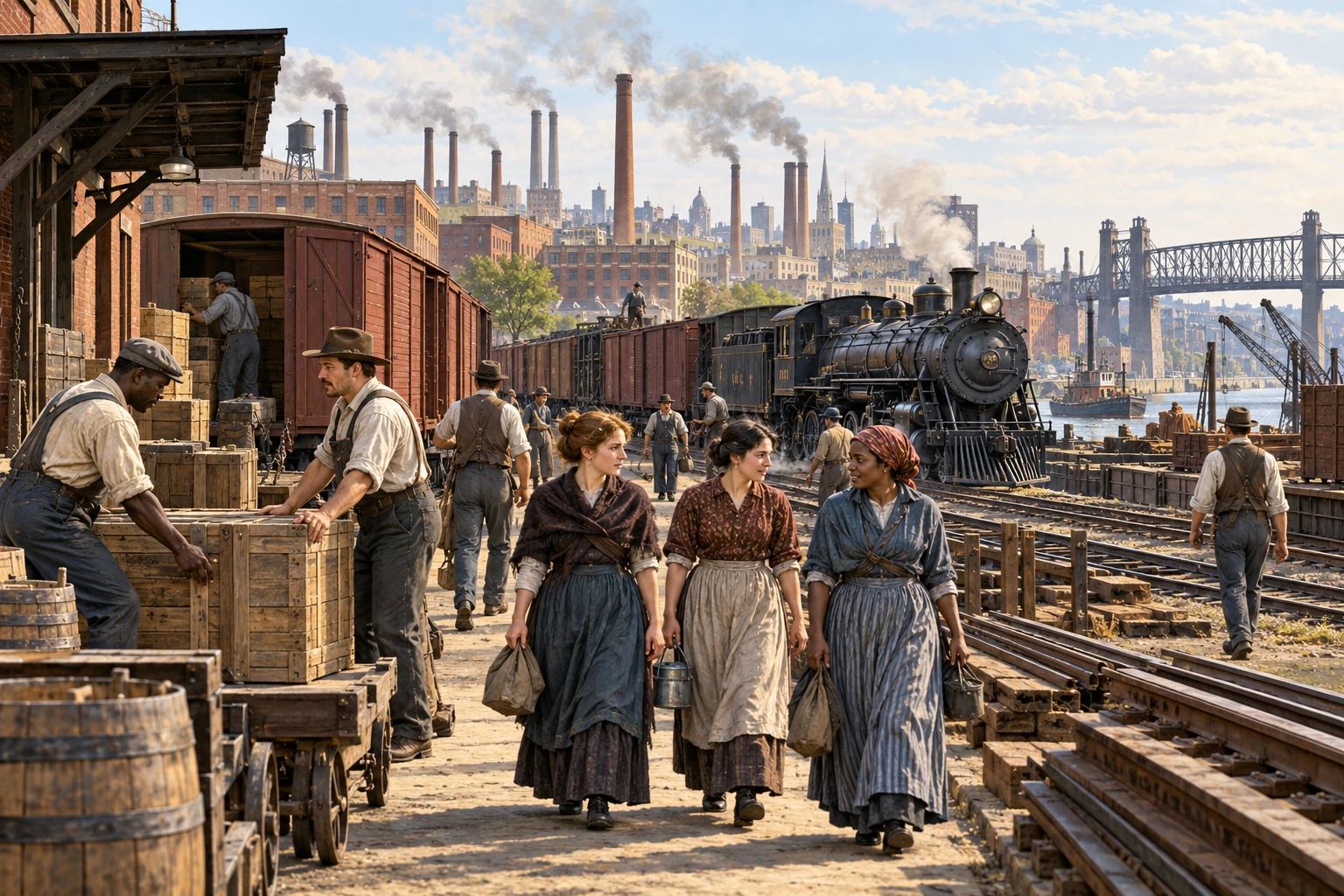
Modern AI-generated teaching illustration; not a historical painting or exact reconstruction.
6.1 Contextualizing Period 6: 1865–1898
Industrial capitalism connected the United States through railroads, corporations, wage work and expanding cities. These changes generated wealth and new opportunities while intensifying struggles over labor, land, citizenship and government power.
The Gilded Age in context
Period 6 begins in 1865, at the end of the Civil War, and overlaps with Reconstruction. It does not begin when Reconstruction conventionally ends in 1877. The period closes in 1898, a year associated with the Spanish–American War and a more assertive overseas role. Its main emphasis is the transformation of the domestic economy and society, with later developments providing connections rather than replacing that focus.
The label “Gilded Age” comes from the title of an 1873 novel by Mark Twain and Charles Dudley Warner. Gilding suggests a bright surface over less attractive material: extraordinary fortunes and technological achievement coexisted with corruption, dangerous work and deep inequality. The label is useful, but it should not imply that every person prospered, every official was corrupt or the era lacked meaningful reform.
American industrial development had earlier roots in the Market Revolution, commercial agriculture, immigration and antebellum manufacturing. Civil War mobilization and Republican economic legislation accelerated national development. After emancipation, millions of formerly enslaved people sought freedom and economic independence while confronting racial coercion. Western expansion continued on Native homelands, and overseas investment and markets increasingly connected American production to the wider world.
Factors behind industrial growth
- Resources and energy: Coal, iron ore, timber, petroleum and agricultural products supported production, transportation and trade.
- Capital and organization: Domestic savings, banks, stock markets and foreign investment financed enterprises whose scale exceeded that of many earlier businesses.
- Labor and migration: Immigrants, internal migrants, women and children supplied labor in varied settings. Their experiences depended on race, gender, occupation and location.
- Technology and infrastructure: Steelmaking, rail networks, communications and electrical systems lowered some costs and expanded markets.
- Government action: Land grants, patents, protective tariffs, property law and military protection helped development. Later regulatory measures reveal growing disputes over its consequences.
| Development | Opportunity or change | Conflict or limitation |
|---|---|---|
| National markets | Goods and information moved across longer distances. | Farmers and small businesses faced powerful intermediaries and unstable prices. |
| Corporate industry | Large-scale production increased output and created fortunes. | Concentration raised questions about competition, wages and political influence. |
| Migration and cities | Jobs, communities, services and cultural exchange expanded. | Overcrowding, discrimination and exclusion accompanied urban growth. |
| Reform organizing | Unions, farmers' groups and civic associations proposed alternatives. | Divisions and resistance limited many gains. |
Question to carry through the unit
To what extent did industrialization change American life between 1865 and 1898, and why were its benefits, costs and political opportunities distributed so unequally?
6.2 Westward expansion: economic development
Railroads and federal support
The Union Pacific and Central Pacific joined at Promontory Summit, Utah Territory, on May 10, 1869. Promontory Summit should not be confused with Promontory Point. The Union Pacific built westward from the Omaha area and the Central Pacific eastward from Sacramento. Their connection linked western and eastern rail systems, although it was not one continuous direct train from the Atlantic shore to the Pacific shore on that date.
Chinese workers were crucial to Central Pacific construction; Irish immigrants and many other workers helped build the Union Pacific. Dangerous blasting, weather, difficult terrain and unequal treatment shaped their experience. Federal land grants and loans reduced companies' financial risks. Railroads then encouraged settlement, promoted land sales and carried farm products, livestock, minerals and manufactured goods.
Railroads were large corporate enterprises requiring managers, schedules, capital and coordination. Their purchasing stimulated steel, coal and timber industries. Companies could charge discriminatory rates, offer favored shippers rebates or compete destructively and then seek agreements to stabilize earnings. The Crédit Mobilier scandal exposed how railroad construction arrangements could enrich insiders and influence public officials. Railroads also adopted standard time zones in 1883; these did not appear automatically with the 1869 completion.
Mining, ranching and commercial agriculture
Mineral discoveries attracted migrants to Colorado, Nevada's Comstock Lode and the Black Hills, among other regions. Early prospecting could give way to capital-intensive mining requiring expensive equipment and wage labor. Boomtowns grew rapidly; some declined when deposits or investment disappeared, while others developed more durable economies. Mining altered water systems and landscapes and intensified conflicts over land, particularly where prospecting violated Native treaty rights.
Cattle ranching linked Texas herds to railroad towns such as Abilene and Dodge City through routes including the Chisholm Trail. Cowboys included Mexican, Black, Native and white workers; popular imagery often obscured that diversity and the importance of Mexican ranching practices. Fencing, overgrazing, changing land ownership and severe weather contributed to the decline of the long-drive open-range system. Ranching continued, increasingly within different business arrangements.
The Homestead Act of 1862 offered eligible claimants a path to land ownership, commonly involving 160 acres, residence and improvement requirements. “Free land” is shorthand that hides fees, equipment costs, labor and the displacement of Native peoples. Some settlers succeeded; others faced drought, grasshoppers, isolation, debt or inadequate acreage for local conditions. Mechanization, barbed wire, rail access and irrigation changed farming without eliminating environmental risk.
Farmers in national and global markets
Farmers increasingly purchased equipment on credit and produced cash crops for distant buyers. Mechanization increased output, but falling prices could leave an individual farmer earning less despite producing more. Railroad charges, storage fees, mortgages and merchant credit shaped profits. Deflation could increase the amount of crops needed to pay a fixed dollar debt, helping explain later demands for monetary reform.
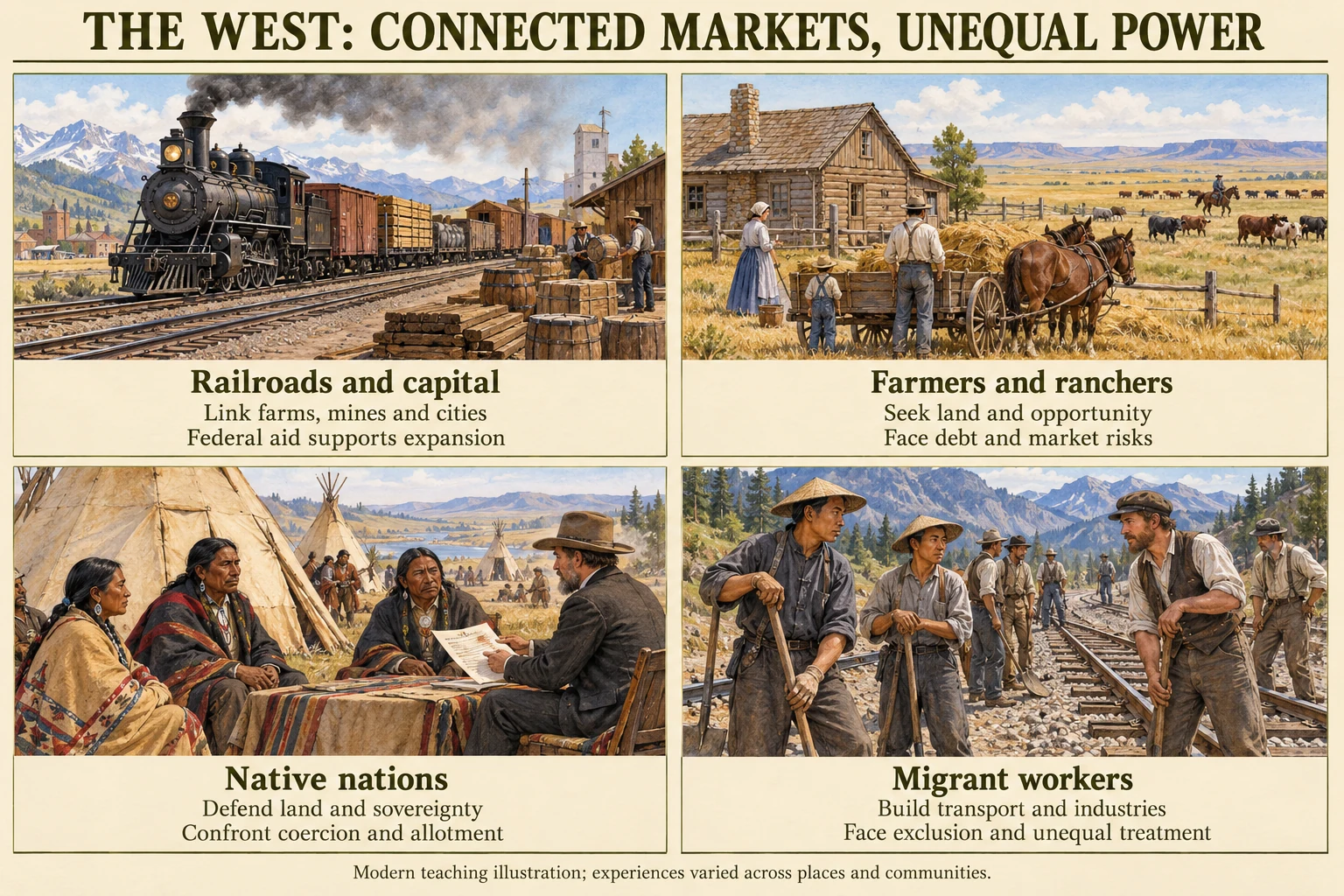
The West was therefore an integrated commercial region, not simply a place where isolated individuals made themselves independent. Federal aid, corporations, wage workers and overseas demand mattered alongside settler initiative. Black Exodusters moving to Kansas and other western places after Reconstruction sought land, safety and autonomy, but discrimination and limited resources continued to constrain opportunity.
Explain the connection
Railroads made distant markets accessible, but access did not guarantee bargaining power. This helps connect western development to corporate consolidation, farmers' alliances and arguments for railroad regulation.
6.3 Westward expansion: social and cultural development
Native nations, land and sovereignty
Western development took place on homelands already occupied and governed by Native nations. These communities pursued different strategies, including diplomacy, treaty-making, armed defense, adaptation and cultural preservation. They were neither one unified group nor passive obstacles to settlement. U.S. officials, settlers and corporations often violated agreements or demanded new concessions when land or resources became valuable.
Commercial hunting, ecological change and expanding settlement devastated bison herds. The destruction served commercial interests and also weakened the economic foundations of Plains peoples; some military and government figures welcomed or encouraged that result. The consequences were severe, but descriptions of Native cultures as simply “destroyed” erase survival, continuing sovereignty claims and later resistance.
Reservations restricted mobility and exposed communities to coercive administration, inadequate provisions and pressure to abandon cultural practices. Policies differed among nations and regions. Conditions were shaped by land loss, violence, broken promises and the authority of federal agents, not by an inherent inability of Native communities to adapt.
| Event or policy | What happened | How to use it accurately |
|---|---|---|
| Sand Creek, 1864 | Colorado troops attacked a Cheyenne and Arapaho village, killing many people, including women and children. | Background immediately before this unit; shows continuity in expansion and violence. |
| Little Bighorn, 1876 | Lakota and Northern Cheyenne forces defeated Custer's command during a wider campaign. | A significant Native victory; not the end of the conflict or a victory that stopped U.S. expansion. |
| Dawes Act, 1887 | Authorized allotment of many communally held reservation lands and transfer of designated surplus land. | Connect assimilation goals to loss of land and attacks on collective political and economic institutions. |
| Wounded Knee, 1890 | U.S. troops killed a large number of Lakota people during a disarmament confrontation. | A massacre associated with the suppression of the Ghost Dance movement; not the end of Native identity or all resistance. |
Allotment and coercive assimilation
The Dawes Act sought to replace many communal landholding arrangements with individual allotments and promote assimilation into American farming and property practices. Allotment sizes varied by category; not every person received the same 160-acre plot. Land categorized as surplus could be opened to non-Native acquisition. Subsequent policies, sales and fraud produced enormous Native land loss over the allotment era, extending well beyond 1898.
Boarding schools, including Carlisle, founded in 1879, attempted to reshape Native children through separation from families, suppression of languages and control over religion, clothing and daily life. Attendance occurred under varying circumstances, including coercion, and children and families resisted and adapted. Educational opportunity should not be used to obscure the system's attack on cultural continuity. Native people continued to maintain family ties, languages and political identities despite these pressures.
Turner's frontier thesis and its limits
Frederick Jackson Turner argued in 1893 that frontier settlement had helped shape American individualism and democracy. He drew attention to the 1890 census finding that a continuous frontier line could no longer be identified. That statistical finding did not mean all western land was occupied, available land had literally vanished or the West had ceased changing.
Turner's interpretation became influential, but it centered white settlers and underplayed federal assistance, corporations, women, Mexican communities, racial conflict and Native sovereignty. Use the thesis as a historical interpretation to analyze rather than as an uncontested fact. A comparison between Turner's claims and evidence about railroad subsidies or allotment reveals important limits.
6.4 The “New South”
Industrial promises and agricultural realities
New South advocates such as Atlanta editor Henry Grady promoted investment, industrialization and reconciliation with northern business interests. Textile mills, tobacco processing, railroads and iron and steel centers such as Birmingham demonstrated genuine economic change. These developments created wage jobs and tied the region to national capital.
Nevertheless, much of the South remained poor, rural and dependent on agriculture. Sharecropping, tenant farming and crop-lien credit limited economic independence. Low wages, child labor and restricted opportunities for Black workers meant industrial growth did not produce equal prosperity. The phrase “New South” therefore describes both a development program and a contested claim about how much had changed.
Convict leasing supplied coerced labor to private enterprises through criminal punishment systems. Discriminatory policing and courts made Black people especially vulnerable. The arrangement differed legally from slavery but connected racial control, punishment and economic exploitation. It also complicates any claim that the transition to wage labor automatically produced free and equal labor relations throughout the region.
Segregation and disfranchisement
White Democratic governments expanded racial segregation and restricted Black political participation. Poll taxes, literacy requirements, discretionary administration and intimidation undermined voting rights. Grandfather provisions in some states exempted certain people based on ancestors' voting eligibility, creating an advantage for white voters while excluding many Black citizens. These policies developed unevenly and continued to expand after 1898.
In Plessy v. Ferguson in 1896, the Supreme Court upheld Louisiana's segregated railroad-car law and gave constitutional support to the separate-but-equal doctrine. The case arose from organized resistance by Homer Plessy and a New Orleans citizens' committee. Justice John Marshall Harlan dissented. The decision did not invent segregation, make facilities genuinely equal or instantly establish every later Jim Crow rule. Its later rejection in school segregation through Brown v. Board of Education belongs to 1954, well beyond this unit.
Violence enforced racial hierarchy beyond written law. Lynchings terrorized communities and often targeted economic independence and political activity. The 1898 Wilmington coup overthrew a legitimately elected biracial local government through organized white supremacist violence. That event demonstrates that Black political participation persisted in some places after Reconstruction, and that its suppression was an active political process.
Black strategies for education, rights and community strength
Booker T. Washington promoted vocational training, economic development and institution building through Tuskegee Institute. His 1895 Atlanta address emphasized economic cooperation and moderated immediate public demands for social and political equality. White audiences often welcomed that approach, while critics feared accommodation would entrench inequality. It is too simple to say that Washington rejected every civil-rights effort: his public strategy and less public support for some legal challenges could differ.
Ida B. Wells investigated lynching, challenged its purported justifications and used journalism, organizing and international advocacy to expose racial terror. Her work connected evidence gathering to political action. Black churches, schools, women's clubs, businesses and mutual-aid organizations also sustained community life. These institutions show agency under oppression rather than a population merely waiting for later reformers to act.
W. E. B. Du Bois's early work, including his 1899 study of Philadelphia, belongs near or just beyond the period's endpoint; the Niagara Movement and NAACP are later developments. They can be used as connections, but should not replace the specific evidence available before 1898.
Continuity and change
Pair evidence of economic change—textiles, railroads or Birmingham steel—with evidence of continuity and coercion—land inequality, sharecropping, disfranchisement or convict leasing. Then explain why new industries did not necessarily overturn the region's racial hierarchy.
6.5 Technological innovation
Steel, energy and communications
Advances in steelmaking, including the Bessemer process and later open-hearth production, made large quantities of steel more affordable. Steel rails, bridges, machinery and building frames supported transportation and urban growth. The process depended on mines, fuel, capital and workers as well as invention; a technological breakthrough needed an entire system to become economically transformative.
Alexander Graham Bell received a major telephone patent in 1876, and telephone networks changed business communication. Telegraph lines and transatlantic cables already allowed information to travel faster than physical transport. Faster communication helped coordinate prices, orders, financial transactions and railroad operations across wide distances.
Thomas Edison and his collaborators developed commercially practical incandescent lighting and associated power systems around 1879 and the early 1880s. Edison did not invent light or work without predecessors and competitors. Electrical generation, wiring, meters and distribution made the bulb useful on a large scale. Access spread unevenly; electricity did not immediately reach every household, factory or rural community.
| Innovation or system | Economic and social effect | Qualification |
|---|---|---|
| Steel production and construction | Supported rail networks, large bridges and taller buildings. | Urban form also depended on elevators, finance, engineering and local conditions. |
| Telephone and telegraph networks | Accelerated communication and business coordination. | Networks required investment and did not give all users equal access or control. |
| Electric lighting and power | Changed work schedules, transport and urban life. | Benefits arrived at different times across regions and classes. |
| Typewriters and office equipment | Supported clerical work and expanded some employment opportunities for women. | Occupational segregation and wage inequalities persisted. |
| Mechanized production | Increased output and standardized some goods and tasks. | Could reduce workers' control over pace and craft skills. |
Productivity, environment and the timing of change
Technology allowed some firms to produce more with lower unit costs, creating opportunities to sell to national and overseas markets. It also increased demand for resources, generated pollution and intensified dangerous work. Owners could celebrate efficiency while workers experienced speedups or loss of autonomy. A sound explanation considers who controlled the machinery and how gains were distributed.
Interchangeable parts, mechanized equipment and coordinated production developed across the nineteenth century. Ford's famous moving automobile assembly line dates to 1913, outside Period 6. Do not use that later example as though it had already transformed the economy in the 1870s. Explain the earlier growth of mass production without collapsing distinct innovations into a single date.
6.6 The rise of industrial capitalism
Corporations, finance and economies of scale
Large corporations pooled capital from many investors, used managerial hierarchies and coordinated production across multiple locations. Limited liability reduced some investors' personal exposure to business debts. Banks and financial markets connected enterprises with domestic and foreign capital. These arrangements helped companies grow beyond the scale of individual proprietorships, although small businesses continued to exist.
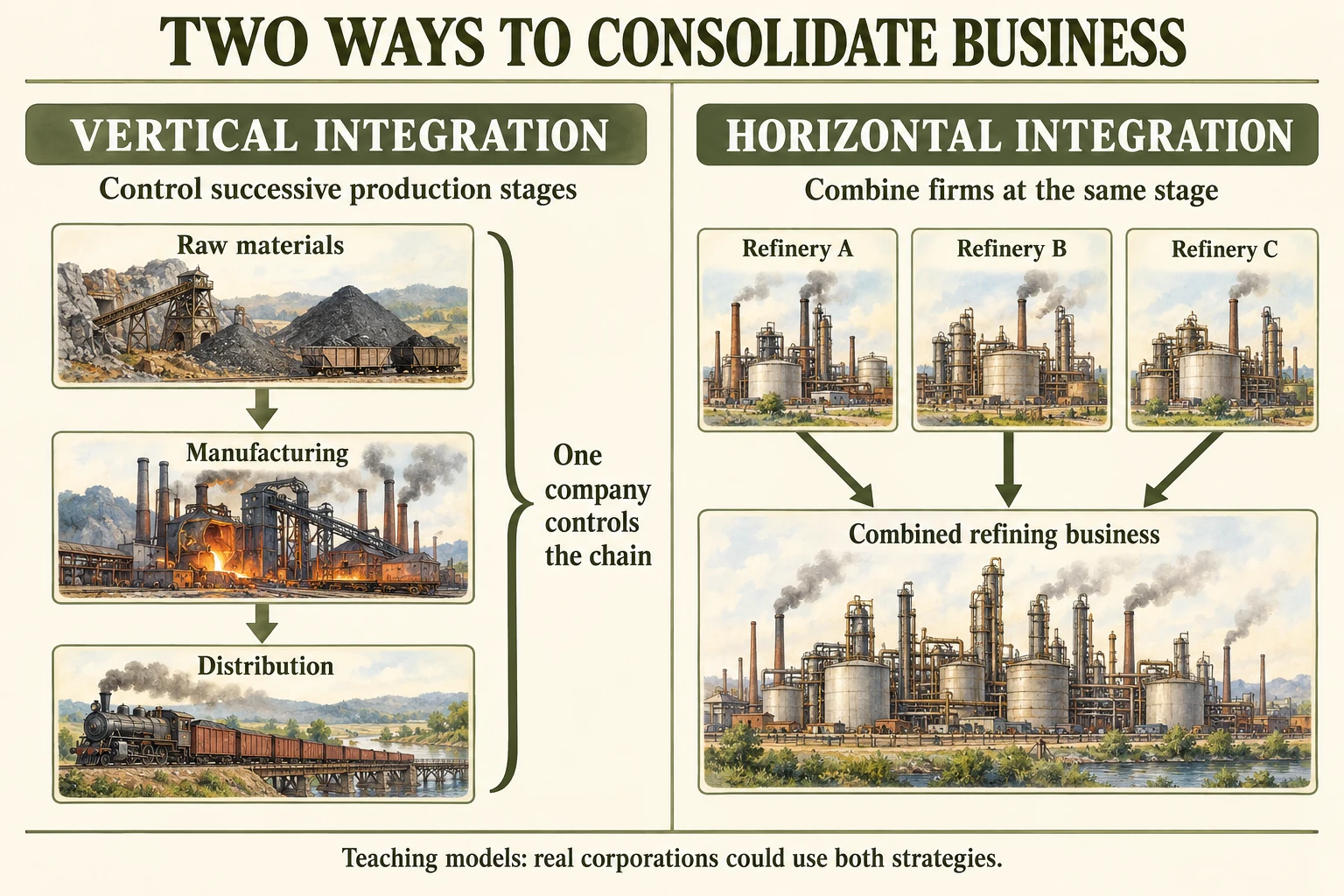
Large-scale firms could lower average costs through economies of scale, coordinate supply and distribution and invest in expensive technology. They could also use their size to disadvantage rivals, control access to transport or influence politics. Growth and consolidation were related but not identical: a company could expand its own operations, acquire competitors or combine stages of production.
| Strategy or arrangement | Meaning | Historical application |
|---|---|---|
| Vertical integration | Control of successive stages, from inputs to production and distribution. | Carnegie's steel operations linked resources, transport and manufacturing. |
| Horizontal integration | Acquisition or combination of firms at the same production stage. | Standard Oil absorbed competing refiners; its development also involved other strategies. |
| Trust | A legal arrangement placing control of participating companies under trustees. | The Standard Oil Trust formed in 1882. |
| Holding company | A corporation controlling other companies through share ownership. | One means of coordinating large combinations under changing state laws. |
Industrial leaders and competing judgments
Andrew Carnegie built a major steel enterprise. John D. Rockefeller consolidated oil refining through Standard Oil. Cornelius Vanderbilt developed a transport fortune and railroad network. J. P. Morgan used finance and reorganization to influence railroads and other industries. Their activities involved both business innovation and practices critics regarded as coercive or anticompetitive. Morgan's formation of U.S. Steel in 1901 is a later connection, not a Period 6 event.
The phrases “captains of industry” and “robber barons” frame competing evaluations. The first emphasizes productive investment, lower costs and philanthropy; the second emphasizes exploitation, monopoly power and political influence. A historical argument should assess specific evidence rather than choose a label and assume it explains everything. Carnegie's philanthropic ideals, for example, can be considered alongside labor conflict at Homestead.
Ideas used to defend or criticize inequality
Some defenders of laissez-faire argued that competition rewarded ability and that government interference would undermine efficiency or liberty. Social Darwinist arguments, associated with thinkers such as Herbert Spencer and William Graham Sumner, applied ideas about competition and fitness to human society. These were political and social interpretations, not proof that inequality was natural or morally justified.
Carnegie's “Gospel of Wealth” in 1889 argued that wealthy people should use their fortunes for public purposes, such as libraries and education, rather than distribute them indiscriminately. This defended concentrated wealth while imposing a claimed obligation on its holders. Reformers questioned whether private philanthropy addressed the conditions that created inequality or gave wealthy donors too much power over public priorities.
Workers, farmers, socialists, religious reformers and other critics proposed different solutions, from collective bargaining and cooperative ownership to regulation and public ownership. These approaches were not one unified opposition movement. Their differences matter when comparing reform strategies and assessing why some attracted wider support than others.
Key distinction
Vertical integration follows a production chain; horizontal integration combines competitors at a similar stage. A trust is an organizational mechanism, while monopoly describes a market position. These terms should not be used interchangeably.
6.7 Labor in the Gilded Age
Wage work, conditions and bargaining power
Industrialization expanded wage labor and made many households dependent on employers and business cycles. Long hours, dangerous machinery, poor ventilation and irregular employment were common in many sectors, but conditions varied by industry and occupation. Women and children often received lower pay and had fewer opportunities. Skilled workers might retain more bargaining power than workers easily replaced, but mechanization could weaken craft control.
Company housing, stores and credit could increase dependence on employers. Some enterprises used scrip, but company towns did not all operate identically, and Pullman paid wages in money rather than simply company scrip. Public protections were limited and uneven: some states adopted labor laws, yet enforcement was often weak, and comprehensive modern unemployment insurance, social security and workplace compensation systems were not in place.
Employers could use strikebreakers, lockouts, blacklists, private guards and anti-union employment conditions. Workers faced language barriers, exclusion and racial divisions, but they also built solidarity through communities and shared grievances. Describing immigrants as an “endless supply” of compliant labor erases their own organizing and resistance.
| Organization | Approach and aims | Membership and limitations |
|---|---|---|
| Knights of Labor, founded 1869 | Broad reform, shorter hours, cooperatives and a more equitable economy; associated with Uriah Stephens and Terence Powderly. | Organized across many skills and included women and Black workers in some assemblies, but discrimination persisted and its opposition to Chinese labor contradicted universal inclusion. |
| American Federation of Labor, founded 1886 | Under Samuel Gompers, emphasized wages, hours and conditions through collective bargaining and craft organization. | Centered skilled workers; affiliates often excluded or marginalized women, Black workers and unskilled laborers. Practices were not identical in every union. |
| American Railway Union, founded 1893 | Sought organization across railroad occupations and supported the Pullman boycott. | Associated with Eugene V. Debs; racial exclusion limited its claim to broad labor solidarity. |
Four major conflicts
Great Railroad Strike, 1877: Wage cuts during a prolonged downturn helped trigger a strike beginning on the Baltimore and Ohio Railroad and spreading across rail networks. Workers and supporters blocked trains; clashes and destruction followed. State forces and federal troops helped end the movement. Its scale revealed widespread discontent and the importance of public power in industrial disputes.
Haymarket, 1886: A Chicago rally followed conflict connected to the eight-hour movement and police violence at the McCormick works. An unidentified person threw a bomb as police moved against the gathering. The bombing and subsequent gunfire caused deaths. Eight anarchists were prosecuted; four were executed, while the trial and evidence became deeply controversial. The Knights did not organize the bombing, but association of labor with radical violence contributed to their decline alongside other organizational problems.
Homestead, 1892: A conflict at Carnegie's steelworks under Henry Clay Frick's management became a lockout and major struggle over union power. Fighting between workers and Pinkerton guards caused deaths. Pennsylvania militia intervened, and the union suffered a decisive defeat. Carnegie was abroad, but his company's policies and his relationship to management remain relevant to assessing his responsibility.
Pullman, 1894: Wage reductions without corresponding rent reductions in the company town prompted a strike. Debs's American Railway Union supported a boycott of trains carrying Pullman cars, spreading disruption. Federal officials cited interstate commerce and mail delivery, obtained an injunction and sent troops under President Cleveland despite Illinois Governor John Peter Altgeld's opposition. The strike was defeated, and Debs was imprisoned for violating the injunction.
A worked example: interpreting a wage cut
Suppose weekly wages fall from $30 to $24. This is a hypothetical example, not a claim about the precise wage of a Pullman worker. The percentage decrease uses the original wage as its denominator:
If rent and other essential costs do not fall with wages, the household has less money left for food and other needs. A percentage change in nominal wages does not by itself measure the full change in living standards: prices, working hours and job availability also matter.
Assess labor's results with qualifications
Large employers, government intervention, injunctions, economic downturns and divisions among workers limited union victories. Yet unions survived, won some local gains and made collective bargaining and working conditions national issues. “Labor always failed” is too broad; identify the organization, place, date and standard of success.
6.8 Immigration and migration in the Gilded Age
Changing origins and reasons for migration
Immigration supplied workers, entrepreneurs, families and communities to an expanding economy. Migrants came to seek employment, acquire land, join relatives or escape poverty, persecution and political restrictions. Those motives could overlap. Chain migration linked later arrivals with people who had already established jobs, housing and information networks.
Migration from northern and western Europe continued, while arrivals from southern and eastern Europe became increasingly important late in the nineteenth century. Italians, people from the Russian and Austro-Hungarian empires and many Jewish migrants contributed to this shift. The labels “old” and “new” immigration are historical shorthand, not evidence that earlier immigrants were culturally uniform or automatically accepted. Irish Catholics had faced intense hostility well before these later arrivals.
Chinese migrants participated in western mining, railroad construction, agriculture, services and business. Mexican communities in the Southwest included both recent migrants and residents whose families lived there before U.S. conquest. These distinctions matter: not everyone described as foreign in public debate had actually crossed an international border to arrive in the United States.
Entry, work and community networks
Ellis Island opened in New York Harbor in 1892 and became an important inspection station. Not every immigrant passed through it, and the millions processed over its full history should not be counted as arrivals during this unit alone. Medical and administrative inspection could lead to exclusion or detention. Angel Island's immigration station opened in 1910, outside Period 6; it is a later example of unequal immigration enforcement rather than an 1880s entry station.
Many newcomers settled in ethnic neighborhoods where language, religion, food, newspapers and associations offered support. Mutual-aid societies, congregations and family networks helped people find work and confront hardship. Communities could preserve traditions while adapting to American institutions; assimilation was neither immediate nor one-directional.
Work included factories, mines, construction, domestic service, garment production and small businesses. Sweatshop labor and crowded tenements exposed many families to exploitation and illness. Women and children contributed to household income, and some migrants traveled repeatedly rather than settling permanently. Migrants were active participants in cultural, economic and political change, including labor organizing.
Internal migration and urban growth
Americans also moved from farms and small towns to cities, and from older regions toward western opportunities. Railroads facilitated mobility, but migration depended on money, information and networks. Urban growth resulted from immigration, internal migration and other demographic changes; it should not be attributed to foreign arrivals alone.
Black migration after emancipation included movement to southern towns and western destinations. The Exoduster movement to Kansas in 1879 is an important Period 6 example connected to land, safety and independence. Some Black people also moved north before 1900, but the large-scale movement conventionally called the Great Migration began around World War I. Use that later movement as a connection rather than dating its major phase to the 1870s.
Use a precise comparison
Compare migrants' motives, destinations, work and reception. Differences in origin did not determine a single experience, and racial laws, gender, skills and family resources shaped opportunities after arrival.
6.9 Responses to immigration in the Gilded Age
Nativism and exclusion
Nativists sought to privilege people they considered native-born or culturally acceptable. Anti-Catholic prejudice, antisemitism, racial ideology, economic insecurity and fear of political radicalism all contributed to hostility. Such claims described immigrants as threats and often ignored their economic contributions and organizing. They were arguments used to justify exclusion, not neutral findings about immigrant character.
The American Protective Association, founded in 1887, mobilized anti-Catholic sentiment. The Immigration Restriction League, founded in 1894, advocated restrictions including a literacy test. Some labor organizations also supported exclusion, especially of Chinese workers, combining concern about wages with racial prejudice. Employers' demand for labor and restrictionists' demands did not produce one consistent national position.
The Chinese Exclusion Act of 1882 suspended the immigration of Chinese laborers for ten years, subject to specified exceptions and documentation rules, and prohibited Chinese naturalization. It did not ban every Chinese person without exception. Renewals and additional restrictions extended exclusion, separating families and reinforcing racial boundaries. The Page Act of 1875 had already restricted entry in ways that especially affected Chinese women, so calling the 1882 law the first immigration restriction of any kind is inaccurate.
Other restrictions and legal resistance
Federal laws in the 1880s excluded additional categories of people and restricted certain imported contract labor. The 1891 law expanded federal administration and exclusion categories. Regulation increasingly became a national responsibility, although officials' discretion and local hostility still shaped enforcement. The Gentlemen's Agreement with Japan belongs to 1907–1908, after this unit.
Immigrants challenged discriminatory treatment through community organization and litigation. In Yick Wo v. Hopkins in 1886, the Supreme Court rejected racially discriminatory administration of a San Francisco laundry ordinance. In United States v. Wong Kim Ark in 1898, the Court upheld birthright citizenship for a U.S.-born child of Chinese parents under the circumstances of the case. Restrictions and resistance therefore developed together; exclusion did not mean affected communities lacked political or legal agency.
Settlement houses, schools and Americanization
Jane Addams and Ellen Gates Starr founded Hull House in Chicago in 1889. Settlement residents offered educational, cultural and practical services, including classes and childcare, and investigated neighborhood conditions. Such work could connect immediate assistance with demands for housing, labor and public-health reform. Immigrants also maintained their own institutions rather than depending entirely on outside reformers.
Public schools, employers, civic groups and settlement houses encouraged English learning and participation in American institutions. Some reformers valued cultural exchange; others expected conformity and treated immigrants' customs as problems. “Americanization” could therefore offer resources while imposing cultural pressure. Do not turn the contrast into a simple division between uniformly hostile nativists and perfectly respectful reformers.
Two responses, overlapping assumptions
Restrictionists sought to control entry or rights; settlement workers generally sought to address conditions and support adjustment. Both could make assumptions about who belonged and what American identity required. Evaluate specific actions and language rather than assuming every member of either group thought alike.
6.10 Development of the middle class
New occupations and education
Expanding corporations and cities needed managers, accountants, salespeople, engineers, teachers, clerks and other professionals. These occupations helped grow a salaried middle class whose work differed from both manual wage labor and ownership of major enterprises. Department stores, telephone systems and office technologies created new positions, including clerical opportunities increasingly filled by women.
Middle-class identity often emphasized education, respectability, regular income and a comfortable home. These were ideals and aspirations, not guarantees: clerks could lose jobs, households could face debt, and professionals had unequal earnings. Race and gender restricted access to credentials and advancement. White-collar work did not automatically remove insecurity or place every worker at the same social level.
High schools expanded, and colleges, including land-grant institutions and women's colleges, increased opportunities. Education could prepare students for technical employment, professional careers and civic roles, but access remained unequal. Black educational institutions and community efforts were crucial in settings where segregation and discrimination restricted options.
Gender ideals and women's public activity
The ideal of separate spheres associated men with paid work and public authority and women with domestic responsibility and moral influence. The older cult of domesticity continued to shape middle-class expectations. Household labor and childrearing remained demanding even where consumer goods or paid servants changed particular tasks.
Actual lives often crossed these boundaries. Many unmarried middle-class women worked as teachers, clerks or nurses; some pursued higher education and professional careers. Working-class, immigrant and Black women frequently performed paid labor as well as household work. Women's clubs and reform organizations used claims of moral responsibility to justify public action, creating opportunities beyond formal voting.
These developments could both challenge and reinforce gender hierarchy. A woman organizing a public-health campaign expanded her civic role while sometimes presenting it as an extension of motherhood. Explaining that tension is more useful than claiming that separate-spheres ideology described every household or that employment immediately produced equality.
Consumer culture, leisure and urban space
Department stores, advertising and mail-order catalogs from firms such as Montgomery Ward and Sears connected producers with urban and rural consumers. Standardized goods and retail innovations changed shopping habits and aspirations. Consumer culture depended on purchasing power, so access to fashionable clothing, household equipment and leisure remained unequal.
Newspapers, magazines, dime novels, vaudeville, theater, professional baseball and bicycling reached growing audiences. Commercial amusements created shared experiences, although admission prices, segregated facilities and social expectations affected participation. Electric streetcars and commuter railways enabled some households to live farther from city workplaces, contributing to suburban development.
Rapid urban growth strained water supplies, sewage disposal, refuse collection, fire protection and housing. Municipal investments could improve health and daily life, but benefits and burdens were distributed unevenly. Housing regulation and sanitation therefore became arguments about public responsibility as well as private behavior. Urban neighborhoods reflected class and racial boundaries as well as mobility. Wealthier districts and suburbs contrasted with crowded working-class housing. Middle-class comfort was connected to the labor of factory workers, domestic servants and transport employees. The rise of consumption should therefore be studied alongside the production and service systems that supported it.
6.11 Reform in the Gilded Age
Religious and social responses to inequality
Social Gospel advocates argued that Christianity required action against poverty, unsafe housing and unjust labor conditions, not solely attention to individual salvation. Washington Gladden was an important figure; Walter Rauschenbusch's ministry developed in the late nineteenth century, while his best-known published formulations came later. Religious reformers differed in how far they challenged capitalism, but they helped make social conditions a moral and public responsibility.
Settlement houses, charitable organizations and civic reformers addressed neighborhood needs through education, childcare, investigation and advocacy. Jacob Riis's How the Other Half Lives in 1890 used reporting and images to draw attention to New York tenement conditions. His work helped mobilize reform, but its selection of scenes and ethnic stereotypes also require source criticism. Reformers should not be treated as perfectly neutral observers simply because they exposed hardship. Some charities emphasized moral discipline and individual behavior; others examined structural causes of poverty. This disagreement matters because it shaped whether reform focused on changing poor people's habits, changing institutions or combining both.
Writers proposed broader alternatives. Henry George's Progress and Poverty in 1879 argued that rising land values could enrich owners while poverty persisted, and promoted a tax on land values. Edward Bellamy's Looking Backward in 1888 imagined a cooperative future organized very differently from competitive capitalism. Such works demonstrate that criticism extended beyond modest charity or a single regulatory law.
Women, temperance and reform networks
The Women's Christian Temperance Union, founded in 1874, grew under Frances Willard's leadership. Temperance activists connected alcohol with household insecurity, domestic violence and poverty. Willard broadened the organization's activities to include education, labor issues and women's political rights. The language of home protection allowed women to claim public authority even where they could not vote.
Women's clubs supported libraries, education, sanitation and other improvements. Black women formed their own organizations in response to exclusion and distinctive community needs. The National Association of Colored Women formed in 1896, with leaders including Mary Church Terrell, and linked education and social welfare with opposition to racism. Ida B. Wells's anti-lynching work also exposed conflicts within reform networks, including racist claims by some white reformers.
Suffrage activists continued organizing after Reconstruction. The National American Woman Suffrage Association formed in 1890 through the merger of earlier organizations. Western successes, including Wyoming's entry as a state with women's voting rights in 1890 and Colorado's 1893 referendum, provided evidence that change could occur before a national amendment. The Nineteenth Amendment belongs to 1920 and did not eliminate every barrier facing women voters.
Farmers' organizations and collective action
The Grange, founded in 1867, offered social support, education and cooperative economic strategies. Farmers' Alliances expanded organizing in the 1880s, promoting cooperation and demands for changes in credit, transport and currency. The Colored Farmers' Alliance reflected Black farmers' efforts within a system of segregation and unequal power.
Cooperatives attempted to improve bargaining power, but limited capital, opposition and market pressures created difficulties. Some activists moved toward independent electoral politics through the People's Party. That transition connected practical economic grievances to arguments about democracy and the distribution of national power. The party's program and the election of 1896 are developed in Topic 6.13.
Reform existed before the Progressive Era
Gilded Age organizing supplied people, evidence and ideas for later reform. Avoid treating 1900 as the moment Americans first noticed social problems. Also avoid assuming every later Progressive policy had already been adopted by 1898.
6.12 Controversies over government in the Gilded Age
Laissez-faire rhetoric and an active state
Some business leaders and politicians opposed regulation in the name of property rights, individual liberty and market efficiency. Yet governments actively created conditions for development through protective tariffs, land grants, patents, banking rules, contracts and infrastructure. Courts enforced contracts and property claims, while public force could be used in labor conflicts and western expansion.
The central question was therefore not simply whether government should act, but whose interests its actions should serve and what constitutional powers it could use. Farmers wanted fair transport charges; workers sought protection and bargaining rights; corporations wanted stability, favorable law and access to markets. Different levels of government could pursue different policies, and courts could restrict legislative or administrative efforts.
| Policy or case | Action | Limit or significance |
|---|---|---|
| Granger laws and Munn v. Illinois, 1877 | State regulation addressed charges associated with grain storage and transport; the Court upheld regulation of certain businesses affected with a public interest. | Evidence that regulation existed before the Progressive Era. |
| Wabash v. Illinois, 1886 | The Court limited state regulation of interstate railroad rates. | Increased pressure for federal action. |
| Interstate Commerce Act, 1887 | Required reasonable and just railroad rates, addressed discriminatory practices and created the Interstate Commerce Commission. | A major federal regulatory step, but weak authority, resources and adverse rulings limited early enforcement. |
| Sherman Antitrust Act, 1890 | Prohibited specified restraints of interstate or foreign trade and monopolization. | Broad language and narrow interpretations limited early corporate cases; the law also supplied arguments against labor combinations. |
| United States v. E. C. Knight, 1895 | The Court distinguished manufacturing from interstate commerce in a major sugar-consolidation case. | Restricted federal antitrust reach in that context without eliminating the act itself. |
Currency, debt and the gold–silver controversy
Debate over money reflected different experiences of falling prices and debt. Creditors often preferred money that retained purchasing power; debtors could find that deflation made fixed dollar obligations harder to repay through the sale of crops. Greenback advocates sought a larger paper-money supply. Free-silver supporters wanted unrestricted coinage of silver alongside gold at a legally fixed relationship, commonly expressed by the following weight ratio:
The ratio concerns the relative amounts of metal assigned equivalent monetary value, not the number of silver coins exchanged for any one gold coin regardless of size. Silver supporters expected expanded coinage to increase the money supply and relieve debt pressure. Gold-standard supporters feared depreciation, instability and loss of investor confidence. These were competing expectations and interests, not guarantees that a policy would fix every farmer's problem.
The Coinage Act of 1873 ended the standard silver dollar's role in free coinage, helping generate later accusations about a “Crime of '73.” Subsequent silver-purchase laws provided partial concessions without adopting the full free-silver program. Cleveland's support for repeal of the Sherman Silver Purchase Act during the 1893 crisis sharpened divisions over monetary policy.
Worked example: why lower crop prices could burden a debtor
Consider a hypothetical fixed debt of $1,000. Ignore interest, production costs and other income to isolate the price effect. The quantity of crop needed to obtain the repayment amount is:
| Crop price | Quantity needed for the same $1,000 debt |
|---|---|
| $1 per bushel | |
| $0.75 per bushel |
The nominal debt stays the same, but the required crop quantity rises by about 33.3%. This explains a debtor's concern without claiming that every farm faced these exact prices or that all deflation had one cause. Real farmers also faced interest, variable harvests, transport charges and changing input costs.
A stronger government argument
Describe a specific policy, identify the group seeking or resisting it and explain the effect of enforcement. Passing a law, enforcing it effectively and changing economic power are three different stages.
6.13 Politics in the Gilded Age
Party competition and the boundaries of participation
Republicans and Democrats competed intensely in many elections, and turnout among eligible voters could be high. Republican strength often lay in the North and Midwest, while Democrats dominated much of the white South. Religion, ethnicity, Civil War loyalties and local issues shaped affiliations. Both parties contained factions, and national elections could turn on a small number of competitive states.
It is inaccurate to say that only white men were legally eligible everywhere. Black men voted and held office in some places, even as violence and restrictive laws undermined their rights. Women had voting rights in certain western jurisdictions. Many immigrants could become citizens, although racial naturalization restrictions and local rules excluded others. High participation among eligible voters therefore coexisted with profound limitations on democracy.
Parties were not identical on every economic issue. Republicans generally supported protective tariffs more strongly; Democrats often favored lower tariffs. Monetary disputes divided parties internally, particularly during the 1890s. The persistence of intense party loyalties helps explain why reformers sometimes worked inside existing parties and sometimes sought an independent alternative.
Political machines and patronage
Urban machines organized votes, distributed jobs and mediated access to services. Tammany Hall in New York became a famous Democratic example. William “Boss” Tweed and associates used contracts, inflated bills and kickbacks to divert public funds. Thomas Nast's cartoons and newspaper investigations helped expose the ring, contributing to Tweed's downfall.
Machines also assisted constituents with food, employment, housing problems, legal matters and naturalization. These services could be valuable where formal public support was limited. Assistance, however, often depended on political loyalty and reinforced unequal access and corruption. Describing machines only as generous community institutions misses coercion; describing their supporters as merely ignorant misses practical reasons people relied on them.
At the national level, the spoils system distributed public employment as a reward for partisan service. President James Garfield's assassination in 1881 by a disappointed office-seeker intensified pressure for change. The Pendleton Act of 1883 established competitive selection for a portion of federal employment and a Civil Service Commission. Coverage expanded over time; the law did not instantly end patronage in every federal, state and city office.
Populism and the Omaha program
The People's, or Populist, Party emerged from farmers' organizing and criticism of concentrated economic power. Its 1892 Omaha platform connected debt, transport charges and unequal influence to a broader crisis of democracy. James B. Weaver won more than a million popular votes and 22 electoral votes in the 1892 presidential election, demonstrating meaningful regional support without approaching a national majority.
- Money and credit: Expanded currency and free silver, together with proposals for more accessible credit and storage arrangements for farmers.
- Transport and communication: Public ownership of railroads, telegraph and telephone systems to challenge private control.
- Taxation: A graduated income tax to shift more of the burden toward those with greater ability to pay.
- Political reform: Direct election of senators and other democratic reforms supported in the party's wider resolutions and movement.
- Labor and land: Efforts to address working conditions and concentrated landholding, alongside appeals for cooperation among producers.
Populism's reach was limited by regional differences, competing interests and racial divisions. Some organizers pursued biracial cooperation, but others accepted racist arguments or exclusion. Black farmers faced particular risks when challenging white political and economic control. The movement should not be treated as either perfectly inclusive or merely a protest by isolated white farmers.
The election of 1896
Democrat William Jennings Bryan's free-silver campaign, symbolized by his “Cross of Gold” speech, attracted Populist support. Fusion with Democrats promised a larger coalition but threatened the independent party's identity. Republican William McKinley defended a gold-oriented monetary position, protective tariffs and a promise of prosperity; business support and Mark Hanna's organizing strengthened his campaign.
McKinley's victory weakened the national Populist challenge. It did not cause every Populist organization to disappear overnight. Some reform demands remained influential, while later changes such as the Sixteenth and Seventeenth Amendments in 1913 arose through additional struggles. A proposal's later adoption is a connection, not proof that the entire Populist program succeeded in the 1890s.
6.14 Continuity and change in Period 6
Major changes to explain
Industrial capitalism increased the scale of production, finance and managerial organization. More Americans depended on wages or sold goods into distant markets. Railroads and communications linked regions, while corporate enterprises exercised new forms of power. Cities expanded, clerical occupations grew and consumer culture reached wider audiences.
These changes did not mean that every small business vanished, agriculture ceased to matter or the nation had already become majority urban by 1898. The census first recorded a majority of the population in urban areas in 1920. Period 6 marks a powerful movement toward urban and industrial life, not the completion of every later transformation.
Migration changed neighborhoods and public culture, while exclusion laws and segregation drew tighter racial boundaries. Reformers created organizations and policy experiments addressing labor, housing, economic concentration and political corruption. Their achievements and failures shaped the next period's arguments without predetermining one uniform Progressive response.
| Area | Significant change | Continuity or qualification |
|---|---|---|
| Work and business | Corporate scale and wage labor expanded. | Family farms, small firms and unequal bargaining power persisted. |
| The West | Rail networks, settlement and commercial production intensified. | Native dispossession continued older patterns, while Native communities survived and resisted. |
| The South | New industries and Black institutions developed after emancipation. | Land inequality, racial coercion and disfranchisement constrained freedom. |
| Citizenship and migration | New communities and legal challenges reshaped belonging. | Nativism and racial exclusions continued to restrict opportunities. |
| Government | Federal regulatory institutions and civil-service reform appeared. | Enforcement limits and business influence constrained their impact. |
Causation and comparison
For industrial growth, combine resources, labor, technology, capital and public policy. For labor conflict, connect economic downturns and employer practices to organization, state power and divisions among workers. For farmers' protest, explain how markets, debt, transport and currency interacted. A single-cause explanation rarely accounts for the different experiences of the era.
Compare reform strategies by their goals and methods. The AFL sought practical bargaining gains; Populists sought electoral and structural economic changes; settlement workers combined services and investigation; anti-lynching activists challenged racial violence through evidence and organizing. All responded to unequal power, but their constituencies and proposed solutions differed.
Constructing an argument with evidence
Sample claim: Industrialization transformed the scale of American business and the organization of work between 1865 and 1898, but its social effects were uneven because racial hierarchy, unequal landownership and limits on political participation restricted access to its benefits.
Support the first part with railroads, corporate integration and clerical occupations; support the qualification with allotment, sharecropping, exclusion and labor conflict. Then address counterevidence, such as new institutions, organizing or legal victories, rather than pretending no one gained greater opportunity. A nuanced argument identifies the dimension of change being assessed.
When analyzing a source, consider its purpose, audience and situation. A railroad advertisement encourages investment or settlement; a union statement mobilizes support; a reformer's photograph or report selects evidence to persuade. These sources are valuable, but their claims require comparison with other evidence. Modern teaching illustrations on this page explain concepts and are not historical primary sources.
Period 6 revision timeline
Follow the overlap among economic growth, restriction, organizing and regulation. Do not treat events after 1898 as if they occurred within the unit.
| Date | Evidence | Connection |
|---|---|---|
| 1865 | Civil War ends; emancipation and Reconstruction reshape labor and citizenship. | Unit 6 overlaps with Reconstruction rather than starting after it. |
| 1867–1869 | Grange founded; transcontinental railroad connection; Knights of Labor founded. | National markets and collective responses grow together. |
| 1873 | Financial panic; Coinage Act; Twain and Warner's The Gilded Age. | Instability and criticism accompany economic expansion. |
| 1874–1877 | WCTU founded; Little Bighorn; Great Railroad Strike; Munn. | Reform, western conflict and debates over public authority intersect. |
| 1879 | Exoduster movement; Carlisle opens; George's Progress and Poverty. | Different efforts to secure opportunity or impose assimilation. |
| 1881–1883 | Garfield assassination; Chinese Exclusion Act; Pendleton Act; railroad time zones. | Restriction, administrative reform and national coordination. |
| 1886 | Haymarket; AFL founded; Wabash; Yick Wo. | Labor conflict and contested government authority. |
| 1887 | Dawes Act; Interstate Commerce Act. | Federal action takes very different forms in land policy and regulation. |
| 1889–1890 | Hull House; Gospel of Wealth; Sherman Act; Wounded Knee. | Competing responses to inequality, concentration and sovereignty. |
| 1892 | Ellis Island opens; Homestead conflict; Omaha platform; Weaver's campaign. | Migration, labor and farmers' politics. |
| 1893–1894 | Panic of 1893; Turner's thesis; Pullman strike. | Depression sharpens conflict over work, money and government. |
| 1895–1896 | Atlanta address; E. C. Knight; Plessy; McKinley defeats Bryan. | Limits on rights and regulation, plus a turning point for national Populism. |
| 1898 | Wong Kim Ark; Wilmington coup; Spanish–American War. | Contested citizenship and democracy alongside a wider overseas role. |
Essential Unit 6 terms
- Gilded Age
- A label emphasizing the contrast between conspicuous prosperity and underlying inequality, corruption and conflict.
- Economies of scale
- Cost advantages that can arise when enterprises produce at a larger scale; not proof that every large firm operates efficiently.
- Vertical integration
- Control over successive stages of production and distribution.
- Horizontal integration
- Combination of enterprises operating at the same stage of an industry.
- Trust
- An arrangement consolidating control through trustees; distinct from the broader concept of monopoly.
- Social Darwinism
- Social interpretations of competition and fitness used to justify hierarchy; not a neutral scientific verdict on poverty.
- Gospel of Wealth
- Carnegie's argument that wealthy people should administer their fortunes for public purposes.
- Collective bargaining
- Negotiation between organized workers and employers over pay, hours and conditions.
- Injunction
- A court order requiring or prohibiting specified actions; a significant tool in labor conflicts.
- Allotment
- Division of many communally held Native lands into individual holdings, associated with assimilation and extensive land loss.
- New South
- A program and claim of regional economic renewal through industry, alongside persistent agricultural dependence and racial hierarchy.
- Jim Crow
- A system of racial segregation and unequal power reinforced by law, administrative practices and violence.
- Disfranchisement
- Removal or obstruction of voting rights through formal rules, discriminatory administration or intimidation.
- Nativism
- Efforts to privilege groups identified as native-born or acceptable while stigmatizing or excluding immigrants.
- Settlement house
- A neighborhood institution combining services, education, cultural activity and, often, investigation and reform advocacy.
- Social Gospel
- Religious arguments that social conditions and economic injustice demanded collective moral action.
- Populism
- The farmers' and allied reform movement associated with the People's Party and challenges to concentrated power.
- Deflation
- A decline in the general price level; fixed dollar debts may become harder to repay from falling sales receipts.
- Free silver
- A program for expanded silver coinage at a fixed legal relationship to gold, promoted as relief from tight money.
- Patronage
- Distribution of jobs or benefits through political connections and loyalty.
- Civil-service reform
- Replacement of some patronage appointments with merit-based selection and protected administration.
- Frontier thesis
- Turner's influential interpretation of settlement and national character, requiring qualification through evidence of conquest and institutional support.
Check your understanding
Answer first, then expand the explanation. These independent revision prompts are not official College Board questions.
1. Why is “government did nothing under laissez-faire” inaccurate?
Governments supported development through land grants, tariffs, patents, contracts and property enforcement. They also created regulatory measures such as the Interstate Commerce Act. The debate concerned purposes, beneficiaries and limits of intervention, rather than a simple choice between action and no action.
2. How do vertical and horizontal integration differ?
Vertical integration coordinates successive stages, such as resource supply, manufacturing and distribution. Horizontal integration combines firms at the same stage, such as competing refineries. A company could use both, while a trust describes a legal means of control rather than either strategy alone.
3. Compare the Knights of Labor and the AFL.
The Knights pursued broader social reform and organized across many types of labor; the AFL emphasized craft organization and bargaining over wages, hours and conditions. The Knights included some groups excluded elsewhere, but their racial exclusions prevent describing them as universally inclusive. AFL affiliates also varied while often marginalizing women, Black workers and unskilled laborers.
4. Explain how a fixed debt could become harder to pay when crop prices fell.
A farmer receives less money for the same quantity of crop, while the dollar debt does not shrink. More output is required to obtain the repayment amount. This helps explain monetary reform demands, though actual household outcomes also depend on costs, interest, production and other income.
5. Why does western development require more than a story of individual settlers?
Federal aid, corporate investment and migrant labor helped build markets and infrastructure. Native nations defended sovereignty against coercion, treaty violations and allotment. Settlers' opportunities and risks must be considered alongside those institutions and the unequal consequences of expansion.
6. What evidence shows both change and continuity in the New South?
Textile mills, railroads and industrial centers demonstrate economic change. Sharecropping, convict leasing, segregation and disfranchisement demonstrate continuing or reconstructed forms of inequality. Black schools, businesses, organizing and legal challenges also show agency, so neither complete modernization nor complete stagnation adequately describes the region.