
Period 3 · 1754–1800
APUSH Unit 3
Study Notes
Revolution, the Constitution and the early republic.
Study the American Revolution, constitutional debates and the early republic with detailed notes, clear comparisons and visual guides.

Modern AI-generated teaching illustration; not a historical painting or exact reconstruction.
3.1 Contextualizing Period 3
The big picture: 1754–1800
APUSH Unit 3 follows a transformation from British colonies to an independent republic. It begins with the fighting in North America that became part of the Seven Years’ War and ends with the election of 1800. Between those boundaries, colonists contested imperial authority, declared independence, won a long war, experimented with the Articles of Confederation and adopted the Constitution. Americans then argued over how the new government should use its powers.
The Revolution grew out of the colonial world studied in Unit 2. Colonists had experience with assemblies, local institutions, Protestant debate, Atlantic commerce and British legal traditions. Many identified strongly as British subjects. The imperial crisis was therefore partly a dispute over the rights colonists believed they already possessed. Independence developed through escalating conflict and changing choices; it was not the original goal of every protester in 1765.
Neither the Revolution nor the Constitution produced one uniform experience of freedom. Political participation expanded for some people, while slavery, restrictions on women and settler pressure on Native lands continued. Enslaved people, free Black communities, women and Native nations acted to defend their interests and challenge limits. Their petitions, military choices, political work and resistance belong inside the story of nation-building.
Questions that connect the whole unit
- Empire and resistance: how did victory over France produce new disputes between Britain and its colonies? Trace debt, western policy, taxation, enforcement and competing claims about representation.
- Ideas and institutions: how did natural rights, republicanism and fears of concentrated power influence independence, state constitutions, the Articles and the federal Constitution?
- War and international relations: why did military survival, foreign assistance, diplomacy and Britain’s global commitments matter to American victory?
- Equality and exclusion: which institutions changed, which inequalities persisted, and how did different groups use revolutionary language to press claims?
- Union and disagreement: why did disputes about public finance, foreign affairs, land and constitutional interpretation create political parties?
The dates are useful boundaries, not complete breaks. The imperial rivalry behind the war began earlier. The election occurred in 1800, but Jefferson’s inauguration and the final resolution of the electoral tie took place in 1801. That transition introduces Period 4.
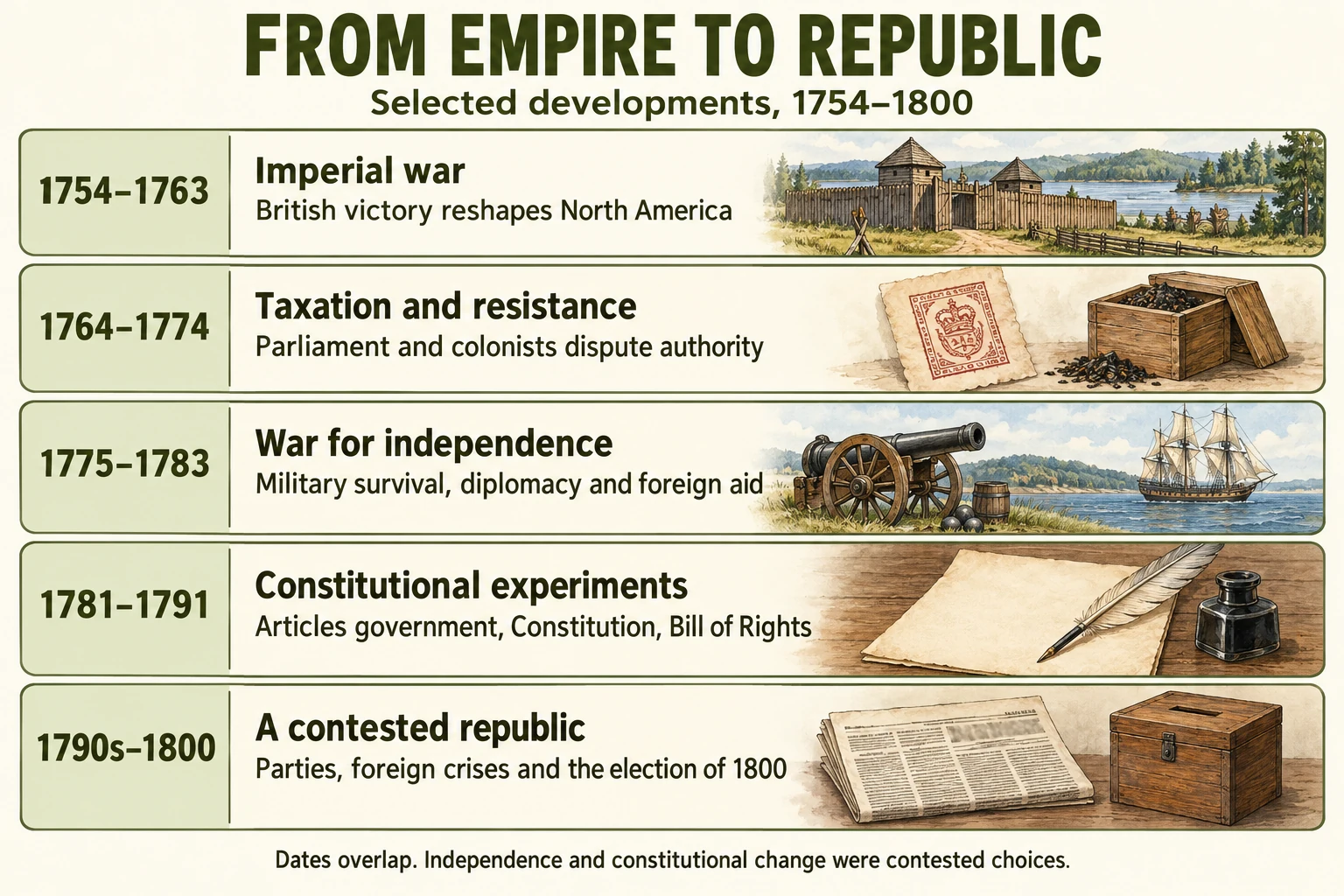
Use the weighting correctly: Unit 3 represents 10–17% of the multiple-choice section. Several other units share this range. It does not guarantee an exact number of questions, make this period uniquely the “most tested,” or predict a free-response prompt.
3.2 The Seven Years’ War (The French and Indian War)
A struggle over land, trade and sovereignty
British and French claims overlapped in the Ohio Valley, where Native nations pursued their own diplomatic and commercial goals. British land companies and settlers wanted western opportunities; French officials sought to connect Canada with the Mississippi Valley and protect trade. Native communities tried to preserve territory and bargaining power among competing empires. A European map’s territorial claim did not mean European control over the people living there.
Fighting began in 1754 after a Virginia expedition led by George Washington encountered French forces. Washington’s subsequent surrender at Fort Necessity was an early British colonial setback. The wider European war began in 1756, explaining why the North American conflict is often dated 1754–1763 while the global Seven Years’ War is dated 1756–1763. Fighting extended across multiple continents and oceans.
The Albany Congress of 1754 combined efforts at Native diplomacy with discussion of colonial defense. Benjamin Franklin’s Albany Plan proposed a joint government for common concerns under British authority. It was not adopted. Colonial governments feared losing autonomy, and imperial authorities did not implement the proposal. Franklin’s divided-snake cartoon promoted cooperation; it did not originally call for independence.
British victory and the peace settlement
Early British campaigns struggled, including Braddock’s defeat in 1755. Greater British spending and coordination under William Pitt helped change the balance. British forces captured Louisbourg and Fort Duquesne in 1758, Quebec in 1759 and Montreal in 1760. Naval power, resources, supply arrangements and changing Native alliances all contributed. Native participants were not a single unified “side”; local interests and the course of the war shaped choices.
The 1763 Treaty of Paris transferred Canada and most French claims east of the Mississippi to Britain, with New Orleans excepted. Britain also received Florida from Spain. France had separately arranged the transfer of Louisiana west of the Mississippi, including New Orleans, to Spain. France retained Caribbean possessions and limited North Atlantic holdings and fishing interests. Saying that France kept “only Caribbean islands” is inaccurate.
These were agreements among empires. Native nations did not collectively consent to the transfer of their lands. The removal of France as a major continental rival weakened some Native diplomatic options, but Native military power and resistance continued. Britain’s victory enlarged its empire and its obligations, rather than simply solving its North American problems.
The aftermath: debt, resistance and the western boundary
Britain faced a large wartime debt and the cost of administering and defending new territory. Officials believed colonists should contribute more reliably to imperial expenses. Colonists often emphasized their own wartime sacrifices and resented restrictions and demands imposed without their assemblies’ consent. Disputes about military service, supplies and status had already strained relations during the war.
In 1763, Native resistance across the Great Lakes and Ohio region challenged British forts and settlements. Pontiac was an important Odawa leader, but this was a decentralized movement involving many communities and leaders, not one army commanded by him. Resistance responded to settlement pressure, British policies and threats to Native autonomy. At Fort Pitt, British personnel attempted to transmit smallpox through contaminated items; that documented attempt does not establish the cause or extent of subsequent disease outbreaks.
The Royal Proclamation of 1763 sought to restrict colonial settlement beyond a boundary along the Appalachian region and reserve land transactions to imperial authority. It aimed to reduce warfare and regulate expansion. Settlers and speculators challenged it, and enforcement was uneven. Native resistance influenced western policy, but neither the proclamation nor later treaties ended land disputes.
Causation: victory increased Britain’s territory, debt and administrative responsibilities. New revenue and enforcement policies then collided with colonial expectations of local consent. Explain each connection; “Britain won, so revolution happened” leaves out the political choices that produced the crisis.
3.3 Taxation Without Representation
The dispute was about authority as well as money
After 1763, Parliament and imperial officials tried to make colonial revenue and administration more effective. Earlier oversight had been uneven, rather than completely absent. Colonists disagreed among themselves about which regulations were legitimate, but many insisted that taxation required the consent of their own elected assemblies. Parliament asserted authority over the empire and defended virtual representation: members supposedly represented the interests of all subjects, including people who did not vote for them.
Colonial critics answered that their distant communities could not meaningfully consent through representatives they had not elected. Some initially distinguished external trade regulation from internal taxation. Arguments broadened when duties were clearly intended to raise revenue or make royal officers less dependent on local assemblies. The slogan against taxation without representation therefore expressed a larger constitutional disagreement, not merely a demand for lower prices.
| Measure | What it did | Why it mattered |
|---|---|---|
| Sugar Act, 1764 | Lowered the molasses duty while strengthening collection and enforcement; raised revenue from trade. | A lower nominal rate could still create a greater burden when smuggling became harder. Admiralty proceedings raised concerns about legal protections. |
| Stamp Act, 1765 | Required paid stamps on specified printed materials and legal transactions. | An internal revenue measure affected printers, lawyers, merchants and many others. The Stamp Act Congress, boycotts and intimidation challenged implementation. |
| Quartering Act, 1765 | Required colonial support for specified military accommodation and supplies. | Arguments about troops and assembly control intensified. It should not be summarized as a blanket order to lodge soldiers in occupied private homes. |
| Declaratory Act, 1766 | Accompanied Stamp Act repeal and asserted Parliament’s legislative supremacy over the colonies. | Repeal changed the immediate tax without settling the principle of authority. |
| Townshend measures, 1767 | Imposed import duties on glass, lead, paint, paper and tea; strengthened customs administration. | Revenue could pay royal officials, reducing assembly influence. Renewed boycotts and John Dickinson’s arguments challenged revenue taxation. |
| Tea Act, 1773 | Gave the East India Company commercial advantages in colonial tea sales while retaining the existing tea duty. | It introduced no new tea tax. Lower prices did not resolve concerns about parliamentary authority and favored commercial arrangements. |
| Coercive Acts, 1774 | Closed Boston’s port pending restitution, restricted Massachusetts government and changed judicial and quartering arrangements. | Punishment of Massachusetts encouraged intercolonial solidarity and the First Continental Congress. |
How resistance became a wider movement
The Stamp Act Congress brought delegates from nine colonies together in 1765. Petitions asserted rights while often affirming loyalty to the king. Merchants organized nonimportation agreements; artisans, laborers and crowds pressured stamp distributors. Sons of Liberty groups used public protest and sometimes intimidation and violence. Resistance was not simply directed by one founder, and commercial interests did not always agree with popular crowds.
Women participated in consumer resistance by avoiding imported goods, producing homespun cloth and organizing local support. These activities gave household consumption political importance. Committees of correspondence circulated news and arguments, making disputes in one colony meaningful elsewhere. Colonial newspapers, sermons and meetings helped create connections across communities that remained socially and economically different.
In the Boston Massacre of March 1770, British troops killed five civilians after a confrontation. Crispus Attucks was among those killed. Patriot accounts and Paul Revere’s engraving turned the event into an argument about military oppression. The image is evidence of persuasion, not a neutral photograph of the encounter. John Adams helped defend the soldiers; acquittals and lesser convictions show that the legal outcome was more complicated than the propaganda.
The Boston Tea Party of December 1773 destroyed East India Company tea. Participants, some adopting Native disguises, challenged both the company’s privileges and the tax’s constitutional meaning. Parliament’s response included the Coercive Acts. The separate Quebec Act extended Quebec’s jurisdiction into the Ohio country, accommodated Catholic religious practice and retained government without an elected assembly. Many colonists grouped it with the “Intolerable Acts,” although it was not primarily a punishment for the tea protest.
The First Continental Congress in 1774 coordinated grievances and a Continental Association to enforce economic resistance. Local committees helped enforce agreements, sometimes coercively. Congress still sought redress within the empire. By early 1775, armed preparation and Britain’s effort to restore authority made reconciliation increasingly difficult, but support for independence was not yet universal.
3.4 Philosophical Foundations of the American Revolution
Several traditions supplied revolutionary arguments
Colonial political thought combined Enlightenment ideas, British constitutional traditions, Protestant reasoning and republican fears of corruption. Colonists invoked inherited rights, including representative institutions and protections against arbitrary government. They also argued that people possessed rights prior to government and could resist a government that violated its legitimate purposes. These traditions overlapped, but no single philosopher supplied every revolutionary belief.
John Locke helped articulate natural rights, consent and the conditional nature of political authority. His work offered a vocabulary for criticizing rulers who failed to protect rights. Montesquieu was important to arguments about distributing government powers and preventing tyranny; his influence is especially useful when discussing later constitutional design. Rousseau belongs to the wider Enlightenment discussion of sovereignty, but the American founding cannot be treated as a direct application of his entire political program.
Republicanism rejected hereditary monarchy as a basis of legitimate rule and emphasized government serving a public good. Writers valued civic virtue and worried that dependence, luxury, patronage and concentrated power could corrupt politics. Ideas about property and independence could also justify limiting participation to people considered economically independent. A republic was therefore not automatically a modern democracy with equal voting rights.
Paine, independence and the Declaration
Thomas Paine’s Common Sense, published in January 1776, openly attacked monarchy and hereditary succession. Its accessible prose argued that the colonies could govern themselves and benefit from independence. It reached readers and listeners beyond elite political circles. Exact sales estimates vary, so its importance is better explained through circulation, public discussion and argument than an unsupported precise readership figure.
The Second Continental Congress approved independence on July 2, 1776 and adopted the Declaration’s text on July 4. Thomas Jefferson drafted it as part of a committee that included John Adams and Benjamin Franklin; Congress revised the draft. Most delegates signed the engrossed parchment in August, rather than all signing it on July 4. Distinguish the decision, adoption, publication and signing.
The Declaration begins with an explanation of legitimate government, presents grievances against the king and announces separation. Its reasoning connects human equality, inherent rights, consent and the right to change a government that persistently violates those principles. Its audience included colonists, British readers and potential foreign supporters. It justified independence; it did not itself establish the detailed machinery of the later federal government.
The document’s universal language existed alongside slavery and other exclusions. Jefferson and several other leaders enslaved people, and the new governments did not automatically extend equal rights to women, Black Americans or Native peoples. The contradiction gave later petitioners and reformers a powerful standard with which to challenge practice. Native people were also described in hostile terms in the Declaration, reminding readers that a source expressing liberty for one audience could endorse violence or exclusion toward another.
Keep the documents distinct: the Declaration justified separation in 1776; the Articles organized a confederation; the Constitution established a different federal structure; the Bill of Rights added protections in 1791. A claim about natural rights is not the same kind of evidence as a rule defining the Senate.
3.5 The American Revolution
War began before independence was declared
British troops marched toward Concord in April 1775 to seize colonial military supplies. Warning networks included Paul Revere, William Dawes and Samuel Prescott, alongside many local participants. Fighting at Lexington and Concord on April 19 began the Revolutionary War; militia attacked British troops as they returned toward Boston. The familiar story of one rider shouting a polished slogan should not replace the larger network of preparation and alarm.
The Second Continental Congress met in May 1775, created the Continental Army and selected George Washington to command it. Congress coordinated diplomacy, military policy and finance without a reliable independent taxing power. It continued to seek reconciliation through the Olive Branch Petition even while fighting continued. The king’s rejection of the rebellion and subsequent events made separation more plausible to many colonists.
Patriots were people supporting resistance and then independence; Loyalists supported continued allegiance to Britain. Many inhabitants were uncertain, changed positions or tried to avoid the conflict. Loyalties varied by locality, religion, family interests, race, status and the presence of armies. It is safer to describe this uneven division than assign one precise percentage to every colony and year. The war included local intimidation, civil conflict and struggles over property as well as battles between armies.
Why Britain’s advantages did not guarantee victory
Britain possessed a powerful navy, professional forces, credit and an imperial supply system. It could capture major ports and cities. Americans struggled with shortages, enlistments, inflation and disagreements among states. Local geography did not eliminate American supply problems, and militia service was not a substitute for sustaining a trained Continental Army.
The Patriot strategy increasingly depended on keeping that army in existence, sustaining political support and making the war too expensive for Britain to continue. Washington combined retreats and preservation with opportunities for attack. Militias supplied local defense, intelligence and pressure, sometimes through irregular tactics, while regular troops fought conventional campaigns. American victory cannot be explained solely as sharpshooters defeating rigid British formations.
Women worked as nurses, cooks, laundresses, suppliers and household managers; some carried intelligence or served in combat under unusual circumstances. Free Black men and enslaved men served on both sides under changing recruitment policies. British offers of freedom, including Dunmore’s 1775 proclamation aimed at enslaved people belonging to rebels who could serve the British, encouraged escapes but did not promise universal emancipation. Native nations made strategic choices to defend their communities rather than simply adopting colonists’ ideological categories.
| Development | Result | Explain the significance |
|---|---|---|
| Bunker Hill, June 1775 | Britain took the position, largely on Breed’s Hill, at substantial cost. | A costly British victory showed both colonial resistance and the difficulties of dislodging it. |
| New York campaign, 1776 | British forces occupied New York; Washington’s army escaped destruction. | Preserving the army mattered even when the Americans lost territory and battles. |
| Trenton and Princeton, winter 1776–1777 | American attacks produced victories after a difficult campaign. | They supported morale and enlistments; they did not by themselves defeat Britain. |
| Saratoga, 1777 | Burgoyne’s British army surrendered. | The victory strengthened the case for a formal French alliance and made the conflict increasingly international. |
| Valley Forge, 1777–1778 | The Continental Army endured shortages and disease while reorganizing and training. | Supply reform and training associated with von Steuben improved effectiveness. This was an encampment, not a battle. |
| Southern campaigns, 1780–1781 | Britain won important engagements but faced sustained regular and irregular resistance. | Occupation did not guarantee political control. Local warfare was especially destructive. |
| Yorktown, October 1781 | American and French land forces, supported by French naval power, trapped Cornwallis. | The surrender was decisive politically, but fighting did not instantly stop everywhere and peace followed in 1783. |
Foreign assistance and the Treaty of Paris
France provided aid before becoming a formal ally in 1778. Money, supplies, soldiers and especially naval power expanded American possibilities. Franklin’s diplomacy helped secure support. Lafayette served the American cause, while Rochambeau and de Grasse were central to the Yorktown campaign. Spain entered the wider war against Britain in 1779 as France’s ally, without becoming a formal U.S. ally; Spanish campaigns and resources also strained British power. Dutch financial and commercial connections mattered, and Britain’s war with the Netherlands further widened the conflict.
The Treaty of Paris of 1783, negotiated for the United States by figures including Franklin, John Adams and John Jay, recognized U.S. independence and boundaries reaching to the Mississippi. It also addressed fishing, private debts and Loyalist property. Congress was to recommend restitution for certain Loyalist losses, rather than guarantee that every confiscation would be reversed. Boundary disputes and British retention of western posts continued.
Britain’s recognition of U.S. territorial claims did not mean Native nations surrendered their sovereignty or accepted American settlement. Native representatives were excluded from the peace settlement. Loyalists who left could face displacement and loss; Black Loyalists and other formerly enslaved people pursued uncertain routes to freedom, including evacuation to British territories. The war’s end changed governments without resolving all the struggles it had intensified.
3.6 The Influence of Revolutionary Ideals
Revolutionary equality became a language for making claims
Independence challenged hereditary rule and strengthened arguments that legitimate government should rest on the people. State constitutions and declarations of rights expressed these principles in different ways. Some states reduced property or religious qualifications, dismantled inherited privileges or broadened representation. Other restrictions persisted. Political change was uneven, and neither “nothing changed” nor “everyone became equal” describes the results.
Petitions and public arguments show how people used the Revolution’s language to demand more than many leaders intended. Enslaved and free Black people asserted rights, women questioned legal subordination, religious dissenters challenged establishments, and ordinary men demanded more responsive government. These movements were not simply gifts from founders; they involved pressure from people whose rights were denied.
Slavery, emancipation and Black activism
Northern antislavery movements produced important changes, although emancipation was often gradual and incomplete. Vermont’s 1777 constitution contained an antislavery provision while Vermont was an independent polity; it did not become a U.S. state until 1791, and implementation was not a simple instant end to all bondage. Pennsylvania’s 1780 gradual abolition law did not immediately free everyone enslaved: children born after its enactment to enslaved mothers faced lengthy service before freedom. Massachusetts court decisions in the early 1780s undermined slavery through the state constitution’s equality language.
Black petitioners connected liberty and natural rights with demands for freedom, education and protection. Prince Hall and others challenged slavery and racial exclusion in Massachusetts. Phillis Wheatley’s poetry and public correspondence asserted intellectual authority in a society structured by enslavement and racism. Free Black institutions, religious communities and mutual support networks developed, but discrimination remained severe even where slavery declined.
In the Chesapeake, some enslavers manumitted people, especially where law made it easier, while many others resisted emancipation. In the Lower South and elsewhere, slavery remained central to wealth and production. The cotton gin’s invention in 1793 falls within this period; the much larger expansion of cotton slavery developed afterward. Do not describe 1793 itself as outside Unit 3 or imply that slavery was weakening everywhere before a single invention revived it.
Freedom obtained through military service, escape or manumission remained insecure. Families could be separated, and free people faced kidnapping and legal discrimination. Revolutionary ideas mattered because they provided tools for contesting slavery, not because statements of equality automatically overrode slave law.
Women, education and legal limits
Women’s political activity included boycotts, fundraising, writing, petitioning and public discussion as well as wartime work. Abigail Adams asked John Adams to consider women’s legal protection when forming new government. Judith Sargent Murray’s On the Equality of the Sexes, published in 1790, challenged claims of women’s intellectual inferiority and emphasized education. Women were not absent from politics simply because they usually lacked the vote.
Republican motherhood was an ideal linking women’s education with their role in raising informed, virtuous citizens. It could justify educational opportunities, yet also keep women’s recognized civic role tied to family and domestic duties. It did not create universal suffrage or erase coverture, the legal restrictions attached to marriage. Widows, unmarried women and married women did not have identical property positions.
New Jersey was a significant exception: under its 1776 constitution and later election laws, some women and free Black residents meeting qualifications voted. These rights were restricted in 1807, beyond the unit’s main boundary. The exception demonstrates both the possibilities of revolutionary change and the danger of saying that every state had identical rules.
Native nations, religion and the Atlantic world
Native nations judged the Revolution through questions of land and sovereignty. Some supported Britain as a potential restraint on settlers; some supported the Americans, pursued neutrality or divided internally. Haudenosaunee communities experienced especially damaging divisions, and American campaigns destroyed villages and food supplies. The Treaty of Paris excluded Native nations, while settlers treated imperial cessions as permission for expansion.
Religious liberty advanced through state debates and measures such as Virginia’s 1786 Statute for Religious Freedom. Disestablishment occurred at different times; some tax-supported churches survived beyond 1800. The Revolution’s influence was international: French and Haitian revolutionaries engaged with Atlantic ideas of rights, sovereignty and liberty while responding to their own societies. The Haitian Revolution began in 1791 and exposed the tension between universal rights and slavery. U.S. reactions ranged from inspiration to deep fear, especially among enslavers.
Compare outcomes by group and place: northern gradual abolition, women’s education and Native land loss are different developments. A strong argument identifies who gained which opportunity, who remained excluded, and how law and practice could diverge.
3.7 The Articles of Confederation
A union designed to protect state authority
Congress adopted the Articles in 1777; final state ratification came in 1781. The confederation operated until the new federal government began in 1789. Its design reflected distrust of distant coercive authority and attachment to state governments. The Articles were a deliberate constitutional choice, not merely an accidental failure to think of a president.
A unicameral Congress represented the states, with one vote per state. Congress could conduct diplomacy, make war and peace, borrow and coin money, manage a postal system and address western affairs within important limits. There was no separate chief executive comparable to the later presidency and no general federal court system comparable to the later judiciary. Congress nevertheless used committees and executive officers and had arrangements for certain disputes; “there was no government at all” is inaccurate.
Congress could request money from states but could not levy taxes directly on individuals. It lacked a general power to regulate interstate and foreign commerce. Important measures required nine states’ agreement; not every routine decision required that threshold. Amendments required unanimity. State interests and noncompliance therefore made national finance and coordinated policy difficult.
Achievements: diplomacy and western organization
The confederation government helped conduct the final phase of the war and diplomacy leading to peace. Its western land policies created a framework for surveying territory, selling public land and admitting new states. These achievements should be considered alongside its weaknesses.
The Land Ordinance of 1785 organized surveyed land into townships six miles on each side, normally divided into thirty-six one-square-mile sections of 640 acres. A section was reserved to support schooling. The system made land legible for sale and taxation, but purchasers with capital often benefited more readily than poor families. Survey lines also imposed U.S. claims on Native homelands, where occupation and ownership were contested.
The Northwest Ordinance of 1787 provided stages of territorial government and a route to admission as states on an equal footing. It supported education, protected specified civil liberties and prohibited slavery in the territory while including a fugitive-labor provision. The ordinance’s statehood threshold referred to sixty thousand free inhabitants; admission still involved Congress. Its promises of fair treatment for Native peoples were repeatedly contradicted by expansion and warfare.
The territorial ban did not instantly eliminate every form of bondage in practice. Nor did the ordinance grant full political equality to everyone living there. Its major significance was the principle that western territories could become equal states, rather than remain permanent subordinate colonies.
Finance, foreign pressure and Shays’ Rebellion
War debt, unstable currency, postwar trade disruption and demands for payment strained governments and households. Congress depended on unreliable state contributions. States pursued different trade and monetary policies, making coordinated responses difficult. Britain retained western forts, Spain restricted Mississippi access, and American shipping faced threats without British protection. These problems encouraged some leaders to call for stronger national institutions.
In Shays’ Rebellion, 1786–1787, debt-burdened Massachusetts farmers and veterans closed courts and resisted tax and debt collection; an attempt to seize the Springfield arsenal failed. Daniel Shays was one of several leaders. State forces suppressed the uprising, aided by private financing. Debtors viewed their actions through economic hardship and republican claims, while many property holders feared disorder and threats to lawful government.
The rebellion intensified support for constitutional reform, but it was not the only cause. Commercial disputes, failed revenue amendments, western diplomacy and elite concerns about state legislation were already important. The 1786 Annapolis Convention’s limited attendance nevertheless helped produce a call for a broader Philadelphia meeting. The political challenge was how to create national capacity without recreating the arbitrary power Americans had opposed.
Balanced assessment: the Articles coordinated a union and produced important land policy. Their limited revenue and enforcement powers made other tasks difficult. Explain the connection between an institutional rule and a particular problem, rather than describing the entire period as “chaos.”
3.8 The Constitutional Convention and Debates over Ratification
From revision to a new framework
Delegates met in Philadelphia in 1787 under a mandate associated with revising the Articles, but drafted a replacement constitution. Washington presided, Madison played a major role in preparation and debate, and Franklin encouraged compromise. The Virginia Plan drew heavily on Madison’s thinking and was introduced by Edmund Randolph. William Paterson introduced the New Jersey Plan. The Constitution was the product of collective bargaining and conflict, not one person’s complete blueprint.
The delegates were an unrepresentative group of men with substantial political experience; many had wealth and slaveholding interests. Women, enslaved people and Native nations had no delegates speaking on equal terms in the convention. Closed proceedings facilitated negotiation but also became a point of suspicion. Rhode Island sent no delegation. Jefferson and John Adams were abroad.
| Question | Debate or arrangement | Consequence |
|---|---|---|
| Representation | The Virginia Plan favored population-based representation; the New Jersey Plan preserved equal state voting in a revised confederation. The Connecticut or Great Compromise produced a population-based House and equal state representation in the Senate. | Each state received two senators, originally selected by state legislatures. The two chambers balanced different principles of representation. |
| Slavery and apportionment | The Three-Fifths Compromise counted part of the enslaved population for House apportionment and direct taxation. | It increased slaveholding states’ political power relative to excluding enslaved people from the count, without granting those people votes or political consent. |
| Slave importation | Congress could not prohibit the importation covered by the constitutional clause before 1808. | The clause protected continued importation for a period. A later ban on overseas imports did not abolish slavery or the domestic slave trade. |
| Commerce | Congress gained interstate and foreign commerce powers; the Constitution barred federal taxes or duties on exports from states. | National capacity increased, while specific restrictions addressed economic interests. Regional interests were more complicated than a uniform North–South division on every proposal. |
| Presidential selection | States would appoint electors in a manner directed by their legislatures; each state’s electoral total reflected its congressional delegation. | Selection mixed state authority with indirect election. The Constitution did not require a nationwide popular vote or one uniform method of choosing electors. |
Understand the Three-Fifths Compromise precisely
The rule concerned apportionment and direct taxation. It did not declare that an enslaved person possessed a fraction of the rights of a free person, and it did not allow enslaved people fractional votes. Free inhabitants were counted fully under the rule, including free Black inhabitants; the original text separately excluded “Indians not taxed.” Political rights and population counting were distinct questions.
For a simplified numerical example, suppose a state had fifty thousand free inhabitants included in the count and thirty thousand enslaved inhabitants, with no other relevant categories. Its population total for this rule would be:
This hypothetical count is sixty-eight thousand. It is not the number of eligible voters, seats or actual ballots. Actual House apportionment also required a national allocation process.
The fugitive-slave clause further protected slaveholders’ claims across state lines. These arrangements show how the Constitution accommodated and strengthened slavery despite the language of revolutionary liberty. Enslaved people themselves did not consent to the compromise.
Federalists, opponents and the Bill of Rights
Federalists argued that a stronger national government could protect the union, regulate commerce, establish public credit and defend the country. They insisted that divided institutions and a large republic could restrain tyranny. Hamilton, Madison and Jay wrote the eighty-five Federalist essays under the name Publius to support ratification, especially in New York.
Anti-Federalists were a diverse group, not one organized party with identical views. George Mason, Patrick Henry, Mercy Otis Warren and other critics feared distant consolidated authority, an overly powerful executive, weak representation and the absence of explicit rights protections. Some preferred substantial reform of the Articles rather than the proposed replacement. Support and opposition crossed simple lines of rich versus poor or urban versus rural.
Federalist No. 10 argued that a large republic could make an oppressive majority faction harder to organize. No. 51 explained how institutional ambition and divided power could check abuses. No. 78 defended an independent judiciary and constitutional limits on legislation. These essays reveal arguments for the proposed system; they are not neutral descriptions of how every institution subsequently operated.
Ratification occurred through special state conventions. The new framework required approval by nine states to take effect among ratifying states, a different rule from unanimous amendment under the Articles. Delaware ratified first in December 1787; New Hampshire became the ninth in June 1788. Virginia and New York followed after contentious debates. North Carolina and Rhode Island ratified after the government began operating in 1789.
Federalist commitments to consider amendments helped secure support, but the Bill of Rights was not already part of the Constitution when the convention signed it. Congress proposed amendments in 1789; ten were ratified in 1791. The debate joined questions of effective government to questions of enforceable liberty.
3.9 The Constitution
National authority combined with limits on power
The Constitution established a federal system with national institutions that could act more directly on individuals than the confederation government. Congress gained reliable taxing and commerce powers; a separate presidency and federal judiciary were created. State governments retained substantial responsibilities. The arrangement combined increased national capacity with several ways of dividing and limiting authority.
Popular sovereignty locates legitimate authority in the people, but the founding system filtered that authority through institutions and unequal participation rules. Limited government means officials act within constitutional authority rather than possess unlimited discretion. Separation of powers assigns legislative, executive and judicial functions to different institutions. Checks and balances give those institutions overlapping roles that can restrain one another. These are related but distinct concepts.
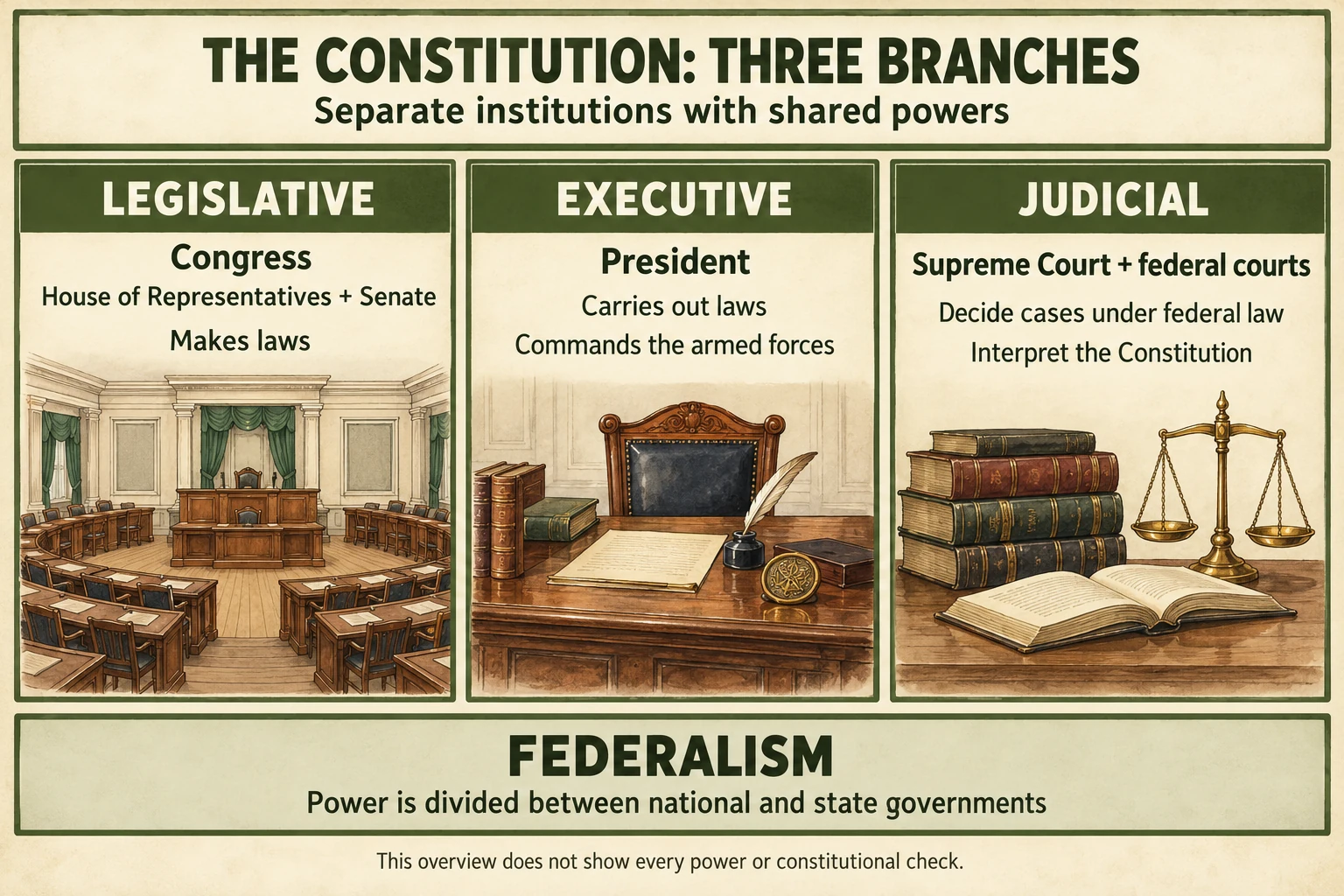
The branches and their checks
- Congress: the House and Senate enact legislation and control appropriations. Congress can declare war and exercise other enumerated powers. The House impeaches; the Senate tries impeachments and can remove an official upon conviction. Impeachment by itself is not removal.
- President: carries out laws, serves as commander in chief and conducts important diplomatic and appointment functions. The president may veto legislation; Congress can override a veto with the required supermajority in both houses. Treaties require Senate consent, and major appointments also involve the Senate.
- Federal judiciary: Article III establishes the Supreme Court and permits Congress to establish lower courts. Judges serving during good behavior have protection from ordinary political dismissal. Federal courts decide cases within their jurisdiction and interpret constitutional and legal questions.
Judicial review was debated during the founding, including in Federalist No. 78. The later Marbury v. Madison decision in 1803 is an important milestone beyond Unit 3. Do not describe that specific decision as occurring in 1787. Likewise, presidential pardons concern federal offenses, do not apply to impeachment and do not authorize the president to dismiss a judge at will.
Federalism and constitutional flexibility
Federalism divides authority between national and state governments. National powers include regulating interstate and foreign commerce, coining money and conducting war and diplomacy. States administer many areas of local government, property law and elections, subject to constitutional restrictions. Both levels exercise some powers, including taxation. The Supremacy Clause makes the Constitution, valid federal laws and treaties superior to conflicting state law; it is not a claim that any action by any federal official is automatically constitutional.
The Necessary and Proper Clause permits Congress to choose means for carrying out its constitutional powers. Its scope became central to the bank debate. Article V provides a formal amendment process requiring broad agreement: the usual proposal route uses two thirds of both houses of Congress, followed by ratification in three fourths of the states. It also provides a convention route for proposal. This is different from both ordinary lawmaking and the Articles’ unanimous amendment rule.
Electoral arrangements changed over time. In the original system, state legislatures selected senators; direct election came with a later amendment. States determined how to appoint presidential electors, with methods varying. Electoral votes reflected House representation plus the state’s two senators. Slavery-related apportionment increased slaveholding states’ influence without enfranchising enslaved people.
| Amendment | Study focus |
|---|---|
| First | Religion, speech, press, assembly and petition; limits on national religious establishment and interference with religious exercise. |
| Second | Arms and militia language; understand it in the founding context without substituting a modern political argument for historical analysis. |
| Third | Restrictions on quartering soldiers in private homes, including consent in peacetime. |
| Fourth | Protection against unreasonable searches and seizures and requirements for warrants. |
| Fifth | Due process, self-incrimination, double jeopardy, grand-jury provisions and compensation for public taking of property. |
| Sixth | Protections in criminal prosecutions, including a speedy public trial, an impartial jury and assistance of counsel. |
| Seventh | Jury protections in specified civil cases. |
| Eighth | Limits on excessive bail, excessive fines and cruel and unusual punishment. |
| Ninth | Listing some rights does not deny other rights retained by the people. |
| Tenth | Powers not delegated to the United States or prohibited to states are reserved to the states or the people. |
Historical scope: these amendments originally constrained the federal government. Their later application to state governments developed through later constitutional change and court decisions. The Bill of Rights did not abolish slavery, establish universal voting or immediately make all state law conform to modern civil-rights standards.
3.10 Shaping a New Republic
Washington’s government turned a framework into practice
Washington became president in 1789. Congress organized executive departments and federal courts; Washington developed a cabinet advisory practice and appointed officials with competing visions. The Judiciary Act of 1789 established the lower-court structure within the constitutional framework. Practice, legislation and conflict all shaped how the system worked.
Washington’s voluntary retirement after two terms established a precedent, not a constitutional two-term limit in the 1790s. His 1796 Farewell Address urged national unity and warned about faction and lasting foreign entanglements. It did not prohibit all diplomacy, trade or temporary cooperation. Despite hopes for unity, disagreement about the government’s purposes became organized political opposition.
Hamilton’s financial program and the bank debate
Treasury secretary Alexander Hamilton wanted durable national credit and a government capable of supporting commerce. His program included funding national obligations, assuming specified state Revolutionary debts and securing dependable revenue. Creditors’ financial interests would become linked to the national government. Critics worried about speculation, unequal burdens and the political influence of wealthy investors.
The 1790 compromise linked support for assumption with the location of a future permanent capital on the Potomac. It should not be described as instantly moving the operating government to Washington, D.C.; the government relocated there in 1800 after an intervening period in Philadelphia. Different states’ debt positions and regional interests shaped the bargain.
The Bank of the United States, chartered in 1791, would hold government funds, support payments and credit, and issue banknotes. It was a corporation with both public and private investment, not the same institution as the modern Federal Reserve. Jefferson and Madison questioned its constitutionality and concentrated financial power. Hamilton argued that incorporation was an appropriate means of carrying out enumerated fiscal powers. Washington accepted the case for the bank.
Import duties supplied major revenue, while the whiskey excise created a contentious internal tax. Hamilton advocated encouragement of manufacturing, but not every proposal in his manufacturing report became law. Distinguish his program and arguments from a claim that the United States immediately became an industrial economy.
The Whiskey Rebellion of 1794 involved resistance to the excise, especially in western Pennsylvania, where distilled grain was economically important and taxpayers objected to burdens and enforcement. Washington accompanied the mobilization of a large militia force before returning east; he did not personally direct every later operation. Resistance dispersed. Comparing it with Shays’ Rebellion highlights increased federal capacity, while also raising questions about taxation, protest and who defined legitimate resistance.
| Question | Federalists | Jeffersonian or Democratic-Republicans |
|---|---|---|
| Prominent leaders | Hamilton and John Adams, despite disagreements between them. | Jefferson and Madison; Madison had supported constitutional ratification before opposing Hamilton’s program. |
| Economic outlook | Public credit, national bank and commercial development. | Agrarian independence and criticism of concentrated financial power. |
| Constitutional approach | Generally supported a broad reading of national powers. | Generally emphasized limits on federal power and a narrower reading; practice could become more flexible. |
| Foreign sympathies | Often favored stable commercial relations with Britain and feared radical French developments. | Often sympathized with revolutionary France and distrusted Britain, while also valuing U.S. independence. |
| Support | Strong among commercial networks and in New England, but not confined to one occupation. | Strong in the South and West and among some farmers and artisans, but also supported by major slaveholders and other elites. |
Foreign affairs sharpened domestic divisions
The French Revolution and renewed European war forced Americans to reconsider the 1778 alliance and their vulnerable international position. Washington’s 1793 neutrality proclamation sought to keep the country out of the conflict. The Citizen Genêt controversy, British interference with shipping, impressment and frontier posts all complicated neutrality. Neither admiration for France nor trade with Britain made the United States fully dependent on one side.
Jay’s Treaty, signed in 1794, addressed British-held western posts and some commercial and financial disputes but did not end all maritime grievances. Opponents saw concessions to Britain as an abandonment of France and republican principle. Pinckney’s Treaty with Spain in 1795 addressed the southern boundary and provided navigation of the Mississippi and a right of deposit at New Orleans, valuable to western commerce.
Under President John Adams, French seizures of American shipping and the XYZ Affair intensified hostility. American diplomats reported demands by intermediaries for payments before negotiations. An undeclared naval Quasi-War with France followed. Adams pursued a diplomatic settlement through the Convention of 1800, angering some members of his own party while avoiding a larger declared war.
The Alien and Sedition Acts of 1798 formed a group of laws, not one identical measure. They lengthened the naturalization residency requirement, expanded specified executive powers concerning noncitizens and criminalized certain criticism of the federal government. Federalist enforcement of the Sedition Act against Republican critics raised central questions about free expression and opposition. Jefferson and Madison’s Kentucky and Virginia Resolutions challenged the measures through arguments about the compact and state resistance; they did not establish an uncontested constitutional right of unilateral nullification.
Western sovereignty and the election of 1800
Federal claims to western land faced Native resistance and European influence. U.S. officials asserted power to make treaties, while settlers and state interests often pushed beyond boundaries or violated agreements. Native leaders defended sovereignty through diplomacy and warfare. Spain also expanded missions and settlements in California beginning in 1769, using Native labor under coercive conditions; imperial competition continued beyond the Atlantic seaboard. Topic 3.12 develops these migrations and conflicts in detail.
The election of 1800 challenged the durability of the constitutional system. Jefferson and Aaron Burr tied in electoral votes under the original rules, which did not separate presidential and vice-presidential ballots. The outgoing House chose Jefferson in February 1801. Power passed from the Federalists to their Republican opponents without a military seizure. Calling this a peaceful transfer describes the institutional outcome, not a campaign free from hostility, exclusion or crisis. The Twelfth Amendment later revised the electoral procedure.
3.11 Developing an American Identity
A national culture grew alongside regional identities
Independence encouraged efforts to define a shared political and cultural identity. Public celebrations, newspapers, portraits, civic buildings and accounts of the Revolution promoted ideas of republican citizenship. Yet local, state, religious, racial and regional identities remained powerful. Americans disagreed about whether national identity rested primarily on constitutional principles, British inheritance, Protestant culture, race, republican virtue or some combination.
Noah Webster’s educational writing and spelling work from the 1780s promoted cultural independence and a common language. His famous large dictionary appeared in 1828, outside Unit 3. Likewise, Washington Irving’s best-known stories belong to the nineteenth century. Using them as events of the 1790s confuses later cultural nationalism with the early republic’s beginnings.
Charles Willson Peale’s portraits and museum projects connected Revolutionary leaders, learning and national achievement. Phillis Wheatley’s 1773 poetry challenged assumptions about Black intellectual ability while engaging religion and public affairs. Judith Sargent Murray’s 1790 essay connected women’s education with arguments about equality. These examples show that the culture of the new nation was made by more people than its officeholders.
Education, religion and public life
Republican writers argued that self-government required informed citizens. Proposals for broader schooling and female education gained support, but a uniform, fully accessible public school system did not immediately result. Access depended on location, wealth, gender, race and legal status. Colleges and academies expanded while maintaining substantial exclusions.
Religious pluralism and disestablishment debates created new definitions of liberty. Virginia’s religious-freedom legislation and constitutional protections limited national establishment, but state churches ended at different times. Enlightenment reason, deism and evangelical faith coexisted in a religiously varied society. Founding leaders did not all hold one identical theology, and religion remained politically influential.
The press became a major arena of partisan conflict. Newspapers connected distant readers but could also intensify divisions and circulate attacks. Debates over the Sedition Act show that constitutional guarantees did not automatically settle the acceptable limits of criticism. National identity developed through argument as well as shared symbols.
Citizenship was not identical to voting, residence or naturalization
The Naturalization Act of 1790 restricted the federal process for immigrants becoming citizens to free white persons meeting statutory requirements. It should not be summarized as a complete definition of the citizenship of everyone already born in the country. Birth, state recognition, federal law and practice created disputed and changing statuses, especially for free Black people.
Voting qualifications were largely set by states. Property, tax, race, sex, religion and residency rules varied. Some free Black men could vote in certain states; some qualified women voted in New Jersey. Many other residents were excluded. The expansion of white male suffrage developed unevenly and continued well beyond 1800; it was not universal by a single date in every state.
Native nations asserted their own political identities and sovereignty. Describing them only as people “not yet admitted” into American citizenship misses those claims. Enslaved people were subjected to property law and denied political consent, while their resistance and demands for freedom challenged the nation’s self-description. American identity was both a claim about belonging and a contested boundary around rights.
3.12 Movement in the Early Republic
Settlement moved into inhabited and contested places
Population growth, land hunger, debt, speculation and hopes for independence drew settlers across the Appalachians into Kentucky, Tennessee and the Ohio country. Families used mountain routes, river transport and existing paths. Surveyed land and future statehood encouraged migration, but access depended on money, credit, legal claims and military power. “Available land” was often Native land that U.S. officials and settlers claimed despite Indigenous resistance.
Western farmers sought markets through the Mississippi, explaining the importance of Spain and Pinckney’s Treaty. Their commercial interests could differ from those of eastern merchants, and they resented some federal tax and land policies. Kentucky entered the union in 1792 and Tennessee in 1796. Migration changed political representation and strengthened disputes over the balance between national and local authority.
Movement was not always voluntary. Enslaved people were relocated with enslavers or sold away from families. Slavery expanded into southwestern settlements even as northern abolition movements developed. Escape, manumission and petitions also created routes toward freedom. Gabriel’s planned uprising in Virginia in 1800, suppressed before its intended action, demonstrates continued resistance and the reach of revolutionary claims at the period’s end.
Native coalitions and U.S. military expansion
Native nations in the Ohio region formed changing coalitions to defend their homelands. Miami leader Little Turtle, Shawnee leader Blue Jacket and many other leaders and communities participated; no single person represented every nation’s interests. Native forces defeated U.S. expeditions, including St. Clair’s army in 1791. This major defeat shows that American territorial claims were not the same as secure control.
Anthony Wayne’s army won the Battle of Fallen Timbers in 1794. The Treaty of Greenville in 1795 imposed major land cessions in much of present-day Ohio and other specified places. The result opened more territory to U.S. settlement, but did not end Native resistance or extinguish all Native landholding across the Northwest. British withdrawal from posts under Jay’s Treaty affected the regional balance.
Federal treaties and promises of protection coexisted with settlers’ invasions, coercive negotiations and disputes over which representatives could legitimately cede land. Some Native peoples negotiated or adapted economic practices; others relocated or resisted. The Constitution’s allocation of national treaty and commerce powers did not eliminate conflicts among federal officials, states, settlers and sovereign Native nations.
The West included Spanish borderlands and varied migration
Spain’s Alta California mission chain began at San Diego in 1769. Missions, presidios and settlements advanced Spanish imperial aims and Catholic conversion. Native people supplied labor and faced confinement, punishment, disease and disruption of existing lifeways. They responded through selective cooperation, cultural persistence, flight and revolt. Native communities were not passive recipients of a new culture.
Mission agriculture, ranching, military service and settlement produced cultural exchange and some opportunities for soldiers and settlers, including people of varied ancestry. Those opportunities existed within unequal colonial hierarchies and coercive labor arrangements. Spanish California was not part of the United States in this period. Its inclusion shows that the continent’s history did not follow a single uninterrupted U.S. frontier line.
Other migrations included Loyalist departures after the Revolution and people fleeing upheaval in the Caribbean, including Saint-Domingue. Refugees brought different political experiences, racial statuses, skills and relationships to slavery. Immigration and the rules governing newcomers became part of partisan debate, especially during the 1790s. Movement connected the early republic to Atlantic and continental struggles rather than isolating it from them.
Analyze several kinds of movement: voluntary settler migration, forced relocation of enslaved people, Native displacement and resistance, imperial mission expansion, and Atlantic refugee migration. Ask who controlled the movement, what institutions supported it and who bore its costs.
3.13 Continuity and Change in Period 3
Explain the extent of transformation
The Revolution transformed political sovereignty and created institutions claiming legitimacy from the people. British subjects became members of independent states joined in a republic, although rights within that republic remained unequal. A confederation was replaced by a federal system with stronger taxing, executive and judicial institutions. National identity developed through war, print, education, public culture and constitutional debate.
Continuities were substantial: agriculture remained central, wealth influenced power, slavery survived and expanded, married women faced legal restrictions, and settlers pursued Native land. Some continuities became more entrenched through new institutions. Constitutional apportionment and fugitive-slave provisions strengthened slaveholding interests, while national military power supported western expansion.
Change and continuity can occur in the same development. Northern gradual abolition altered slavery’s geography without immediately freeing everyone. Republican motherhood expanded arguments for women’s education while limiting recognized civic roles. Native diplomacy shifted from competing European empires toward a growing U.S. republic, but the struggle to defend sovereignty persisted.
| Dimension | Change | Continuity or limit |
|---|---|---|
| Government | Independence, state constitutions, federal Constitution. | Political participation remained restricted and uneven. |
| National power | Federal taxation and enforcement exceeded the Articles’ capacity. | State institutions remained powerful and federal authority was contested. |
| Slavery | Northern abolition measures and Black activism challenged bondage. | Gradual processes, discrimination and expanding slavery limited emancipation. |
| Women | Political mobilization and arguments for education grew. | Coverture and exclusion from most formal offices and voting persisted. |
| Native sovereignty | New U.S. treaty and military pressures changed regional power. | Land struggles, diplomacy and resistance continued. |
| International status | Britain recognized U.S. independence. | The republic remained economically and strategically vulnerable to other powers. |
Model a qualified historical argument
Practice question: To what extent did the American Revolution change political life by 1800?
Possible claim: The Revolution fundamentally changed the source and structure of government by replacing imperial rule with republican constitutions and a stronger federal union. Its transformation of political participation was more limited, because racial slavery, gender restrictions and uneven state voting rules survived and sometimes gained new institutional protection.
Develop the reasoning: use the Declaration and Constitution to establish changes in sovereignty and government. Contrast northern emancipation and new educational arguments with the Three-Fifths Compromise, coverture and contested Native land claims. Connect evidence to the particular dimension of political life being evaluated; do not simply list examples.
A different argument may be valid if supported by appropriate evidence and reasoning. Keep the timeframe clear, distinguish institutions from lived experience, and avoid importing the Louisiana Purchase, Marbury decision or later mass-democracy developments into events completed before 1800.
Period 3 timeline: 1754–1800
Use this timeline to separate causes, turning points and later consequences. Events with similar names, especially the two Paris treaties, served different purposes.
| Date | Development | Historical connection |
|---|---|---|
| 1754 | Ohio Valley fighting; Albany Congress. | Imperial competition, Native diplomacy and an unadopted plan for colonial cooperation. |
| 1763 | Paris peace settlement, Native resistance and royal proclamation. | British victory creates new expenses and disputes over the West. |
| 1764–1766 | Sugar Act, Stamp Act, Congress and repeal; Declaratory Act. | Resistance changes policy without resolving parliamentary authority. |
| 1767–1770 | Townshend duties, boycotts and Boston Massacre. | Revenue, enforcement and military presence intensify conflict. |
| 1773–1774 | Tea Act, tea protest, Coercive Acts and First Continental Congress. | Local punishment becomes a wider constitutional crisis. |
| 1775 | Lexington and Concord; Continental Army; reconciliation efforts. | War precedes the formal declaration of independence. |
| 1776 | Common Sense; independence vote and Declaration; new state constitutions. | Separation acquires a public justification and institutional forms. |
| 1777–1778 | Saratoga; Articles adopted; Valley Forge; French alliance. | Military survival, constitutional planning and diplomacy overlap. |
| 1780–1781 | Pennsylvania gradual abolition; Articles ratified; Yorktown. | Social change remains uneven while military and political structures develop. |
| 1783 | Treaty of Paris recognizes U.S. independence. | Territorial claims and unresolved obligations outlast the war. |
| 1785–1787 | Land Ordinance, Shays’ Rebellion, Northwest Ordinance and Constitutional Convention. | Confederation achievements and crises shape reform. |
| 1788–1789 | Ratification threshold met; new government begins. | A federal union replaces the confederation’s institutional structure. |
| 1790–1791 | Assumption and residence bargain, bank charter and Bill of Rights. | Finance and constitutional interpretation become political disputes. |
| 1793–1795 | Neutrality, whiskey resistance, Fallen Timbers, Jay’s and Pinckney’s treaties. | Domestic enforcement, foreign policy and western sovereignty intersect. |
| 1796–1798 | Washington retires; Adams takes office; XYZ crisis and Alien and Sedition Acts. | Party divisions raise questions about opposition and civil liberty. |
| 1800–1801 | Convention with France; election, electoral tie and transfer to Jefferson. | The election is in 1800; its House resolution and inauguration follow in 1801. |
Essential Unit 3 terms and documents
- Virtual representation
- The argument that Parliament represented imperial interests even for subjects who had not elected its members; colonial opponents emphasized consent through their own assemblies.
- Nonimportation and committees of correspondence
- Economic resistance and communication networks that linked local grievances across colonies, while also creating pressure for compliance.
- Natural rights and social contract
- Claims about rights people possess and government’s conditional legitimacy. These helped justify resistance but did not automatically determine who received rights in practice.
- Republicanism
- Government directed toward a public good rather than hereditary monarchy, often emphasizing civic virtue and fears of corruption.
- Common Sense and Declaration of Independence
- Paine’s argument for separation and Congress’s public justification of independence. Neither is the detailed federal constitutional structure adopted in 1787.
- Patriots and Loyalists
- Supporters of independence and continued British allegiance; identities varied over time, and many people tried to remain neutral.
- Saratoga and Yorktown
- A 1777 victory crucial to formal French alliance and a 1781 Franco-American victory crucial to the move toward peace.
- Republican motherhood
- An ideal connecting women’s education with raising virtuous citizens; it opened some arguments for education while reinforcing domestic expectations.
- Gradual abolition
- Emancipation through laws that often imposed continuing service or other limits, rather than immediately ending bondage for every enslaved resident.
- Articles of Confederation
- The first national constitutional framework, emphasizing state authority and limited central revenue powers while still enabling diplomacy and western legislation.
- Northwest Ordinance
- A 1787 framework for territorial government and equal statehood, including a slavery prohibition whose implementation and limits require attention.
- Federalists and Anti-Federalists
- Supporters and critics of constitutional ratification. These labels should not be treated as identical to the later first-party-system divisions.
- Federalism, separation and checks
- Division between national and state authority; distribution among branches; and overlapping institutional powers that constrain each other.
- Necessary and Proper Clause
- A source of implied means to carry out enumerated powers, central to Hamilton and Jefferson’s disagreement over the bank.
- Democratic-Republicans
- Jefferson and Madison’s emerging opposition to Federalist policy. This is a historical party label, not the name of today’s Republican Party.
- Alien and Sedition Acts
- 1798 measures concerning naturalization, executive powers over certain noncitizens and criminal penalties for specified criticism, provoking debate about liberty and authority.
- Naturalization
- The legal process by which immigrants become citizens; distinguish its racial restrictions from the separate questions of birth status and voting qualifications.
- Native sovereignty
- Native nations’ claims to political authority and territory, pursued through diplomacy and resistance despite imperial cessions and U.S. settlement claims.
Source analysis and active-recall practice
Read the source before using it as evidence
Identify the creator, date, audience and purpose. Describe its argument or features accurately, place it in the historical situation and explain what it can establish. A law reveals what officials sought to authorize or prohibit, not perfect enforcement. A political engraving shows a persuasive representation, not an unmediated record of a crowd. A treaty can recognize one government’s territorial claim while excluding the people who actually live there.
Worked source comparison: place the Declaration’s argument about legitimate government beside an Anti-Federalist objection to distant power. Both can invoke liberty, yet support different institutional choices. Explain what threat each author perceives: imperial authority in one context, concentrated national authority in the other. Similar vocabulary does not make their immediate aims identical.
Build a causation paragraph: begin with a claim about why the constitutional system changed, use the Articles’ revenue limits and a specific postwar challenge as evidence, then explain the mechanism. Add qualification by recognizing the confederation’s land-policy achievements. Avoid treating Shays’ Rebellion as the single cause of every provision drafted in Philadelphia.
Why did Britain’s victory in 1763 create new problems?
Victory enlarged territory, debt and defense responsibilities. Britain’s effort to secure revenue and regulate the West conflicted with colonial expectations of assembly consent and settlers’ land ambitions. Native resistance also demonstrated that imperial cession did not mean uncontested control.
Why did resistance become independence rather than remain a tax protest?
Repeals did not resolve parliamentary supremacy. Military presence, coercive legislation, intercolonial organization and armed conflict undermined reconciliation. Paine and other writers made separation more persuasive, while political decisions in 1775–1776 turned resistance into an independence movement.
How did Americans win without matching every British resource?
The Continental Army survived repeated setbacks, local support sustained resistance, and foreign money, supplies, troops and naval power changed the war. Britain faced global commitments and the difficulty of converting occupation into lasting control. Explain Saratoga and Yorktown through these connections.
What did the Three-Fifths Compromise do—and not do?
It defined part of a population count for apportionment and direct taxation, increasing slaveholding states’ power compared with excluding enslaved people from that count. It did not give enslaved people votes or a fractional package of legal rights.
How did Federalists and Anti-Federalists both claim to defend liberty?
Federalists emphasized the dangers of a weak union and argued that divided institutions and a large republic would protect liberty. Critics feared distant power, insufficient representation and the absence of explicit rights guarantees. Their disagreement was about the institutional means of protection as well as the goals.
How revolutionary was the Revolution for different groups?
Independence and constitutional government changed sovereignty substantially. Northern abolition, women’s educational claims and broader political activity created real but uneven openings. Slavery, gender restrictions and Native dispossession persisted. Compare particular groups and places rather than assume one uniform outcome.
Revision routine: explain one event’s causes, compare two institutions or groups, and use a source’s date to test your argument. These are independent NUM8ERS study prompts, not official College Board exam questions.