
Period 2 · 1607–1754
APUSH Unit 2
Study Notes
Colonial America: regions, connections and competing ideas.
Understand colonial regions, Atlantic trade, Native resistance, slavery and colonial culture through detailed notes and visual comparisons.
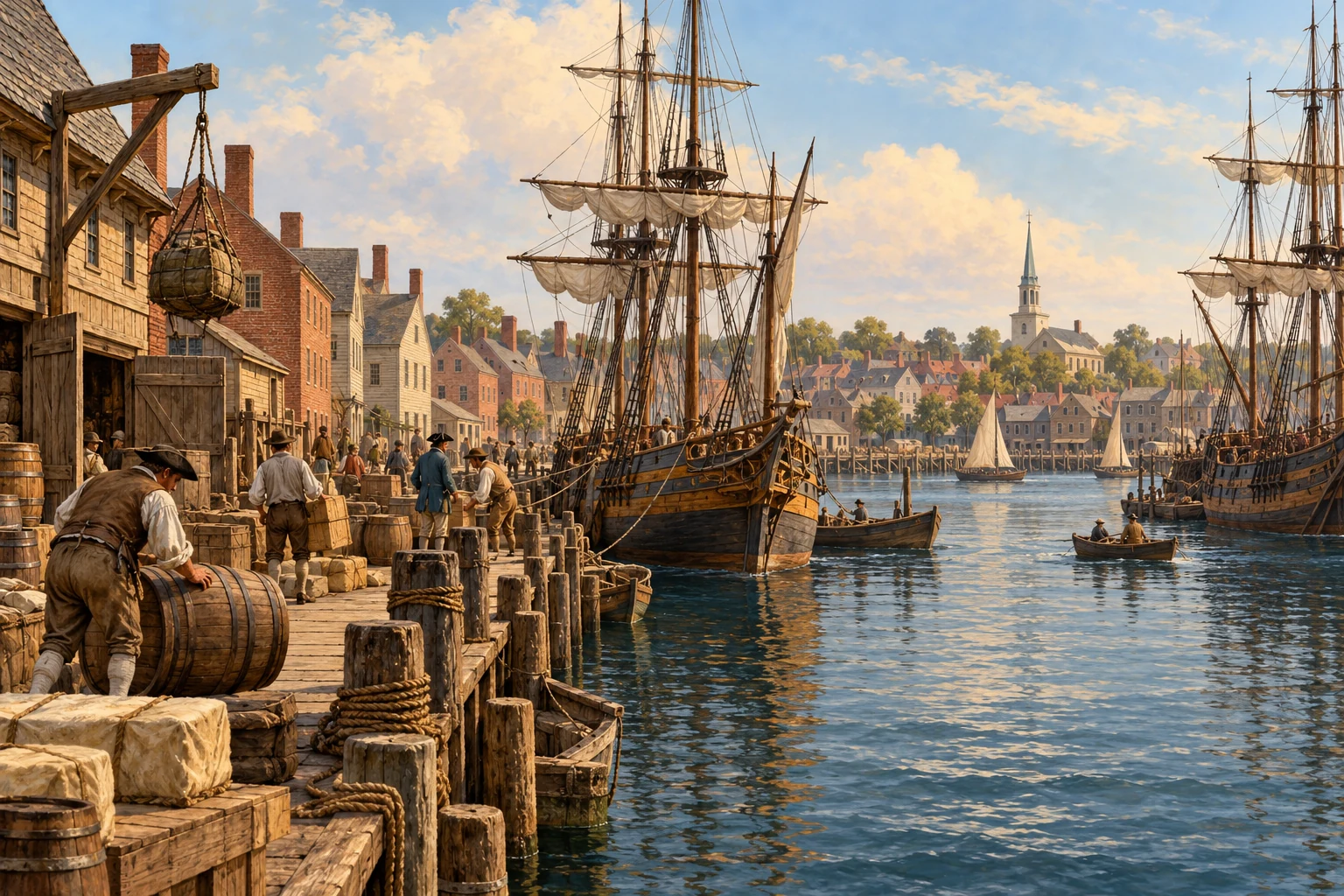
Modern AI-generated teaching illustration; not a historical painting or exact reconstruction.
2.1 Contextualizing Period 2
The big picture: 1607–1754
APUSH Unit 2 follows the establishment and development of European colonies in North America and the Atlantic world. 1607 marks Jamestown, the first enduring English settlement in what became the United States. It does not mark the beginning of Native history, African presence or European colonization in the Americas. 1754 marks the outbreak of the French and Indian War, the North American conflict that leads into Period 3. By then, British mainland colonies had developed diverse economies, expanding populations and local political institutions within an imperial system.
The period is about more than the origins of thirteen future states. Spanish borderlands, New France, New Netherland, the Caribbean and African societies shaped colonial development. Native nations retained power, pursued diplomacy and responded to settlement and commercial pressures. Enslaved Africans and their descendants sustained colonial production while resisting bondage and creating communities.
European colonization continued processes begun in Period 1: biological exchange, imperial rivalry, religious conversion and resource extraction. New developments included the scale of English settlement, expanding plantation economies, more systematic hereditary racial slavery and growing connections among colonial ports. Regional differences developed alongside shared British cultural and political practices.
Four connections to keep in view
- Environment and human decisions: soil, waterways, climate and disease environments influenced settlement and production. Investment, law, migration and coercion determined how resources were used. Geography alone did not make slavery inevitable.
- Trade and labor: tobacco, rice, sugar and other exports connected colonial producers to distant markets. Profit depended heavily on systems that exploited servants, enslaved people and Indigenous land and labor.
- Empire and local government: colonists developed assemblies and town institutions while remaining subjects of a monarchy and subject to imperial laws. Local political participation was restricted by gender, race, property and, in some settings, religion.
- Cultural ties and tensions: print, migration, consumer goods, the Enlightenment and Protestant revivalism linked colonists to Britain and one another. Strong British identification coexisted with local interests; independence was not a predetermined outcome.
How to study this unit: compare specific colonies, institutions and groups. Explain how a development worked, who benefited and who faced constraints. A claim about “colonial freedom” means something very different for a voting landowner, an indentured servant, an enslaved woman or a Native community defending its land.
2.2 European Colonization
Spain, France, the Netherlands and England pursued overlapping goals: profit, strategic influence, settlement and religious expansion. Different migration patterns and institutions produced different societies. No empire had one uniform relationship with Native peoples, and diplomatic cooperation could coexist with warfare and exploitation.
Spanish colonization: missions, settlements and borderlands
Spain governed a large American empire centered on Mexico, the Caribbean and parts of South America, with northern settlements and missions in Florida, New Mexico, Texas and other borderlands. Santa Fe was established in 1610; Spanish settlements, presidios and missions expanded imperial claims, promoted Catholic conversion and sought labor and tribute. Military, religious and civilian authorities did not always agree about how to govern.
Encomienda and other labor demands continued in some regions, alongside ranching, farming and local exchange. Mission communities could face forced work, restrictions on movement and suppression of religious practices. Native responses included negotiation, selective adoption, flight and revolt. The Pueblo Revolt of 1680 exposed the limits of Spanish authority and encouraged some later accommodation of Pueblo practices.
Spanish colonial societies included Europeans, Indigenous peoples, Africans and people of varied ancestry, under unequal legal and social arrangements. Borderland conditions differed from the mining centers of Mexico and the Andes. Do not assume that every Spanish settlement was a gold mine or that every Native person had the same status.
Chronology check: the famous mission chain in present-day California began in 1769, after this unit. Earlier missions existed in Baja California and elsewhere. For 1607–1754, Florida, New Mexico and Texas provide clearer northern colonial examples.
French colonization: trade, diplomacy and settlement
French colonization developed around the St. Lawrence River, Great Lakes and Mississippi watershed. Quebec, founded in 1608, became a center of New France. Fur trading and fishing mattered, but New France also included agricultural settlements, families, towns and institutions. Louisiana connected French claims to the lower Mississippi; New Orleans was founded in 1718.
Because French settlers were relatively few across much of the interior, they depended on Native trading partners, guides, suppliers and military allies. Traders, including coureurs de bois, operated through Indigenous networks and sometimes formed families with Native women. Such relationships helped create distinct communities, including the historical foundations of Métis peoples; “Métis” should not be used as a casual label for every person with mixed ancestry.
Jesuit missionaries pursued conversion, sometimes in ways that challenged Native religious authority. Alliances with Wendat and other peoples drew the French into conflicts with Haudenosaunee nations and their partners. French diplomacy could offer Native nations advantages, but commerce also increased pressures on animal populations and heightened competition. Later French Louisiana also developed plantation slavery. A blanket description of the French as peaceful and the English as violent obscures these differences.
Dutch colonization: commercial networks and unequal power
The Dutch West India Company promoted New Netherland around the Hudson River and New Amsterdam. Fur trading and Atlantic commerce were central. The patroon system offered large estates to investors who brought settlers, producing concentrated landholding and tenant relationships in some areas.
New Netherland attracted people of different European origins and religious backgrounds. Its commercial setting encouraged some accommodation of diversity, but toleration was limited and contested. Company interests, slavery, dispossession and wars with Native communities were also part of Dutch colonial society. Trade did not eliminate struggles over territory.
English forces took New Netherland in 1664, and New Amsterdam became New York. A brief Dutch recovery in the 1670s did not reverse lasting English control. Dutch families, churches, landholdings and commercial relationships continued to influence the region.
English colonization: several motives and forms of government
Some English migrants sought profits, land or employment; others wanted religious communities, refuge from persecution or new opportunities. English population growth and economic pressures supplied migrants, while investors and monarchs promoted overseas expansion. Migration was not uniformly voluntary: indenture, penal transportation and enslavement also shaped colonial populations.
Early Chesapeake migration was heavily weighted toward young men seeking work and profit. New England received more family groups, particularly during the Puritan Great Migration of the 1630s. Later colonies attracted Germans, Scots-Irish and other migrants as well as English settlers. These differences affected household formation, institutions and community life.
- Joint-stock company: investors pooled capital and shared risks and returns. The Virginia Company financed Jamestown; the Massachusetts Bay Company also operated under a charter.
- Proprietary colony: the crown granted governing rights to an individual or group, as in Maryland and Pennsylvania. Proprietors and assemblies could disagree over policy.
- Royal colony: the crown appointed a governor and exercised more direct authority. Assemblies could still influence taxation and spending. Virginia became royal in 1624.
- Charter government: a charter could provide substantial local governing privileges, as in Connecticut and Rhode Island. Arrangements changed over time rather than fitting one permanent category.
The expansion of farms and towns increased pressure on Native land. Colonial self-government was therefore compatible with dispossession and racial exclusion. It should not be equated with modern universal democracy.
| Empire | Important northern patterns | Relationships and limits |
|---|---|---|
| Spanish | Settlements, presidios, missions, tribute and ranching in borderlands | Conversion and coercion met resistance; local accommodations varied |
| French | St. Lawrence settlements, interior fur trade and Mississippi connections | Dependence on Native allies and exchange coexisted with religious pressure, warfare and slavery |
| Dutch | Hudson trade, New Amsterdam and patroon estates | Commercial diversity alongside unequal landholding, slavery and Native conflicts |
| English | Growing agricultural settlements and varied colonial governments | Local assemblies and family migration alongside land expansion and labor coercion |
2.3 The Regions of British Colonies
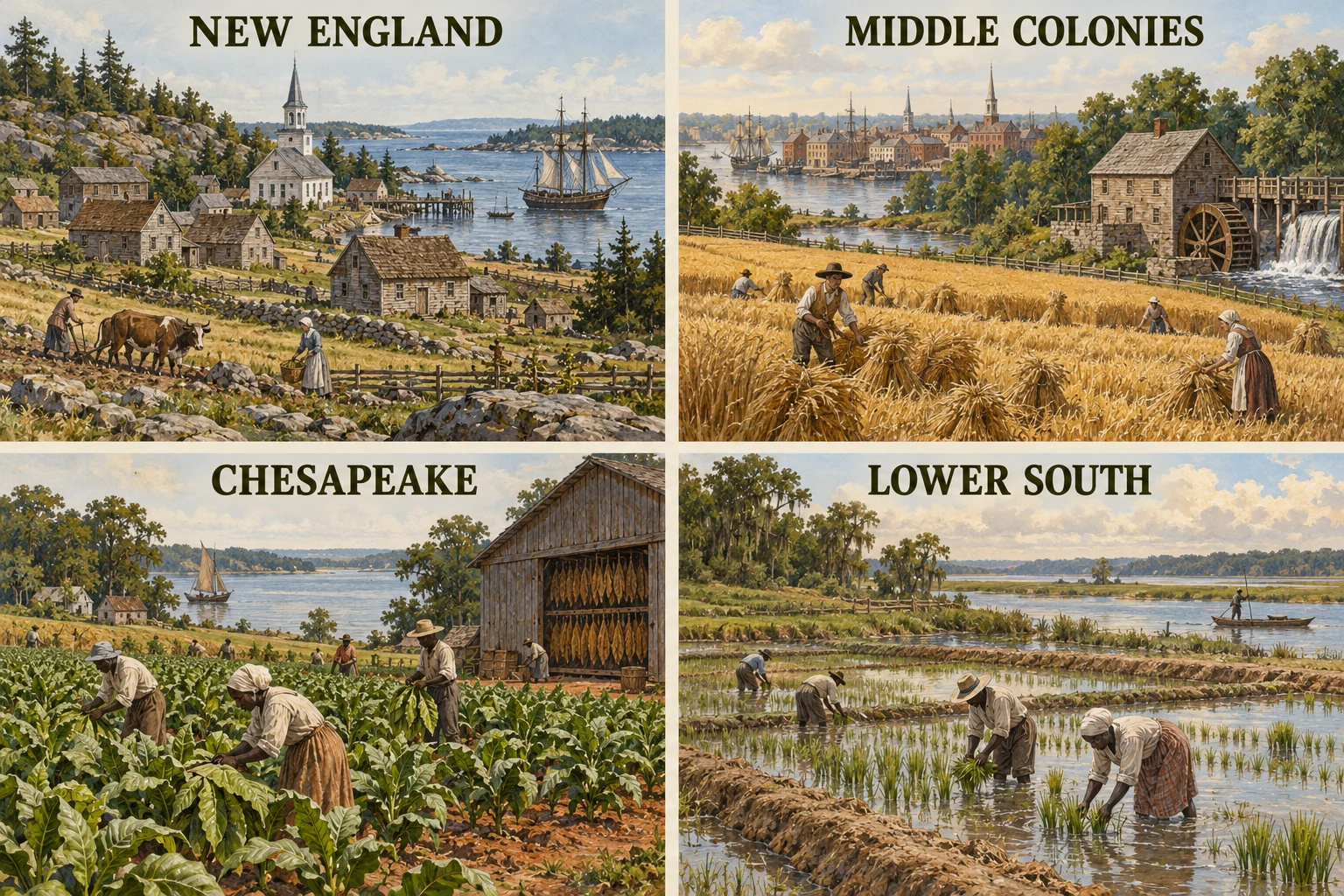
Regional differences emerged from environmental conditions, settler goals, migration, trade, institutions and Native relationships. They were tendencies, not rigid boundaries. The Chesapeake belongs to the broader Southern colonies but is separated here from the Lower South to make tobacco and rice economies easier to compare.
New England: towns, family farms and maritime commerce
Colonies and origins: Plymouth was founded in 1620 by Separatists often called Pilgrims; Massachusetts Bay was established in 1630 by Puritans seeking a reformed religious society. Connecticut, Rhode Island and New Hampshire developed distinct histories. Plymouth was incorporated into the new Massachusetts charter government in 1691. Maine was not a separate member of the thirteen colonies; much of it was governed within Massachusetts.
Environment and economy: short growing seasons and often rocky soils limited large staple-crop plantations. Families cultivated mixed farms, raised livestock and produced household goods. Forests, fisheries and harbors supported lumbering, shipbuilding, fishing, whaling and commerce. Merchants traded food, fish, timber and other products with the Caribbean, Britain and neighboring colonies. New England was commercial as well as agricultural, not merely a collection of isolated subsistence farms.
Settlement and households: family migration and comparatively favorable mortality conditions helped produce more stable households than in the early Chesapeake. Towns often centered on a meetinghouse and common lands. Life remained demanding, and outcomes varied by wealth and locality; a regional comparison is not a promise that everyone lived comfortably or equally long.
Religion and dissent: Puritans aimed to establish their own godly communities, not religious liberty for all. Church membership affected voting in early Massachusetts Bay. Roger Williams challenged religious coercion and colonial claims to Native land; his banishment led to Providence in 1636. Anne Hutchinson challenged clerical authority and was banished. Rhode Island became an important example of greater religious liberty, although freedom there was still shaped by colonial inequality and slavery.
Government and education: town meetings allowed some eligible men to participate in local decisions; assemblies governed colony-wide affairs. Eligibility differed by place and time, and women, enslaved people and many others were excluded. Bible reading encouraged schools and literacy, while Harvard, founded in 1636, trained clergy and other leaders. Access remained unequal. The Half-Way Covenant of 1662 addressed baptism and membership challenges as the religious commitments of later generations changed.
Slavery and commerce: enslaved Africans and Native Americans worked in households, farms, workshops and maritime settings. Their share of the population was generally lower than in plantation regions, but merchants and ports profited from slave trading and the Caribbean plantation economy. Smaller local enslaved populations did not mean the region was economically separate from slavery.
Middle Colonies: grain, ports and religious pluralism
Colonies: New York, New Jersey, Pennsylvania and Delaware developed from overlapping Dutch, Swedish and English settlements and claims. Delaware had a separate assembly from 1704 while remaining connected to Pennsylvania’s proprietor and governor. Colonial boundaries and governance were products of change, not an original fixed map.
Economy: productive farmland and access to rivers supported wheat and other cereal crops, flour milling and exports. The “breadbasket” label describes an important pattern, not the only occupation. Philadelphia and New York linked farming districts to Atlantic markets. Artisans, dockworkers, merchants, shipbuilders, iron producers and laborers contributed to regional growth. Large estates and tenancy persisted in parts of New York, alongside smaller family farms elsewhere.
Pennsylvania: William Penn received a charter in 1681 and promoted a Quaker “Holy Experiment.” Quaker beliefs emphasized an inward spiritual light and challenged established hierarchies in religious life. Pacifism and broader religious toleration attracted settlers, but practice did not erase inequalities. Some Quakers enslaved people, and organized Quaker opposition to slavery developed over time rather than existing uniformly from the start.
Diversity: English, Dutch, German, Scots-Irish, Swedish and other migrants brought different languages and churches. Quakers, Presbyterians, Lutherans, Reformed Christians, Anglicans, Jews and other groups lived in the region. Pluralism could encourage accommodation while also producing disputes over land, representation and religion. Toleration was not equivalent to equal citizenship for everyone.
Native relations and labor: Penn’s early diplomacy differed from later coercive practices and land claims, including the Walking Purchase of 1737. Free farmers, tenants, wage workers, indentured servants and enslaved people all participated in regional production. New York and Philadelphia were important sites of slavery even though the region lacked the Lower South’s rice-plantation pattern.
Chesapeake: tobacco, rivers and changing labor
Virginia: the Virginia Company established Jamestown in 1607 for commercial purposes. Disease, food shortages, poor planning, drought and conflict threatened survival. The Starving Time of 1609–1610 was especially severe. Colonists depended at different moments on trade with, and demands upon, Powhatan communities. Tobacco cultivation, associated with John Rolfe’s marketable crop from the 1610s, created a major export economy.
Land and settlement: navigable rivers helped plantations ship tobacco to market and encouraged dispersed settlement. Tobacco cultivation demanded labor and contributed to pressure for new land as fields lost productivity. The headright system awarded land, commonly fifty acres per qualifying person whose passage was financed, to encourage migration and investment. Sponsors could accumulate claims; servants did not automatically receive the land simply because they crossed the Atlantic.
Labor and society: indentured servants were important in seventeenth-century tobacco cultivation. Planters increasingly purchased enslaved Africans and their descendants as commercial supply, profitability and colonial laws reinforced hereditary bondage. This transition was uneven and developed over decades. Planter wealth and political power grew, while small farmers, tenants, servants and enslaved people faced very different prospects. Early male-heavy migration and high mortality affected family formation, although demography changed as the region matured.
Maryland: the proprietary colony settled in 1634 offered a setting for English Catholic interests under the Calvert family, but many settlers were Protestant. Its 1649 Act Concerning Religion protected certain Trinitarian Christian worship while imposing severe restrictions on others. It was not universal freedom of religion. Virginia’s Anglican establishment and Maryland’s religious conflicts show the limits of simple “religious refuge” labels.
Government: the representative assembly first met in Virginia in 1619. The House of Burgesses became a major institution of the planter elite. Representation gave some colonists a political voice, but voting qualifications and social power limited participation. The assembly’s role coexisted with royal authority and the exploitation of people excluded from representation.
The Lower South: rice, indigo and Caribbean connections
Carolina: the charter of 1663 created a proprietary colony that later divided; North and South Carolina became separate in 1712. Migrants from Barbados helped introduce plantation institutions and slaveholding practices to the Charleston area. North Carolina more often combined smaller farms, tobacco, timber and naval stores—tar, pitch and related shipbuilding supplies—although slavery also existed there.
South Carolina: rice became a major export, with indigo growing in importance during the 1740s. Lowcountry wetlands and waterways helped make rice cultivation profitable, but African agricultural knowledge, extensive labor, capital and coercion were essential. Early inland and swamp rice systems should not be confused with every later form of large tidal plantation. Enslaved Africans formed a majority of South Carolina’s population by the early eighteenth century; proportions varied locally and over time.
Labor and culture: demanding rice work often operated through a task system, assigning particular daily jobs. Completing a task could provide some time for household cultivation, exchange or community life, but this was constrained time within slavery, not legal freedom or an absence of violence. Gullah Geechee languages and cultural traditions developed through the interaction of diverse African knowledge and colonial conditions along the coast.
Georgia: the colony received its charter in 1732, and settlement at Savannah began in 1733 under James Oglethorpe and the trustees. It served as a strategic buffer against Spanish Florida and reflected plans for economic and social reform. Although relief for debtors influenced early proposals, describing all settlers as released debtors is inaccurate. Trustees initially prohibited slavery and imposed other restrictions; planter pressure and violations contributed to legalization in 1751. Georgia therefore cannot be described as a mature slave plantation colony from its first year.
Regional hierarchy: large planters exercised considerable influence, but the region also contained smaller farmers, towns, artisans and varied frontier communities. Anglican establishments did not produce complete religious uniformity. Spanish Florida’s offers of conditional freedom to some escapees made the border a site of both imperial conflict and African resistance.
| Region | Production and trade | Labor and settlement | Useful evidence |
|---|---|---|---|
| New England | Mixed farming, fisheries, timber, shipping and commerce | Family farms and towns; wage labor and slavery also present | Massachusetts Bay, town meetings, Harvard, dissenters |
| Middle Colonies | Grain, milling, crafts and Atlantic ports | Family farms, estates, tenants, servants and enslaved workers | Pennsylvania pluralism, Philadelphia, New York estates |
| Chesapeake | Tobacco exports through river networks | Dispersed plantations; growing hereditary racial slavery | Headrights, House of Burgesses, Virginia labor laws |
| Lower South | Rice, indigo, naval stores and Caribbean commerce | Plantations alongside smaller farms; major differences between colonies | South Carolina task labor, Gullah Geechee culture, Georgia’s changing policy |
Comparison tip: “New England had farms; the Chesapeake had plantations” is only a description. Explain how family migration, export crops, local conditions and investment produced different settlement and labor patterns. Then identify a shared connection, such as participation in Atlantic markets.
2.4 Transatlantic Trade
An Atlantic network, not one compulsory triangle
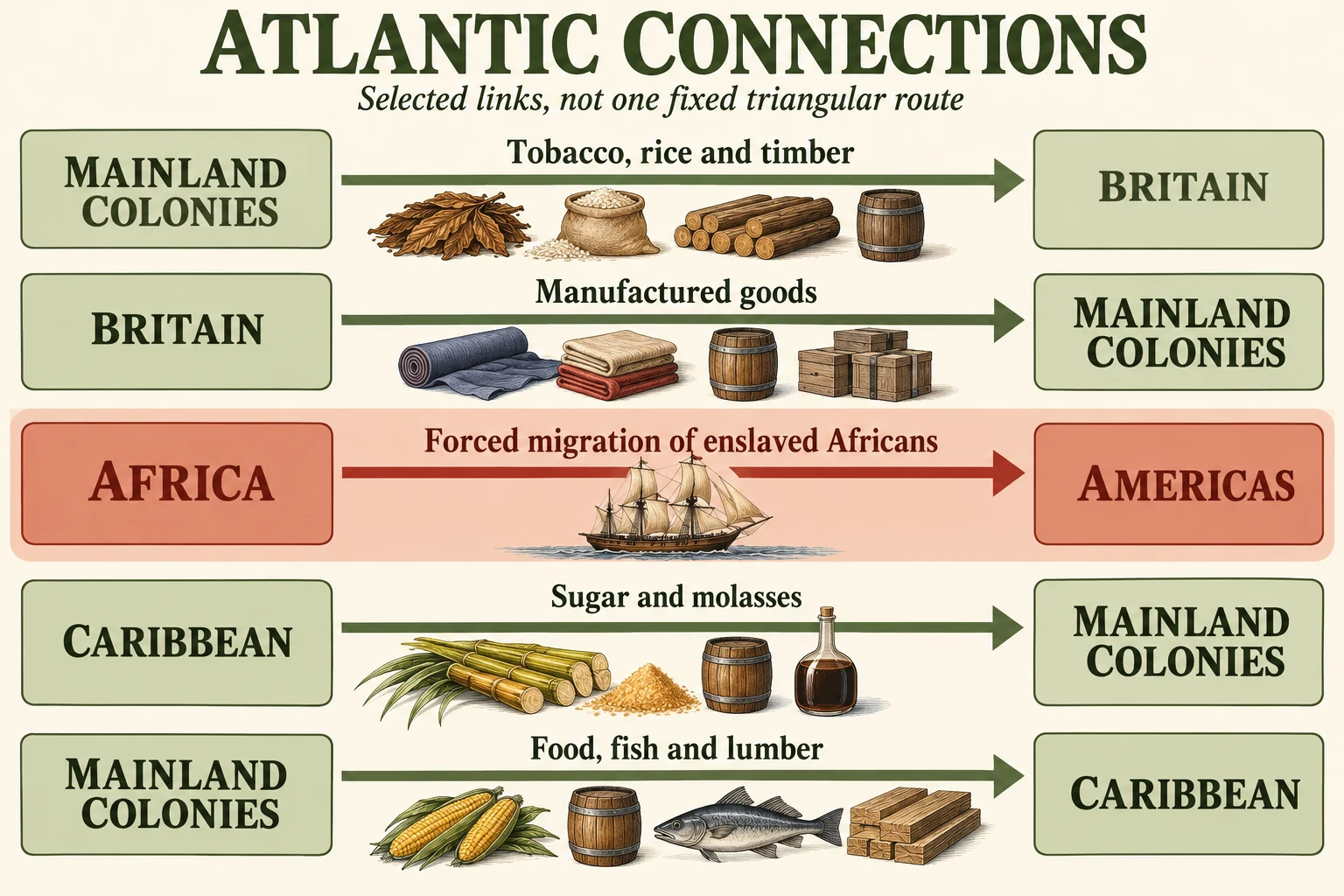
Colonial economies connected Europe, Africa, mainland North America and the Caribbean through shipping, credit, insurance, migration and commodity markets. Merchants carried goods along many routes, including direct voyages and exchanges among colonies. Triangular trade is a useful schematic for some connections, not a description of every ship completing three identical legs.
Mainland colonies exported tobacco, rice, indigo, grain, fish, timber and naval stores. Britain supplied manufactured goods and financial services. Caribbean sugar economies purchased food, animals, lumber and shipping services while exporting sugar and molasses. New England rum production depended on imported molasses; some merchants exchanged rum and other goods in African slave-trading networks. Legal and illegal routes overlapped.
The forced transportation of enslaved Africans was central to the Atlantic economy, but people should not be reduced to another interchangeable commodity in a diagram. Their captivity involved violence and the destruction and reconstruction of human relationships. Most transatlantic captives were taken to the Caribbean and Brazil over the trade’s full history, rather than to the thirteen mainland colonies. British Caribbean destinations were especially important within British networks; they were not the destination of most captives across every empire and century.
Mercantilism and imperial economic goals
Mercantilism describes policies that sought to strengthen a state’s wealth and power by regulating commerce, protecting shipping and securing useful colonial production and markets. European rulers linked trade to military competition. Colonies supplied valuable exports and purchased goods within an imperial system intended to benefit the home country.
Mercantilist practice was more complicated than “colonists could trade only with Britain.” Restrictions depended on the product, destination, ship and law. Some foreign commerce remained permitted, while smugglers circumvented other rules. Colonial shipbuilders, merchants and producers could gain protected markets and naval protection even as regulations constrained them. Benefits were unequal, and policies provoked bargaining as well as resistance.
Credit tied producers to distant merchants. A tobacco planter could purchase imported goods against expected future crops and incur debts when prices changed. Port cities connected regional production with global consumption, while demand for tea, cloth, ceramics and other imports helped shape a shared British consumer culture. Economic integration could strengthen British identification rather than immediately produce separatism.
| Measure | Main purpose or rule | Historical significance |
|---|---|---|
| Navigation Act, 1651 | Restricted carriage of imports to English ships or ships from the producing country, targeting commercial rivals | Promoted English shipping in competition with the Dutch |
| Navigation Act, 1660 | Strengthened imperial shipping requirements and designated enumerated colonial exports for restricted destinations | Tied colonial staples such as tobacco and sugar to imperial commercial channels |
| Staple Act, 1663 | Generally required European goods bound for colonies to pass through England | Supported English merchants and customs collection; exceptions and enforcement mattered |
| Plantation Duty Act, 1673 | Placed duties on certain enumerated goods moved through colonial trade routes | Sought to prevent evasions of imperial customs rules |
| Navigation legislation, 1696 | Strengthened customs enforcement and administrative oversight | Demonstrates that imperial supervision existed before 1763 |
| Molasses Act, 1733 | Imposed duties on foreign molasses and related sugar products entering British colonies | Protected British Caribbean interests; widespread evasion revealed conflicting colonial interests |
Uneven enforcement and colonial responses
Salutary neglect is a later label commonly used for periods of relatively loose or inconsistent imperial enforcement, particularly in the early eighteenth century. Distance, administrative limits, political priorities and local resistance made control uneven. It was not a permanent promise of independence or an absence of laws, royal governors, customs officers and imperial intervention.
Colonists used negotiation, lobbying, legal argument and smuggling. Merchants might evade duties while still valuing British markets and protection. Imperial officials tried to coordinate colonies and enforce rules, but colonists defended charter rights, local institutions and economic interests. These disagreements created important precedents for later conflict.
Do not compress a century of commerce into “Navigation Acts caused the Revolution.” Before 1754, many colonists remained loyal British subjects and benefited from empire. Later wars and post-1763 policies changed the political context. For this unit, explain the tension between integration and local autonomy without assuming the final outcome.
Reading the diagram: the five arrows illustrate selected relationships, not trade volumes or every destination. The Caribbean was part of the Americas; it is shown separately to clarify its connections with the British mainland. Some commodities moved through intermediate ports.
2.5 Interactions Between American Indians and Europeans
Native-European relationships did not move everywhere through an identical sequence of friendship, war and disappearance. Nations pursued their own interests, formed and changed alliances, traded, adopted technologies and defended sovereignty. Colonization brought severe disease, violence, enslavement and land loss, but Native communities survived and continued to shape the continent.
Trade, alliances and contested land
Native food, knowledge, diplomacy and military power were essential to early colonies. Wahunsenacawh, often called Powhatan, led a powerful network of communities in the Chesapeake. Ousamequin, often called Massasoit, negotiated an alliance with Plymouth in 1621 amid regional political pressures and epidemic losses. Neither leader acted simply to help Europeans; both pursued strategic goals.
Fur trading connected French and Dutch merchants with Native suppliers and intermediaries. Access to metal tools, firearms and other goods could strengthen particular communities while increasing commercial dependencies and warfare. Beaver hunting and competition over routes altered environments and political relationships. Haudenosaunee nations used alliances, including relationships later called the Covenant Chain, to pursue influence among competing powers. Native diplomacy was not merely a reaction to European decisions.
European settlement intensified land disputes. Native tenure could include territorial boundaries, community rights and family use rights; saying Indigenous people had “no concept of property” is inaccurate. Colonists might interpret agreements differently, impose courts, exploit debt or expand beyond negotiated limits. Livestock could damage fields, and new farms could restrict access to hunting and fishing. Cultural differences mattered alongside unequal power and deliberate dispossession.
Native adoption of horses and firearms also changed regional balances. Horses spread from Spanish settlements and helped transform mobility, hunting and warfare in parts of the West. The timing and meaning of those changes differed among peoples. Do not substitute a single mounted Plains image for the diversity of all Native North America.
Anglo-Powhatan wars and the Chesapeake
Relations around Jamestown included exchange, negotiation, demands for food and recurring warfare. The Anglo-Powhatan wars developed through several conflicts from the 1610s to the 1640s, as tobacco settlement expanded and Native leaders sought to constrain English power. An uneasy peace followed the marriage of Pocahontas, also known as Matoaka, to John Rolfe in 1614.
Pocahontas had been taken captive by the English in 1613 before her conversion and marriage. Describing her only as a willing peacemaker erases coercion. Later stories, including John Smith’s account of rescue, require critical source analysis rather than unquestioning repetition.
Opechancanough’s forces attacked English settlements in 1622 and again in 1644; English retaliation devastated communities and accelerated dispossession. The 1646 treaty imposed restrictions and tribute on surviving Powhatan peoples. English power increased, but Native nations did not cease to exist. Continuing treaty relationships and community survival complicate accounts of complete disappearance.
Pequot War, 1636–1638
Competition over trade, influence and territory contributed to war in southern New England. English forces and Native allies attacked the Pequot settlement at Mystic in 1637, killing hundreds, including women and children. The massacre illustrates the extreme violence of colonial warfare and the participation of Native alliances on different sides.
The defeat, forced dispersal and enslavement of survivors weakened Pequot political power and expanded English influence. It did not mean that Pequot people vanished. Avoid turning the conflict into “all Europeans against all Native Americans”: Mohegan and Narragansett interests differed from Pequot interests, and alliances were neither permanent nor equal.
Metacom’s War, or King Philip’s War
Land pressure, colonial jurisdiction, religious demands and deteriorating relationships produced war in 1675. Metacom, a Wampanoag leader called King Philip by the English, became a central figure. The execution of three Wampanoag men following the death of John Sassamon formed part of the immediate crisis.
Wampanoag, Nipmuc, Narragansett and other peoples fought against English colonies, while other Native communities allied with the English, remained neutral or made different local choices. The English attack on the Narragansett winter settlement in the Great Swamp in December 1675 helped bring Narragansett fighters into the war. Christian Native people also faced internment and suspicion, demonstrating that conversion did not guarantee protection.
The main southern New England fighting ended in 1676 with Metacom’s death, while related warfare continued farther north through 1678. Towns and communities suffered destruction, death, displacement and enslavement. English settlement expanded and Native power was severely weakened in parts of southern New England, but neither all Native sovereignty nor Native presence ended. Avoid unsupported universal casualty percentages or claims that this was one identical experience across the Northeast.
Pueblo Revolt, 1680: resistance reshapes Spanish rule
In New Mexico, demands for tribute and labor and suppression of Indigenous religion combined with drought, food insecurity and regional conflict. Po’pay, also written Popé, helped coordinate Pueblo communities in the revolt of 1680. Rebels expelled Spanish authorities and settlers from much of the region, demonstrating effective Indigenous organization across distinct communities.
Spanish forces returned under Diego de Vargas in 1692, with reconquest and resistance continuing beyond that initial return. The reestablishment of Spanish rule combined military pressure, negotiation and settlement. Spanish authorities subsequently accommodated some Pueblo practices more than before, without ending colonial inequality or coercion.
The revolt was a major successful expulsion of colonial power, not the “only successful Native revolt” in all American history. It belongs to a wider history of adaptation, resistance and negotiated limits. Pueblo peoples retained distinct communities, religious traditions and political identities.
Bacon’s Rebellion and the politics of frontier violence
In Virginia in 1676, Nathaniel Bacon challenged Governor William Berkeley amid disputes about frontier policy, political favoritism, taxation, land and economic conditions. Bacon was himself connected to the colonial elite; the rebellion cannot simply be reduced to a spontaneous poor-person uprising. His forces attacked Native communities, including people allied with the colonial government, and burned Jamestown.
The rebellion exposed class conflict and the difficulty of controlling settler expansion. It also shows how colonists’ arguments about security and opportunity could involve violence against Native peoples. It was not a modern democratic or anticolonial movement committed to equal rights.
Historians connect the rebellion to elite fears of social unrest, but racial slavery was already developing. Virginia’s hereditary-status law of 1662 preceded 1676. Changes in labor supply, Atlantic slave trading, life expectancy, profitability and law must also explain the expansion of slavery. Native perspectives are essential to understanding what the rebellion did, not merely how it affected white labor policy.
Compare outcomes: Metacom’s War strengthened English expansion after devastating conflict; the Pueblo Revolt temporarily expelled Spanish authority and influenced its later return. Both involved colonial pressure and Native coalitions, but their timing, objectives, alliances and consequences differed.
2.6 Slavery in the British Colonies
How did hereditary racial slavery develop?
Colonial slavery grew through deliberate decisions by merchants, planters, lawmakers and imperial authorities. Demand for profitable staple crops encouraged the purchase of enslaved people. Atlantic commercial expansion increased access to captives, while colonial statutes defined racial status and strengthened owners’ claims. Racial ideology justified exploitation and was further entrenched through institutions.
Indentured servitude required service for a specified term, often several years, commonly in exchange for passage. Contracts could be coercively enforced, workers could be punished or transferred, and many died before completing service. Survivors might receive freedom dues, but land and prosperity were not guaranteed. Some people entered contracts under extreme economic pressure or were transported unwillingly.
Chattel slavery treated people as property under generally lifelong, hereditary bondage. Enslaved people faced sale, family separation, sexual exploitation and violent discipline. Legal restrictions were shaped by race and ancestry. Although both systems involved coercion, temporary service with a potential legal end differed fundamentally from a system transmitting bondage to children.
The growing reliance on slavery in the Chesapeake was gradual. Improvements in survival made lifetime labor more profitable to buyers; changing servant migration and the expansion of slave-trading networks also mattered. Bacon’s Rebellion may help explain elite concerns about control, but it neither created slavery nor caused one immediate colony-wide switch. Small farmers, servants and free wage workers continued to exist alongside plantation slavery.
Law created and maintained unequal status
In 1662, Virginia made the status of children follow the condition of their mother, a principle commonly called partus sequitur ventrem. Children of enslaved women were thus enslaved, regardless of their father’s status. The rule protected slaveholders’ claims and intensified the exploitation of enslaved women. It also confirms that the legal hardening of bondage began before Bacon’s Rebellion.
A Virginia law of 1667 stated that baptism did not change an enslaved person’s condition. Later statutes, including the Virginia code of 1705, consolidated distinctions involving race, labor and legal power. Other colonies developed their own codes. These were changing legislative constructions, not a natural or inevitable social order.
Slave codes restricted movement, assembly, testimony, marriage and access to resources and empowered coercive policing. Specific provisions differed across colonies and decades. Do not assume every colony prohibited all reading and writing throughout this period, or describe every legal rule as identical. Laws imposed brutal inequality without extinguishing the humanity, relationships or resistance of the people they targeted.
Free Africans and their descendants also lived in colonial societies, but faced increasing restrictions. Wealth and freedom did not reliably remove racial barriers. White political participation expanded in some settings while racial exclusion hardened, creating a central contradiction in the history of colonial liberty.
| Category | Indentured servitude | Racial chattel slavery |
|---|---|---|
| Duration | A stated service term, sometimes extended as punishment | Generally lifelong unless freedom was secured through an exceptional route |
| Children’s status | Service did not automatically reproduce an identical lifelong hereditary status | Colonial laws tied children’s bondage to the enslaved mother |
| Freedom and opportunity | Survivors could complete service; freedom dues and later prospects varied | Manumission or escape were constrained; no ordinary contractual end |
| Coercion | Harsh labor, punishment, transfer and restricted mobility | Ownership claims, sale, family separation and racialized violence |
| Historical change | Important in early Chesapeake production and later migration | Expanded unevenly as markets, laws and plantation investment developed |
Regional experiences and work systems
Chesapeake tobacco: enslaved people performed field, household, craft and other labor. Supervised group work, often called gang labor, was important on plantations. Conditions changed with plantation size, demography and owners’ practices. By the eighteenth century, family and community formation became more possible in some settings, while sale and coercion continued to threaten those relationships.
Lowcountry rice: large concentrations of African-born people and their descendants worked in dangerous, disease-prone environments. The task system assigned daily work; completing it could allow limited control over remaining time. It did not give workers legal freedom, guarantee humane treatment or apply to every enslaved worker. African agricultural expertise and community relationships were important to production and cultural life.
Northern colonies: enslaved people worked on farms, in domestic service, crafts, docks and maritime trades. Port cities combined greater movement in some occupations with surveillance and severe restrictions. New England and Middle Colony involvement in slave trading, shipping and plantation supply made slavery an Atlantic economic relationship, not exclusively a Southern institution.
British Caribbean: sugar plantations relied heavily on enslaved labor, high levels of forced importation and brutal work regimes. Their wealth and institutions influenced mainland colonies, especially South Carolina. The history of British North America cannot be understood by excluding Barbados, Jamaica and other Caribbean colonies.
Resistance, kinship and African American cultures
Enslaved people resisted through escape, revolt, refusal, work slowdowns, damage to production and efforts to preserve autonomy. Such actions carried severe risks. Maintaining families, religious practices, language, food traditions, music and knowledge also sustained people under a system intended to control them. Not every personal or cultural act was the same kind of organized resistance, but community life was far more than passive acceptance.
People brought from different African regions adapted practices to new circumstances and formed African American cultures. Gullah Geechee traditions in the coastal Southeast reflect both African continuities and new cultural creation. Family ties could include extended or chosen kin when sale and separation disrupted households. Christian conversion and African spiritual traditions interacted in varied ways; one uniform religious experience did not develop everywhere.
The Stono Rebellion of 1739 in South Carolina involved enslaved people seizing weapons and moving toward Spanish Florida, where imperial policy offered a possible route to freedom under specified conditions. Colonial forces violently suppressed the rebellion, and lawmakers imposed harsher controls in its aftermath. The revolt connects local resistance, African experiences, plantation conditions and international rivalry.
Some escapees formed maroon communities in difficult terrain or sought refuge among Native communities or in rival imperial territories. Freedom was uncertain and often contested. These strategies demonstrate how geography and competing jurisdictions could be used against slaveholders’ power.
Essential distinction: describing how slavery produced wealth explains an institution; it does not justify it. Historical analysis should identify enslavers’ incentives while preserving the experiences, skills and decisions of enslaved people.
2.7 Colonial Society and Culture
Migration, population and unequal opportunity
Colonial populations grew through migration, forced migration and natural increase. Family migration and births were especially important in New England; early Chesapeake settlement relied more heavily on incoming workers before demographic conditions changed. German-speaking migrants and Scots-Irish settlers added to the diversity of the Middle Colonies and backcountry. Enslaved Africans arrived through forced transportation, while Native communities faced migration and displacement under colonial expansion.
Colonial society was hierarchical. Wealthy planters and merchants exercised disproportionate influence; small farmers, tenants, artisans and laborers had differing opportunities. Port cities included poverty as well as commercial wealth. Land could offer mobility to some European settlers, but access depended on money, connections, legal claims and the dispossession of Native peoples. Indentured service did not guarantee a prosperous farm afterward.
Women’s work was central to agriculture, household production, commerce and family economies. Under coverture, a married woman’s legal identity and property powers were generally restricted through her husband, although rules and practical opportunities varied. Unmarried women and widows could have different legal capacities. Enslaved women faced ownership claims and reproductive exploitation; Native women’s authority depended on their own communities and on colonial interventions. A general description of “colonial women” cannot capture all these experiences.
Social hierarchy and opportunities for some free colonists expanded together with racial exclusion. Claims about liberty should therefore name who could exercise a particular right. The existence of assemblies and courts did not mean equal protection, universal voting or freedom from exploitation.
Anglicization: stronger British ties and growing local institutions
Anglicization means the adoption or strengthening of English and later British cultural, political and commercial patterns. Colonists bought British consumer goods, read imported books and newspapers, followed fashions and emulated elite architecture and manners. Merchants relied on British credit and shipping, and educated colonists drew on English law and political ideas.
These ties did not prevent locally distinctive societies from emerging. Assemblies, towns, religious communities and commercial relationships developed their own priorities. Colonists often defended local autonomy by appealing to their rights as English or British subjects, rather than rejecting British identity. Local political confidence and imperial identification could reinforce one another.
Growing intercolonial connections did not erase differences between colonies. Religious revivals, mail, print and commerce spread ideas, but disputes over borders, taxes, religion and representation continued. Avoid calling the colonies a unified American nation before independence.
The Enlightenment: reason, inquiry and political argument
The Enlightenment emphasized reason, observation, the study of nature and critical examination of inherited authority. Thinkers developed different views about society, religion and government; it was not one complete program accepted by all colonists. Scientific curiosity and practical improvement found audiences through correspondence, books and learned societies.
John Locke argued that legitimate government rested on consent and should protect natural rights. Such ideas later influenced revolutionary arguments, but their application in colonial society was selective and contradictory. Natural-rights language did not automatically produce equality for women, enslaved people or Native nations.
Benjamin Franklin illustrates practical inquiry, print culture and civic improvement. His publishing and associational activities helped circulate knowledge and promote libraries and public projects. His electrical experiments in the 1740s and early 1750s demonstrate the transatlantic exchange of scientific ideas. Use him as evidence of colonial participation in a wider intellectual world, not proof that all colonists rejected religion.
Deism generally emphasized a creator understood through reason and nature rather than reliance on revelation alone. Some educated people found such approaches persuasive; most colonists did not become deists. Enlightenment inquiry could coexist with Christianity and other religious commitments.
The First Great Awakening: conversion, print and division
Religious revivals in the 1730s and 1740s emphasized personal conversion, spiritual renewal and the experience of a new birth. The movement crossed the Atlantic and spread through traveling preachers, local congregations and print. It was a series of uneven regional revivals rather than a single synchronized event reaching everyone identically.
Jonathan Edwards became associated with revival in New England, while George Whitefield attracted large audiences during his tours. Preachers called listeners to examine their faith, sometimes challenging established ministers and institutional authority. Many participants understood revival as a renewal of Christianity, not a rejection of religious truth.
Supporters often called New Lights and critics called Old Lights disputed proper religious experience and clerical authority. Related divisions appeared among Presbyterians as New Side and Old Side. Revival could increase denominational competition and offer some people new roles, while also dividing communities. It did not lead uniformly to religious tolerance or a single colonial church.
Women, Africans and Native people participated in different settings, but spiritual appeals did not guarantee political or social equality. Whitefield’s support for slavery in Georgia demonstrates the contradictions of revivalist culture. The Awakening challenged some forms of authority while leaving or reinforcing other hierarchies.
| Category | Enlightenment | First Great Awakening |
|---|---|---|
| Typical emphasis | Reason, observation, inquiry and improvement | Personal conversion, spiritual renewal and evangelical preaching |
| Examples | Locke’s political arguments; Franklin’s publishing and scientific work | Edwards’s ministry; Whitefield’s tours; revival debates |
| Networks | Books, newspapers, correspondence and learned associations | Itinerant preaching, congregations, correspondence and print |
| Authority | Invited examination of inherited assumptions and institutions | Sometimes challenged established ministers and encouraged religious choice |
| Limits | Reason and rights were not applied equally to every population | Conversion did not automatically abolish slavery or end hierarchy |
Schools, print and public debate
Religious commitments encouraged literacy and schooling, especially in New England, but access varied by gender, wealth, place and legal status. Colleges such as Harvard, Yale and the College of New Jersey—later Princeton—trained ministers and other leaders. A college’s modern name should not be assumed to have been its name at founding.
Newspapers, sermons, pamphlets and almanacs connected readers with commercial information, religious disputes, imperial affairs and intellectual developments. Printers helped create networks that later served political mobilization, but early print culture also spread British fashions and loyalties. Literacy was not universal, and reading aloud could circulate material beyond individual readers.
The John Peter Zenger trial of 1735 in New York became an important example in debates about criticism of officials and freedom of the press. His acquittal did not establish unrestricted press freedom throughout the empire. Distinguish an influential precedent in public memory from a comprehensive legal guarantee.
Self-government inside an empire
Colonial assemblies claimed authority over local taxation and spending, and governors often depended on them for financial support. Town meetings, county courts and representative bodies gave eligible colonists practical experience in political debate. Property, gender, race and sometimes religious qualifications restricted participation. Assemblies could resist governors while supporting the exploitation of people excluded from politics.
England and later Britain attempted to coordinate colonial government and trade. The Dominion of New England, established in 1686, combined colonies under greater royal supervision; Governor Edmund Andros became a focus of resentment over authority, taxes, land titles and religion. The upheaval of the Glorious Revolution of 1688–1689 helped trigger the Dominion’s collapse in 1689. The restoration of local institutions still occurred within imperial rule.
English political traditions—including representative government, consent to taxation, legal rights and opposition to arbitrary power—provided language for colonial claims. Crown officials also asserted authority through royal appointments, charter changes and trade enforcement. “Salutary neglect” describes aspects of uneven oversight, not complete colonial independence.
By 1754, colonial societies possessed strong local institutions alongside extensive British cultural and economic ties. The French and Indian War would alter this balance. The war’s ending in 1763, the Stamp Act of 1765 and the Declaration of Independence in 1776 belong to later developments, not the core chronology of Unit 2.
2.8 Comparison in Period 2
Build a comparison around a shared question
A useful comparison selects a category—labor, religion, settlement, government or relations with Native nations—and explains both similarity and difference with specific evidence. Two unrelated descriptions are not enough. Identify how the examples answer the same historical question and explain why a similarity or difference matters.
- New England and Chesapeake settlement: both expanded English land claims and participated in Atlantic commerce. Family migration, mixed farming and town institutions were more prominent in much of New England; tobacco exports, dispersed plantations and growing enslaved labor characterized much of the Chesapeake.
- French and English colonization: both sought profit and strategic power and depended on Native knowledge and relationships. Interior French trade often required durable Native alliances, while the larger scale of English agricultural settlement intensified land pressure. Neither pattern eliminates warfare, coercion or local variation.
- Indenture and slavery: both involved harsh labor discipline and restricted mobility. Indenture had a stated service term, while colonial racial slavery generally imposed lifelong hereditary status. Explain law and experience instead of simply calling one system “free.”
- Enlightenment and revival: both circulated through transatlantic networks and could question authority. They emphasized different approaches to knowledge and religious life, and neither uniformly produced modern equality.
- Native resistance: Metacom’s War and the Pueblo Revolt involved pressure on land, authority and culture. Their coalition-building, opponents and results differed, showing that resistance had no single outcome.
A model comparison paragraph
Practice prompt: Compare the development of New England and the Chesapeake during the seventeenth century.
Possible claim: Both regions developed through Atlantic migration and expanding English claims to Native land, but migration patterns and export opportunities helped produce more town-centered family communities in New England and dispersed tobacco settlements in the Chesapeake.
Evidence and explanation: Puritan family migration supported Massachusetts towns and religious institutions, while tobacco production encouraged Virginia planters to locate along navigable rivers and recruit workers. The headright system rewarded financed migration and helped concentrate land claims. These differences shaped community organization and labor demand. Nevertheless, New England merchants and Chesapeake planters both participated in Atlantic commercial systems involving slavery.
Why it works: the paragraph identifies a shared process, gives specific evidence and explains a difference without claiming every household followed the same pattern. A longer response should develop the particular categories requested by its prompt.
Avoid simple chains: warm weather did not automatically create slavery, revival did not automatically create revolution, and a European trading alliance did not mean equal power. Explain the choices, institutions and circumstances connecting cause and outcome.
Period 2 timeline: 1607–1754
| Date | Development | Why it matters |
|---|---|---|
| 1607–1610 | Jamestown, Quebec and Santa Fe established | Different English, French and Spanish colonial patterns |
| 1619 | Virginia representative assembly; captive Africans arrive at Point Comfort | Political participation and labor coercion developed together; African presence elsewhere was earlier |
| 1620 and 1630 | Plymouth; Massachusetts Bay | Different Separatist and Puritan settlement projects |
| 1634–1638 | Maryland settlement; Providence; Pequot War | Religion, dissent, land and colonial warfare |
| 1649–1663 | Maryland religion law; major Navigation Acts; Virginia hereditary-status law | Limits of toleration, imperial regulation and the legal construction of slavery |
| 1664 | English seizure of New Netherland | Imperial rivalry reshapes the Middle Colonies |
| 1675–1678 | Metacom’s War and northern continuation; Bacon’s Rebellion in 1676 | Native sovereignty, settler expansion and contested authority |
| 1680–1681 | Pueblo Revolt; Pennsylvania charter | Different struggles over colonial authority and religion |
| 1686–1692 | Dominion of New England; Glorious Revolution; Spanish return to New Mexico | Imperial centralization and resistance, followed by changing settlements |
| 1705–1712 | Virginia slave code; formal division of the Carolinas | Consolidation of racial slavery and regional government |
| 1732–1733 | Georgia charter and Savannah settlement; Molasses Act | Imperial strategy, social planning and competing commercial interests |
| 1730s–1740s | First Great Awakening; growing print and intellectual networks | Religious division and stronger transatlantic connections |
| 1739 | Stono Rebellion | Enslaved resistance linked to plantation conditions and Spanish Florida |
| 1751 | Slavery legalized in Georgia | Colonial policy changed under economic and political pressure |
| 1754 | French and Indian War begins; Albany Congress | Transition into Period 3; proposals for coordination did not create a unified colonial government |
Essential Unit 2 terms and people
- Joint-stock, proprietary and royal colonies
- Different arrangements involving investors, proprietors or more direct crown authority. Governing arrangements changed over time.
- Puritans and Separatists
- Puritans sought further religious reform; Separatists broke from the Church of England. Plymouth and Massachusetts Bay had distinct origins.
- Mayflower Compact
- The 1620 agreement among male signers at Plymouth to form a civil body and obey its laws; not universal democratic government.
- Roger Williams and Anne Hutchinson
- Dissenters whose conflicts with Massachusetts authorities reveal limits of Puritan religious toleration.
- William Penn and Quakers
- Penn’s Pennsylvania project promoted religious accommodation; Quaker spiritual principles did not remove every colonial inequality.
- Headright system
- Land claims awarded for financing qualifying migration, benefiting sponsors as well as encouraging settlement.
- House of Burgesses and town meetings
- Representative and local institutions that gave some colonists political experience while excluding many others.
- Mercantilism and Navigation Acts
- Imperial efforts to promote state power through regulated commerce, shipping and colonial markets.
- Enumerated goods
- Specified colonial products subject to restricted destinations under imperial trade laws, with rules changing over time.
- Salutary neglect
- A label for periods of comparatively loose or uneven imperial enforcement, not a grant of independence.
- Middle Passage
- The forced Atlantic crossing of enslaved Africans, marked by violence, deprivation and death.
- Indenture and chattel slavery
- Specified-term service versus property-based bondage that colonial laws generally made lifelong and hereditary.
- Partus sequitur ventrem
- The principle that a child’s status followed the mother’s condition, used by Virginia’s 1662 law to reproduce slavery.
- Task and gang labor
- Work organized by assigned daily tasks or supervised groups; neither made enslaved workers legally free.
- Gullah Geechee and maroon communities
- Distinct coastal African American cultures; and communities formed by people escaping slavery. These are different concepts, not interchangeable labels.
- Metacom and Po’pay
- Major leaders associated respectively with the New England war beginning in 1675 and the Pueblo Revolt of 1680.
- Bacon’s Rebellion
- A 1676 challenge to Virginia’s governor involving settler violence, frontier policy and social tensions; not the sole origin of slavery.
- Stono Rebellion
- The 1739 South Carolina uprising connecting enslaved resistance with possible refuge in Spanish Florida.
- Anglicization
- Growing participation in British cultural, commercial and political patterns, alongside local colonial development.
- Enlightenment and deism
- A broad emphasis on inquiry and reason; and a religious approach emphasizing a creator understood through nature and reason.
- First Great Awakening
- Uneven transatlantic religious revivals emphasizing conversion and renewal, especially in the 1730s and 1740s.
- Edwards, Whitefield, Franklin and Locke
- Examples respectively connected to revival preaching, itinerant evangelism, practical inquiry and publishing, and political arguments about rights and consent.
- Dominion of New England
- A royal centralizing project established in 1686 and overturned during colonial upheaval in 1689.
- Coverture
- Legal restrictions generally placing a married woman’s identity and property powers under her husband, with variations and exceptions.
Source analysis and active-recall practice
Read a source in its historical situation
Identify the author or creator, date, audience and purpose. Describe the argument or visual features before drawing conclusions. Ask what the source can establish and what it leaves uncertain. An assembly’s law reveals what lawmakers sought to enforce; it does not prove perfect compliance. A map may express a claim rather than actual control, and a later painting may tell you more about its own era than the event it depicts.
Worked example: Virginia’s 1662 hereditary-status law provides evidence of lawmakers deliberately defining bondage through the mother. Its date demonstrates that the legal construction of slavery preceded Bacon’s Rebellion. It does not, by itself, reveal every enslaved family’s experience or prove that law operated identically in all colonies. Compare it with other statutes, petitions, contracts and family histories.
For a sermon or revival account, consider why a preacher emphasized conversion and how supporters and critics might describe the same gathering differently. For a shipping record, identify the route and product but do not assume every voyage followed that route. Specific evidence supports bounded claims rather than unlimited generalizations.
Why did New England and the Chesapeake develop different settlements?
Migration patterns, production, local environments and institutions interacted. Family migration and mixed farming supported many New England towns. Tobacco exports and river access encouraged dispersed Chesapeake plantations and heavy labor recruitment. Both regions remained linked to Atlantic commerce and Native dispossession.
Why is Bacon’s Rebellion insufficient to explain slavery’s growth?
Slavery and hereditary-status legislation preceded 1676. The rebellion exposed political and social tensions, but expanding slave-trading networks, changing servant supply, planter calculations, survival conditions and discriminatory laws also shaped the transition.
Compare the Pueblo Revolt and Metacom’s War.
Both involved Native responses to colonial pressure and coalition-building. The Pueblo Revolt expelled Spanish authority from much of New Mexico and affected later accommodation. Metacom’s War devastated New England communities and strengthened English expansion, without eliminating Native peoples.
How could anglicization and local self-government grow together?
Colonists adopted British goods, ideas and political models while developing assemblies and local institutions. They often defended local privileges as rights of British subjects. Strong British identity did not prevent disputes over imperial control.
What did the Enlightenment and Great Awakening share?
Both crossed the Atlantic through people, communication and print, and both could question authority. Their emphases differed—reason and inquiry versus evangelical conversion—and neither guaranteed equal rights or inevitably led to independence.
Revision routine: explain one development with two examples, compare two regions or institutions, and connect a source’s date to its argument. Use the timeline to keep Period 2 separate from the later imperial crisis. These are independent NUM8ERS study exercises, not official College Board questions.