
Period 1 · 1491–1607
APUSH Unit 1
Study Notes
The Americas and the beginnings of an Atlantic world.
Explore Native American societies, European expansion, the Columbian Exchange and colonial life with detailed notes and visual explanations.
Modern AI-generated teaching illustration; not a historical map or primary source.
1.1 Contextualizing Period 1
What does APUSH Unit 1 cover?
Period 1: 1491–1607 explains the societies that existed in the Americas before sustained European contact and the changes produced by Atlantic exploration, conquest and colonization. Its central story connects three broad regions—the Americas, Europe and Africa—while recognizing the many different peoples within each. Native Americans and Africans made decisions, negotiated, resisted and maintained communities; they were historical actors as well as targets of European exploitation.
1491 is a useful starting point, not the beginning of American history. Indigenous histories extend thousands of years before Columbus. By the late fifteenth century, the Americas contained cities, villages, mobile communities, extensive trade networks and varied political systems. The date encourages you to explain that existing world before discussing European arrival. 1607 marks the founding of Jamestown, the first enduring English settlement in what became the United States. It does not mark the first European settlement in North America or the end of Native independence.
Spanish and Portuguese expansion dominated much of this early Atlantic transformation. France and England also explored and attempted settlement before 1607. The Spanish Caribbean, Mexico and Andes matter to AP U.S. History because their colonial institutions, labor demands and exchanges shaped the wider Atlantic world and later North American development.
The three contexts to connect
- The Americas: migration, crop domestication, exchange and environmental management had produced diverse societies. Maize farming supported population growth in some regions; elsewhere fishing, gathering and hunting sustained substantial communities.
- Europe: monarchs and merchants sought profitable trade routes, resources and strategic advantages. Maritime experience, finance and navigational knowledge made repeated ocean voyages increasingly feasible. Christian expansion supplied another powerful justification.
- Africa: politically and culturally diverse societies participated in regional and long-distance commerce. Portuguese maritime expansion connected existing systems of captivity and trade to Atlantic plantation economies. The expanding traffic in enslaved people brought profound violence and disruption, with different effects across African regions.
The resulting contact was both an exchange and an unequal struggle over land, labor, religion and sovereignty. Biological transfers crossed the ocean in both directions, but epidemic disease, conquest and forced labor imposed especially destructive consequences on Indigenous communities.
Revision focus: For every development, ask who acted, what they wanted, what conditions made action possible and what changed. “European contact changed America” is a starting claim; a strong explanation identifies a specific mechanism, such as smallpox disrupting communities or sugar cultivation increasing coerced labor demand.
1.2 Native American Societies Before European Contact
Native North America was a continent of distinct nations, languages, economies and political traditions. Geography influenced opportunities, but people actively transformed their surroundings through agriculture, irrigation, burning, construction and resource management. Avoid describing one region as more “advanced” simply because it farmed or built large cities.
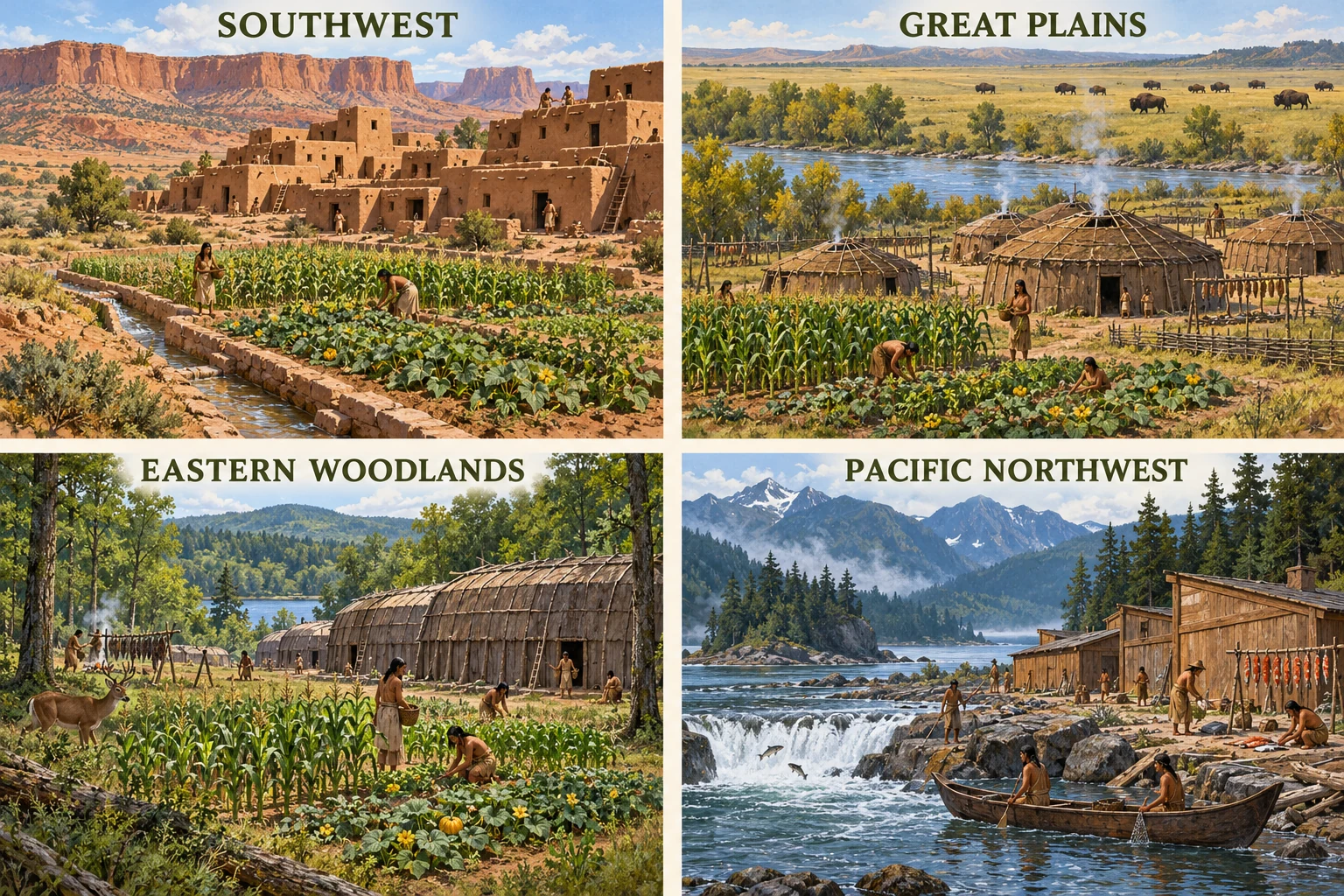
Maize, agriculture and social organization
Maize was domesticated in present-day Mexico and spread northward over many centuries. Together with other crops, it supported more reliable food supplies, denser settlements and occupational specialization in many places. Agriculture required choices about planting, storage, water, labor and political authority; it did not automatically produce the same society everywhere.
The Three Sisters—maize, beans and squash—provided complementary foods and could be grown in mutually useful combinations. Maize stalks supported climbing beans; bean-associated bacteria helped fix nitrogen; squash leaves shaded the soil. Practices varied by region, so do not assume every community planted all three identically. Farming often coexisted with hunting, fishing and gathering.
Food surpluses could support craft workers, religious specialists and political leaders. Trade connected communities with different resources, moving goods such as shells, copper, stone and agricultural products. Exchange also circulated ideas, strengthened alliances and sometimes produced rivalry. Neither mobile communities nor settled farmers were isolated from wider networks.
Southwest: managing scarce water
Aridity encouraged several approaches to agriculture: irrigation canals where conditions allowed, runoff collection, terraces and dry farming adapted to local rainfall. Pueblo communities cultivated maize and other crops and built settled villages, often using adobe or stone. Coordinating water and agricultural labor supported complex community organization, although social and political arrangements differed among communities.
Ancestral Pueblo history includes Mesa Verde, whose cliff dwellings demonstrate sophisticated construction and long agricultural traditions. Most residents left that region by around 1300, well before 1491; their descendants continued their histories in other Pueblo communities. Do not place a flourishing Mesa Verde cliff city in a scene labeled 1491.
The Southwest was not culturally uniform. The histories and economic practices of Pueblo, Diné (Navajo), Apache and other peoples differed and changed over time. It is inaccurate to label all of them as the same irrigation-based village society. The useful AP comparison is the relationship between limited water, agricultural strategies and settlement choices.
Great Basin and Great Plains: distinguish the regions
The Great Basin had dispersed water sources and varied seasonal foods. Many communities used flexible, mobile settlement patterns to gather seeds and nuts, hunt and fish where possible, and move among ecological zones. Seasonal mobility was an organized response to resource distribution, not evidence of an absence of social institutions. Shoshone and other regional histories illustrate such adaptations, while varying across location and time.
The Great Plains combined grasslands, bison and river valleys. On much of the western Plains, mobility supported hunting and gathering. Along rivers, other communities lived in more permanent villages, grew maize and combined farming with bison hunting and trade. Plains societies therefore cannot all be described as exclusively nomadic hunters.
Before European reintroduction of horses, hunting and transportation depended on human movement and, in some settings, dogs. The widely familiar image of mounted Plains hunters belongs to later transformations. Horses arrived through Spanish colonization and spread unevenly; do not project the mature horse cultures of later centuries backward into 1491.
Eastern Woodlands, Atlantic coast and Mississippi Valley
Many societies combined maize agriculture with fishing, hunting and gathering. Fertile river valleys and coastal resources supported villages and trade. Settlement could include seasonal movement as well as substantial permanent buildings. Communities used controlled burning and cultivation to shape landscapes; Europeans did not encounter an untouched wilderness.
Haudenosaunee communities in the Northeast developed longhouse settlements and clan relationships. Their confederacy, also called the Iroquois Confederacy or Great League of Peace, linked initially five nations; the Tuscarora joined in the eighteenth century, beyond this unit. Its founding date is debated, so avoid memorizing one supposedly certain year. Matrilineal descent and the political influence of clan mothers are important examples of the diversity of Native gender and political arrangements.
Mississippian societies constructed earthen mounds, ceremonial centers and settlements supported by agriculture and regional exchange. Cahokia, near present-day St. Louis, demonstrates the scale of precontact urban and political organization north of Mexico. Its major urban period ended before 1491. Other Southeastern towns and chiefdoms continued; the decline of one center did not mean that Native societies disappeared.
Along the Atlantic seaboard, communities such as the Lenape and the peoples later encountered around Roanoke and the Chesapeake combined farming with local marine and woodland resources. Regional trade, diplomacy and warfare connected their histories before English settlement.
Pacific Northwest and California
The Pacific Northwest offered salmon, shellfish, forest products and other abundant resources. In some areas, these supported settled communities without intensive grain agriculture. Cedar plank houses, watercraft and specialized fishing and storage practices show how rich marine environments could sustain large communities and social differentiation. Peoples including the Tlingit and Chinook had distinct political and cultural traditions.
Gift-giving ceremonies, including potlatches in some Northwest Coast societies, expressed social relationships, obligations, authority and status. They were more than celebrations of personal wealth. Practices differed among nations and changed over time; do not assign one custom or house form to every coastal people.
California contained many ecological zones and language communities. Acorn processing, seed gathering, fishing, hunting and coastal trade supported varied settlement patterns. The Chumash, for example, developed sophisticated maritime connections. California should not simply be folded into a single salmon-and-plank-house description of the Pacific Northwest.
| Region | Resources and strategies | What to explain |
|---|---|---|
| Southwest | Maize, water management, dry farming and settled Pueblo villages | How communities adapted cultivation to limited and variable water |
| Great Basin | Seasonal gathering, hunting and flexible mobility | Why dispersed resources encouraged movement between ecological zones |
| Great Plains | Bison hunting; mobile western groups; riverine farming villages elsewhere | Why one “nomadic Plains” model cannot describe the whole region |
| Eastern Woodlands and Mississippi Valley | Mixed agriculture, hunting, fishing, villages and regional exchange | How food production supported settlement and varied political structures |
| Pacific Northwest | Salmon, marine resources, cedar, storage and waterborne trade | How settled communities could develop without intensive crop agriculture |
| California | Acorns, seeds, fishing, hunting and locally varied resource management | How ecological diversity supported many different economies |
Build a comparison: Southwest Pueblo communities and some Northwest Coast communities both supported settled populations. Their food systems differed: water-managed farming was important in many Pueblo communities, while abundant marine resources sustained many Northwest Coast settlements. Name the similarity, identify the difference and explain the environmental relationship.
1.3 European Exploration in the Americas
Why did Europeans pursue Atlantic expansion?
Economic motives: merchants and rulers wanted access to Asian spices and luxury goods, new sources of precious metals and profitable commercial networks. Sea routes offered potential advantages over existing systems involving multiple intermediaries. Ottoman power and Mediterranean competition formed part of the context, but the 1453 fall of Constantinople did not simply close all trade or single-handedly cause exploration.
Political motives: monarchs sponsored voyages to increase prestige, secure resources and compete with rivals. Expansion also offered individuals opportunities for status, royal rewards and wealth. Growing state power and commercial investment helped finance expensive ventures. Explorers often depended on negotiation among rulers, investors and experienced mariners.
Religious motives: rulers and missionaries sought to spread Christianity and presented conquest and conversion as linked goals. The end of Muslim rule in Granada in 1492 contributed to the crusading and expansionist outlook of the Spanish monarchy. Christian missionary ambitions predated the Protestant Reformation, which began in 1517; that later conflict cannot explain Columbus’s original 1492 voyage.
“God, gold and glory” is a useful memory aid, but explain the particular motive relevant to your evidence. A missionary account and a merchant’s proposal might both support expansion while emphasizing different purposes.
What made repeated voyages possible?
- Ships and sailing knowledge: improved vessels and rigging, including caravels, helped mariners navigate Atlantic winds and coastlines. Different voyages used different ship types.
- Navigation: compasses, astronomical instruments such as the astrolabe, charts and practical seafaring experience helped sailors estimate direction and position. These drew on knowledge circulating across cultures.
- Finance and royal sponsorship: rulers and investors supplied support in exchange for prospective profits, claims and influence. Technology alone did not pay for ships or sustain settlements.
- Accumulated information: Portuguese voyages along Africa developed knowledge of currents, routes and commercial opportunities. Later voyages changed European maps, even though maps remained incomplete and often served imperial claims.
Educated Europeans generally knew the Earth was spherical. Columbus’s major error concerned distances and geography, including the size of the ocean he expected to cross to Asia. Do not explain his voyage as a successful challenge to a universal belief in a flat Earth.
Explorers and competing claims
Portugal developed maritime routes along western Africa and around its southern tip. Vasco da Gama reached India by sea in 1498. Portuguese Atlantic islands also became important settings for sugar cultivation and enslaved labor before the plantation model expanded in the Americas. Pedro Álvares Cabral reached Brazil in 1500, adding a major American dimension to Portuguese expansion.
Christopher Columbus, a Genoese navigator sailing for Spain, sought a westward route to Asia. In 1492 he reached the Bahamas and subsequently Cuba and Hispaniola. His voyages began sustained transatlantic connections, Spanish colonization and rapidly escalating demands on Indigenous communities. They did not “discover” an uninhabited continent or represent the first human settlement of the Americas.
The Treaty of Tordesillas (1494) divided competing overseas claims between Spain and Portugal along an agreed line. It helps explain Portugal’s later claim to Brazil. The treaty represented an agreement between European monarchies, not Indigenous consent to their authority, and other European powers did not accept an exclusive Iberian division of the world.
Amerigo Vespucci’s voyages and published accounts contributed to European recognition that the lands across the Atlantic were distinct from Asia. The name America appeared on Martin Waldseemüller’s 1507 map. Naming and mapping reveal European efforts to organize knowledge and assert claims; they do not establish ownership over the peoples already living there.
England and France explored before 1607. John Cabot sailed under English sponsorship in 1497; Jacques Cartier explored the St. Lawrence region for France in the 1530s. English settlement attempts at Roanoke occurred in the 1580s. These examples correct the mistaken idea that both powers first entered North America after Jamestown.
Connect motive to outcome: The search for Asian trade did not produce the route Columbus expected. It instead initiated sustained Atlantic connections that enabled conquest, resource extraction and the Columbian Exchange. Historical consequences can differ from the original purpose of an action.
1.4 Columbian Exchange, Spanish Exploration and Conquest
The Columbian Exchange: biological transfers after 1492
The Columbian Exchange describes the movement of plants, animals and pathogens between the Americas and Afro-Eurasia following sustained Atlantic contact. It formed part of broader migrations, forced migrations, trade and cultural exchanges. Biological transfers were two-way, but their consequences were unequal and unfolded at different speeds in different places.
Separate the origin of a species from the route by which it moved. A crop originating in one region could spread through several others before reaching the Americas. Likewise, European shipping carried organisms and people whose origins were African or Asian; “European introduction” does not mean “European origin.”
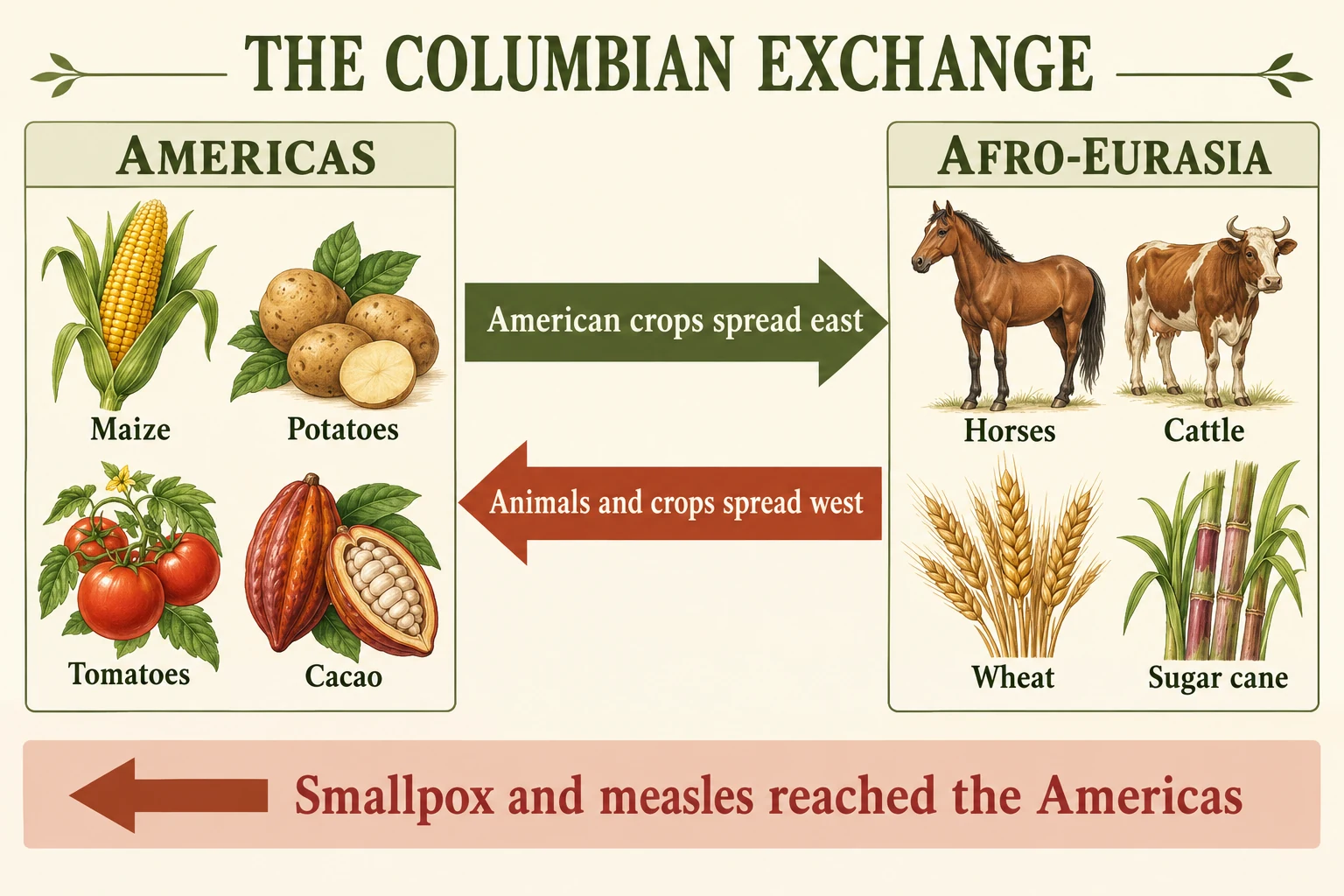
| Direction | Examples | Consequences and limits |
|---|---|---|
| Americas to Afro-Eurasia | Maize, potatoes, cassava, tomatoes, beans, squash, peppers, cacao and tobacco | New foods supported dietary change and, over time, population growth. Commercial crops reshaped consumption and trade. Adoption was gradual rather than instantaneous everywhere. |
| Afro-Eurasia to the Americas: crops | Wheat, sugar cane, rice and bananas | New agriculture altered land use. Sugar was particularly important in the growth of plantation economies and coerced labor. Coffee became a major American export chiefly in later periods. |
| Afro-Eurasia to the Americas: animals | Horses, cattle, pigs, sheep and chickens | Livestock changed transport, diets and land use, sometimes damaging Native fields. The spread of horses later transformed many Native economies and military practices. |
| Pathogens reaching the Americas | Smallpox, measles and influenza among several introduced diseases | Epidemics caused devastating mortality. Warfare, displacement, hunger and forced labor compounded their effects. Malaria and yellow fever also became important in Atlantic history, with timing and impacts varying by place. |
Why was Indigenous population loss so severe?
Many Native populations had little prior exposure to several pathogens carried across the Atlantic. Disease spread through communities and sometimes along exchange routes beyond direct European control. Mortality disrupted food production, families, political leadership and the transmission of knowledge. Colonial violence and forced labor made recovery harder, while malnutrition and displacement increased vulnerability.
Estimates of population loss depend on the region, baseline population and time span. Some regions experienced extraordinarily high losses, but a single “90% everywhere within a century” figure is not a precise description of every society. Explain the scale and mechanisms without presenting a uniform statistic as settled for all the Americas. Catastrophic loss also did not mean extinction: Indigenous peoples survived, rebuilt communities and continued to shape colonial history.
Food transfers eventually increased agricultural possibilities in many parts of Europe, Africa and Asia. That long-term effect should not be confused with immediate, universal population growth after 1492. Local cultivation, tastes, distribution and political conditions affected adoption.
Spanish conquest: more than weapons
Conquistadors were Spanish military adventurers who sought wealth, status and imperial expansion. Hernán Cortés’s campaign culminated in the fall of the Mexica capital, Tenochtitlan, in 1521. Francisco Pizarro captured the Inca ruler Atahualpa in 1532, and Spanish forces entered Cuzco in 1533. These events undermined major empires, but resistance and negotiations continued long afterward.
- Indigenous alliances: large numbers of Native allies, including Tlaxcalans in Mexico, pursued their own interests against imperial rivals. They supplied military strength, provisions and local knowledge. A tiny Spanish force acting alone is a misleading model of conquest.
- Disease and political disruption: smallpox weakened communities and leadership. In the Andes, an Inca succession conflict also created openings for intervention. The interaction of circumstances mattered more than one universal explanation.
- Military resources: steel weapons, armor, cavalry and gunpowder could offer advantages, but their effectiveness depended on terrain, supply, numbers, tactics and allies.
- Interpreters and diplomacy: communication made negotiations and alliances possible. Malintzin, also known as Doña Marina, played a major role as an interpreter in Cortés’s campaign. Her position also reflects coercion and the complicated choices available within conquest.
- Capturing rulers and reorganizing authority: Spaniards used existing political and tribute networks where possible. Replacing imperial rulers did not instantly establish control over every community.
Exploration and settlement in North America
Spanish expeditions entered Florida, the Southeast and the Southwest seeking wealth, routes and territory. Hernando de Soto and Francisco Vázquez de Coronado led major expeditions in the 1530s and 1540s. Such ventures relied on Native guides and provisions and often brought violence, forced demands and disappointment when expected riches were not found.
St. Augustine, founded in 1565 on Timucua land, became a lasting Spanish settlement in present-day Florida. It predated Jamestown and helped Spain protect strategic interests against rivals. Free and enslaved Africans were among its early inhabitants. The French attempt at Fort Caroline in 1564 also shows that North American rivalry was underway before 1607.
Spanish colonization in the Southwest expanded with Juan de Oñate’s expedition in 1598. Conflict, forced labor and mission activity challenged Pueblo communities. Keep chronology clear: the Pueblo Revolt of 1680 is a later example of resistance, not an event within Period 1.
Silver, sugar and the emerging Atlantic economy
Silver deposits at Potosí in the Andes and Zacatecas in Mexico became major centers of extraction in the mid-sixteenth century. Mining stimulated transport, agriculture and commercial activity, while imposing heavy labor burdens. Spanish American silver circulated through Europe and across Pacific routes into Asian markets; colonial economies were connected to more than a simple Atlantic triangle.
American silver contributed to the European Price Revolution, a long period of rising prices, alongside other factors such as population change. Avoid making it the sole cause of inflation or assuming that all wealth remained in Spain. Sugar production in Atlantic islands, Brazil and the Caribbean linked European demand to plantation land and escalating labor coercion.
Environmental change included introduced animals consuming or trampling crops, new pasture and plantation landscapes, and extraction of timber and minerals. These changes affected Native access to land and resources as well as colonial profits. Exchange was simultaneously ecological, economic and political.
1.5 Labor, Slavery and Caste in the Spanish Colonial System
Spanish colonizers sought labor and tribute for agriculture, mining, construction and households. They used several overlapping institutions, adapting Indigenous obligations and imposing new forms of coercion. Labor demand, epidemics, resistance, royal regulation and local conditions shaped their development. These systems did not form a universal sequence in which each completely replaced the previous one.
Encomienda: tribute, labor and coercion
An encomienda granted a colonist, the encomendero, rights to receive tribute and, particularly in early forms, labor from designated Indigenous communities. In return, the holder was supposed to provide protection and Christian instruction. The institution rewarded conquest and enabled extraction through existing community structures.
Excessive demands and violent enforcement produced severe exploitation. Encomienda was not simply a grant of land and was legally distinct from ownership of people as chattel. Indigenous people were theoretically royal subjects rather than the encomendero’s property. That distinction did not make treatment voluntary or humane. Indigenous enslavement also occurred through other practices, exceptions and violations of legal restrictions.
Royal officials tried to restrain some abuses while strengthening the monarchy against powerful colonists. Indigenous resistance, petitions and reformers challenged exploitation. Colonial opposition and uneven enforcement limited reform. Compare what an institution officially promised with how its demands operated in practice.
Repartimiento, mita and haciendas
Repartimiento involved officially organized, rotating labor drafts from Indigenous communities. Workers were theoretically entitled to regulated terms and payment, but compulsion and dangerous conditions remained. It expanded in some places as encomienda labor obligations were restricted. Terminology and practice varied by region and period.
The Spanish colonial mita in the Andes adapted an existing Inca labor obligation to colonial purposes, especially mining. Its reorganization in the 1570s supported recruitment for Potosí. Spanish exploitation changed the purposes and burdens of the institution; it was not simply an unchanged Indigenous system under a different ruler.
A hacienda was a large agricultural estate rather than one particular legal labor status. Estates could use wage labor, compelled work, tenancy and indebtedness in different combinations. Debt could restrict mobility, but debt peonage varied. Estate production developed alongside tribute, mining and other institutions.
| System | Core feature | Key distinction |
|---|---|---|
| Encomienda | Tribute rights over designated communities; early labor demands | Not identical to a land grant or ownership of every individual |
| Repartimiento | Rotating compulsory labor drafts | Nominal payment and regulated terms did not eliminate coercion |
| Colonial mita | Andean labor draft adapted to colonial extraction | Colonial purposes and conditions differed from the earlier Inca institution |
| Hacienda | Large agricultural estate | An economic organization using varied labor arrangements |
| Chattel slavery | People treated as transferable property, generally in lifelong hereditary bondage | Distinct from temporary drafts or tribute obligations, despite exploitation across these systems |
African slavery and Atlantic forced migration
Atlantic slavery expanded from Portuguese commercial networks and plantation ventures into the Americas. European traders, colonial buyers and African intermediaries participated in changing systems of capture and sale. Captives came from many societies through war, raids, kidnapping and other forms of enslavement. “Africans” does not describe one united population choosing to participate: rulers, merchants and captives had sharply different interests and experiences.
Plantation and other colonial labor demand expanded the trade. Indigenous mortality and restrictions on some forms of Native exploitation influenced colonial choices, but slavery was not an inevitable biological solution to a labor shortage. Existing commercial networks, profit, political power, laws and deliberate coercion were essential.
The asiento was a royal contract or licensing mechanism used to authorize the supply of enslaved Africans to Spanish territories. It organized and generated revenue from the trade; it was not a distinct job or form of labor performed by captives. Arrangements changed over time.
The Middle Passage was the forced Atlantic voyage. Confinement, violence, disease, deprivation and death characterized the crossing. Survivors faced sale, forced work and family separation. Africans worked on plantations, in towns and households, in skilled trades and in some mining settings. Employment varied; Indigenous labor remained particularly important in many Spanish American mines.
Chattel slavery treated people as property that could be bought, sold and inherited, generally imposing lifelong and hereditary bondage. Enslaved people retained humanity, knowledge, families and forms of agency. Spanish law offered some limited avenues such as manumission and legal petitions; these possibilities did not remove slavery’s violence or make freedom easily accessible.
Put statistics in their proper period: SlaveVoyages estimates approximately 12.5 million captives embarked from Africa and approximately 10.7 million survived to disembark over the full transatlantic trade across several centuries. Those are not Unit 1 totals, not counts of arrivals in the future United States and not counts of every death associated with enslavement. Most forced arrivals were elsewhere in the Americas.
1619 was not the first African presence in North America. Free and enslaved Africans participated in Spanish ventures before then, including St. Augustine in 1565. The 1619 landing at Point Comfort, outside this unit, matters to English Virginia. Do not describe forcibly transported people as ordinary voluntary indentured servants or assume that later Virginia slave law already existed in its fully developed form.
Colonial hierarchy and the casta system
Spanish colonial inequality involved ancestry, birthplace, legal condition, religion, wealth, occupation and reputation. Europeans generally claimed superior positions, Indigenous communities faced tribute obligations and enslaved Africans endured bondage. APUSH often summarizes these relationships as a caste or casta system.
- Peninsulares: people born in Spain; birthplace could favor access to powerful imperial offices.
- Criollos, or creoles: people of Spanish descent born in the Americas. Some held substantial wealth and local influence, although birthplace affected opportunity.
- Mestizo: a classification generally associated with Spanish and Indigenous ancestry; a socially constructed status, not a fixed biological division.
- Mulatto and zambo: historical classifications associated respectively with European-African and African-Indigenous ancestry. Recognize these discriminatory colonial terms in sources rather than apply them casually to people today.
- Indigenous and African populations: neither had one identical legal or social position. Indigenous nobles and commoners could differ in status; Africans and their descendants included both free and enslaved people.
Limpieza de sangre, or “purity of blood,” referred to ancestry-based ideas of exclusion originating in Iberian religious history and adapted in colonial settings. Such ideas justified discrimination. Ancestry was not an objective measure of worth, and a historical explanation should not adopt colonizers’ assumptions uncritically.
The hierarchy was unequal but was not one perfectly fixed ladder applied identically everywhere. Marriage, wealth, reputation and legal claims affected status. Familiar paintings showing elaborate casta categories generally date to the eighteenth century. They do not prove that a uniform sixteen-category chart governed every colony in 1500. Later creole resentment of imperial restrictions can help explain subsequent history, but independence movements are far outside Period 1.
Remember overlap: a mining region could depend simultaneously on drafted Indigenous workers, paid workers, food from estates and enslaved labor in related activities. Keep tribute rights, worker recruitment, production and personal legal status distinct.
1.6 Cultural Interactions Between Europeans, Native Americans and Africans
Contact produced conflict and unequal power, alongside negotiation, exchange and adaptation. Differences over religion, land, gender and authority mattered, but no continent shared a single unchanging worldview. Explain interactions using particular peoples and circumstances.
Religion, missions and syncretism
Spanish rulers connected empire with Catholic Christianity. Missionaries sought conversions through institutions that could combine religious teaching, labor demands, settlement changes and cultural discipline. Missions helped extend imperial influence and challenged local religious and political authority. Their operation and the responses they encountered differed by region.
Indigenous spiritual traditions were diverse, often connecting community life, place, ancestors and seasonal activities. Avoid reducing every religion to one description such as “nature worship.” People could reject Christianity, adopt selected practices, reinterpret teachings or use Christian institutions for specific purposes while maintaining other traditions.
Africans brought varied languages, religions and cultural knowledge, including Indigenous African traditions and, among some people, Islam. Under coercion they maintained and reshaped practices and formed new communities. Syncretism means blending or recombining traditions. It can demonstrate creativity and survival without implying that the encounter was equal or voluntary.
Franciscans, Dominicans and Jesuits played different roles across the Spanish empire. Use early Caribbean, Mexican and Florida examples as chronological anchors. The later California mission network of the eighteenth century should not be placed inside Period 1.
Land, gender and family relationships
Land and resources: colonizers asserted authority through conquest, royal grants and religious or legal arguments. Native societies had their own systems of territorial control, cultivation, hunting and access. Some rights were communal; others belonged to families or particular users. Saying Native Americans had “no property” ignores these institutions. Europeans also had varied land tenures, including communal rights.
Colonists might treat seasonally used land as vacant or interpret permission to use resources as a permanent transfer of sovereignty. Such differences created conflict, while livestock and new extractive demands altered access to resources. Native people actively managed landscapes through farming, burning and harvesting. They did not occupy an untouched environment outside history.
Gender: European institutions generally privileged male authority, but women still worked, traded, managed households and sometimes exercised property or political influence. Native divisions of labor and authority varied. In many Haudenosaunee communities, women’s agricultural work, matrilineal clans and clan mothers’ influence differed from Spanish expectations about gender.
Kinship: extended families, clans and reciprocal obligations organized many societies. Matrilineal means tracing descent through the mother’s line, not necessarily women controlling every institution. Slavery disrupted African families through capture and sale, yet enslaved people built and maintained ties wherever possible. European households likewise cannot all be reduced to isolated nuclear families.
Arguments over conquest and Indigenous humanity
Claims of Christian superiority and “civilization” helped Europeans justify conquest and forced labor. The Requerimiento, introduced in 1513, asserted Spanish and Christian authority and threatened consequences for refusal. A demand delivered in a language its audience did not understand did not establish meaningful consent. Read it as a justification of power rather than a neutral record of fair negotiation.
Bartolomé de las Casas, a former encomendero who became a Dominican friar, condemned brutality and defended Indigenous humanity. His criticism contributed to debates surrounding the New Laws of 1542, which attempted to restrict abuses and Indigenous enslavement and curb encomendero power. Colonial resistance and uneven enforcement limited their effect.
At the Valladolid debate of 1550–1551, Las Casas and Juan Ginés de Sepúlveda advanced opposing arguments about conquest and Native peoples. Las Casas criticized coercion and supported peaceful conversion; Sepúlveda defended arguments used to justify conquest. There was no simple outcome that ended exploitation. Las Casas’s support for Christian conversion also shows that criticism of abuse did not necessarily imply acceptance of every Indigenous belief or complete independence.
Debates over Native treatment did not end African slavery. Protections could be selective and contradictory. Comparing law with practice reveals how wealth, power and local resistance affected whether reform changed daily life.
Resistance, negotiation and cultural exchange
- Armed resistance: Native forces fought conquest and colonial demands. The Guale uprising of 1597 in Spanish Florida is an example within this period of conflict surrounding mission authority.
- Diplomacy: Native leaders negotiated trade, peace and military partnerships to pursue their own goals. An alliance against one enemy did not necessarily surrender all autonomy to another.
- Everyday resistance: flight, refusal, concealment of practices and maintaining local institutions challenged control. Africans resisted through escape, rebellion, preserving knowledge and building relationships.
- Maroon communities: people escaping slavery formed independent communities in parts of the Americas. Their survival sometimes involved both fighting and negotiation.
- Borrowing and trade: Europeans adopted Native foods, watercraft and local knowledge; Native people acquired tools, animals and goods selectively. Exchange could create opportunities alongside dependency and exploitation.
- Family formation: intermarriage linked communities and produced new identities, but relationships occurred within unequal conditions and sometimes involved coercion. Mixed ancestry alone does not prove peaceful or equal integration.
Native sovereignty was challenged, and major empires were conquered, but it was not universally destroyed across North America by 1607. Many Native nations remained independent and powerful. Their action continued to shape the next period.
Source caution: a missionary’s description can reveal what that missionary wanted to change. It cannot automatically establish what all Native people believed. Ask how translation, audience, purpose and missing voices affect the account.
1.7 Causation in Period 1
Explain a mechanism rather than list events
A cause explains why a development occurred; an effect is a consequence that can become a cause of another change. Historical arguments require a relationship, specific evidence and an explanation. One event following another does not by itself prove causation.
Long-term conditions included demand for trade, maritime experience and imperial rivalry. Immediate decisions included funding voyages and forming alliances. Unintended consequences included epidemics and ecological disruption. Separate these categories instead of giving every factor the same role.
These processes interacted. Disease did not mechanically create slavery, and conquest did not erase every Native nation’s autonomy.
| Development | Causes or enabling conditions | Consequences |
|---|---|---|
| European exploration | Commerce, finance, state rivalry, religion and seafaring experience | Atlantic connections and imperial claims; outcomes did not always match original goals |
| Spanish conquest | Native allies, disease, political conflicts, military resources and strategy | Colonial extraction alongside resistance and negotiated authority |
| Demographic catastrophe | Pathogens compounded by violence, displacement, hunger and forced labor | Severe disruption; uneven losses, survival and community rebuilding |
| African slavery’s expansion | Labor demand, trading networks, colonial policy and coercive power | Forced migration, family separation, new diasporic communities and resistance |
| Colonial hierarchy | Conquest, unequal legal status, ancestry ideologies and struggles over resources | Discrimination shaped by local conditions, wealth and legal negotiation |
Comparison, continuity and relative significance
Comparison: encomienda and African slavery both supported extraction, but their legal organization differed. Some Pueblo and Northwest Coast communities were both settled, but their primary food systems differed. State a meaningful shared category before explaining differences.
Continuity and change: epidemics, migrants and institutions changed the Americas, while Native languages, communities and political action continued. Colonial rulers often adapted existing tribute networks. Evidence of change does not establish that every earlier practice disappeared.
Relative importance: identify the question being explained. Disease may be central to a demographic argument, while allies are essential to understanding a particular military victory. One cause need not explain every aspect of the period.
A model causal argument
Practice prompt: Explain how sustained Atlantic contact transformed American societies between 1492 and 1607.
Possible claim: Sustained Atlantic contact transformed American societies through destructive epidemics and expanded colonial extraction, while Indigenous resistance and adaptation shaped the limits of European power.
Evidence and explanation: smallpox disrupted communities and leadership in Mexico, but the fall of Tenochtitlan also depended on alliances with Native opponents of Mexica rule. After conquest, encomienda redirected tribute and labor toward colonists. These examples show how biological change and political choices reinforced one another. They do not establish that weapons alone caused conquest or that every Native society immediately lost autonomy.
Why this works: it identifies processes, supplies evidence and retains complexity. Develop the evidence further when an actual prompt requires it. A short response should answer its task directly rather than reproduce a memorized introduction.
Period 1 timeline: 1491–1607
Use chronology to organize relationships, and distinguish background from events inside the unit.
| Date | Development | Significance |
|---|---|---|
| Before 1491 | Long Indigenous histories of agriculture, settlement and exchange | The Americas already contained diverse, complex societies |
| 1492 | Columbus’s first voyage; fall of Granada | Sustained Atlantic contact and context for Spanish expansion |
| 1494 | Treaty of Tordesillas | Division of Spanish-Portuguese claims without Native consent |
| 1497–1500 | Cabot’s voyage, da Gama in India and Cabral in Brazil | Competing routes of maritime expansion |
| 1513 | Requerimiento; Spanish exploration of Florida | Imperial assertions of authority |
| 1519–1521 | Cortés’s campaign and fall of Tenochtitlan | Conquest through interacting military, political and biological factors |
| 1532–1533 | Capture of Atahualpa; Spanish entry into Cuzco | Conquest in the Andes amid political division |
| 1542 | New Laws | Attempts to limit abuses and encomendero power |
| 1540s | Silver extraction develops at Potosí and Zacatecas | New labor demands and wider trade connections |
| 1550–1551 | Valladolid debate | Arguments over conquest and Indigenous humanity |
| 1564–1565 | Fort Caroline; St. Augustine | French-Spanish rivalry and lasting Spanish settlement before Jamestown |
| 1580s | English settlement attempts at Roanoke | English colonial activity predates 1607 |
| 1597–1598 | Guale uprising; Oñate’s Southwest expedition | Resistance to mission authority and further colonization |
| 1607 | Jamestown founded | Conventional transition to APUSH Period 2 |
Later context: the 1619 landing in English Virginia, Pueblo Revolt of 1680 and eighteenth-century casta paintings fall outside 1491–1607. Label them as later developments rather than Period 1 events.
Essential Unit 1 terms and distinctions
- Maize cultivation
- Growing domesticated corn, whose spread supported agricultural and settlement changes in many regions.
- Three Sisters
- Maize, beans and squash in complementary systems, with locally varied practices.
- Pueblo and longhouse
- Pueblo is associated with Southwestern peoples and settled communities; longhouses were substantial dwellings in some Northeastern societies. Neither term describes all Native housing.
- Haudenosaunee Confederacy
- An alliance initially linking five nations under the Great Law of Peace, often called the Iroquois Confederacy in historical sources.
- Cahokia
- A major Mississippian center demonstrating urban and political complexity before its decline prior to 1491.
- Potlatch
- A ceremonial practice in some Northwest Coast societies involving exchange, obligations and recognition of authority and status.
- Columbian Exchange
- Biological transfers linking the Americas with Afro-Eurasia after sustained Atlantic contact.
- Conquistador
- A Spanish military adventurer involved in conquest and expansion.
- Encomienda
- A grant of tribute rights over designated Native communities, associated especially in early forms with compelled labor.
- Repartimiento and colonial mita
- Compulsory labor recruitment systems; mita refers particularly to the Andean institution adapted by Spanish authorities.
- Hacienda
- A large estate that could use several different labor arrangements.
- Asiento
- A royal contract or licensing mechanism used to organize the supply of enslaved Africans.
- Middle Passage
- The forced Atlantic crossing endured by enslaved Africans.
- Chattel slavery
- Enslavement treating people as transferable property, generally under lifelong and hereditary bondage.
- Mestizo and casta
- Mestizo was a colonial ancestry classification; casta refers to broader ancestry-based categorization and inequality with local variation.
- Limpieza de sangre
- An ancestry-based “purity of blood” ideology supporting exclusion and unequal status.
- Mission
- A religious institution seeking conversion, often connected to settlement, labor and political control.
- Syncretism
- Blending or recombination of traditions, including under unequal and coercive conditions.
- Matrilineal and patriarchal
- Matrilineal traces descent through the mother’s line; patriarchal describes institutions privileging male authority. They address different aspects of social life.
- Maroon community
- A community formed by people who escaped slavery and sought to preserve independence.
- Sovereignty
- Political authority and self-government; Native sovereignty was contested but not universally erased by 1607.
Source analysis and active-recall practice
A source-analysis routine
- Identify the source: who made it, when, where and in what form? Distinguish an event’s date from the date of a later depiction.
- Describe its claim or features: explain what it says or shows before adding outside knowledge.
- Place it in context: connect it to imperial rivalry, conversion, labor extraction or another relevant development.
- Analyze purpose, audience or perspective: explain how a specific factor shapes its emphasis and omissions.
- Corroborate: compare another perspective or evidence type. A colonial observer cannot represent every Indigenous or African voice.
A map may express a claim rather than actual control. A later engraving may alter an earlier drawing. A reformer’s description may provide evidence of abuse while serving a persuasive campaign. Perspective does not automatically make a source useless; it helps define what it can establish.
Worked source-analysis example
Practice situation: you read a paraphrase of Las Casas’s criticism of colonial violence. This is a study exercise, not a quotation from a historical document.
Context: conquest generated demands for tribute and labor and disputes about Native treatment. Purpose: Las Casas sought intervention against abuse. What it can show: Spanish Catholic opinion was not uniform, and colonial practices were contested. What it cannot establish alone: every Native community’s experience or effective enforcement of reform everywhere.
Corroboration: compare reform arguments with Indigenous testimony, tribute records or evidence of labor practices. The comparison may reveal a gap between legal promises and actual conditions.
Compare two Native regions using a similarity and a difference.
Some Pueblo and Northwest Coast communities supported settled populations. Many Pueblo communities relied on farming adapted to scarce water, whereas many Northwest Coast settlements relied heavily on marine resources. Permanent settlement did not require one universal agricultural system.
Why is “Spanish weapons caused conquest” incomplete?
Native allies supplied essential numbers, knowledge and support. Epidemics and political conflicts also mattered. The fall of Tenochtitlan is better explained through interacting causes than through technology alone.
Distinguish encomienda and chattel slavery.
Encomienda gave colonists tribute rights and often early labor claims over Native communities, whose members were theoretically royal subjects. Chattel slavery treated people as property, generally in lifelong hereditary bondage. Both exploited people, but their legal organization differed.
Give an exchange and explain its consequence.
Smallpox reached the Americas and contributed to epidemics that disrupted communities and leadership. Alternatively, maize and potatoes spread from the Americas and eventually expanded food production elsewhere. Identify direction and explain an effect instead of only listing goods.
How did Native Americans and Africans shape colonial outcomes?
Native peoples negotiated, resisted demands and selectively adapted practices. Enslaved Africans escaped, maintained knowledge and kinship, formed communities and resisted in several ways. These actions affected colonial control despite severe inequalities in power.
Revision routine: read a topic, close the notes and explain it using two specific examples. Redraw exchange arrows, compare regions and write a causal paragraph. Use the flashcards for recall and the quiz for application. These exercises are independent NUM8ERS practice, not official exam questions.