
9.2 Second Derivatives of Parametric Equations
AP Calculus BC Practice Questions with Detailed Solutions
Understanding Second Derivatives of Parametric Equations
The second derivative of parametric equations is a fundamental concept in AP Calculus BC that helps analyze the concavity and behavior of parametric curves. When a curve is defined parametrically with x = x(t) and y = y(t), finding the second derivative requires a two-step process that builds upon the first derivative formula.
The formula for the second derivative is: \(\displaystyle \frac{d^2y}{dx^2}=\frac{\frac{d}{dt}\left(\frac{dy}{dx}\right)}{\frac{dx}{dt}}\). This means you first find dy/dx using (dy/dt)/(dx/dt), then differentiate that result with respect to t, and finally divide by dx/dt.
Essential Formula
Remember: Always find the first derivative dy/dx before computing the second derivative
Practice Questions with Step-by-Step Solutions
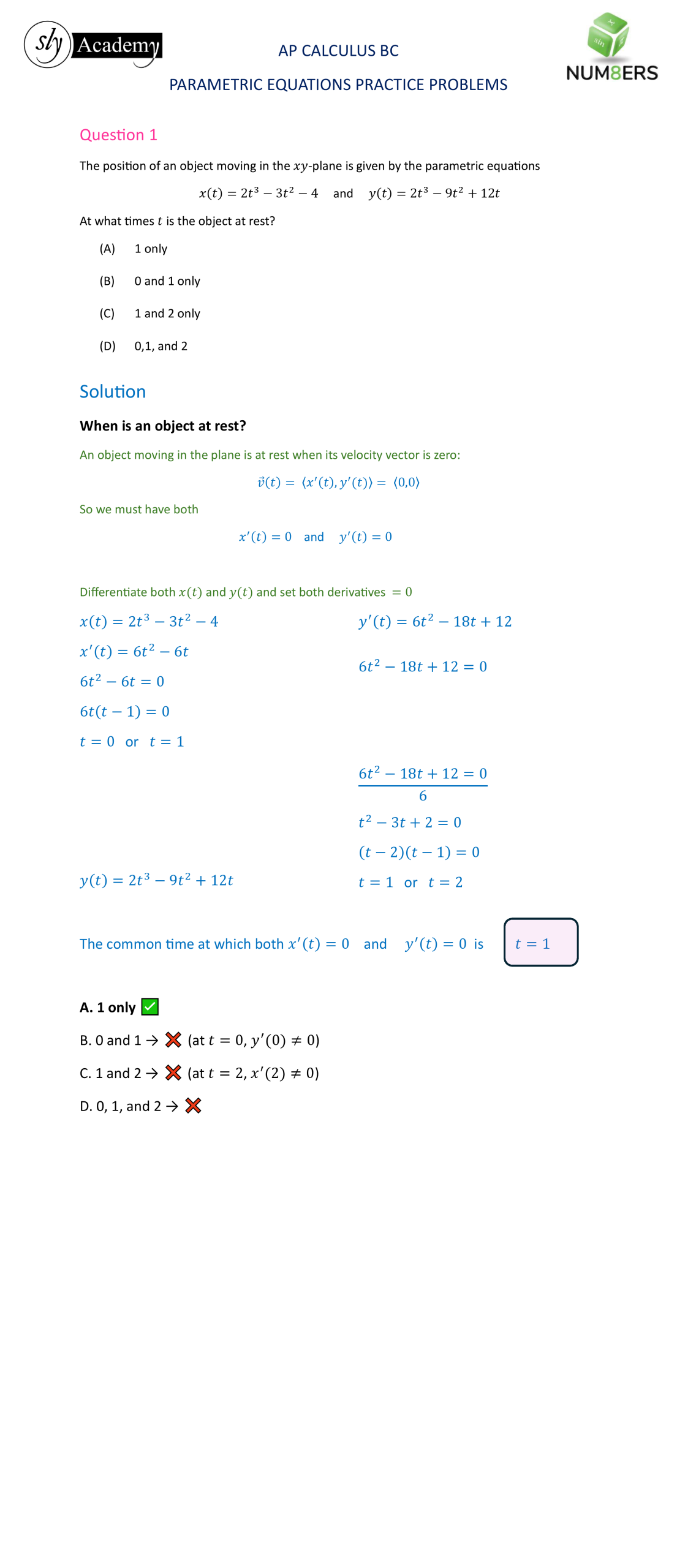
The position of an object moving in the xy-plane is given by the parametric equations \( x(t) = 2t^3 - 3t^2 - 4 \) and \( y(t) = 2t^3 - 9t^2 + 12t \). At what times t is the object at rest?
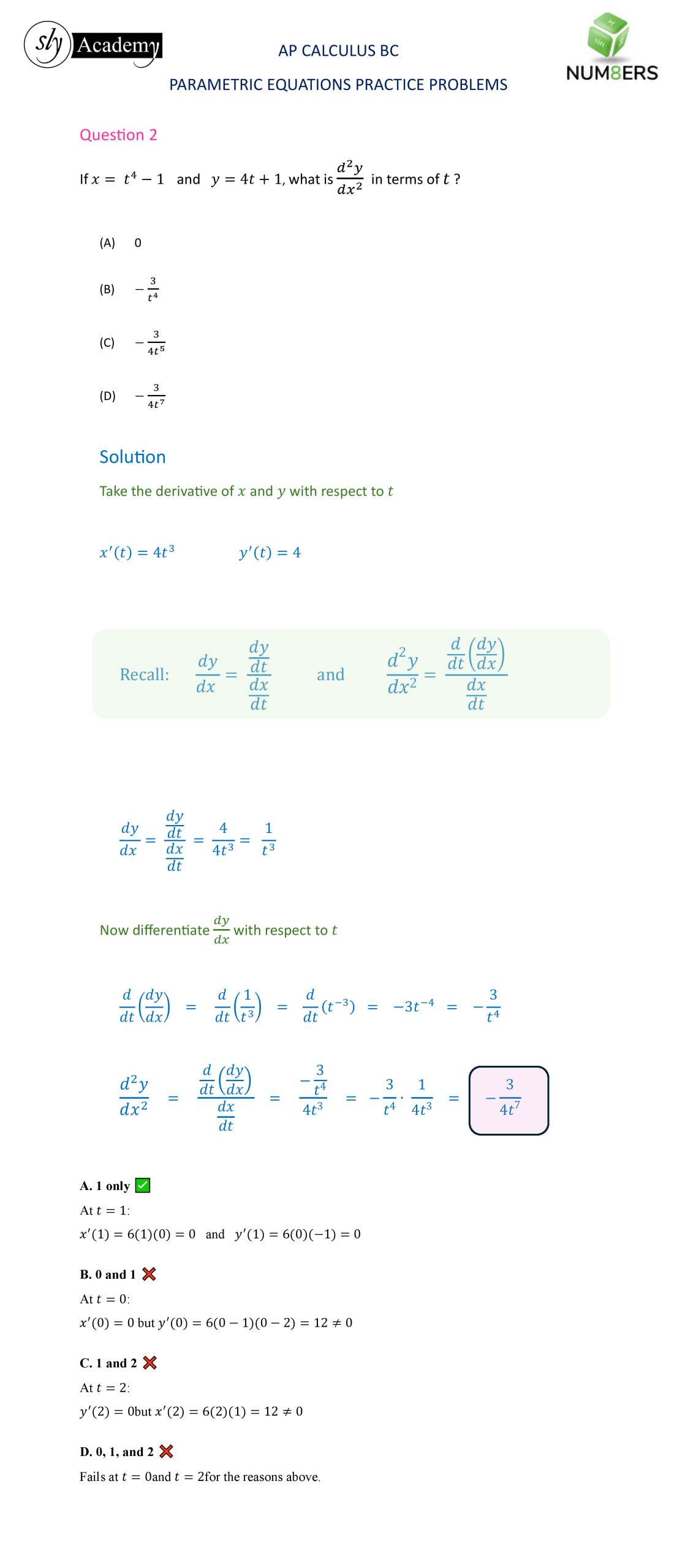
If \( x = t^4 - 1 \) and \( y = 4t + 1 \), what is \( \displaystyle\frac{d^2y}{dx^2} \) in terms of \( t \)?
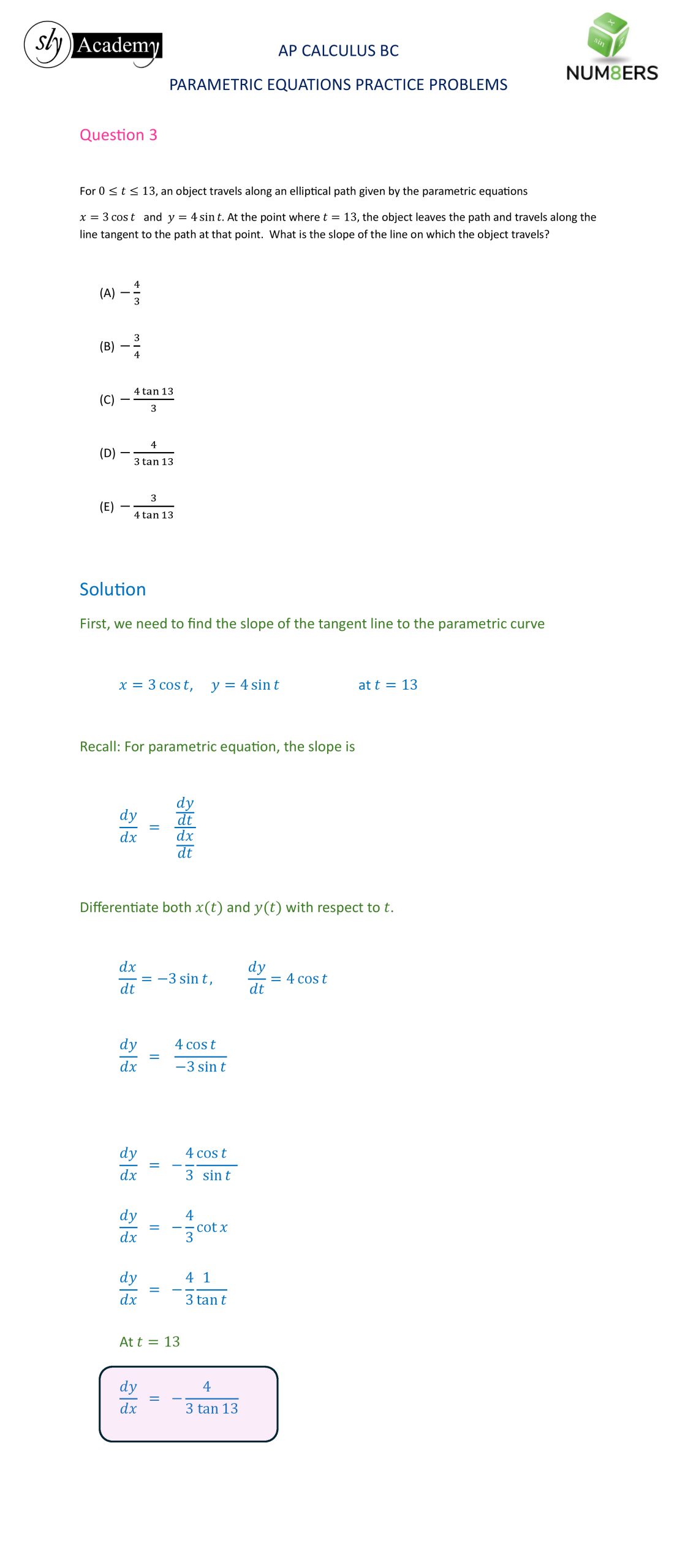
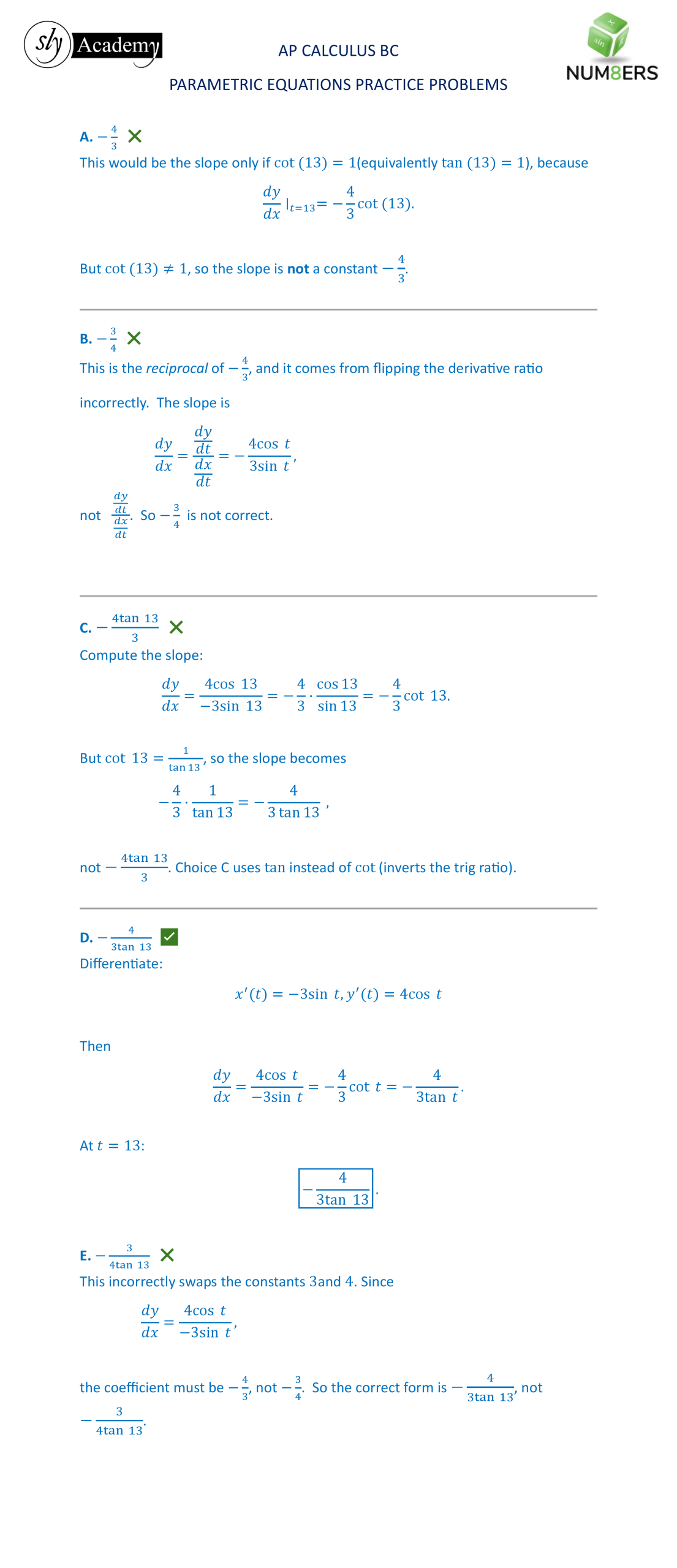
For \( 0 \leq t \leq 13 \), an object travels along an elliptical path given by the parametric equations \( x = 3 \cos t \) and \( y = 4 \sin t \). At the point where \( t = 13 \), the object leaves the path and travels along the line tangent to the path at that point. What is the slope of the line on which the object travels?
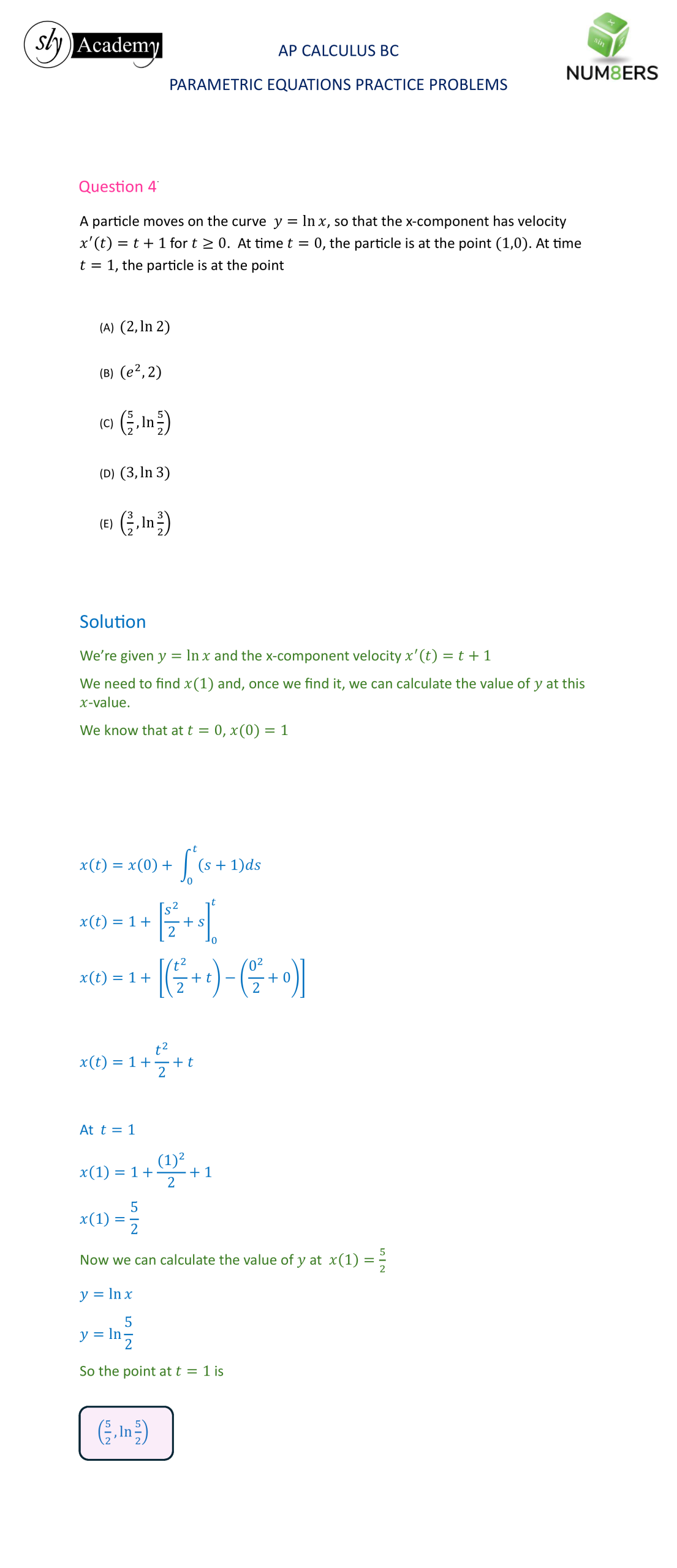
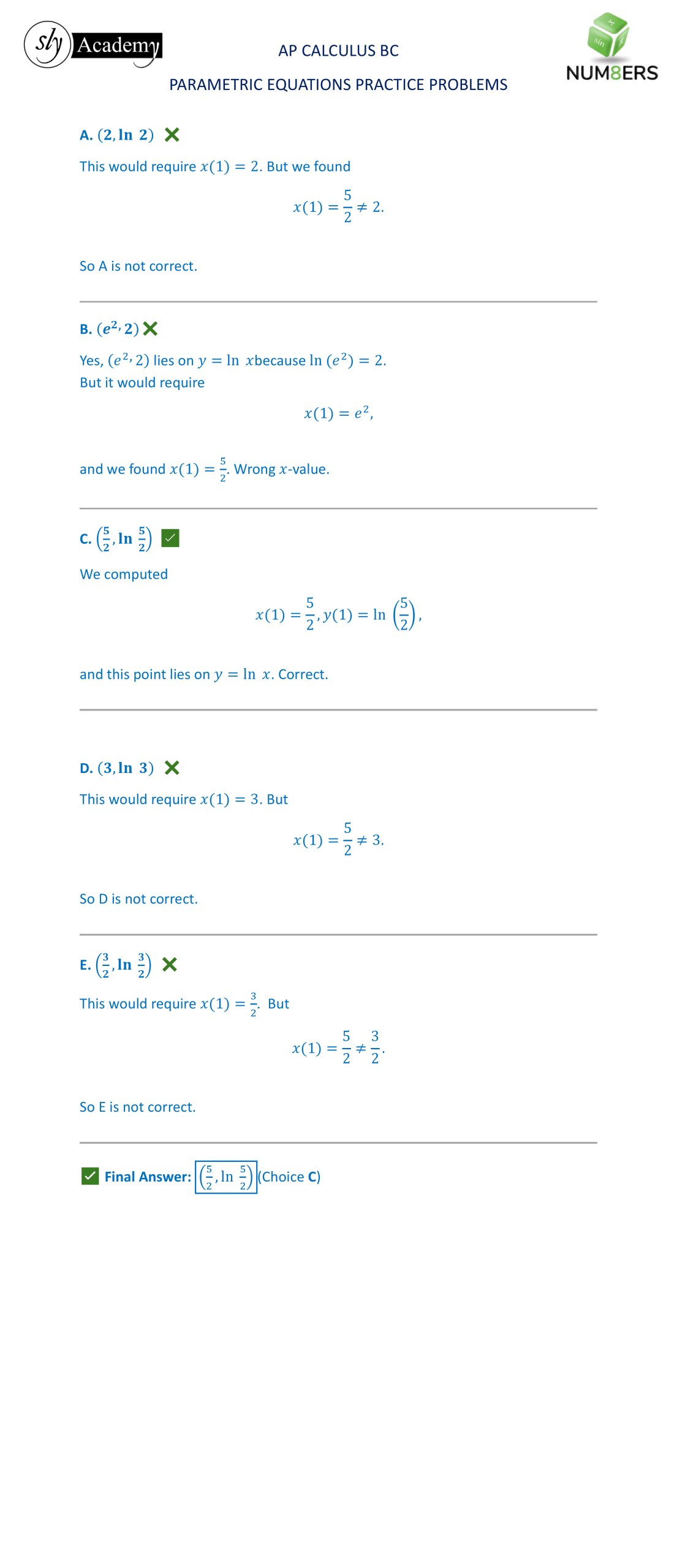
A particle moves on the curve \( y = \ln x \), so that the x-component has velocity \( x'(t) = t + 1 \) for \( t \geq 0 \). At time \( t = 0 \), the particle is at the point \( (1,0) \). At time \( t = 1 \), the particle is at the point
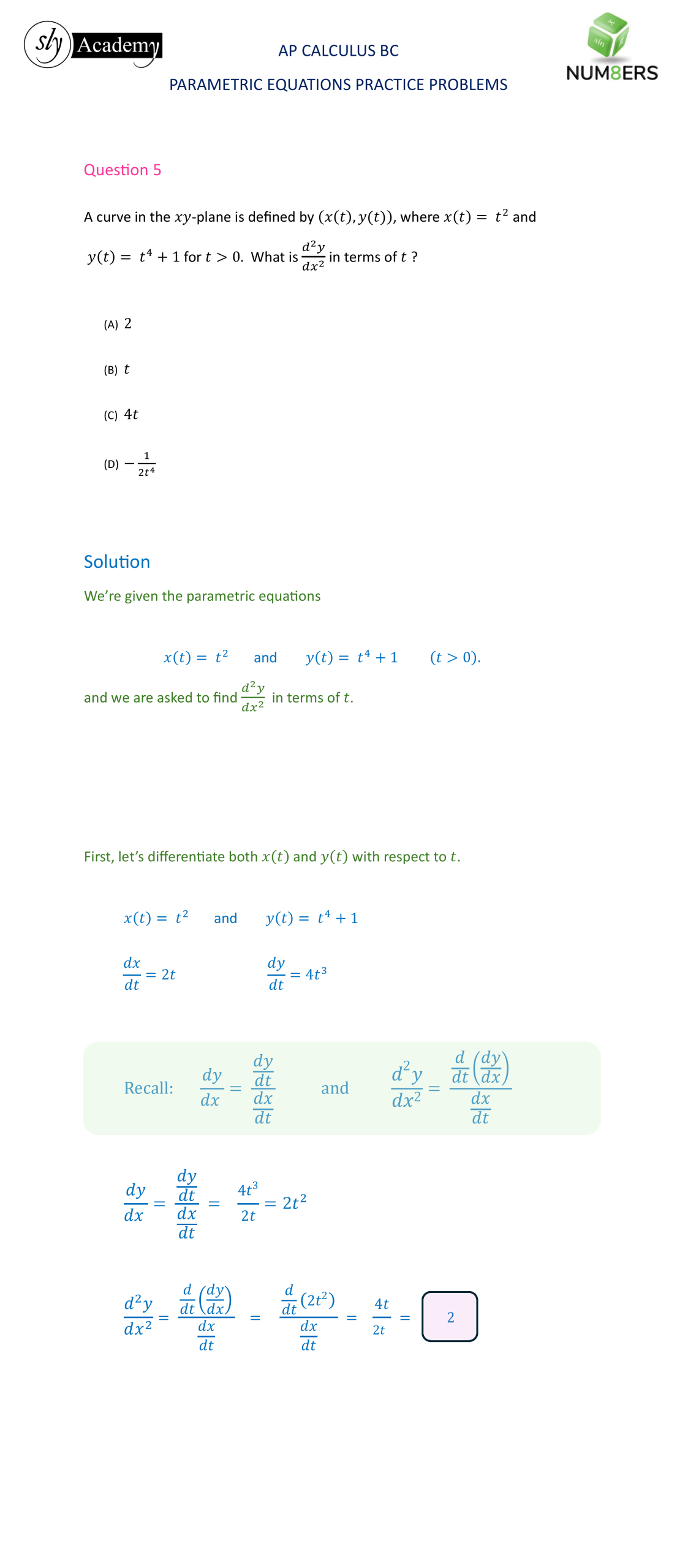
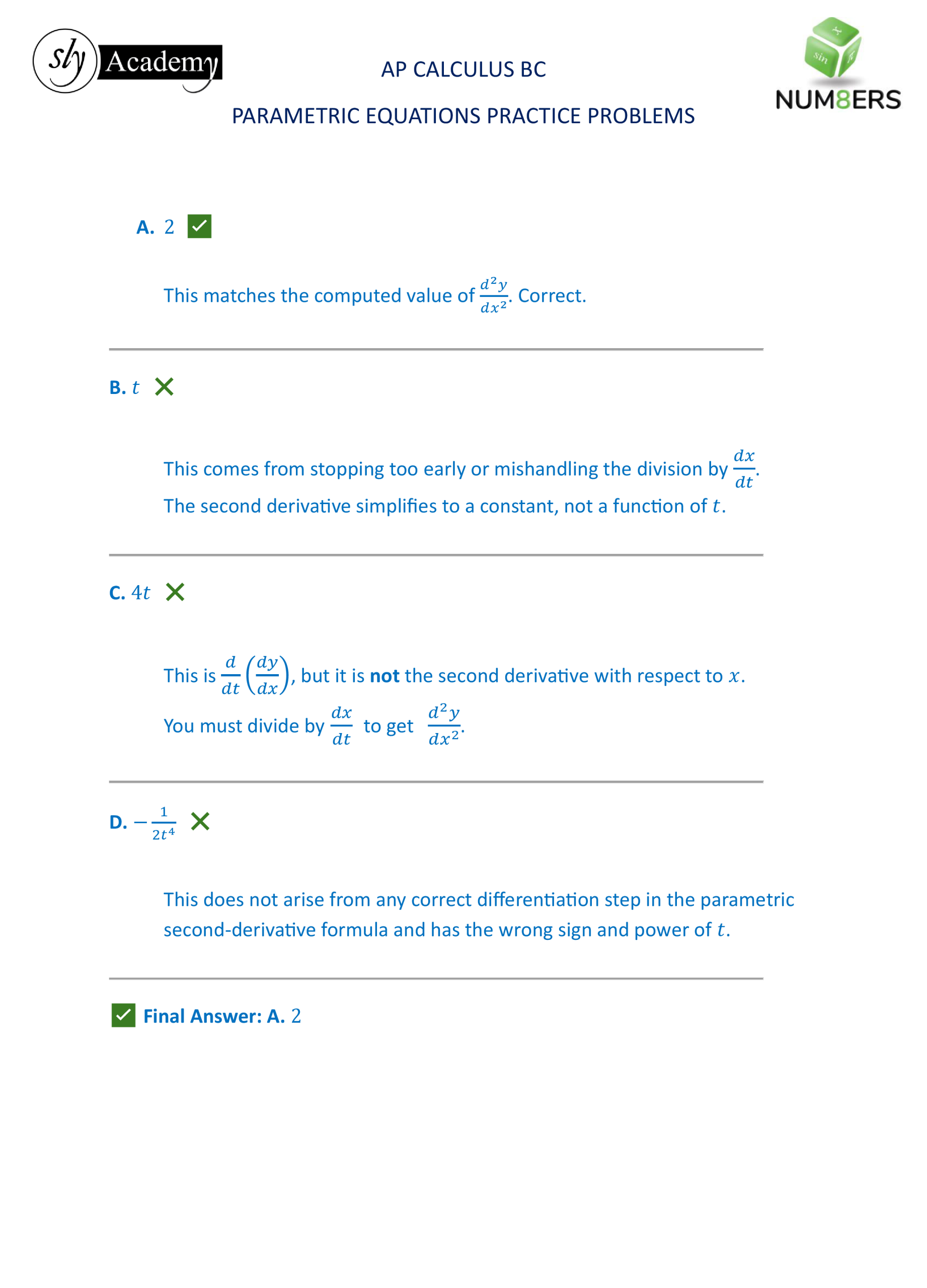
A curve in the xy-plane is defined by \( (x(t), y(t)) \), where \( x(t) = t^2 \) and \( y(t) = t^4 + 1 \) for \( t > 0 \). What is \( \displaystyle\frac{d^2y}{dx^2} \) in terms of \( t \)?
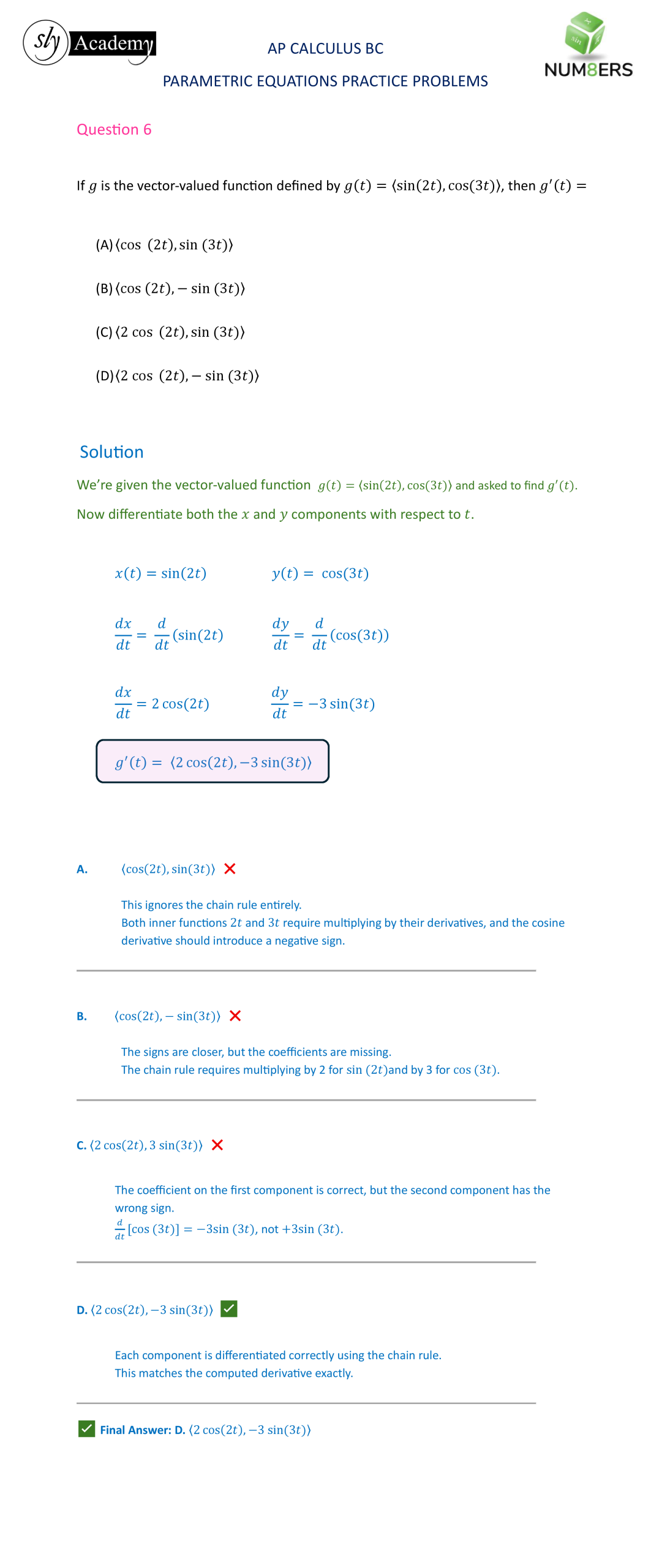
If \( g \) is the vector-valued function defined by \( g(t) = \langle \sin(2t), \cos(3t) \rangle \), then \( g'(t) = \)
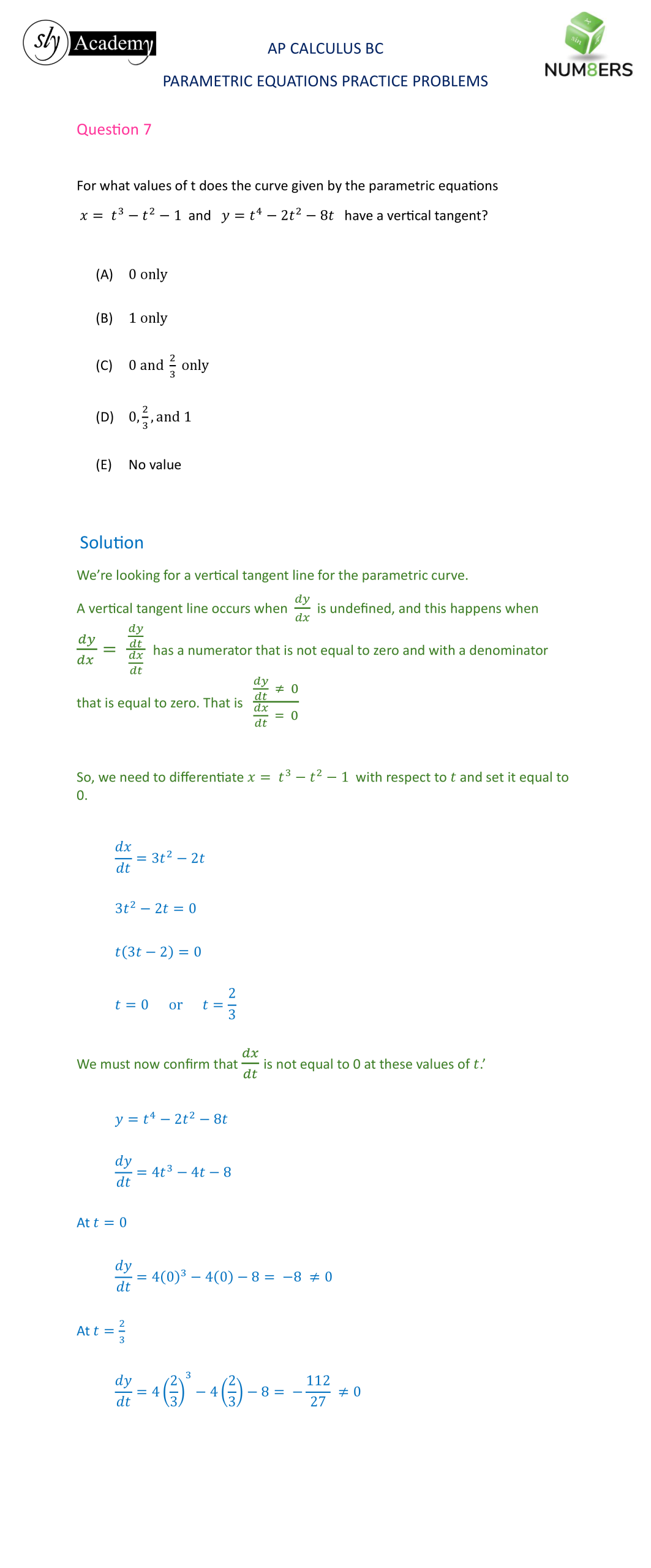
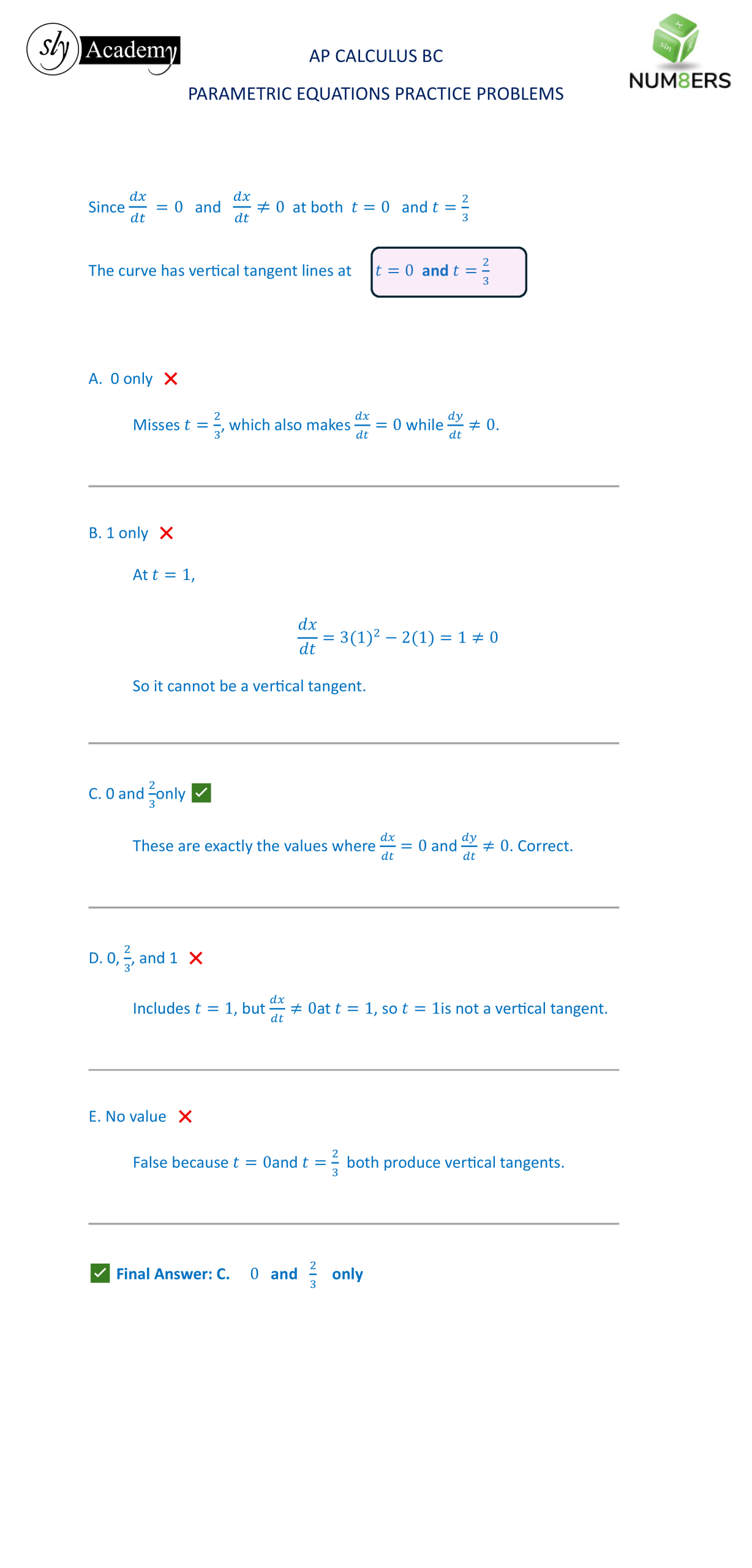
For what values of t does the curve given by the parametric equations \( x = t^3 - t^2 - 1 \) and \( y = t^4 - 2t^2 - 8t \) have a vertical tangent?
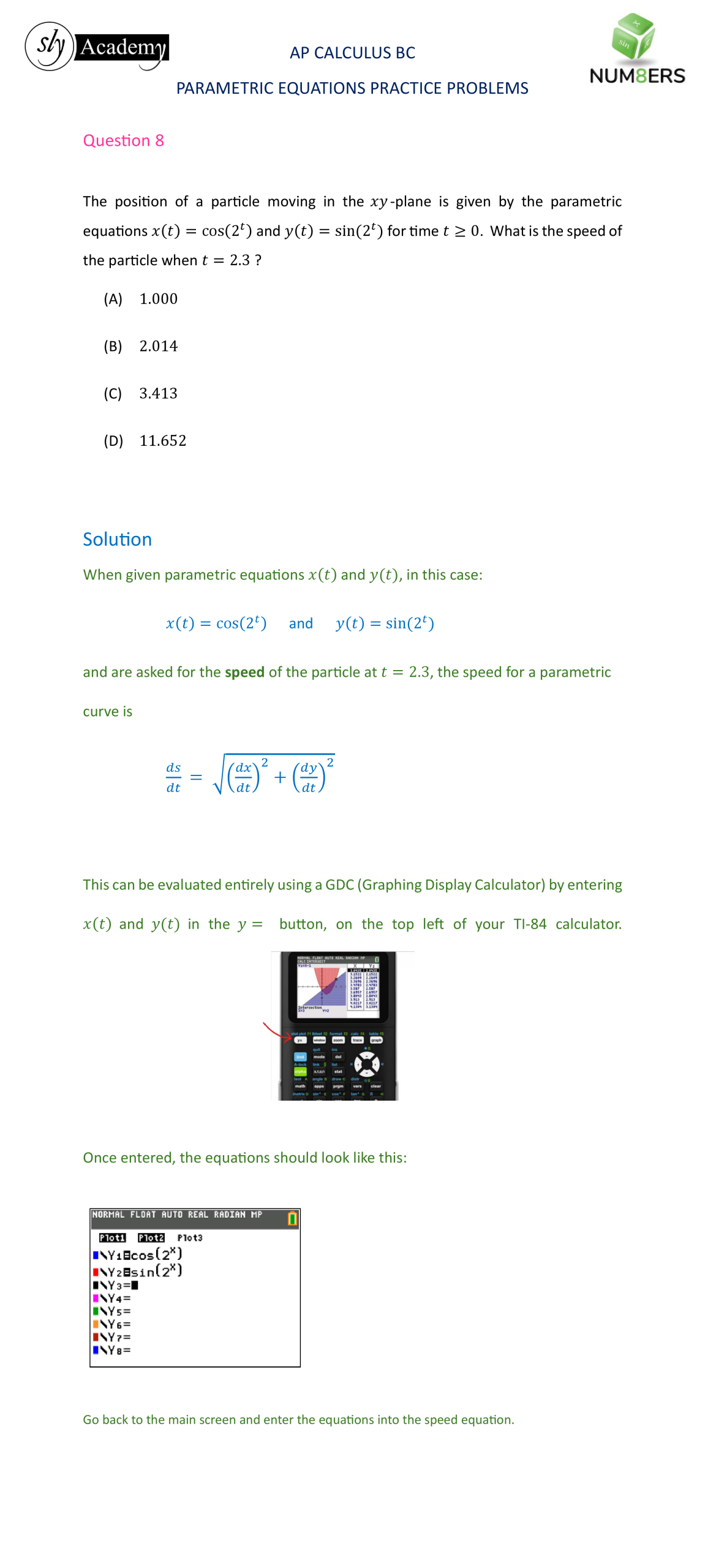
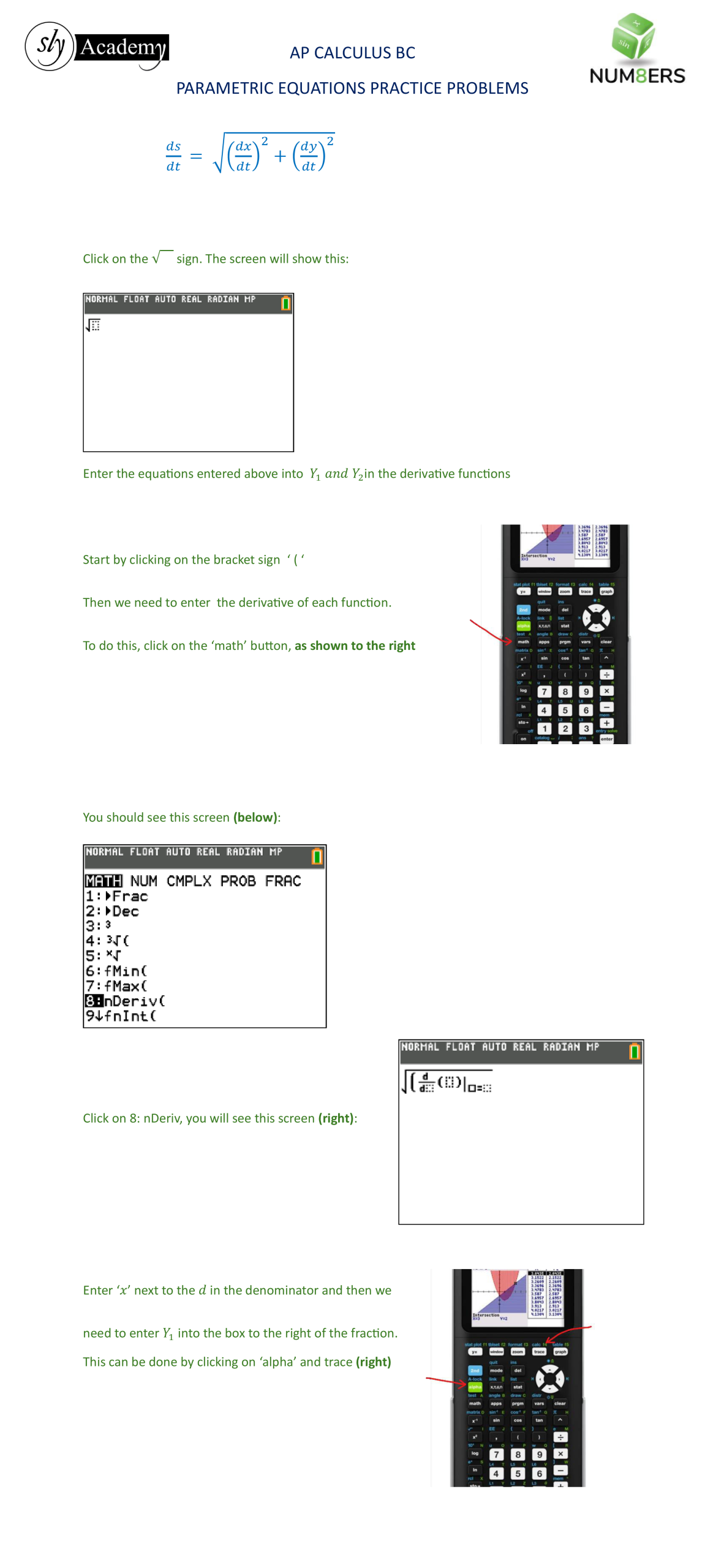
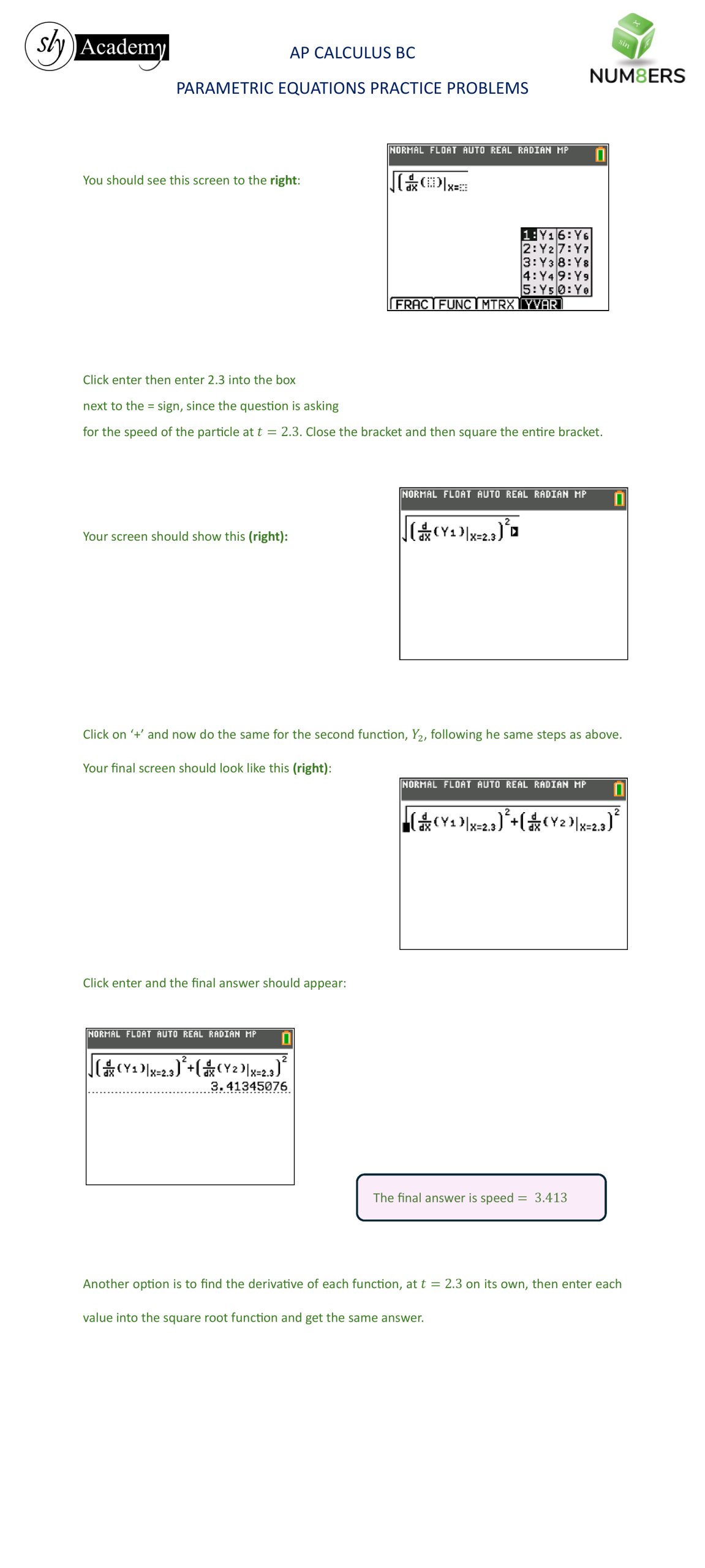
The position of a particle moving in the xy-plane is given by the parametric equations \( x(t) = \cos(2^t) \) and \( y(t) = \sin(2^t) \) for time \( t \geq 0 \). What is the speed of the particle when \( t = 2.3 \)?
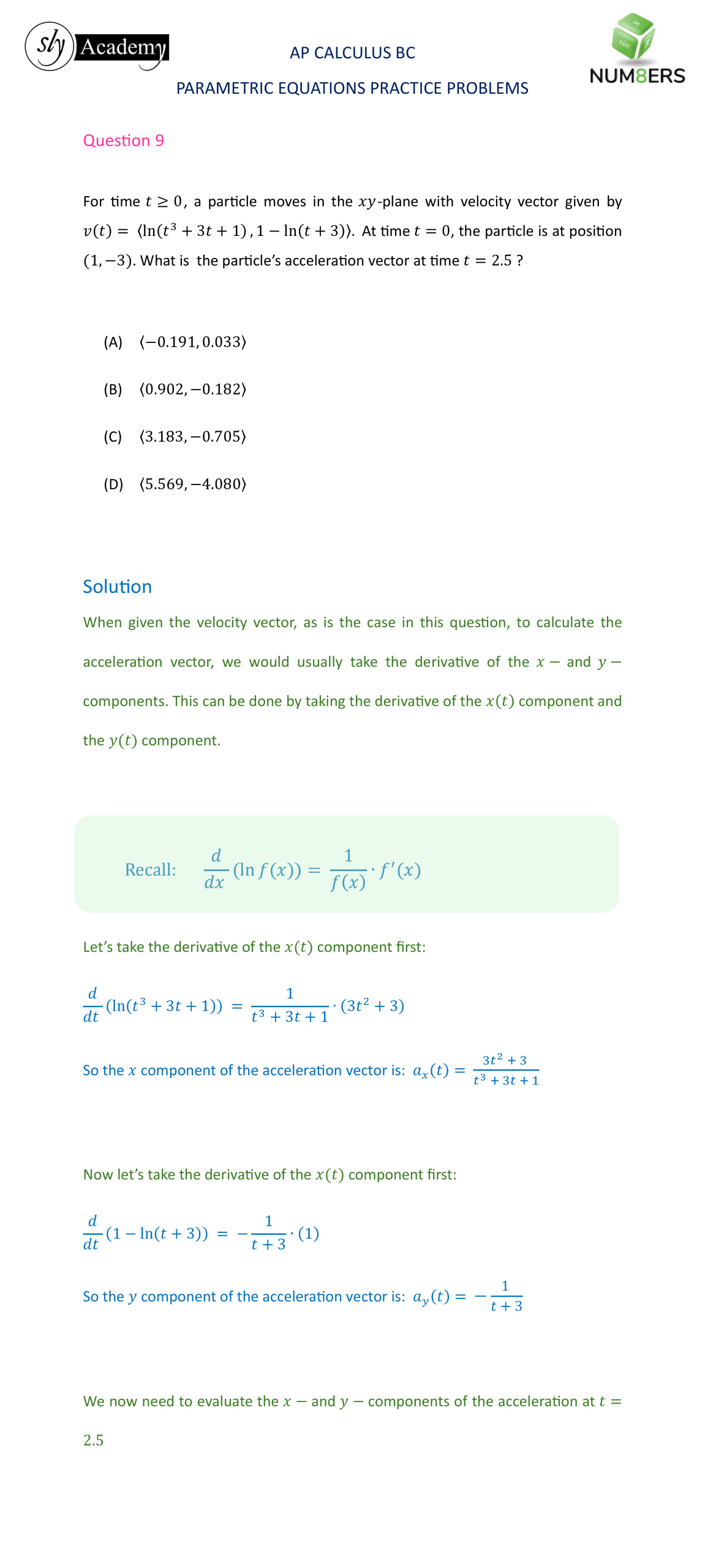
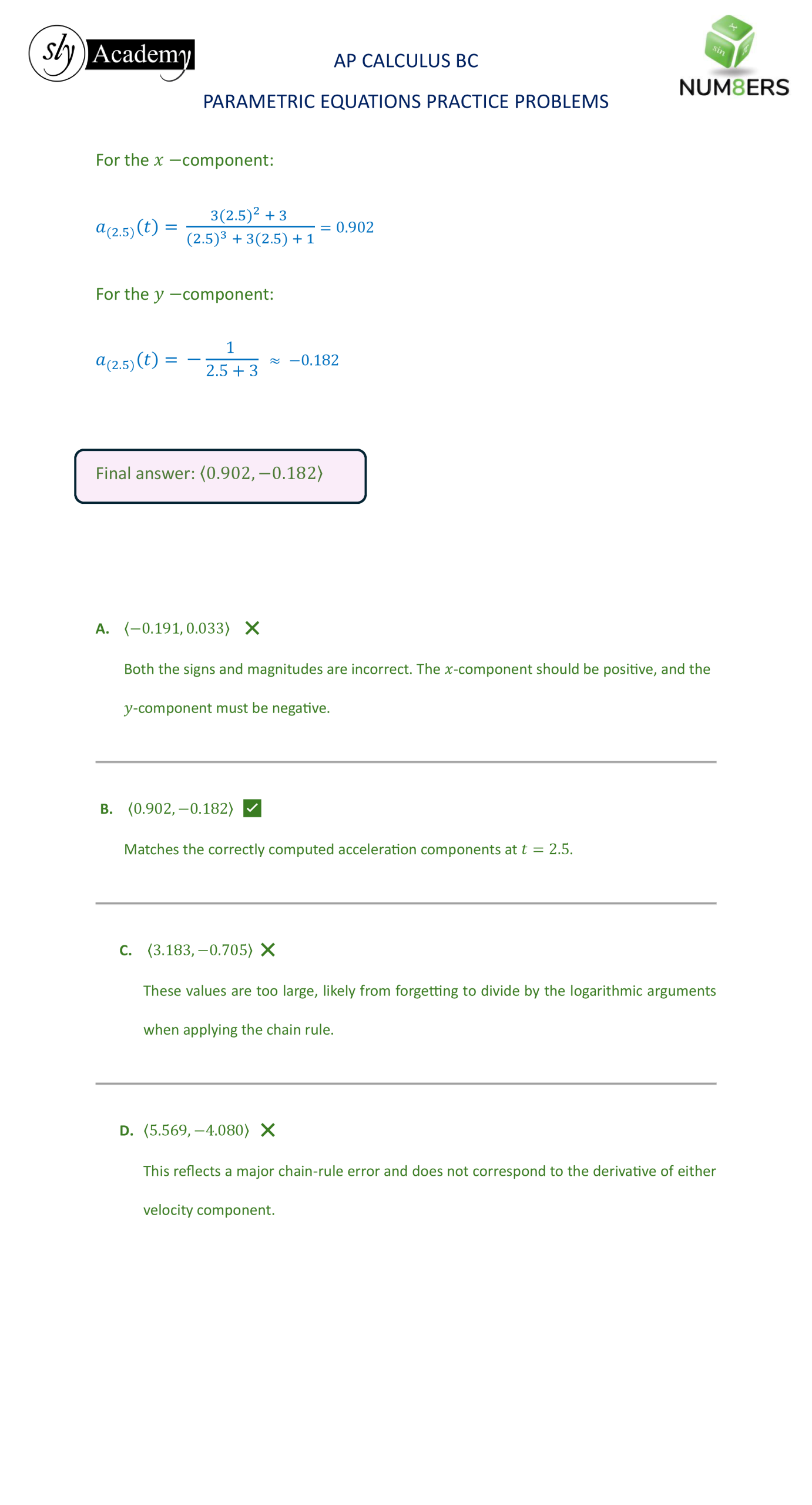
For time \( t \geq 0 \), a particle moves in the xy-plane with velocity vector given by \( v(t) = \langle \ln(t^3 + 3t + 1), 1 - \ln(t + 3) \rangle \). At time \( t = 0 \), the particle is at position \( (1, -3) \). What is the particle's acceleration vector at time \( t = 2.5 \)?
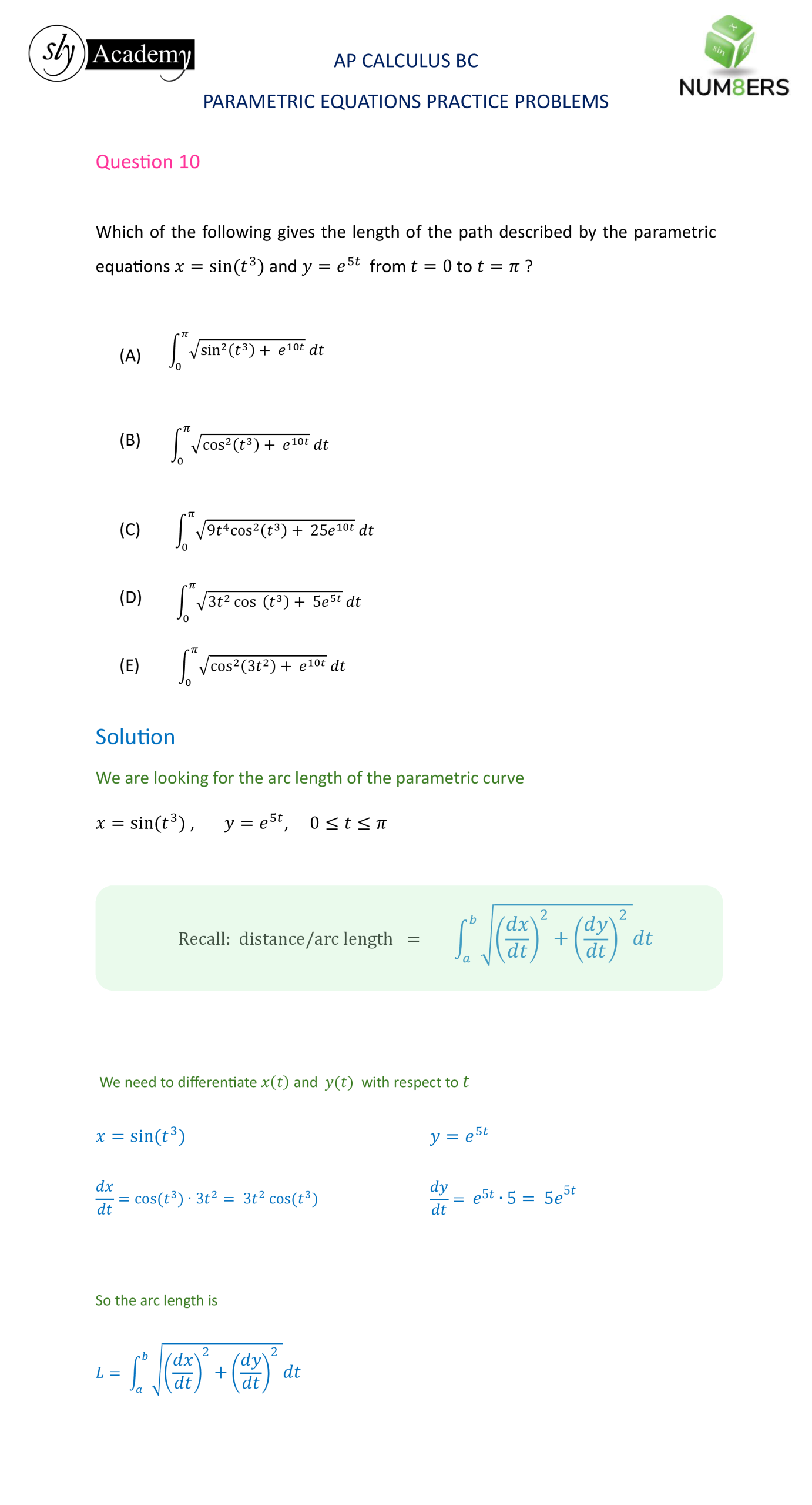
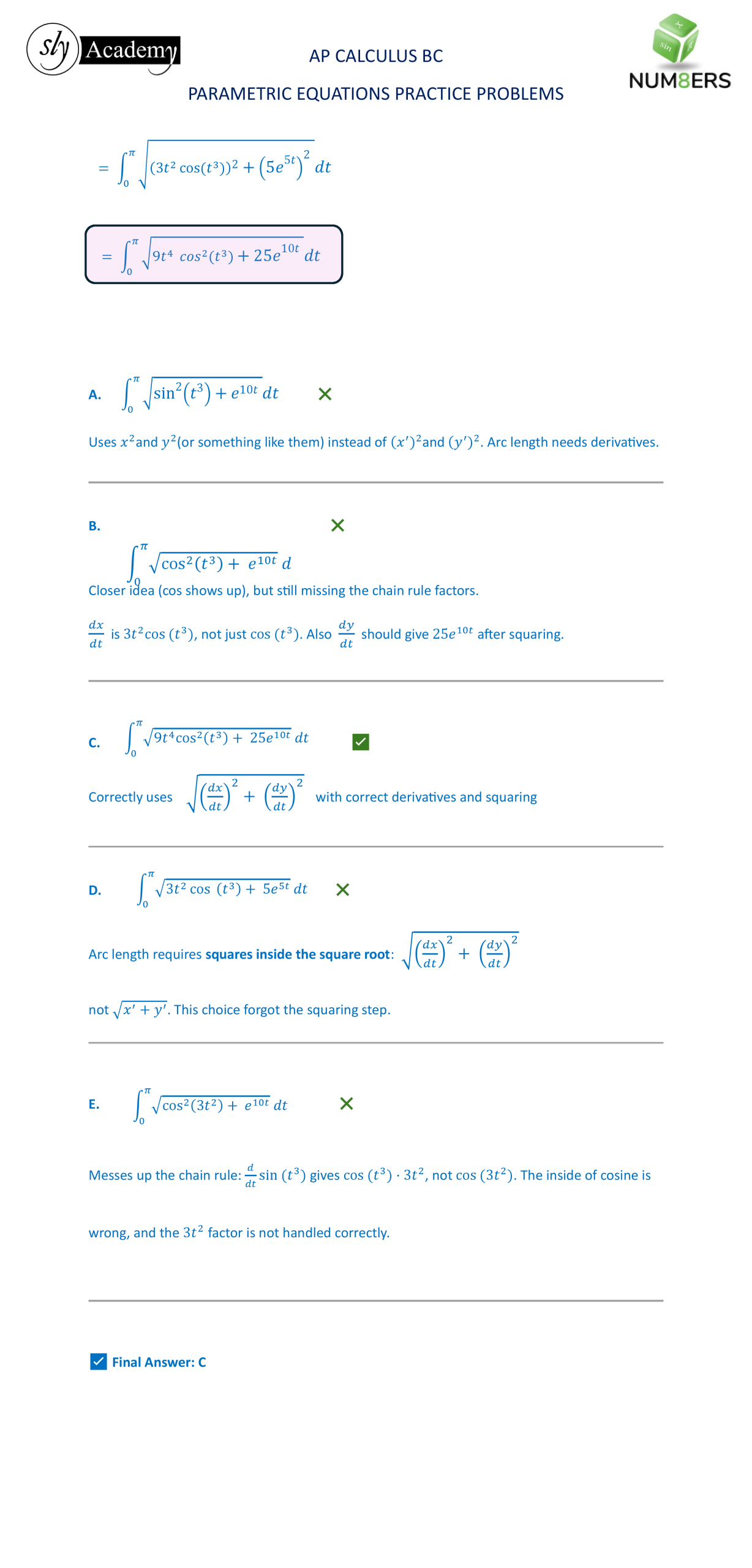
Which of the following gives the length of the path described by the parametric equations \( x = \sin(t^3) \) and \( y = e^{5t} \) from \( t = 0 \) to \( t = \pi \)?
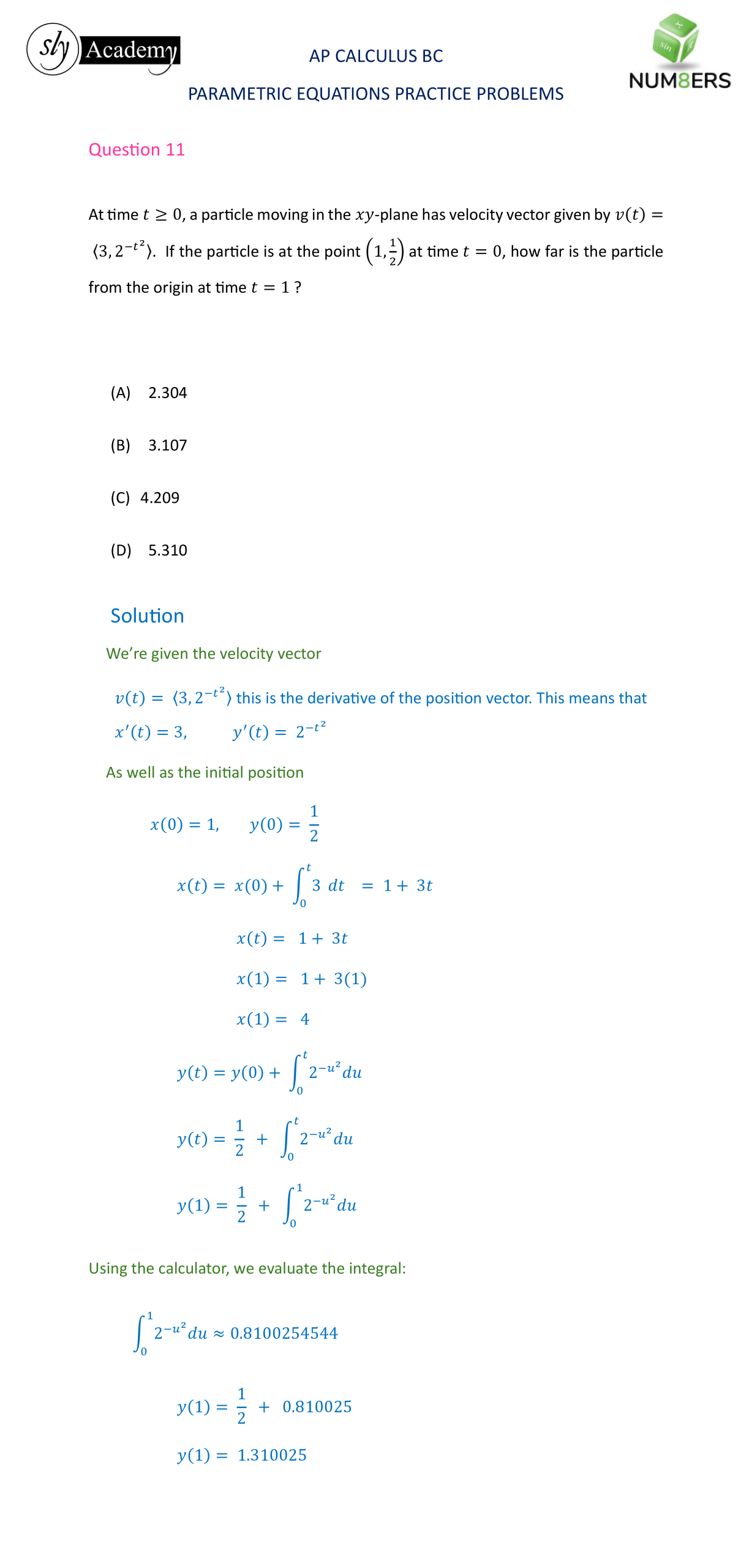
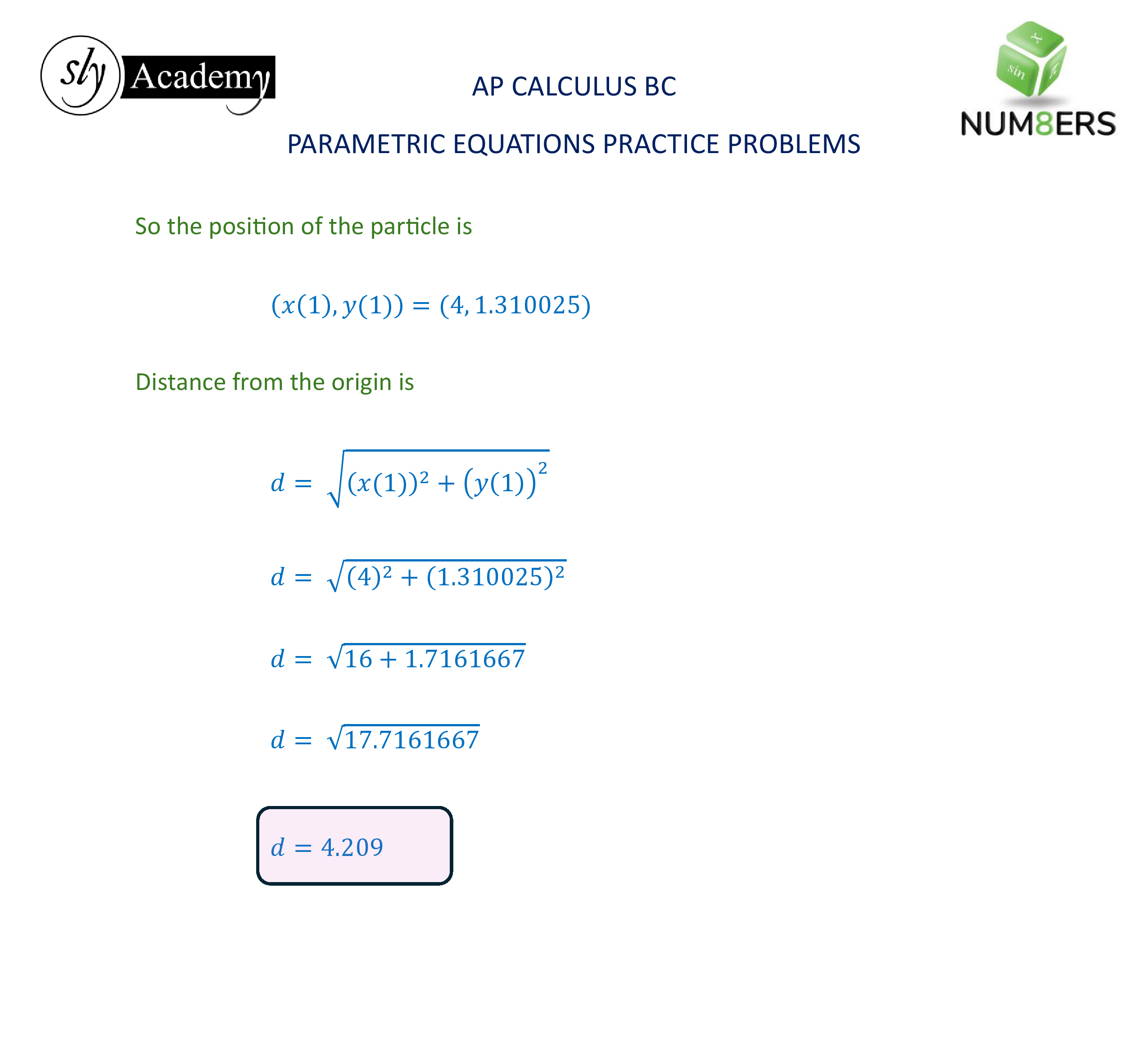
At time \( t \geq 0 \), a particle moving in the xy-plane has velocity vector given by \( v(t) = \langle 3, 2^{-t^2} \rangle \). If the particle is at the point \( \left(1, \frac{1}{2}\right) \) at time \( t = 0 \), how far is the particle from the origin at time \( t = 1 \)?
Tips for Mastering Second Derivatives
- Always find dy/dx first: The second derivative requires the first derivative as its starting point
- Master the quotient rule: Most second derivative problems involve applying the quotient rule to dy/dx
- Keep track of dx/dt: Remember to divide by dx/dt at the final step
- Simplify carefully: Complex algebraic expressions require careful simplification
- Practice concavity analysis: Understanding when d²y/dx² is positive or negative helps analyze curve behavior
Related AP Calculus BC Topics
Need More Practice?
Explore more AP Calculus BC resources and practice questions on NUM8ERS
Visit NUM8ERS