
Early and unofficial 2026 solutions
Early Solutions to the 2026 AP U.S. Government and Politics FRQs | Step by Step
Learn how to solve the Concept Application, Quantitative Analysis, SCOTUS Comparison, and Argument Essay with precise evidence, constitutional reasoning, and exam-ready responses.
How to approach the 2026 AP U.S. Government FRQs
The free-response section has four questions. A strong answer responds to the exact command word, uses a specific scenario fact, data point, constitutional clause, case fact, or document, and then explains the political consequence.
Use the verified NUM8ERS AP U.S. Government FRQ archive, review content in the all-units AP U.S. Government guide, estimate performance with the AP U.S. Government score calculator, or visit the AP Study Hub.
Question 1 - Concept Application
Ross Perot and the 1992 Presidential Election
Apply party-system, election, and voting-behavior concepts to the scenario. Each answer must use a concrete fact from the 1992 campaign.
Scenario facts you should use
Voters entered the 1992 election after a 1991 recession, slow job growth, and concern about the national debt. Republican incumbent George H. W. Bush and Democratic candidate Bill Clinton addressed these economic issues.
AImpact of the third-party candidate
Task: Describe an impact the third-party candidate had on the 1992 presidential election as described in the scenario.
- Read the verb. Describe requires a concrete effect, not a general fact about third parties.
- Choose the clearest scenario impact. Perot influenced the campaign agenda by emphasizing the budget and attracting public attention.
- Use a specific reaction. Clinton changed his message toward deficit reduction and middle-class issues, while Bush promised major budget cuts.
Reasoning chain: Perot gained attention around budget issues - the major parties responded - the campaign agenda and party messages changed.
BStructural barriers and Perot's impact
Task: Explain how structural barriers limited the impact described in Part A.
- Name the barrier. Use the Electoral College combined with plurality and winner-take-all allocation in nearly every state.
- Explain vote conversion. National popular votes do not produce electoral votes unless a candidate wins the required state or district plurality.
- Apply the numbers. Perot received about 19% nationally but no electoral votes, leaving his influence largely indirect.
Reasoning chain: Winner-take-all state contests - no state plurality - 19% national vote converts to 0 electoral votes - no realistic path to the presidency.
CApply a voting-behavior model
Task: Explain how a model of voting behavior could explain citizens' presidential votes in the scenario.
- Name and define the model. Retrospective voting means judging the incumbent party by its past performance.
- Connect it to the scenario. Voters experienced recession, slow job growth, and concern about debt while Bush was the incumbent.
- State the electoral consequence. Dissatisfied voters could punish the incumbent by supporting Clinton or Perot.
Reasoning chain: Negative recent economic conditions - evaluation of the incumbent - reduced support for Bush - votes for a challenger.
Question 1 complete polished response
- Perot shifted the agenda by emphasizing a balanced budget, leading Clinton and Bush to change their economic messaging.
- Winner-take-all Electoral College rules limited his direct impact because about 19% of the popular vote produced no state plurality and no electoral votes.
- Retrospective voting explains why voters dissatisfied with recession, slow job growth, and debt could punish incumbent Bush and support Clinton or Perot.
Question 2 - Quantitative Analysis
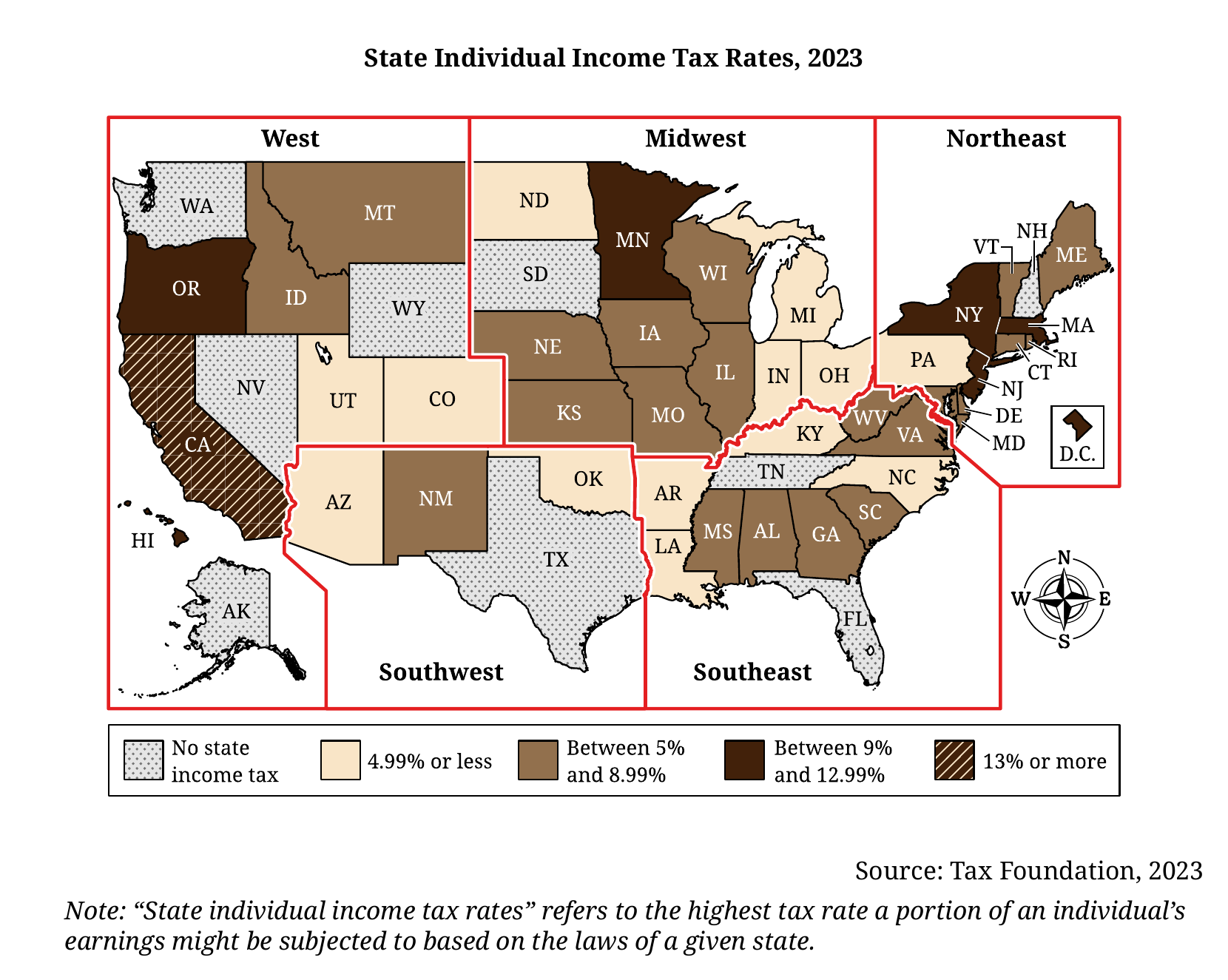
State Individual Income Tax Rates, 2023
Read the map legend before comparing regions. The map shows each state's highest individual income-tax rate category, not the rate paid by every resident.
Map stimulus and legend
In the question paper, "state individual income tax rates" means the highest rate that a portion of an individual's earnings might face under that state's laws. The map does not show the effective rate paid by every taxpayer.
AState with the highest rate
Task: Identify the state with the highest individual income-tax rate.
- Find the highest legend class. It is 13% or more and uses diagonal hatching.
- Locate the state in that class. California is shaded with the highest-category pattern.
- Respect the wording. The prompt asks for a state, so do not select the District of Columbia.
BNortheast-Southeast difference
Task: Describe a difference in individual income-tax rates between the Northeast and Southeast regions.
- Compare the same variable. Use tax-rate categories in both named regions.
- Name examples. New York and New Jersey are in 9%-12.99%; Florida and Tennessee have no state individual income tax.
- State one clear regional difference. The Northeast contains higher-category states that are absent from the Southeast.
Reasoning chain: Northeast includes 9%-12.99% states - Southeast includes no state in that category and more no-tax examples - regional policy difference.
CConclusion about participatory democracy
Task: Draw a conclusion about the impact of participatory democracy based on the map differences.
- State the map pattern. States and regions adopt substantially different tax policies.
- Connect participation to policymakers. Citizens vote, organize, contact officials, and support candidates who reflect their policy preferences.
- Draw a cautious conclusion. Different electorates and organized groups can make state policy responsive in different ways.
Reasoning chain: Citizen participation - influence over state officials - different policy preferences - different tax systems across states.
DFederalism demonstrated by state taxes
Task: Explain how state income taxes demonstrate federalism based on the map.
- Define the principle. Federalism divides governmental authority between national and state governments.
- Apply the map. States independently choose different income-tax rates or no state income tax.
- State the consequence. Diverse state policies coexist within one country while the federal government separately levies federal taxes.
Reasoning chain: Divided sovereignty - independent state policymaking - varied tax policies - policy diversity within one national system.
Question 2 complete polished response
- California.
- The Northeast includes states in the 9%-12.99% category, while no Southeast state is in that category; Florida and Tennessee have no state individual income tax.
- The differences suggest that citizen participation can make state officials responsive to different preferences, producing different tax policies.
- State tax variation demonstrates federalism because states exercise independent policymaking authority within a system of divided national-state power.
Question 3 - SCOTUS Comparison
McCulloch v. Maryland and Bonito Boats v. Thunder Craft Boats
Compare the required case McCulloch v. Maryland (1819) with the nonrequired case Bonito Boats, Inc. v. Thunder Craft Boats, Inc. (1989).
Nonrequired case passage: Bonito Boats
Bonito Boats, a Florida corporation, developed a successful fiberglass recreational-boat hull in 1976. Its manufacturing process used a hardwood model sprayed with fiberglass to make a mold for finished boats, but Bonito never patented either the hull design or the process. In 1983, Florida enacted a law barring duplication of unpatented molding processes and the sale of boats made through such copying.
Bonito sued Thunder Craft, a Tennessee boat manufacturer, in 1984. Thunder Craft argued that Florida's patent-like protection conflicted with federal patent law. Florida courts agreed with Thunder Craft, and Bonito appealed. The Supreme Court unanimously held that states may not give patent-like protection to intellectual creations that federal law leaves unprotected. Justice Sandra Day O'Connor relied on earlier Supreme Court decisions reaching that principle.
| Case or concept | Relevant rule or fact | Why it matters |
|---|---|---|
| McCulloch v. Maryland | Maryland taxed the federally chartered Bank of the United States. | A state could not tax or obstruct a valid federal institution. |
| Bonito Boats | Florida supplied patent-like protection that conflicted with the federal patent system. | The conflicting state law was preempted. |
| Supremacy Clause | Article VI makes the Constitution and valid federal law supreme over conflicting state law. | It resolves both federal-state conflicts. |
| Stare decisis | Courts generally follow legal principles established in earlier decisions. | Bonito Boats applied prior patent-preemption precedent. |
ACommon constitutional clause
Task: Identify the constitutional clause common to McCulloch and Bonito Boats.
- McCulloch involved Maryland's interference with a constitutionally authorized federal institution.
- Bonito Boats involved a Florida statute conflicting with federal patent law.
- The clause resolving both federal-state conflicts is the Supremacy Clause of Article VI.
BHow the facts produced similar holdings
Task: Explain how the facts in McCulloch and Bonito Boats led to similar holdings.
- Explain McCulloch. Maryland's tax burdened a federally chartered bank, so the Court barred the state from taxing or obstructing the valid federal institution.
- Explain Bonito Boats. Florida supplied protection that federal patent law deliberately did not supply, so federal policy preempted the state statute.
- State the common holding. A state law that conflicts with or undermines valid federal law cannot remain in force.
Reasoning chain: State interference with valid federal policy - Supremacy Clause - federal law controls - conflicting state action is invalid.
CBonito Boats and stare decisis
Task: Explain how Bonito Boats illustrates stare decisis.
- Identify the evidence. Justice O'Connor referred to earlier Supreme Court decisions.
- State the earlier rule. States may not create patent-like protection for intellectual creations that federal law leaves unprotected.
- Connect to stare decisis. The Court applied that existing precedent to Florida's law rather than creating a new rule.
Reasoning chain: Prior decisions establish a legal rule - Court applies the same rule to a similar conflict - precedent is followed.
Question 3 complete polished response
- The constitutional clause common to both cases is the Supremacy Clause of Article VI.
- Maryland's tax burdened a federal bank, and Florida's law conflicted with federal patent policy. Both state actions were invalid because valid federal law was supreme.
- Bonito Boats illustrates stare decisis because the Court applied earlier decisions barring states from creating patent-like protection that federal law does not provide.
Question 4 - Argument Essay
Social Movements vs. Congressional Action in Expanding Voting Access
Develop an argument about which has done more to expand opportunities for voting. Use at least one required foundational document, additional evidence, reasoning, and a response to an alternate perspective.
What the argument must contain
Prompt: Since the founding of the United States, access to voting has expanded. Develop an argument about whether social movements or congressional actions have done more to expand opportunities for voting.
| Component | What to do |
|---|---|
| Claim or thesis | Take a defensible position and establish a line of reasoning. Do not say only that both matter. |
| Evidence | Use at least two specific pieces. One must come from Article I, the First Amendment, or Letter from a Birmingham Jail. |
| Reasoning | Explain how each piece of evidence proves the thesis. |
| Alternate perspective | Present a genuine opposing view and answer it through rebuttal or refutation. |
Step 1: Choose a defensible position
Step 2: Build the thesis
Step 3: Select specific evidence
| Evidence | Role | How to connect it |
|---|---|---|
| Article I, Section 4 | Required foundational document | States initially regulate the times, places, and manner of congressional elections, but Congress may make or alter those rules, creating national standards. |
| Voting Rights Act of 1965 | Course evidence | It prohibited racially discriminatory voting practices and provided federal enforcement against barriers such as literacy tests and discriminatory administration. |
| National Voter Registration Act of 1993 | Additional evidence | It expanded federal-election registration through motor-vehicle agencies, public agencies, and mail procedures, lowering participation costs. |
| Civil-rights movement and Selma | Alternate perspective | Mass mobilization and nonviolent protest changed public opinion and increased pressure for federal action. |
| Letter from a Birmingham Jail | Counterargument document | King explains how nonviolent direct action creates pressure that forces negotiation and reform. |
Step 4: Explain the evidence
- Article I mechanism: Congress can alter federal-election rules, so it can impose a national floor rather than depend only on state policy.
- Voting Rights Act mechanism: The law removed discriminatory barriers and supplied federal enforcement, directly changing citizens' legal access.
- National Voter Registration Act mechanism: Registration during ordinary public transactions lowers time, information, and procedural costs.
- Rebuttal mechanism: Movements can set the agenda, but they cannot by themselves invalidate a state restriction or require an agency to register voters.
Full model argument essay
Congressional actions have done more to expand opportunities for voting because Congress can convert demands for reform into binding, nationwide rules that override restrictive state practices and reduce administrative barriers. Social movements have been essential in creating public pressure, but voting opportunities become durable and enforceable when Congress enacts legislation.
Article I, Section 4 of the Constitution gives state legislatures initial authority over the times, places, and manner of congressional elections, but it also authorizes Congress to make or alter those regulations. This constitutional structure supports the claim because it gives Congress direct power to establish national rules for federal elections when state rules are exclusionary or inconsistent. A social movement can demand change, but Article I gives Congress the institutional authority to translate that demand into a legal requirement that applies beyond one protest or one state.
The Voting Rights Act of 1965 is a major example of Congress using federal power to expand voting opportunity. The act prohibited racially discriminatory voting practices and authorized federal enforcement against jurisdictions that had used devices such as literacy tests and discriminatory administration to suppress Black registration and participation. This evidence supports the claim because the law did more than express support for equal voting rights: it changed the rules, limited states' ability to maintain discriminatory barriers, and created enforcement mechanisms. Citizens who had been formally or practically excluded gained a more realistic opportunity to register and vote.
Congress also lowered barriers through the National Voter Registration Act of 1993. The act required covered states to offer registration opportunities for federal elections through motor-vehicle agencies, designated public agencies, and mail procedures. By making registration available during ordinary interactions with government, the law reduced the time, information, and procedural costs that can keep eligible citizens from registering. A national statute can therefore change election administration in many states at once.
An opposing perspective is that social movements have done more because the civil-rights and women's suffrage movements changed public opinion and pressured political leaders to act. Letter from a Birmingham Jail supports this view by explaining that nonviolent direct action creates pressure that forces officials to confront injustice rather than postpone reform. The Selma voting-rights campaign similarly placed disenfranchisement before a national audience. However, movements themselves could not invalidate a literacy test, send federal officials to protect registration, or require states to provide new registration procedures. Those opportunities became legally enforceable through congressional action. Therefore, although social movements were indispensable catalysts, congressional actions did more to create the formal and nationwide expansion of voting access.
Alternative defensible route: social movements did more
- Use Letter from a Birmingham Jail to explain how nonviolent direct action creates pressure and forces negotiation.
- Add the women's suffrage movement, Selma campaign, or civil-rights movement as specific evidence.
- Explain how mobilization made exclusion politically costly and helped produce institutional action.
- Concede that Congress enacted formal laws, then argue those laws would not have occurred, or would have occurred later, without movement pressure.
Final quick-answer and scoring checklist
| Part | What the response must accomplish |
|---|---|
| 1A | Name a scenario-based impact and use a changed major-party message. |
| 1B | Explain why winner-take-all Electoral College rules turned 19% of the popular vote into 0 electoral votes. |
| 1C | Define a voting model and apply it to the economy and incumbent. |
| 2A | Identify California. |
| 2B | Give a specific regional comparison using tax-rate categories or named states. |
| 2C | Connect citizen participation to different state policies without claiming the map proves private preferences. |
| 2D | Explain divided national-state authority and apply it to state tax variation. |
| 3A | Identify the Supremacy Clause of Article VI. |
| 3B | Explain both cases and the shared federal-over-state holding. |
| 3C | Connect the Court's use of prior decisions to following precedent. |
| 4 | Take a side, use two specific pieces of evidence including a listed document, explain the evidence, and rebut an alternate perspective. |
Focused concept glossary
- Winner-take-all
- The candidate with the statewide plurality receives all of that state's electoral votes in nearly every state.
- Retrospective voting
- Evaluating an incumbent or incumbent party based on past performance.
- Prospective voting
- Choosing a candidate based on expectations about future policies or performance.
- Participatory democracy
- A model emphasizing broad citizen involvement through voting, organizing, contacting officials, meetings, initiatives, and other engagement.
- Federalism
- A constitutional system dividing governmental authority between national and state governments.
- Supremacy Clause
- Article VI rule that the Constitution and valid federal laws prevail over conflicting state laws.
- Preemption
- Invalidation of a state law because federal law occupies the field or conflicts with state policy.
- Stare decisis
- The judicial practice of following legal principles established in earlier decisions.
- Foundational-document evidence
- Specific constitutional or documentary evidence used to support an AP argument, not merely a document name.
- Rebuttal
- A response that recognizes an alternate perspective and explains why the original claim remains stronger.
Final takeaway
The strongest AP U.S. Government FRQ answer is specific and connected: identify the political principle, cite the scenario fact, map category, court holding, or document, and then explain why that evidence produces the stated political result.
Source note: The uploaded AP U.S. Government 2026 FRQ Detailed Solutions PDF is the primary source for the reasoning, model responses, evidence plans, alternatives, and common-error guidance. Prompt wording and stimulus details were checked against the released 2026 College Board question paper. This remains an independent study guide, not an official scoring key.