
Early and unofficial 2026 solutions
Early Solutions to the 2026 AP Physics 1: Algebra-Based FRQs | Step by Step
A complete student-friendly walkthrough of all four released FRQs, including projectile graphs, fluid flow, momentum vectors, center-of-mass motion, friction experiments, linearization, rotational work, units, and physical interpretation.
How to use these AP Physics 1 FRQ solutions
Begin every derivation with the governing principle, substitute the relevant conditions, keep signs tied to directions, and state the units and physical meaning of the result. In this guide, bold italic symbols represent vectors; ordinary italic symbols represent scalar components or magnitudes. The positive x-direction is right and the positive y-direction is upward unless stated otherwise.
Mathematical routines
FRQ 1: Fountain projectile and volume flow rate
Water exits a circular fountain nozzle at speed v0 and angle θ0, reaches height h1, and returns to launch height at time tf.
System definition and variables
Air resistance is neglected. Gravity is the only acceleration after the droplet leaves the nozzle.
A(i)Horizontal and vertical velocity graphs
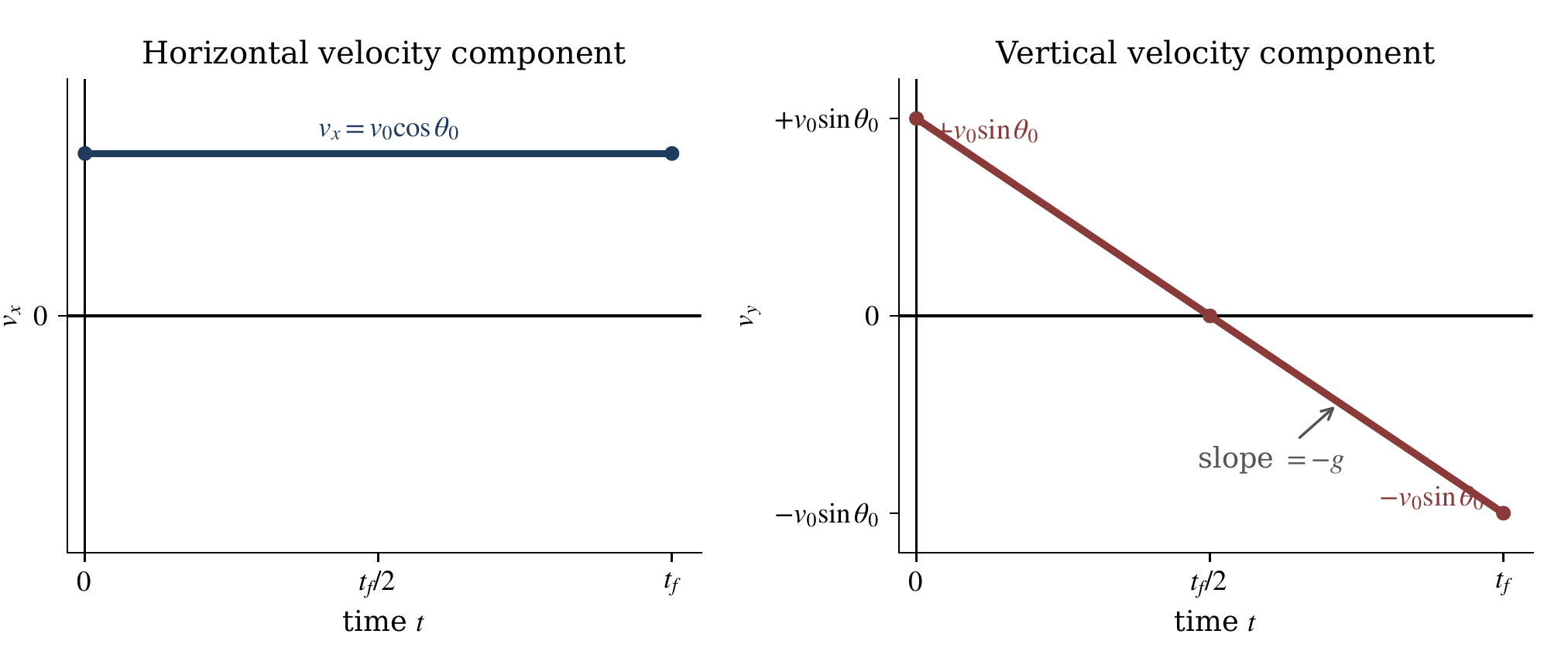
Task: Sketch vx(t) and vy(t) from 0 to tf.
- The horizontal component stays constant and positive because horizontal acceleration is zero.
- The vertical component decreases linearly with slope −g.
- At maximum height, vy = 0. Symmetry places this at tf/2.
- At tf, vy = −v0 sin θ0.
A(ii)Derive the exit speed
Task: Express v0 in terms of θ0, h1, and constants.
- From nozzle to maximum height: vy = 0, v0y = v0 sin θ0, ay = −g, and Δy = h1.
- Substitute and isolate the positive speed.
A(iii)Derive the volume flow rate
Task: Express Q using r0, θ0, h1, and constants.
BSmaller nozzle at the same flow rate
Task: Compare the new maximum height h2 with h1 and give qualitative reasoning.
- A smaller nozzle radius gives a smaller cross-sectional area.
- Because Q = Av is unchanged, the water must leave the smaller area at a greater speed.
- The exit angle is unchanged, so the upward velocity component is greater.
- Gravity needs more time and vertical distance to reduce that component to zero.
Translation between representations
FRQ 2: Collision, momentum, energy, and center of mass
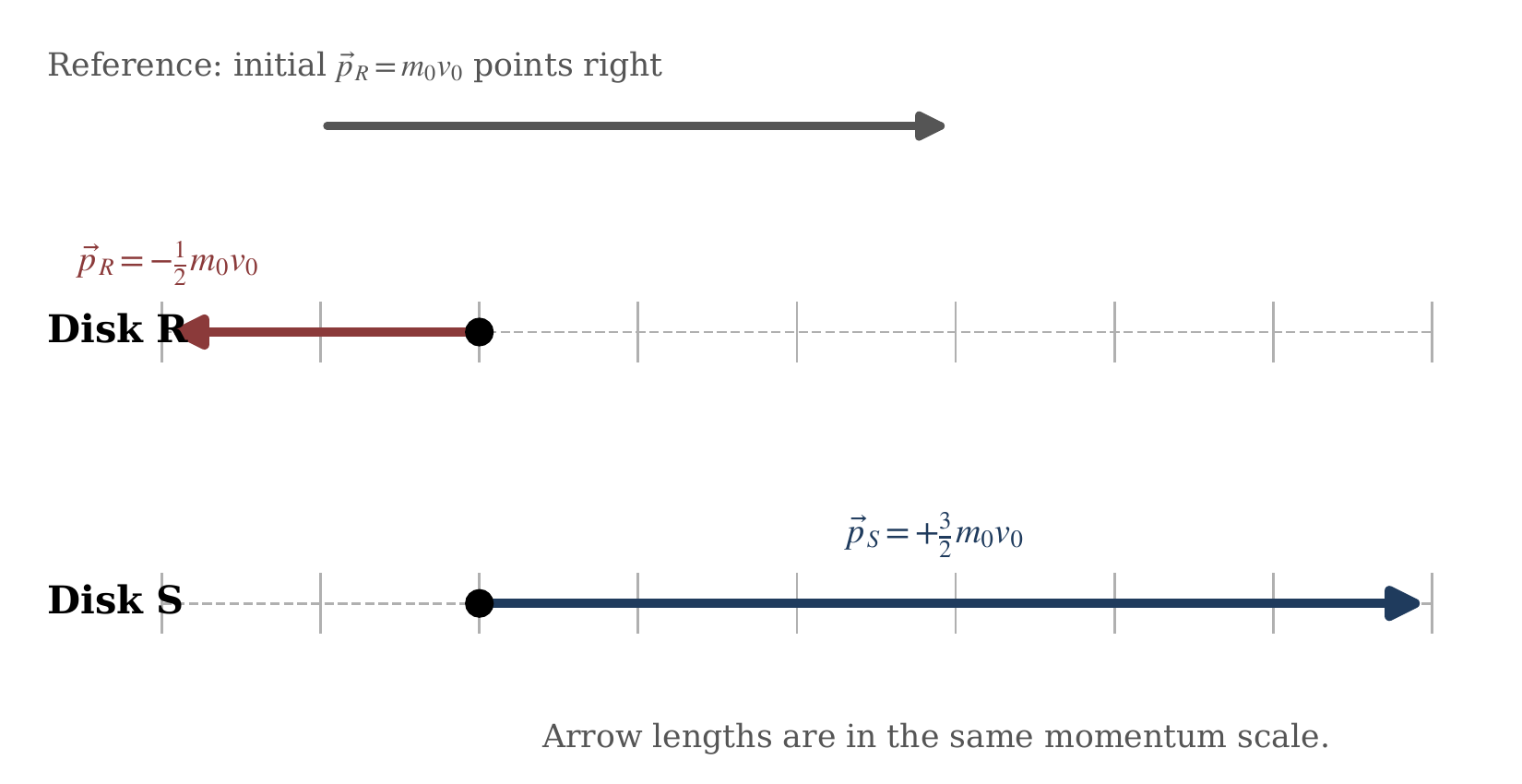
Disk R has mass m0 and initially moves right at v0. Disk S has mass 3m0 and starts at rest. After collision, R moves left at v0/2.
AMomentum vectors after the collision
Task: Determine both final momentum vectors and draw scaled arrows.
BKinetic energy of Disk S
Task: Begin with momentum conservation and derive KS.
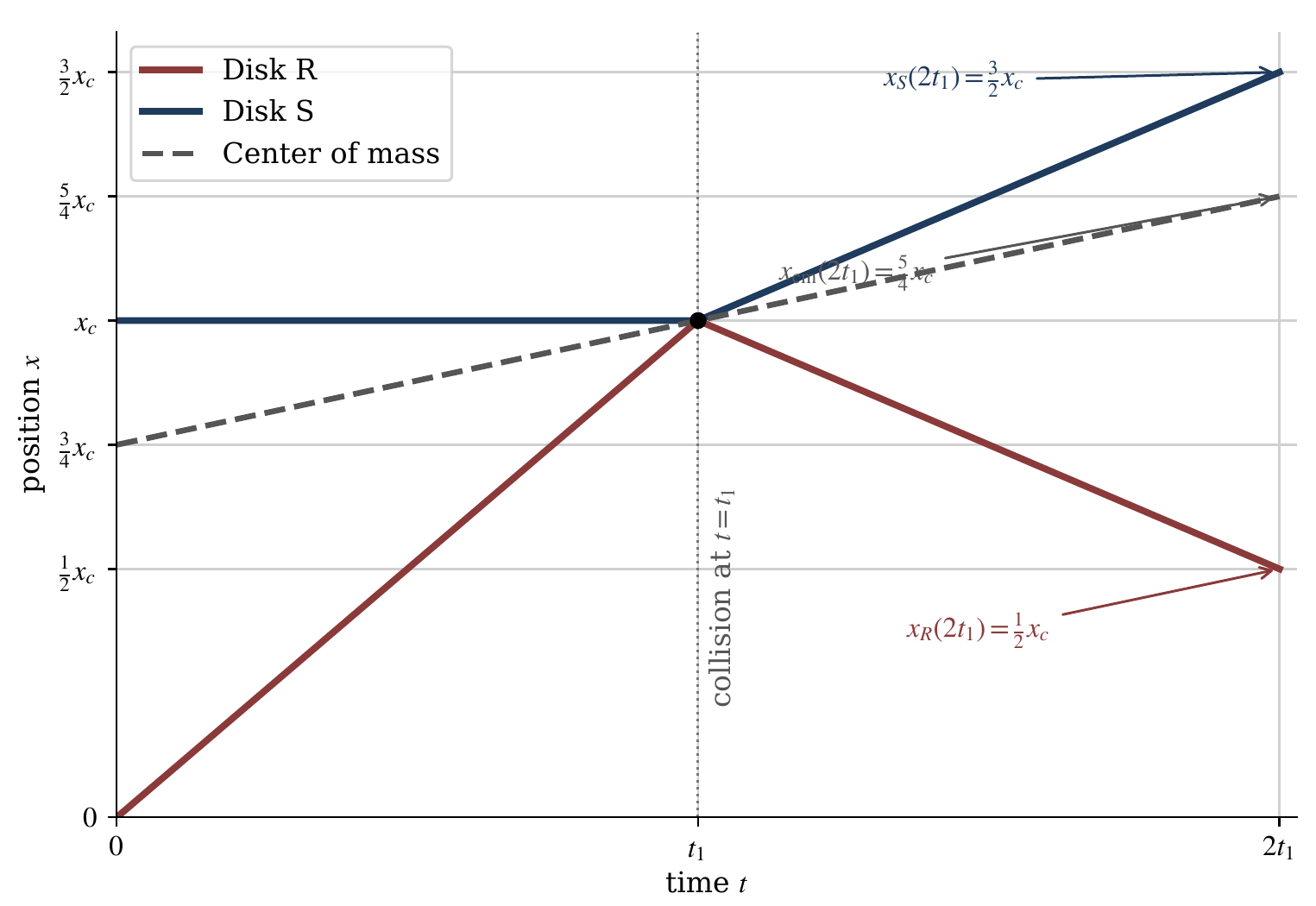
CExtend the position-versus-time graph
Task: Draw and label R, S, and center-of-mass lines from t1 to 2t1.
Let the collision position be xc = v0t1. All three curves pass through the collision point (t1, xc).
DCompare momentum-change magnitudes
Task: Compare |ΔpR| and |ΔpS|.
Experimental design and analysis
FRQ 3: Experimental determination of kinetic friction
Design a meterstick-only experiment, select graph axes, linearize rough-incline data, draw a best-fit line, and extract μk.
Experiment 1: Frictionless curved ramp and rough horizontal surface
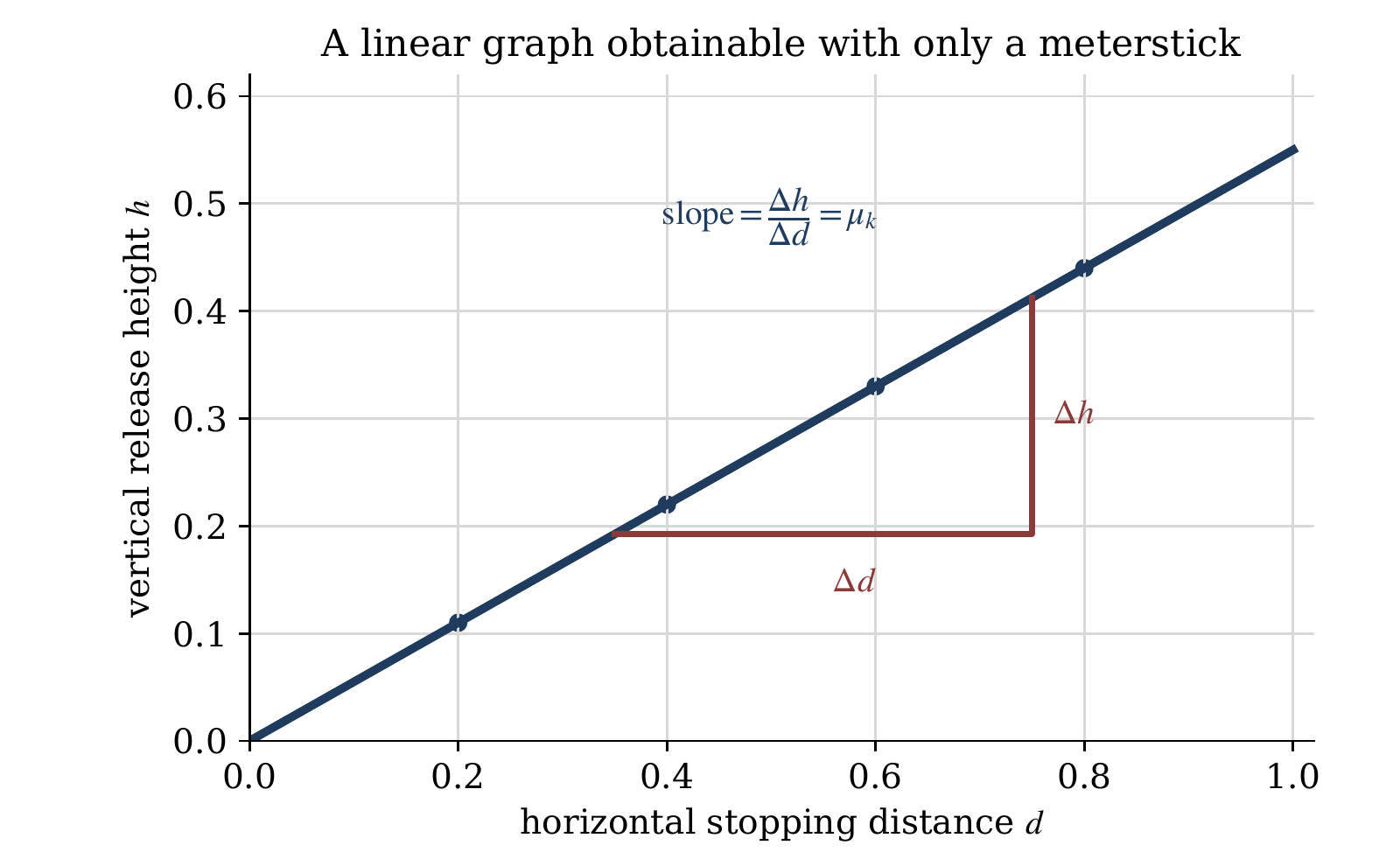
Define h as vertical release height and d as horizontal distance from the bottom of the ramp to where the block stops. The same block starts from rest; only h changes.
A(i)Quantities to measure
Task: Identify meterstick measurements that can determine μk from a linear graph.
- Measure the vertical release height h above the horizontal surface.
- Release the same block from rest.
- Measure the horizontal stopping distance d from the bottom of the ramp to the block's final position.
- Repeat for several values of h.
A(ii)Reduce experimental uncertainty
Task: Briefly describe a method.
Repeat several trials at each release height and average the measured stopping distances. Use the same reference point on the block for every distance and a broad range of heights so measured distances are large compared with the meterstick's smallest division.
B(i)Choose graph axes
Task: Select horizontal and vertical axes for a linear graph.
This matches y = mx + b with an ideal intercept of zero.
B(ii)Relate the graph feature to μk
Task: State how to obtain the coefficient from the graph.
Experiment 2: Rough incline and photogate
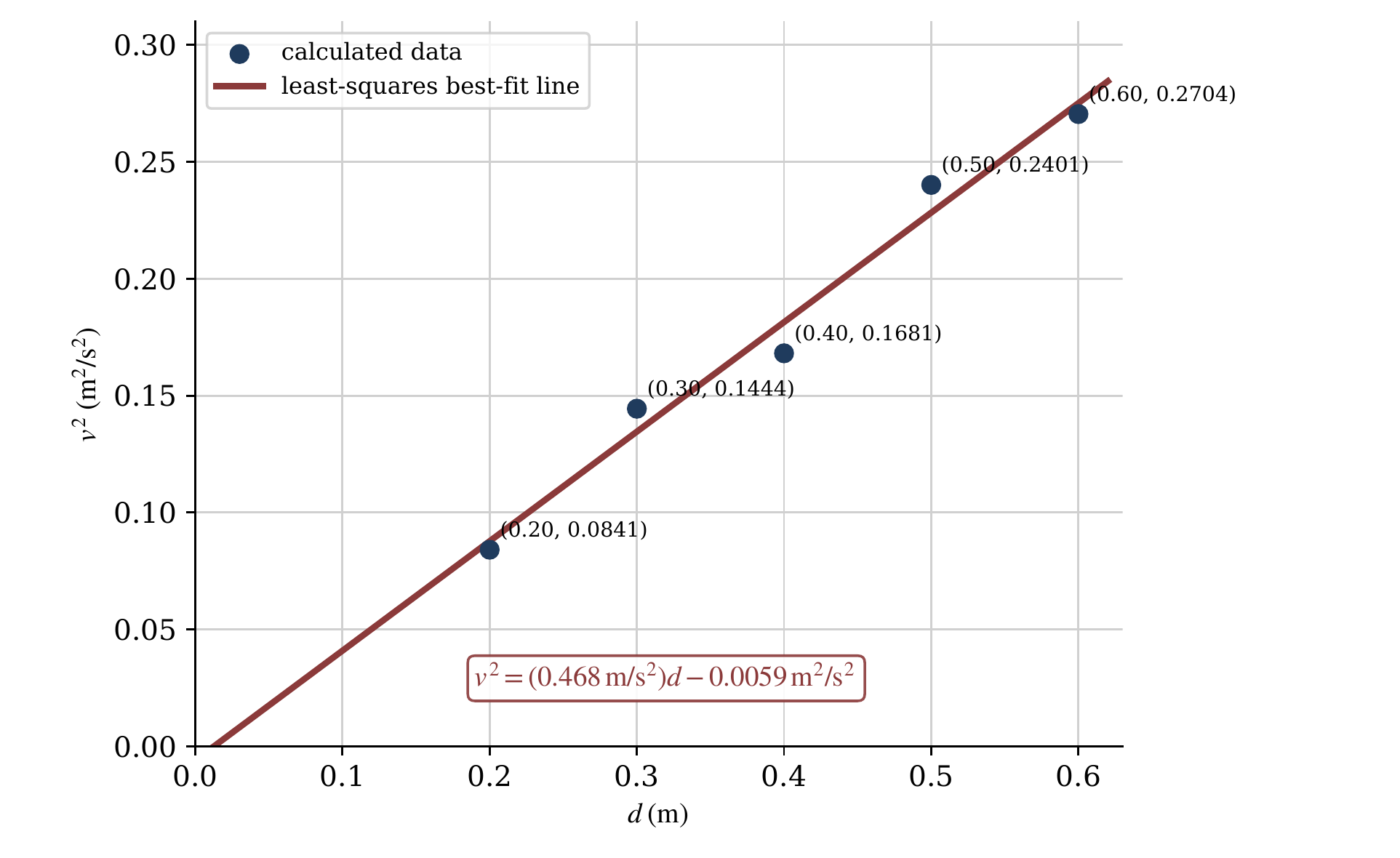
A block starts from rest a distance d up a rough ramp inclined at θ = 30°. A photogate measures speed v near the bottom. The supplied model is
C(i)Vertical-axis label for linearization
Task: The horizontal axis is d. Choose a vertical quantity and units.
The model has the form v2 = (constant)d, so plotting v2 makes the data linear.
C(ii)Calculate and plot transformed data
Task: Square each measured speed and plot v2 versus d.
| d (m) | v (m/s) | v2 (m2/s2) |
|---|---|---|
| 0.20 | 0.29 | 0.0841 |
| 0.30 | 0.38 | 0.1444 |
| 0.40 | 0.41 | 0.1681 |
| 0.50 | 0.49 | 0.2401 |
| 0.60 | 0.52 | 0.2704 |
C(iii)Draw a best-fit line
Task: Draw a line representing the trend, not a point-to-point connection.
The small intercept is close to the zero intercept predicted by the physical model. A hand-drawn best fit may differ slightly.
DExperimental coefficient of kinetic friction
Task: Use the best-fit slope and θ = 30° to calculate μk.
Qualitative/quantitative translation
FRQ 4: Rotational work and angular speed
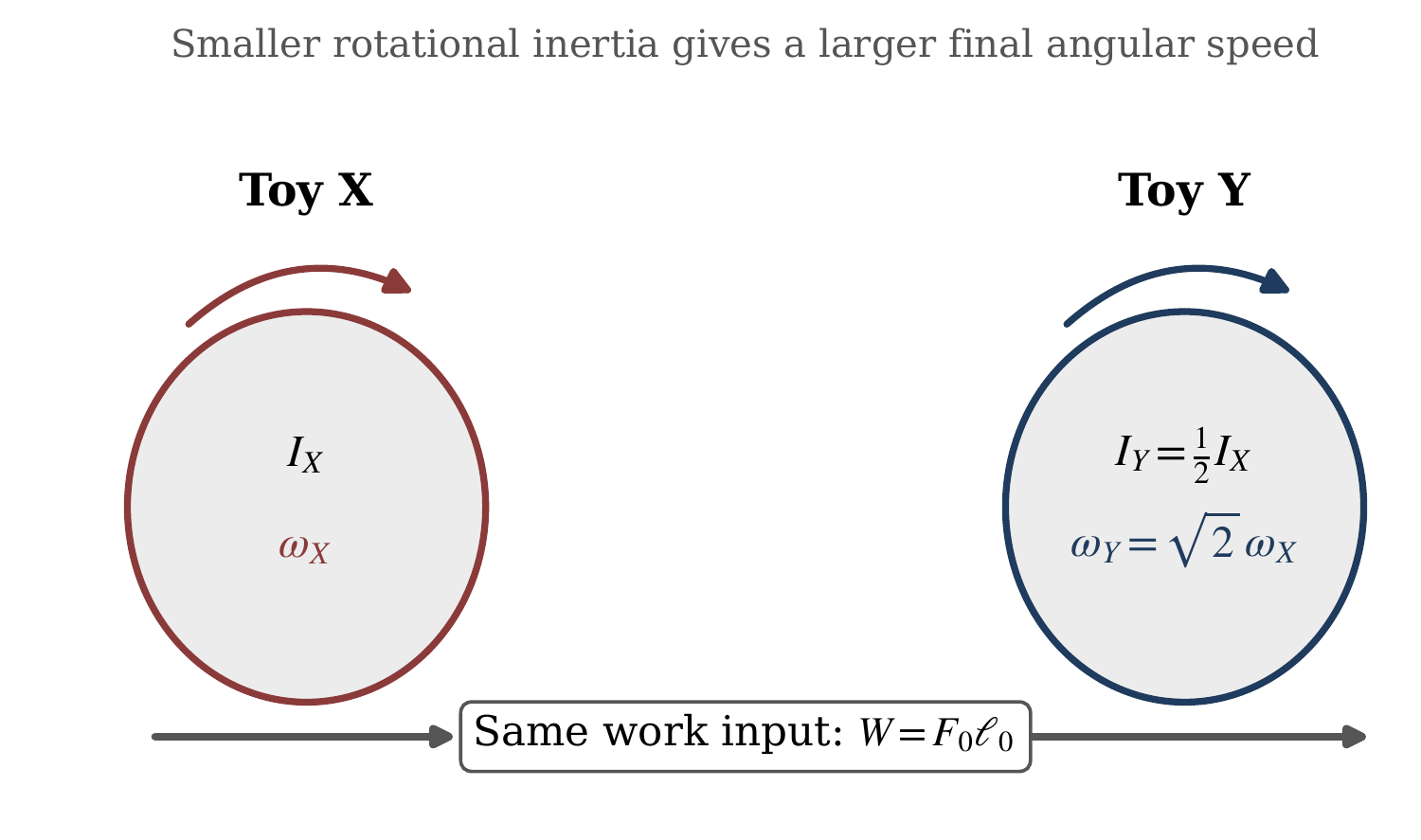
Toys X and Y start from rest. Equal forces F0 pull equal string lengths ℓ0 from equal axle radii r0. Their inertias satisfy IY = (1/2)IX.
AQualitatively compare ωY and ωX
Task: Compare the final angular speeds without relying only on equations.
- The same force acts through the same pulled distance, so the same work and energy are transferred to each toy.
- Toy Y has smaller rotational inertia, so it is less resistant to a change in rotational motion.
- With equal energy input, the toy with smaller inertia must rotate faster. Equivalently, equal torque produces greater angular acceleration for Y.
BDerive ωX
Task: Begin with rotational work-energy and express the result using F0, ℓ0, and IX.
- No slipping gives ℓ0 = r0Δφ, so Δφ = ℓ0/r0.
- The torque magnitude is τ = F0r0.
- Work is τΔφ = (F0r0)(ℓ0/r0) = F0ℓ0; the axle radius cancels.
- Set that work equal to the final rotational kinetic energy.
CCheck consistency with Part A
Task: Apply the derived relation to IY = (1/2)IX.
Final AP Physics 1 response checklist
- State the fundamental principle before the derivation.
- Keep vector directions and algebraic signs consistent.
- Define every variable before using it.
- Show substitutions and include units on numerical results.
- Label graph axes, numerical scales, and plotted lines clearly.
- Explain what each graph slope represents physically.
- Use continuity at collisions or transitions where required.
- Give qualitative mechanisms beyond equations when requested.
- Distinguish a vector from its scalar magnitude.
- Explain the physical meaning of each final result.
Continue your AP Physics 1 review
Rework each released FRQ without the solution, then compare your principles, signs, graph features, units, and justifications with this guide.
Content basis: the user-supplied AP Physics 1: Algebra-Based 2026 FRQ Detailed Solutions PDF. Prompt wording, values, figures, and subparts were cross-checked against the released 2026 question paper. This is an independent educational guide, not an official scoring document.