
Early Solutions to the 2026 AP European History FRQs | Step by Step
Every short-answer option, the complete document-based question, and all three long-essay options—explained with historical context, evidence, sourcing, reasoning, model responses, and rubric checks.
Important: These are early, unofficial solutions based on the supplied 2026 question paper and solution PDF. They are independent educational commentary and are not official College Board scoring guidelines.
How this solution guide is organized
On the exam, students answer Short-Answer Questions 1 and 2 plus either Question 3 or Question 4, then the required DBQ and one of the three LEQs. This guide solves every option so you can study the full range of skills. Read the reasoning plan before the model response; the goal is to learn how evidence earns points, not to memorize wording.
Three reliable writing formulas
- SAQ: direct claim → specific evidence → explanation of how the evidence answers the verb.
- DBQ: contextualization → thesis with judgment → grouped document evidence → outside evidence → sourcing → qualification or counterargument.
- LEQ: context → thesis naming the most significant cause or effect → evidence-driven body paragraphs → explicit historical reasoning → qualification.
Short-Answer Question 1
Jonathan Healey on England, 1603–1689
Decode the three tasks
- Part A: State the author’s overall argument, not a single detail.
- Part B: Select a detail from the passage and explain how it proves the broader claim.
- Part C: Use outside knowledge to build a causal link from social or economic change to political development.
Build the historical chain
Healey’s contrast runs from a poor, rural, disease-prone, politically deferential England in 1603 to a more commercial, urban, prosperous, and politically engaged England in 1689. Trade, consumer markets, towns, coffeehouses, theaters, a larger press, parties, and a stronger Parliament all fit that transformation. The political endpoint can be connected to the Glorious Revolution and Bill of Rights.
Complete model response
A. Healey argues that England underwent a broad transformation between 1603 and 1689: it changed from an agrarian, impoverished, disease-prone, and politically deferential society into a more commercial, urban, prosperous, and politically participatory one, with a stronger Parliament and public sphere.
B. The passage says that trade became a mainstay and that a growing market supported towns, coffeehouses, theaters, and other public spaces. This detail supports Healey’s claim because expanding commerce and urban sociability created new settings in which people consumed news, discussed politics, and participated in public life.
C. Expanding commerce, print culture, and coffeehouse discussion helped create a better-informed property-owning public that expected a voice in taxation and government. During the Glorious Revolution of 1688–1689, Parliament replaced James II with William and Mary, and the English Bill of Rights limited royal power and strengthened parliamentary authority. The changing social and economic public therefore helped support constitutional monarchy.
Why this earns all three points: A states a broad transformation; B uses a passage-specific detail and explains it; C supplies outside evidence and connects change to political development.
Short-Answer Question 2
Stanhope Forbes, The Munitions Girls, 1918
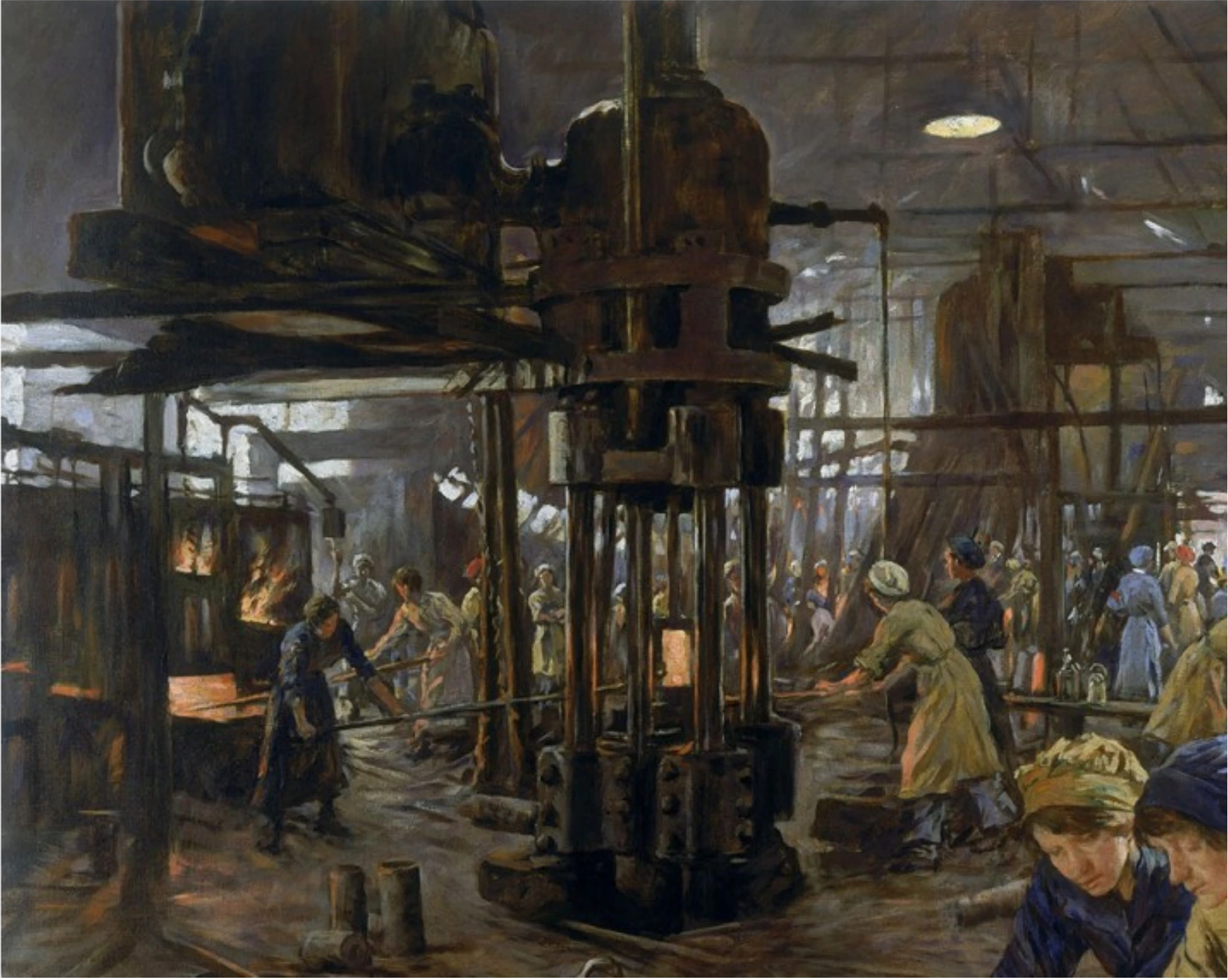
Read the visual historically
The date, 1918, places the image in the First World War. Mass conscription removed millions of men from civilian employment, while total war created enormous state demand for shells. Women shown operating heavy machinery and handling munitions are therefore evidence of female entry into paid industrial work that had commonly been coded as male.
Separate wartime change from permanent equality
The image shows a real expansion of women’s public and economic roles, but it does not prove that equality arrived immediately. Many women were pushed out of wartime jobs after 1918, domestic expectations remained strong, and wage inequality persisted.
Complete model response
A. The image reflects the First World War’s system of total war. Mass conscription created labor shortages, and governments needed huge quantities of ammunition, so women were recruited into munitions production.
B. The painting shows women handling artillery shells and operating heavy industrial machinery. Their paid factory labor placed them in work previously associated with men, expanding women’s public and economic roles and challenging claims that women were incapable of industrial work.
C. After 1950, second-wave feminism and new laws expanded women’s legal and workplace opportunities. In Britain, the Equal Pay Act of 1970 and Sex Discrimination Act of 1975 challenged unequal wages and discrimination in hiring, training, and promotion, helping more women pursue long-term careers.
Short-Answer Question 3
Scientific Revolution option
Choose connected evidence
A strong chain is systematic observation, experiment, and mathematics → a Renaissance-era willingness to reconsider inherited authority → Newtonian natural laws influencing Enlightenment thought.
Complete model response
A. One major feature of the Scientific Revolution was the use of systematic observation, experiment, and mathematics to test explanations of nature. Kepler, Galileo, and Newton used measured evidence and mathematical laws rather than relying only on ancient authorities.
B. Both the Renaissance and the Scientific Revolution encouraged educated Europeans to reconsider medieval authorities and consult evidence or original sources. Humanists used textual criticism to examine classical writings, while natural philosophers tested claims inherited from Aristotle and Ptolemy.
C. Newton’s Principia of 1687 explained earthly and celestial motion through mathematical laws. The success of these natural laws encouraged Enlightenment thinkers to search for discoverable laws of government and society, supporting arguments for reform, toleration, and limits on traditional authority.
Short-Answer Question 4
National unification option
Complete model response
A. The conservative settlement of 1815 was a major obstacle. Austria dominated much of Italy and presided over the German Confederation, while Metternich used censorship, the Carlsbad Decrees, and military intervention to suppress liberal-national movements.
B. Both Italian and German unification were achieved largely through conservative monarchies that used diplomacy and limited wars. Piedmont-Sardinia under Cavour and Victor Emmanuel II led Italian unification, while Prussia under Bismarck and William I used state armies, diplomatic isolation of opponents, and war to create a German empire.
C. A united Germany became Europe’s most populous industrial and military power. Its annexation of Alsace-Lorraine created lasting French hostility, encouraging France to seek partners such as Russia and contributing to the rival alliance system that preceded the First World War.
Document-Based Question
Who transformed Russia more: Peter the Great or Catherine the Great?
Step 1: Establish the judgment
Step 2: Contextualize Russia before the rulers
Before Peter’s reign, Russia was a vast Eurasian state less integrated into western European diplomatic and commercial systems, without secure Baltic access, and governed through Orthodox and noble traditions. At the same time, European monarchies were building standing armies, navies, bureaucracies, and mercantilist economies. Competition with Sweden and the Ottoman Empire made reform especially urgent.
Step 3: Analyze all seven documents
Peter captures the site, fortifies a Baltic harbor, and accepts enormous deaths of laborers and horses. It supports Peter’s military-geopolitical transformation while revealing coercion and human cost. As a military observer, Gordon emphasizes strategy and sacrifice.
Foreign officers, artisans, and merchants are invited to improve the army, administration, trade, and technical skill. Because the decree was intended for a European audience, its promise of discipline, prosperity, and toleration is promotional, yet that purpose confirms Peter’s determination to import western expertise.
The French allegory presents Catherine directing attention to the Nakaz on crime and punishment. It proves her Enlightenment image and legal ambition more clearly than implementation; its purpose is idealization and reputation-building.
Catherine repaired and expanded canals connecting the Volga, St. Petersburg, Caspian, and Black Sea. This is concrete economic development, but the source explicitly notes that Peter planned and began the works, making it evidence of both Catherine’s achievement and Petrine continuity.
A traveler reports free inoculation facilities and schools for soldiers’ children. The praise may be exaggerated, but the institutional details show Catherine extending education and public-welfare activity.
Peter required mixed-gender noble gatherings, western dress, shaved beards, and greater acquaintance before marriage. Shcherbatov’s conservative hostility makes the disruption especially persuasive: changes visible enough to alarm a defender of older customs were socially meaningful.
Catherine’s provincial mapping, roads, courts, police, and commercial measures expanded administrative reach. Dashkova was Catherine’s appointee and had reason to praise her patron, but the specific administrative details remain usable evidence.
Step 4: Group the documents into an argument
- Peter—military, geopolitical, and economic redirection: Documents 1 and 2.
- Peter—elite culture: Document 6.
- Catherine—enlightened image, welfare, infrastructure, and provincial administration: Documents 3, 4, 5, and 7.
- Continuity: Document 4 directly shows Catherine extending a project begun by Peter.
Step 5: Add outside evidence
| Evidence | How to use it |
|---|---|
| Great Northern War and Peter’s navy | Russia’s victory over Sweden and Baltic access made it a major European power. |
| Table of Ranks, 1722 | Tied noble advancement to state service and changed elite-state relations. |
| Holy Synod, 1721 | Peter abolished the patriarchate and placed the Orthodox Church under closer state control. |
| Crimea, 1783 | Catherine’s annexation strengthened the counterargument based on territorial breadth and Black Sea power. |
| Charter to the Nobility, 1785 | Shows Catherine confirming noble privileges and the limits of enlightened reform. |
| Pugachev Rebellion, 1773–1775 | Helps explain Catherine’s retreat from reform and greater dependence on nobles. |
Step 6: Full DBQ model essay
Before Peter the Great, Russia was a vast Eurasian monarchy whose political culture, military organization, and elite customs differed sharply from the increasingly bureaucratic and commercially connected states of western Europe. Russia lacked secure access to the Baltic, and the tsar governed through the Orthodox Church and hereditary service elites. European rulers, meanwhile, were developing standing armies, navies, fiscal institutions, and mercantilist economies. Both Peter and Catherine responded to this competitive environment, but Peter transformed Russia more fundamentally. He redirected the state toward European military and commercial power, remade central institutions and noble service, and forcibly westernized elite culture. Catherine expanded territory, infrastructure, public programs, and provincial administration, yet many of her reforms extended Petrine foundations and remained constrained by noble privilege and serfdom.
Peter’s greatest transformation was the reorientation of the Russian state toward European military power and Baltic commerce. Alexander Gordon describes Peter seizing the site of St. Petersburg and constructing a fortified harbor despite the deaths of thousands of workers and horses (Document 1). The enormous cost reveals the coercive nature of Petrine reform, but the result was a new capital and strategic “window to the West” that redirected the court, navy, and trade toward the Baltic. This change was reinforced by Peter’s decree inviting foreign officers, artisans, and merchants to improve the army, administration, and commerce (Document 2). Because the decree was printed for circulation across Europe, its language about prosperity and religious freedom was designed to persuade skilled foreigners and therefore presents Peter in an unusually benevolent light. Nevertheless, that foreign audience is itself evidence of his deliberate effort to import western expertise. Outside the documents, Peter’s victory over Sweden in the Great Northern War and his construction of a navy made Russia a major European great power, while the Table of Ranks tied noble advancement to state service. These measures altered both Russia’s international position and the machinery of government.
Peter also transformed the behavior and identity of the ruling elite. Prince Shcherbatov reports that Peter required social gatherings at which noble women mixed with men, promoted western clothing and shaved beards, and weakened the older practice of marriages arranged without prior acquaintance (Document 6). Shcherbatov wrote as a conservative critic who believed that western luxury corrupted Russian morals. His hostility makes the document especially useful: changes that alarmed a defender of traditional noble culture must have been visible and disruptive. Peter’s beard tax and compulsory assemblies similarly used autocratic force to remake elite appearance and sociability. He also replaced the patriarchate with the Holy Synod, bringing the Orthodox Church more directly under state supervision. These reforms did not liberate most Russians—serfdom and autocracy continued—but they changed the service, culture, and institutions of the groups through which the empire was governed.
Catherine nevertheless carried out substantial reforms and in some areas extended state power more deeply into the provinces. A French allegory presents her as an enlightened lawgiver directing attention to the Nakaz on crime and punishment (Document 3). The image demonstrates her desire to be recognized by European intellectuals as an enlightened monarch, although its propagandistic purpose means it proves intention and reputation more clearly than successful legal change. Other documents show more concrete achievements. Catherine repaired and expanded canal systems that connected the Volga, St. Petersburg, the Caspian, and the Black Sea (Document 4), sponsored free inoculation facilities and schools for soldiers’ children (Document 5), and reorganized provincial maps, roads, courts, and police (Document 7). Dashkova, the author of Document 7, was appointed by Catherine and had reason to praise her patron, but the administrative details still indicate a broader governmental presence in the empire. Catherine also annexed Crimea in 1783 and participated in the partitions of Poland, greatly expanding Russia’s strategic reach.
These achievements create a serious counterargument: Catherine arguably transformed the territorial scale and provincial reach of the empire more than Peter. Yet the evidence also reveals that her changes were usually extensions or refinements of the state Peter had redirected. The canal account explicitly states that Peter planned and began the works that Catherine completed (Document 4). Her Nakaz did not become a comprehensive new legal code, and after the Pugachev Rebellion she relied more heavily on the nobility. The Charter to the Nobility of 1785 confirmed elite privileges, while serfdom expanded into newly acquired regions. Thus Catherine’s enlightened programs coexisted with stronger noble domination over peasants. Peter’s reforms were also limited and brutally imposed, but they changed the capital, armed forces, church-state relationship, noble service system, and elite culture all at once.
Therefore, Catherine transformed the breadth, administration, and international reach of an already westernizing empire, while Peter transformed the fundamental direction and institutional foundations of the Russian state. Catherine was a major consolidator and extender of change; Peter was the more decisive transformer.
DBQ rubric walk-through
| Rubric element | Where the response earns it |
|---|---|
| Thesis | Makes a direct judgment and establishes military/administrative structure, elite culture, territorial-administrative breadth, and limits as comparison categories. |
| Context | Explains Muscovy’s relative isolation, European state-building, and strategic competition before the reigns. |
| Document evidence | Accurately describes and uses all seven documents, exceeding the four-document requirement for full document evidence. |
| Outside evidence | Integrates the Great Northern War, navy, Table of Ranks, Holy Synod, beard tax, Crimea, partitions of Poland, Pugachev, and Charter to the Nobility. |
| Sourcing | Analyzes Document 2 through purpose/audience, Document 6 through point of view, and Documents 3 and 7 through further sourcing. |
| Complexity | Distinguishes depth from breadth, acknowledges Catherine’s stronger territorial/provincial case, and explains the limits of both rulers. |
DBQ mistakes to avoid
- Writing two separate biographies without directly comparing the rulers.
- Treating the Nakaz image as proof that Catherine enacted a complete legal code.
- Listing documents one by one without grouping them into an argument.
- Identifying bias without explaining why it matters to the comparison.
- Using the same fact for contextualization and the separate outside-evidence point.
Long Essay Question 2
Most significant cause of changes in traditional social hierarchies, 1450–1600
Step 1: Define the change
Late-medieval hierarchy rested heavily on landed nobility, corporate clergy, urban guilds, and dependent peasants. From 1450 to 1600, wealthy merchants and officeholders gained influence; monarchs weakened some feudal intermediaries; church property and clerical status changed in Protestant regions; and market pressures altered the position of peasants and artisans.
Step 2: Choose the most significant cause
Evidence bank
| Evidence | What it shows | How it advances the thesis |
|---|---|---|
| Fugger banking family | Merchant-bankers financed Habsburg rulers and accumulated influence once associated mainly with landed aristocrats. | Demonstrates wealth-based mobility and the political power of finance. |
| Atlantic trade and Iberian ports | Commerce through Lisbon, Seville, and Antwerp expanded merchant fortunes and state customs revenue. | Shows overseas expansion strengthening commercial groups and centralized monarchies. |
| Sale of offices / nobles of the robe | Monarchs sold administrative and judicial offices to educated, wealthy commoners. | Created elites whose status came from education, money, and royal service, not only ancient lineage. |
| Price Revolution and enclosure | Inflation and market-oriented agriculture disrupted fixed incomes and customary land use. | Explains pressure on traditional landlords, peasants, and artisans. |
| English dissolution of the monasteries | Henry VIII transferred church property to the Crown and lay purchasers. | Shows the Reformation weakening clergy while often enriching existing or aspiring elites. |
| German Peasants’ War, 1524–1525 | Peasants used religious language for social demands but were defeated by princes. | Shows both challenges to hierarchy and the ability of elites to preserve it. |
Step 3: Organize the causation argument
- Context: late-medieval estates, the Black Death’s weakening of serfdom in parts of western Europe, and pre-1450 commercialization.
- Body 1: commercial and urban wealth produced new routes to status.
- Body 2: monarchs’ demand for taxes, credit, and skilled officeholders elevated service elites.
- Body 3: Renaissance humanism and the Reformation altered clerical authority and property.
- Qualification: hierarchy persisted; nobles adapted, peasants remained subordinate, patriarchy endured, and eastern European serfdom intensified.
Full LEQ 2 model essay
In the late Middle Ages, European society was commonly imagined as a hierarchy of clergy, nobles, and laboring people, with political and social status tied largely to land, inherited privilege, and corporate membership. Yet the Black Death had already weakened serfdom in parts of western Europe, while Italian cities and northern trading centers demonstrated the growing power of commerce. From 1450 to 1600, the expansion of commercial capitalism and urban markets was the most significant cause of changes in traditional social hierarchies because banking, Atlantic trade, and royal finance elevated merchants and officeholders and made rulers less dependent on feudal nobles. Renaissance humanism and the Protestant Reformation also challenged clerical authority and redistributed church property, but their effects were uneven and frequently reinforced rather than destroyed existing elite and patriarchal structures.
Commercial expansion created forms of wealth that did not depend primarily on hereditary landholding. The Fugger family of Augsburg, for example, used mining, banking, and loans to the Habsburgs to exercise influence at the highest level of European politics. Similar merchant communities prospered in Antwerp, Lisbon, Seville, and Italian cities as long-distance trade expanded. The voyages of exploration and the flow of American silver increased the importance of ports, financiers, and commercial intermediaries. Wealthy merchants could purchase land, marry into noble families, sponsor art and education, and imitate aristocratic lifestyles. The result was not the disappearance of nobility, but a greater permeability between economic wealth and social status.
Commercialization also changed the relationship between monarchs and traditional elites. Centralizing rulers needed cash to maintain courts, diplomats, firearms, and standing forces. They therefore relied on merchant credit, customs duties, and the sale of administrative or judicial offices. In France, the growth of officeholding created a “nobility of the robe” whose position rested on education, purchase, and royal service rather than only on medieval warrior lineage. In Spain and England, rulers similarly drew trained lawyers and administrators into state service. This strengthened monarchies at the expense of some independent feudal nobles and made bureaucratic skill and money increasingly important sources of advancement.
The Renaissance and Reformation were also important causes of hierarchical change, especially in the status of the clergy. Humanists criticized scholastic traditions and promoted education in classical languages, helping educated laypeople claim cultural authority. Protestant reformers rejected papal supremacy, clerical celibacy, and monasticism. In England, Henry VIII’s dissolution of the monasteries transferred enormous amounts of church property to the Crown and then to members of the gentry and nobility, reducing the independent economic position of the clergy. Yet this example also shows why religious change was not the most consistently transformative cause. Much monastic land passed to existing or aspiring elites, and Protestant communities usually preserved patriarchal household authority. The defeat of the German Peasants’ War demonstrated that reformers and princes would suppress popular attempts to use religious ideas for radical social equality.
Moreover, social hierarchy changed differently across Europe. In western cities and Atlantic regions, merchants and professionals gained influence, while in eastern Europe landlords tightened control over peasants in a “second serfdom” tied to grain exports. Old aristocracies often adapted by entering royal service, investing in commerce, or purchasing offices for relatives. Thus the period produced a reorganization of hierarchy rather than a democratic leveling of society.
Overall, the growth of markets, finance, and centralized fiscal states was the most significant cause because it altered the material basis of status and power across both Catholic and Protestant Europe. Religious and intellectual movements changed the legitimacy and property of the clergy, but commercial wealth and royal service most consistently opened new routes into elite society while forcing older elites to adapt.
LEQ 2 rubric walk-through
| Rubric element | Where the response earns it |
|---|---|
| Thesis | Names commercial capitalism as the most significant cause and compares it with Reformation and humanism. |
| Context | Explains the late-medieval estates, Black Death, and pre-1450 commercialization. |
| Evidence | Uses the Fuggers, Atlantic ports and silver, sale of offices, nobility of the robe, dissolution of monasteries, and Peasants’ War. |
| Historical reasoning | Organizes the essay around causation and relative significance. |
| Complexity | Explains regional variation, persistence of hierarchy, adaptation by nobles, and uneven effects of religious change. |
Long Essay Question 3
Most significant effect of governmental responses to industrialization in the 1800s
Step 1: Identify the response categories
- Labor regulation: factory acts, child-labor limits, hours laws, mine regulation, and inspectors.
- Public health and urban government: sewers, water, sanitation, housing regulation, policing, and planning.
- Political incorporation: legalized unions, expanded suffrage, and compulsory education.
- Social insurance: sickness, accident, disability, and old-age programs, especially in Bismarckian Germany.
- Repression: anti-socialist laws, strike restrictions, and policing of radical movements.
Evidence bank
| Evidence | What it shows | How it advances the thesis |
|---|---|---|
| British Factory Act, 1833 | Restricted child labor in textile mills and created factory inspectors. | Shows the state moving beyond laissez-faire toward direct workplace regulation. |
| Ten Hours Act, 1847 | Limited hours for women and young persons in textile factories. | Demonstrates continuing regulation of industrial labor and family life. |
| Public Health Act, 1848 | Created a central public-health framework and encouraged local sanitation boards. | Shows industrial cities producing new administrative responsibilities for health and infrastructure. |
| Reform Act, 1867 / union legalization | Expanded male working-class participation and recognized organized labor more fully. | Shows political incorporation as a response to industrial society. |
| Bismarckian insurance laws | Health insurance (1883), accident insurance (1884), and old-age/disability insurance (1889). | Created foundations of the modern welfare state and attempted to bind workers to the national state. |
| Anti-Socialist Laws, 1878–1890 | Restricted socialist organizations while social insurance expanded. | Provides complexity: reform and repression operated together. |
Step 2: Organize the effect
- Context: rapid urbanization, dangerous work, child labor, and new socialist and labor movements.
- Body 1: workplace and urban reforms expanded administrative capacity and normalized regulation.
- Body 2: welfare and political incorporation made workers stakeholders in national institutions.
- Body 3: reforms also served social control and remained incomplete, so class conflict persisted.
Full LEQ 3 model essay
Early industrialization transformed European production and population patterns faster than existing institutions could respond. Factories concentrated workers under dangerous conditions, cities expanded without adequate water or sewers, and child labor and long hours became symbols of the new economy. Liberal governments initially favored property rights and limited intervention, while socialists and labor movements increasingly demanded reform. The most significant effect of governmental responses to industrialization in the nineteenth century was the expansion of state responsibility for social and economic life. Factory regulation, public-health administration, education, and social insurance improved some working-class conditions and incorporated workers more fully into national political systems, helping reduce the appeal of revolutionary socialism. Nevertheless, these measures were uneven and often combined reform with repression, so they managed rather than eliminated class conflict.
In Britain, industrial problems led the state to regulate workplaces that had previously been treated largely as private property. The Factory Act of 1833 restricted the labor of children in textile mills and established inspectors, creating a permanent administrative mechanism to enforce social legislation. The Ten Hours Act of 1847 further limited the workday of women and young persons in textile factories. These laws did not end exploitation, and they initially covered only certain industries, but their importance lay in the principle that government could set minimum standards inside the workplace. Industrial society therefore expanded the meaning of legitimate state action.
Urbanization produced a similar growth of public administration. Repeated cholera outbreaks and reports on urban poverty helped produce Britain’s Public Health Act of 1848, which created a central health authority and a framework for local boards concerned with drainage, water, refuse, and sanitation. Later public-health legislation strengthened these powers. Comparable projects across Europe, including sewer construction and urban redesign, made municipal and national governments responsible for infrastructure that private charity could not provide at sufficient scale. The modern state became more bureaucratic, technical, and involved in everyday life.
The incorporation of workers into national institutions was even more politically significant. Britain gradually legalized trade-union activity and expanded the male electorate through the Reform Acts, while compulsory schooling and civic administration connected families more closely to the state. In Germany, Bismarck introduced health insurance in 1883, accident insurance in 1884, and old-age and disability insurance in 1889. These programs offered workers limited material security and created precedents for the welfare state. Bismarck’s purpose was not purely humanitarian: he hoped to weaken the Social Democratic movement and strengthen loyalty to the empire. The reforms therefore show how industrial policy could turn workers from potential revolutionary outsiders into partial stakeholders in the nation.
Governmental responses did not eliminate class hierarchy or radical politics. Bismarck enacted the Anti-Socialist Laws while creating insurance programs, demonstrating that welfare and coercion could be used together. Factory laws were often weakly enforced, many workers remained poorly housed, and women were frequently protected in ways that also reinforced assumptions about dependence and domesticity. Socialist parties and unions continued to expand because the distribution of property and power changed less than the administrative role of the state.
Even with those limits, the lasting effect was a transformation in the relationship between citizens, workers, and government. By the end of the nineteenth century, European states were increasingly expected to inspect factories, protect public health, educate children, regulate labor, and provide forms of social insurance. Industrialization therefore helped create the interventionist social state that would expand further in the twentieth century.
LEQ 3 rubric walk-through
| Rubric element | Where the response earns it |
|---|---|
| Thesis | Identifies expansion of state responsibility as the most significant effect and previews political incorporation plus limits. |
| Context | Explains early industrial conditions, urbanization, liberal nonintervention, and labor/socialist pressure. |
| Evidence | Uses the Factory Act, Ten Hours Act, Public Health Act, Reform Acts/union legalization, Bismarckian insurance, and Anti-Socialist Laws. |
| Historical reasoning | Uses causation: industrial problems and movements prompted policies that expanded state capacity and integrated workers. |
| Complexity | Explains reform and repression, uneven enforcement, gendered consequences, and continuing class conflict. |
Long Essay Question 4
Most significant effect of the First World War on international relations within Europe
Evidence bank
| Evidence | What it shows | How it advances the thesis |
|---|---|---|
| Collapse of four empires | German, Austro-Hungarian, Russian, and Ottoman empires were broken or transformed. | Created new states and border disputes, fundamentally changing the map and balance of power. |
| Treaty of Versailles | German territorial losses, military limits, reparations framework, and responsibility clause. | Generated German revisionism and made Franco-German security the central problem of interwar Europe. |
| Poland, Czechoslovakia, Yugoslavia | New states embodied national self-determination but contained large minorities. | Shows that the settlement solved some national claims while creating others. |
| League of Nations | Institutionalized collective security and diplomacy. | Represents a real change from secret alliances but lacked reliable enforcement. |
| U.S. nonmembership and Soviet/German exclusion | Important powers stood outside the early League system. | Weakened the legitimacy and power of collective security. |
| Treaty of Rapallo, 1922 | Germany and Soviet Russia normalized relations and cooperated outside Versailles structures. | Shows excluded revisionist states finding alternatives to the settlement. |
| Locarno Treaties, 1925 | Germany accepted western borders and entered a period of cooperation. | Provides nuance: the system achieved temporary stabilization before the crises of the 1930s. |
Step-by-step structure
- Context: before 1914, Europe operated through a balance of power, rival alliances, imperial competition, and nationalism.
- Body 1: imperial collapse and new borders transformed the map but created minority and security problems.
- Body 2: Versailles and reparations created revisionism and persistent Franco-German conflict.
- Body 3: League collective security offered a new model but was weakened by absent powers and enforcement problems.
- Qualification: Locarno and League diplomacy brought temporary stabilization, yet the settlement remained vulnerable to economic crisis and aggressive revisionism.
Full LEQ 4 model essay
Before 1914, European international relations were shaped by a balance-of-power system, colonial rivalry, and two armed alliance blocs. The First World War converted those tensions into total war, destroyed dynasties, and exhausted the major powers. The most significant effect of the war was the creation of an unstable Versailles order that replaced the prewar balance of power with new states, punitive obligations, and competing revisionist claims. Although the League of Nations introduced the ideal of collective security, the exclusion or withdrawal of major powers and unresolved national minorities made cooperation weak. German resentment and Soviet isolation therefore encouraged new alignments that undermined the settlement and helped prepare the way for another general European war.
The war first transformed the political map. The German, Austro-Hungarian, Russian, and Ottoman empires collapsed or lost vast territories. Poland reappeared, while Czechoslovakia and Yugoslavia were created from former imperial lands. These changes advanced the principle of national self-determination, but they could not produce ethnically uniform states. Germans lived in Czechoslovakia and Poland, Hungarians lived outside the reduced Hungarian state, and rival national claims remained in the Balkans and eastern Europe. As a result, the new borders created states that needed protection from revisionist neighbors and often relied on France or the League of Nations for security.
The Treaty of Versailles made the German question the center of interwar diplomacy. Germany lost territory and colonies, accepted severe military restrictions, and faced reparations under a treaty that assigned responsibility for war damage. France regarded these provisions as necessary protection after invasion and destruction, while many Germans treated them as an unjust dictated peace. The transfer of Alsace-Lorraine to France and the creation of the Polish Corridor intensified revisionist nationalism. France built alliances with eastern European states and sought enforcement of the treaty, while German governments pursued revision. International relations therefore became organized around the conflict between maintaining and revising the peace settlement.
The League of Nations represented a genuine innovation. Instead of relying only on secret alliances and unilateral force, member states pledged to resolve disputes through international discussion and collective security. Yet the institution lacked dependable military power. The United States never joined, Soviet Russia was initially excluded, and Germany did not enter until 1926. The absence of major powers weakened both legitimacy and enforcement. Germany and Soviet Russia demonstrated their shared isolation through the Treaty of Rapallo in 1922, cooperating outside the Versailles system and alarming western governments.
The interwar order was not doomed to immediate failure. The Locarno Treaties of 1925 eased western tensions, Germany joined the League, and the later 1920s saw greater diplomatic cooperation. This temporary stabilization shows that the most significant effect of the war was not simply an automatic march to a second conflict. Nevertheless, Locarno guaranteed Germany’s western borders more clearly than its eastern borders, and the League still depended on the willingness of individual states to act. Once the Great Depression strengthened extremist and revisionist movements, the system could not reliably deter aggression.
Thus the First World War changed international relations most profoundly by replacing the old imperial and alliance order with a contested peace settlement. New states and collective-security institutions offered possibilities for cooperation, but punitive terms, minority disputes, and the exclusion of key powers made the Versailles order unstable. The unresolved struggle between defenders and revisionists of that settlement shaped European diplomacy throughout the interwar period.
LEQ 4 rubric walk-through
| Rubric element | Where the response earns it |
|---|---|
| Thesis | Identifies the unstable Versailles order as the most significant effect and names its mechanisms. |
| Context | Explains the prewar balance of power, alliance blocs, nationalism, and imperial rivalry. |
| Evidence | Uses imperial collapse, new states, Versailles provisions, Polish Corridor, League, U.S. absence, Rapallo, and Locarno. |
| Historical reasoning | Uses causation to connect wartime destruction and the peace settlement to revisionism and new diplomatic structures. |
| Complexity | Balances instability with the genuine innovation of collective security and the temporary stabilization of Locarno. |
Rapid Review and Exam-Day Checklist
Turn knowledge into points under time pressure
Short-answer checklist
- Answer the exact verb: describe means give relevant characteristics; explain means show how or why.
- Use a specific noun in every part: an event, law, person, institution, idea, or visible feature.
- For causal questions, include an explicit because/therefore relationship.
- Do not add a long introduction; move directly to the point.
DBQ checklist
| Rubric element | What to do |
|---|---|
| Thesis | Give a judgment plus categories or reasons in one location in the introduction or conclusion. |
| Context | Write several sentences describing a broader development relevant to Russia before or during the reigns. |
| Documents | Use at least four documents to support the argument; accurately describing more documents provides a safety margin. |
| Outside evidence | Explain and use one specific fact not found in the documents. |
| Sourcing | For two documents, explain why audience, purpose, point of view, or historical situation matters to the argument. |
| Complexity | Qualify the judgment, compare criteria, explain limits, or use all seven documents effectively. |
LEQ checklist
- State the most significant cause or effect, not merely several causes or effects.
- Use at least two specific examples; four or more well-explained examples make complexity easier.
- Make causation, comparison, or continuity/change visible in the essay’s structure.
- Include a qualification such as regional variation, limits, a counterfactor, or a short-term versus long-term distinction.
One-line evidence recall
| Evidence | What it shows | How it advances the thesis |
|---|---|---|
| England, 1688–1689 | Glorious Revolution and Bill of Rights. | Parliamentary authority and constitutional monarchy. |
| Women in WWI | Total war and conscription. | Women entered munitions and industrial work. |
| Scientific Revolution | Experiment and mathematics. | Natural laws influenced Enlightenment reasoning. |
| Unification | Piedmont and Prussia used state power, diplomacy, and war. | United Germany altered the balance of power. |
| Peter vs. Catherine | Peter changed foundations; Catherine expanded reach. | Compare structural depth with administrative-territorial breadth. |
| 1450–1600 hierarchy | Commercial wealth and royal service created new elites. | Reformation weakened clergy but did not erase hierarchy. |
| Industrial response | Factory, sanitation, suffrage, and insurance reforms. | State responsibility expanded while class conflict was managed. |
| WWI diplomacy | Versailles, new states, revisionism, and a weak League. | An unstable interwar order replaced the prewar system. |
Selected references and verification sources
Sources used in the supplied independent solution guide
The model responses are written in exam style and therefore do not include citations. The supplied PDF used the following sources to verify the rubric framework and key historical details. It states that sources were accessed July 15, 2026, unless a print source is listed.
- [R1] College Board. AP European History 2026 Free-Response Questions. Released question paper supplied by the user.
- [R2] College Board. AP European History Course and Exam Description, 2026, especially the AP History DBQ and LEQ rubrics, pp. 256–260.
- [R3] UK Parliament. “Bill of Rights 1689.” Parliamentary history collection.
- [R4] Imperial War Museums. “Women Reveal the Dangers of Working in a Munitions Factory.”
- [R5] House of Commons Library. “50 Years of the Equal Pay Act.”
- [R6] The Royal Society. “History of the Royal Society.”
- [R7] German History in Documents and Images. “Forging an Empire: Bismarckian Germany (1866–1890).”
- [R8] Hughes, Lindsey. Russia in the Age of Peter the Great. Yale University Press, 1998.
- [R9] de Madariaga, Isabel. Russia in the Age of Catherine the Great. Yale University Press, 1981.
- [R10] Wiesner-Hanks, Merry E. Early Modern Europe, 1450–1789. Cambridge University Press, latest edition.
- [R11] UK Parliament. “The 1848 Public Health Act.” Living Heritage.
- [R12] German History in Documents and Images. Bismarckian Germany introduction, including the social-insurance laws of 1883, 1884, and 1889.
- [R13] U.S. Department of State, Office of the Historian. “The Paris Peace Conference and the Treaty of Versailles.”
- [R14] U.S. Department of State, Office of the Historian. “The League of Nations, 1920.”