
Early and unofficial 2026 solutions
Early Solutions to the 2026 AP Chemistry FRQs | Step by Step
A complete walkthrough of all seven released FRQs, with balanced equations, particle-level reasoning, graph interpretation, calculations, units, signs, significant figures, and AP-ready final answers.
How to use these AP Chemistry FRQ solutions
For each part, start with the governing chemical principle, show the calculation or relationship, substitute the data with units, and then state the conclusion. For an “explain” or “justify” prompt, connect the observable result to particles, bonding, energetics, equilibrium, or experimental measurement.
Long free-response question
FRQ 1: Calorimetry, solution enthalpy, and solubility
A student dissolves KCl in a calorimeter, analyzes the temperature decrease, compares KCl with RbCl, and applies Ksp and the common-ion effect.
A(i)Ground-state electron configuration of K+
Task: Write the complete ground-state electron configuration for K+.
- Neutral potassium has atomic number 19 and the configuration 1s2 2s2 2p6 3s2 3p6 4s1.
- Forming K+ removes the outermost 4s electron, leaving 18 electrons.
A(ii)Comparing the radii of K and K+
Task: Identify the larger species and explain using atomic structure.
The K atom has an occupied fourth energy level. K+ has lost that entire outer shell and has the Ar electron configuration. The same 19 protons also attract only 18 electrons in K+, increasing the attraction experienced by the remaining electrons.
Calorimetry data
| Quantity | Value |
|---|---|
| Mass of water | 97.5 g |
| Mass of KCl(s) | 6.80 g |
| Initial temperature | 24.5°C |
| Final temperature | 21.1°C |
| Specific heat capacity of solution | 3.95 J g−1 °C−1 |
BDetermining when dissolution is complete
Task: Describe how the temperature readings show that dissolution is complete.
The endothermic dissolving process absorbs energy and lowers the solution temperature while KCl is still dissolving. When the reading reaches its minimum and stops changing because of dissolution, the process is complete.
C(i)Magnitude of thermal energy transferred
Task: Calculate |q| in joules.
The prompt requests the magnitude, so report the positive magnitude of the transfer.
C(ii)Molar enthalpy of solution
Task: Calculate ΔHsoln for 0.0912 mol KCl, including its sign.
DEffect of imperfect insulation
Task: Compare the calculated magnitude of ΔHsoln with the accepted magnitude.
- The dissolving solution becomes colder than its surroundings.
- Heat leaks from the surroundings into the solution, partly offsetting the cooling.
- The measured |ΔT| and therefore mc|ΔT| are too small.
EComparing |ΔT| for RbCl and KCl
Task: Equal masses of the salts have similar molar enthalpies. Compare their temperature changes.
Because |q| = n|ΔHsoln|, fewer moles of RbCl absorb less energy. With equal total mass and specific heat capacity, |ΔT| = |q|/(mc) is smaller.
F(i)Dissolution equation for RbCl
Task: Write the balanced net ionic dissolution equation with states and charges.
F(ii)Molar solubility in pure water
Task: Calculate the molar solubility when Ksp = 57.
F(iii)Solubility in 1.0 M KCl
Task: Compare the solubility with that in pure water and justify.
KCl supplies the common ion Cl−. Because Ksp = [Rb+][Cl−], beginning with a nonzero chloride concentration requires a smaller equilibrium concentration of dissolved Rb+ and shifts the dissolution equilibrium left.
Long free-response question
FRQ 2: Chromate, electrochemistry, and kinetics
This question combines VSEPR and resonance, chromate-dichromate equilibrium, oxidation numbers, electrochemical thermodynamics, Faraday's law, and first-order kinetics.
A(i)Molecular geometry of CrO42−
Task: Predict the molecular geometry using VSEPR.
Chromium has four Cr-O bonding domains and no lone pairs in the resonance model. A single or double bond counts as one domain.
A(ii)Resonance Lewis structure
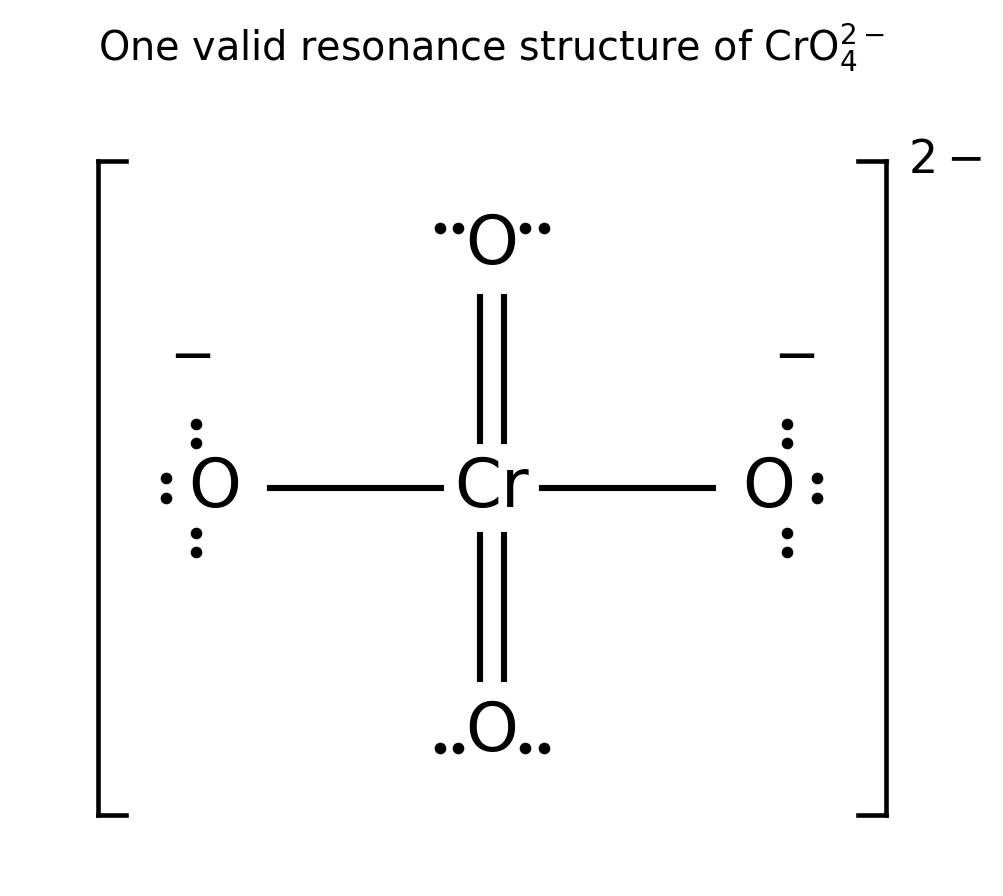
Task: Draw a complete resonance structure with formal charge 0 on two O atoms and −1 on the other two.
Use two Cr=O double bonds and two Cr-O− single bonds. Each double-bonded O has two lone pairs; each single-bonded O− has three lone pairs. Enclose the structure in brackets with an overall 2− charge.
B(i)Chromate-dichromate equilibrium in acid
Task: Write a balanced net ionic equation.
B(ii)Is the reaction redox?
Task: Justify using the oxidation number of Cr.
CThermodynamic favorability of chromium plating
Task: Use E° = −1.32 V for the six-electron half-reaction to calculate ΔG°.
DMass of chromium plated
Task: Calculate the mass deposited by 15.0 A for 3250 s.
EEvidence for first-order behavior
Task: Explain how the concentration-time data support first order in Cr2O72−.
A first-order reaction has a concentration-independent half-life. The concentration falls from 0.50 M to 0.25 M in about 20 min and from 0.25 M to 0.125 M in about another 20 min.
FRate constant from the logarithmic plot
Task: Calculate k from the slope of ln[Cr2O72−] versus time.
GSecond logarithmic plot
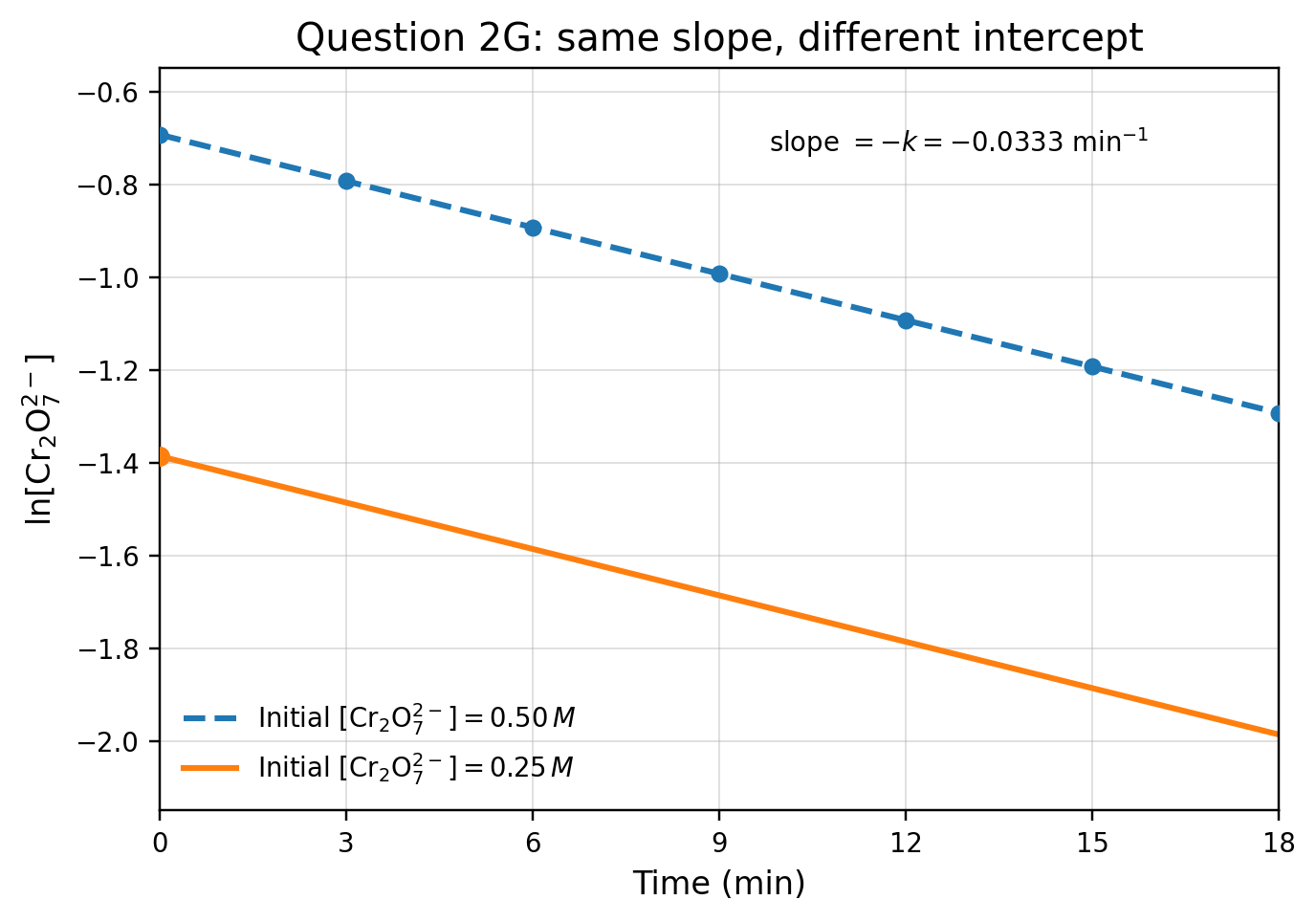
Task: Draw the expected line when the initial concentration is 0.25 M instead of 0.50 M under identical conditions.
- The rate constant is unchanged, so the new line has the same slope, −k = −0.0333 min−1.
- The new intercept is ln(0.25) = −1.386.
- The line is parallel to the original and lower by ln 2 = 0.693.
Long free-response question
FRQ 3: Weak-acid equilibrium and titration
Nitrous acid ionization, temperature dependence of Ka, a weak-acid/strong-base titration, neutralization equilibrium, and indicator choice.
Ionization reaction and given value
At 298 K, Ka = 5.6 × 10⁻⁴.
AConjugate acid-base pair
Task: Identify and label one conjugate pair.
HNO2 donates H+ and becomes NO2−; the two species differ by one proton.
B(i)Hydronium concentration from pH
Task: A 0.125 M HNO2 solution has pH 2.09. Calculate [H3O+].
B(ii)Equilibrium concentration of HNO2
Task: Calculate [HNO2]eq.
Each mole of HNO2 that ionizes produces one mole of H3O+. Neglect the very small contribution from water.
C(i)Ka at 333 K
Task: Use [HNO2] = 0.114 M, [NO2−] = 0.0109 M, and [H3O+] = 0.0109 M.
C(ii)Endothermic or exothermic ionization
Task: Compare Ka at 298 K and 333 K.
Ka increases from 5.6 × 10⁻⁴ to 1.04 × 10⁻³ when heated. Heating shifts equilibrium toward NO2− and H3O+, so heat acts as a reactant in the forward direction.
Titration of unknown HNO2
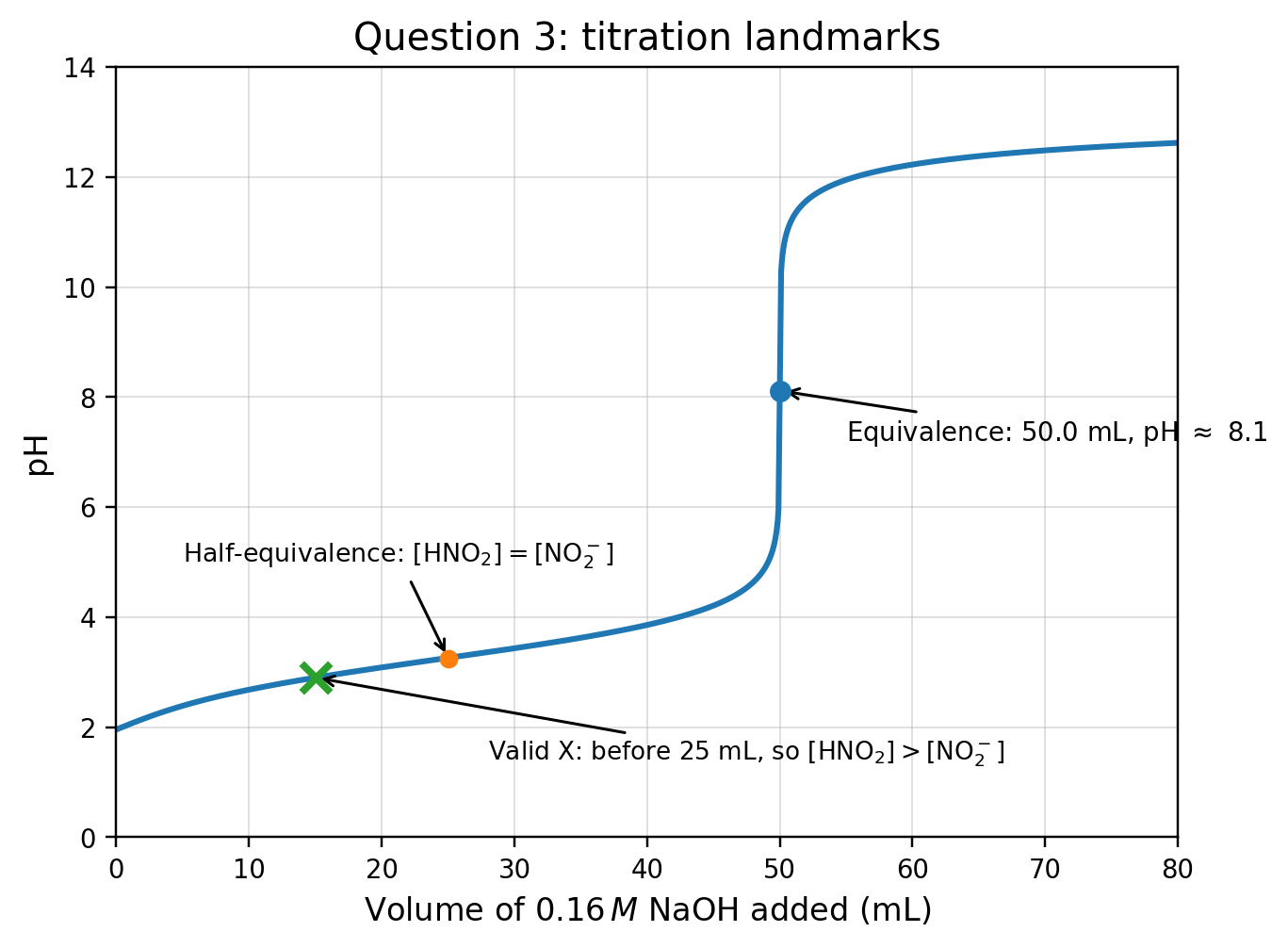
A student titrates 35.0 mL of HNO2 with 0.16 M NaOH. The equivalence point occurs at approximately 50.0 mL of NaOH added.
DpH at the equivalence point
Task: Read the equivalence-point pH from the graph.
The equivalence point is the inflection point in the steep vertical region, at about 50.0 mL. The graph gives a pH near 8; conjugate-base hydrolysis gives approximately 8.1.
EMolarity of the original HNO2
Task: Use the 1:1 neutralization and 50.0 mL equivalence volume.
FWhere [HNO2] > [NO2−]
Task: Place an X on a valid point on the titration curve.
At half-equivalence, [HNO2] = [NO2−]. Because equivalence is 50 mL, half-equivalence is 25 mL. Before 25 mL, more acid than conjugate base remains.
GEquilibrium constant for neutralization
Task: Calculate K2 for HNO2 + OH− → NO2− + H2O.
Add acid ionization to the reverse of water autoionization. H3O+ and one H2O cancel, and equilibrium constants multiply.
HChoosing an indicator
Task: Evaluate the claim that methyl orange is the best choice.
| Indicator | pH range | Fit to equivalence region |
|---|---|---|
| Methyl orange | 3.1-4.4 | Changes before equivalence |
| Thymol blue | 8.0-9.6 | Overlaps steep region near pH 8.1 |
| Clayton yellow | 12.2-13.2 | Changes after equivalence |
Short free-response question
FRQ 4: Phosphorus bonding and gas equilibrium
Compare P-P bond lengths, calculate Kp with an ICE table, and use ΔG° = ΔH° - TΔS° to explain high-temperature favorability.
AWhy P4 bonds are longer than P2
Task: Explain the 221 pm versus 189 pm bond lengths.
Each P-P connection in P4 is a single bond with bond order 1. P2 contains a P≡P triple bond with bond order 3. Higher bond order places more electron density between nuclei, producing stronger attraction and a shorter distance.
BCalculating Kp
Task: For P4(g) ⇌ 2 P2(g), use PP4,initial = 0.470 atm and PP2,eq = 0.630 atm.
| P4 | P2 | |
|---|---|---|
| Initial | 0.470 | 0 |
| Change | −x | +2x |
| Equilibrium | 0.470 − x | 2x |
CWhy high temperature favors decomposition
Task: Evaluate the claim that the reaction must be endothermic.
- The reaction changes one mole of gas into two, so ΔS°rxn > 0.
- In ΔG° = ΔH° - TΔS°, the entropy term becomes more negative as temperature rises.
- For ΔG° to be positive at low temperature and negative only above a threshold, ΔH° must be positive.
Short free-response question
FRQ 5: Bond polarity, VSEPR, and intermolecular forces
Analyze CBrClF2 bond polarity and bond angles, then compare intermolecular forces and boiling points with CBr4.
AMost polar bond in CBrClF2
Task: Choose C-Br, C-Cl, or C-F and justify.
Bond polarity increases with electronegativity difference. Fluorine is more electronegative than chlorine or bromine and much more electronegative than carbon.
BExplaining unequal bond angles
Task: Explain F-C-F = 106.8° and Br-C-Cl = 112.3° using atomic structure and VSEPR.
Carbon has four bonding domains, so the basic geometry is tetrahedral. Fluorine pulls shared electrons away from central C, leaving less bonding electron density near C and weaker repulsion between the C-F domains. C-Br and C-Cl electron density remains closer to C, producing stronger repulsion around the central atom.
C(i)Intermolecular forces
Task: Identify all IMFs in pure liquid CBr4 and CBrClF2.
CBr4 is tetrahedral and symmetric, so bond dipoles cancel. CBrClF2 is asymmetric and polar. Neither contains H bonded to N, O, or F, so neither hydrogen bonds.
CBrClF2(l): London dispersion forces and dipole-dipole attractions.
C(ii)Explaining the boiling-point difference
Task: Explain why CBr4 boils at 463 K while CBrClF2 boils at 269 K.
CBr4 has four large bromine atoms and many more easily distorted electrons. Its highly polarizable electron cloud produces much stronger instantaneous dipoles and London dispersion forces.
Short free-response question
FRQ 6: Spectrophotometry and dilution
Use Beer-Lambert proportionality, read a calibration curve, apply M1V1 = M2V2, and trace the effect of overfilling a volumetric flask.
AParticle diagram at lower absorbance
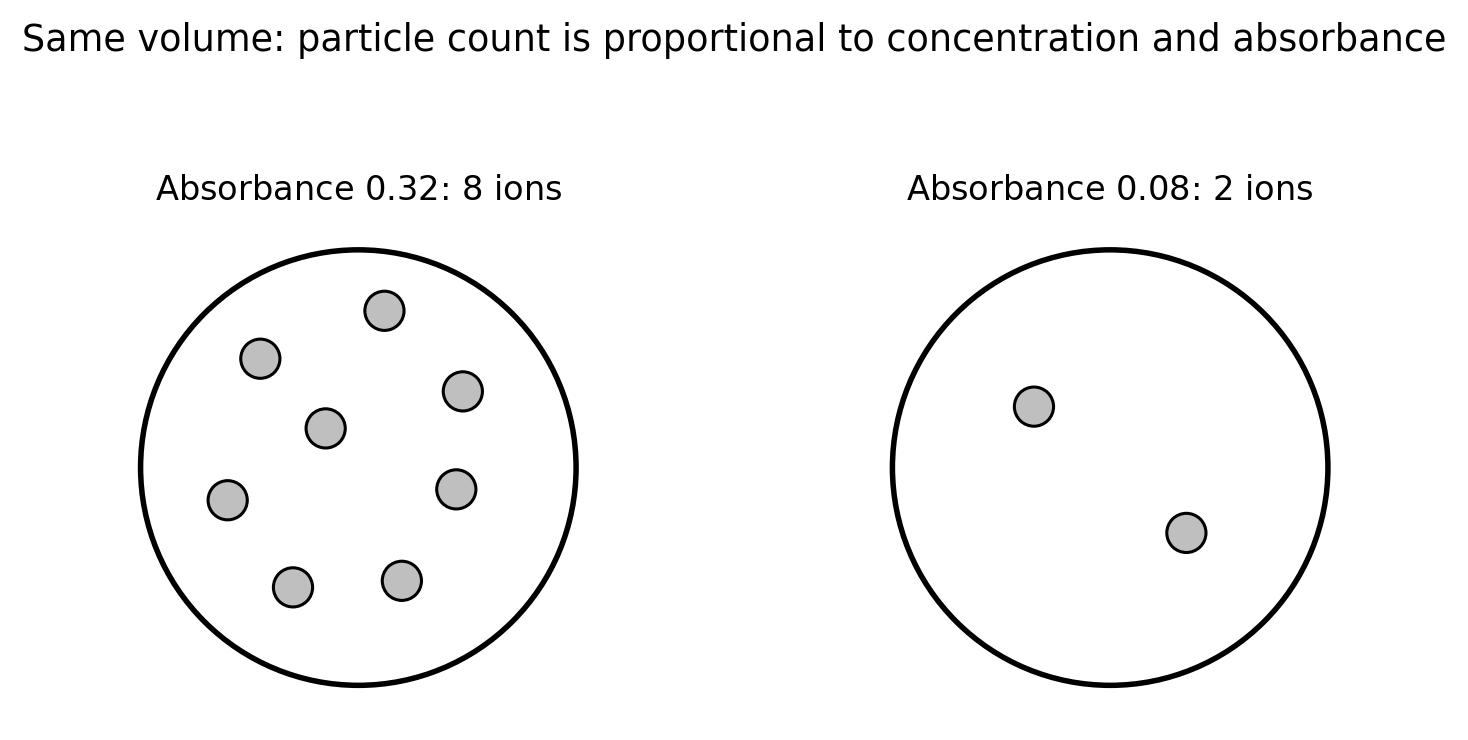
Task: An equal-volume diagram has 8 V2+ ions at absorbance 0.32. Draw the diagram for absorbance 0.08.
Calibration curve
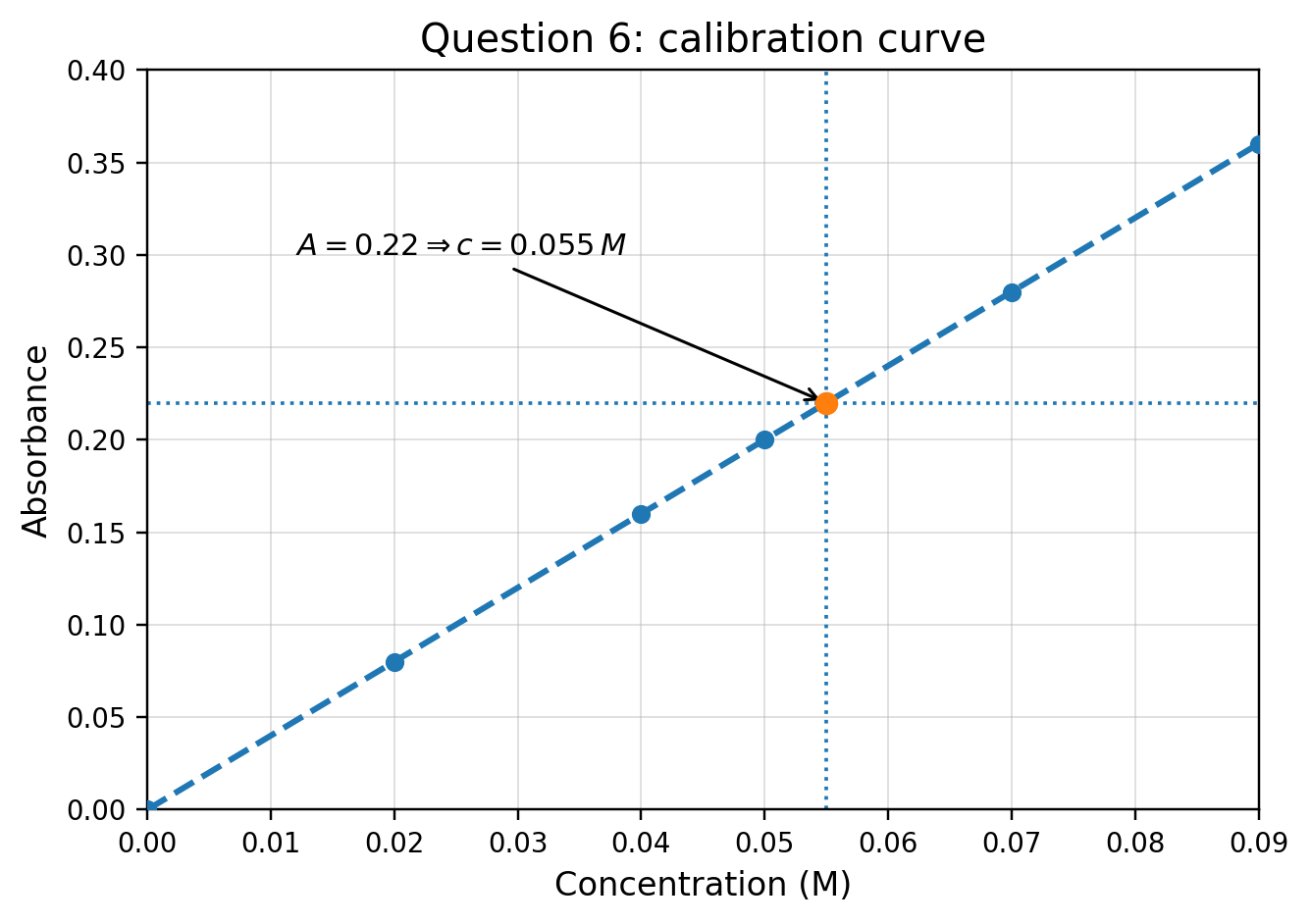
The line passes through the origin and approximately (0.090 M, 0.36), so absorbance is proportional to concentration with slope 4.00 M−1.
B(i)Concentration of the diluted solution
Task: Determine concentration when absorbance is 0.22.
B(ii)Concentration of the original solution
Task: A 3.00 mL sample is diluted to 25.0 mL. Calculate the original concentration.
CEffect of overfilling the volumetric flask
Task: Evaluate the claim that overfilling makes the calculated original concentration too low.
- The actual final volume is greater than 25.0 mL, while transferred moles of V2+ are unchanged.
- The actual diluted concentration and measured absorbance are therefore lower.
- The student back-calculates with 25.0/3.00 even though the actual dilution factor is larger, so the calculated original concentration is below the true value.
Short free-response question
FRQ 7: Enthalpy, limiting reactant, and lattice energy
Use a reaction enthalpy to find ΔH°f, identify the limiting reactant and heat released, and compare ionic lattice enthalpies with Coulomb's law.
Reaction and lattice data
| Compound | Lattice enthalpy |
|---|---|
| Na2O(s) | 2481 kJ mol−1 |
| Rb2O(s) | 2163 kJ mol−1 |
AStandard enthalpy of formation of Na2O(s)
Task: Calculate ΔH°f using the balanced reaction.
BHeat released and limiting reactant
Task: Calculate the heat released when 18.4 g Na reacts with 12.8 g O2.
The stoichiometry requires 4 mol Na per 1 mol O2. The 0.800 mol Na requires only 0.200 mol O2, so O2 is excess and Na is limiting.
CComparing lattice enthalpies
Task: Use Coulomb's law to explain why Rb2O has the smaller lattice enthalpy.
Ion charges are the same in both crystals: M+ and O2−. Rb+ has more occupied energy levels and a larger ionic radius than Na+, so the Rb+-O2− distance is larger and the attraction is weaker.
Final AP Chemistry response checklist
- Balance every requested equation for atoms and charge.
- Include states of matter and ionic charges where required.
- Match thermodynamic signs to the physical process.
- Show formula, substitution, arithmetic, units, and final interpretation.
- Use significant figures consistent with the provided measurements.
- State an equilibrium expression before substituting.
- Support qualitative conclusions with particle-level reasoning.
- Use a visible graph feature such as slope, half-life, or inflection point.
- Trace experimental error from procedure to measurement to calculated result.
- Give only the number of examples or claims requested.
Continue your AP Chemistry review
Practice each released question again without the model response. Then compare your equations, units, signs, significant figures, and written justification with this walkthrough.
Content basis: the user-supplied AP Chemistry 2026 FRQ Detailed Solutions PDF. Prompt wording, values, and figures were cross-checked against the released 2026 question paper. This is an independent educational guide, not an official scoring document.