
Early and unofficial worked solutions
Early Solutions to the 2026 AP Statistics FRQs | Step by Step
Complete worked explanations for all six free-response questions, including calculations, probability models, inference conditions, graph interpretation, and conclusions written in context.
What the 2026 AP Statistics FRQs test
The set moves from descriptive statistics and experimental design to normal, binomial, and geometric models; two-sample inference; categorical data; and regression intervals. Each solution below identifies the method, shows the numerical work, and explains what the result means in the problem's context.
For additional review, use the verified AP Statistics formula sheet while working through the calculations. You can also compare with the AP Statistics FRQ collection and estimate an overall result with the AP Statistics score calculator.
Free-response question 1
Describing and Comparing Goat Weights
This question asks for a five-number summary, a comparison of center and variability, and an explanation of information visible in a stem-and-leaf plot but not in a boxplot.
Part A: Find the five-number summary for Breed H
Given data. The ordered Breed H weights, in pounds, are:
- 48
- 48
- 55
- 56
- 56
- 57
- 62
- 66
- 72
- 72
- 72
- 73
- 80
- 80
There are \(n=14\) observations, so the median is the average of the seventh and eighth values.
- Identify the endpoints. The minimum is \(48\) and the maximum is \(80\).
-
Calculate the median.
\[\operatorname{Median}=\frac{62+66}{2}=64.\]
- Find the first quartile. The lower half is \(48,48,55,56,56,57,62\). Its middle value is \(56\), so \(Q_1=56\).
- Find the third quartile. The upper half is \(66,72,72,72,73,80,80\). Its middle value is \(72\), so \(Q_3=72\).
Part B: Compare center and variability
Read Breed J from the boxplot. Its approximate five-number summary is \((48,56,64,80,88)\) pounds.
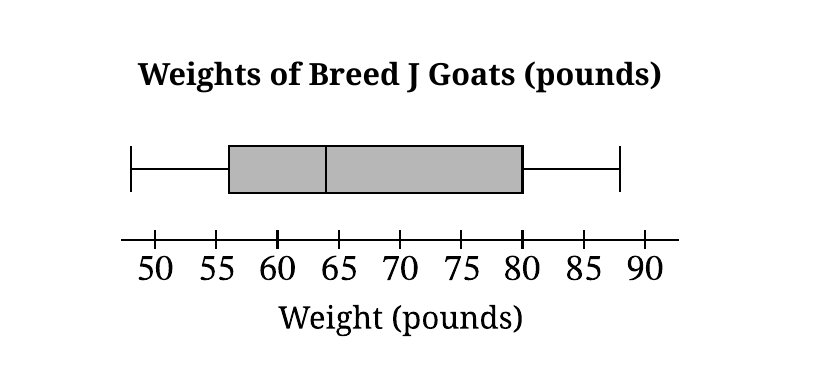
- Compare center. Both breeds have a median of \(64\) pounds, so their typical weights are the same when center is measured by the median.
-
Compare middle-spread using the IQR.
\[\operatorname{IQR}_H=72-56=16,\qquad \operatorname{IQR}_J=80-56=24.\]Breed J's middle 50% covers a wider interval.
-
Compare overall spread using the range.
\[\operatorname{Range}_H=80-48=32,\qquad \operatorname{Range}_J=88-48=40.\]Breed J also has the larger overall range.
Part C: Explain what the stem-and-leaf plot reveals
Part C(i): Distribution details
The stem-and-leaf plot displays every individual weight. It shows empty stretches from \(49\) to \(54\), \(58\) to \(61\), \(67\) to \(71\), and \(74\) to \(79\) pounds. It also shows clusters in the mid-50s and low-70s.
Part C(ii): Why the boxplot cannot show them
A boxplot records only the minimum, \(Q_1\), median, \(Q_3\), and maximum. It does not display the exact values or frequencies within the quartile intervals, so different gaps and clusters can produce the same boxplot.
Free-response question 2
Designing and Interpreting a Rosebush Experiment
The experiment compares weekly coffee grounds with no coffee grounds and measures rose production after three months.
Part A: Identify the elements of the experiment
| Part | Component | Answer in context |
|---|---|---|
| A(i) | Treatments | Add one-half cup of coffee grounds to the soil each week, or add no coffee grounds. |
| A(ii) | Experimental units | The 30 individual rosebushes, because a treatment is assigned to each bush. |
| A(iii) | Response variable | The number of roses counted on each rosebush after three months. |
Part B: Give a valid random-assignment procedure
- Label the rosebushes \(1,2,\ldots,30\).
- Use a random-number generator to select 15 distinct labels from 1 through 30.
- Assign the selected bushes to receive one-half cup of coffee grounds each week.
- Assign the remaining 15 bushes to the no-coffee-grounds treatment.
This creates two groups of exactly 15 and gives every bush a fair random chance of receiving either treatment.
Part C: Interpret statistical significance at \(\alpha=0.05\)
The null hypothesis states that adding coffee grounds has no effect on the mean number of roses. Statistical significance at the \(0.05\) level means the randomization-based p-value is less than \(0.05\).
Free-response question 3
Normal, Binomial, and Geometric Probability Models
Performance time \(T\), in seconds, follows \(T\sim N(109,16)\), where the mean is 109 seconds and the standard deviation is 16 seconds. Performances are independent.
Part A: Find the probability a performance exceeds 120 seconds
-
Standardize 120 seconds.
\[z=\frac{120-109}{16}=\frac{11}{16}=0.6875.\]
-
Use the upper tail of the standard normal distribution.
\[P(T>120)=P(Z>0.6875)=1-\Phi(0.6875)\approx0.2458839.\]
The normal model and standardization process are reviewed in the verified normal distribution guide.
Part B: Find the probability of at least 3 long performances among 10
Define a success as a performance lasting longer than 120 seconds. From Part A, \(p=0.2458839\).
The binomial conditions are satisfied: there are 10 fixed trials, two outcomes on each trial, independent performances, and a constant success probability. Therefore,
Using the complement is shorter than adding eight separate probabilities:
Part C: Games until the first long performance
Let \(Y\) be the number of independent games attended up to and including the first game in which the performance exceeds 120 seconds. Then
Part C(i): Mean
So the expected waiting time is about \(4.067\) games.
Part C(ii): Standard deviation
The standard deviation is about \(3.532\) games.
Part D: Interpret the standard deviation
A correct interpretation names the random variable, includes units, and describes a typical distance from the mean. It should not describe the standard deviation as a probability.
Free-response question 4
Two-Sample Inference for Fertilizer Brands
Brand C and Brand N were each randomly assigned to 58 trees. The sample summaries are \(\bar{x}_C=141\), \(s_C=15\), \(\bar{x}_N=148\), and \(s_N=19\) oranges.
Complete two-sample \(t\) test
Define \(\mu_C\) and \(\mu_N\) as the population mean numbers of oranges for similar trees treated with Brand C and Brand N, respectively.
-
State the hypotheses. The question asks whether the means differ, so use a two-sided alternative:
\[H_0:\mu_C-\mu_N=0,\qquad H_a:\mu_C-\mu_N\ne0.\]
-
Check the conditions.
- Random assignment: 58 trees were randomly assigned to each fertilizer, supporting a cause-and-effect conclusion for comparable trees.
- Independent groups: Different trees received Brand C and Brand N.
- Approximately normal sampling distribution: Both sample sizes are large, \(n_C=n_N=58>30\), so the Central Limit Theorem applies to \(\bar{X}_C-\bar{X}_N\).
-
Calculate the test statistic.
\[ \begin{aligned} \bar{x}_C-\bar{x}_N&=141-148=-7,\\ SE&=\sqrt{\frac{s_C^2}{n_C}+\frac{s_N^2}{n_N}} =\sqrt{\frac{15^2}{58}+\frac{19^2}{58}} =\sqrt{\frac{586}{58}}\approx3.1786,\\ t&=\frac{-7-0}{3.1786}\approx-2.202. \end{aligned} \]Welch's approximation gives approximately \(108\) degrees of freedom.
-
Find the two-sided p-value.
\[p=2P(T_{108}\le-2.202)\approx0.0298.\]
- Make the decision. Since \(0.0298<0.05\), reject \(H_0\).
Free-response question 5
Two-Way Tables, Probability, and Association
The table contains all 4,193 professional athletes in basketball, football, and baseball for the stated year.
The athlete age-by-sport table
| Age group | Basketball | Football | Baseball | Total |
|---|---|---|---|---|
| \(A<25\) | 232 | 807 | 259 | 1,298 |
| \(25\le A<30\) | 175 | 1,326 | 620 | 2,121 |
| \(30\le A<35\) | 90 | 287 | 276 | 653 |
| \(35\le A\) | 19 | 41 | 61 | 121 |
| Total | 516 | 2,461 | 1,216 | 4,193 |
Part A: Calculate probabilities from the table
Part A(i): Probability of football
Part A(ii): Ages 25-29 given football
Once football is known, the denominator becomes 2,461 football players.
Part B: Interpret the mosaic plot
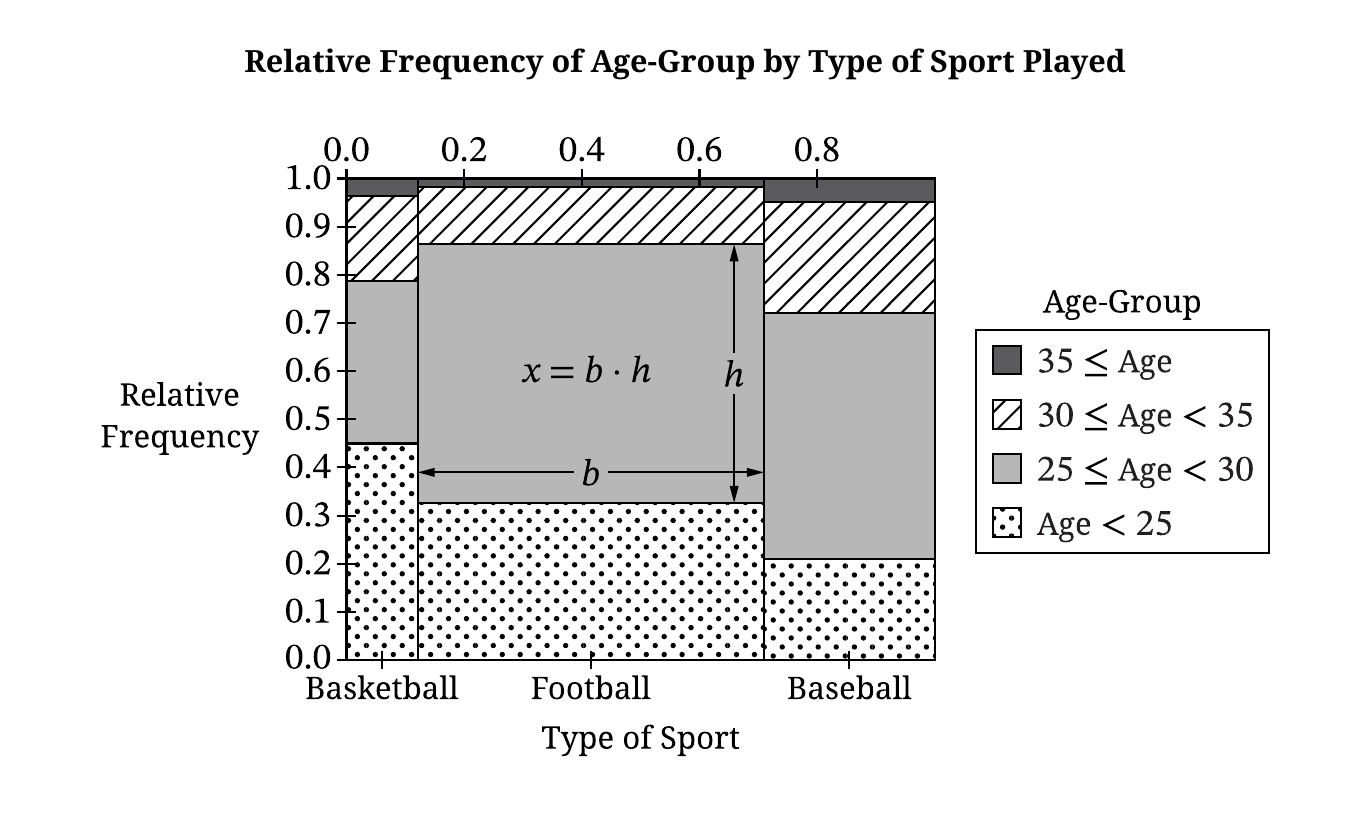
Part B(i): Meaning of \(b\)
The horizontal width of the football column is the proportion of all athletes who play football:
The vertical height is \(h=P(25\le A<30\mid F)\).
Part B(ii): Meaning of \(x=b\cdot h\)
Area in a mosaic plot represents a joint probability:
Part C: Determine whether two events are mutually exclusive or independent
Let \(B\) denote "Baseball" and \(G\) denote "age at least 35."
Part C(i): Mutually exclusive?
No. The table contains 61 athletes who are both baseball players and at least 35 years old:
Part C(ii): Independent?
Compare the conditional probability with the marginal probability:
Because these are not equal, knowing that an athlete plays baseball changes the probability that the athlete is at least 35. The equivalent product check also fails:
Part D: Decide whether a chi-square test for independence is appropriate
A chi-square inference test needs data from a random sample or randomized process when the purpose is to generalize beyond the observed individuals. This table is a census of all professional athletes in the three sports for the stated year, not a random sample.
The expected-count condition would be satisfied. The smallest expected count is
However, meeting the expected-count condition does not repair the failed random-sample condition.
Free-response question 6
Regression, Group Comparisons, and Intervals
This question describes the relationship between hits and runs, compares salary groups, and distinguishes a confidence interval for a mean response from a prediction interval for one team.
Part A: Describe the overall relationship and make a prediction
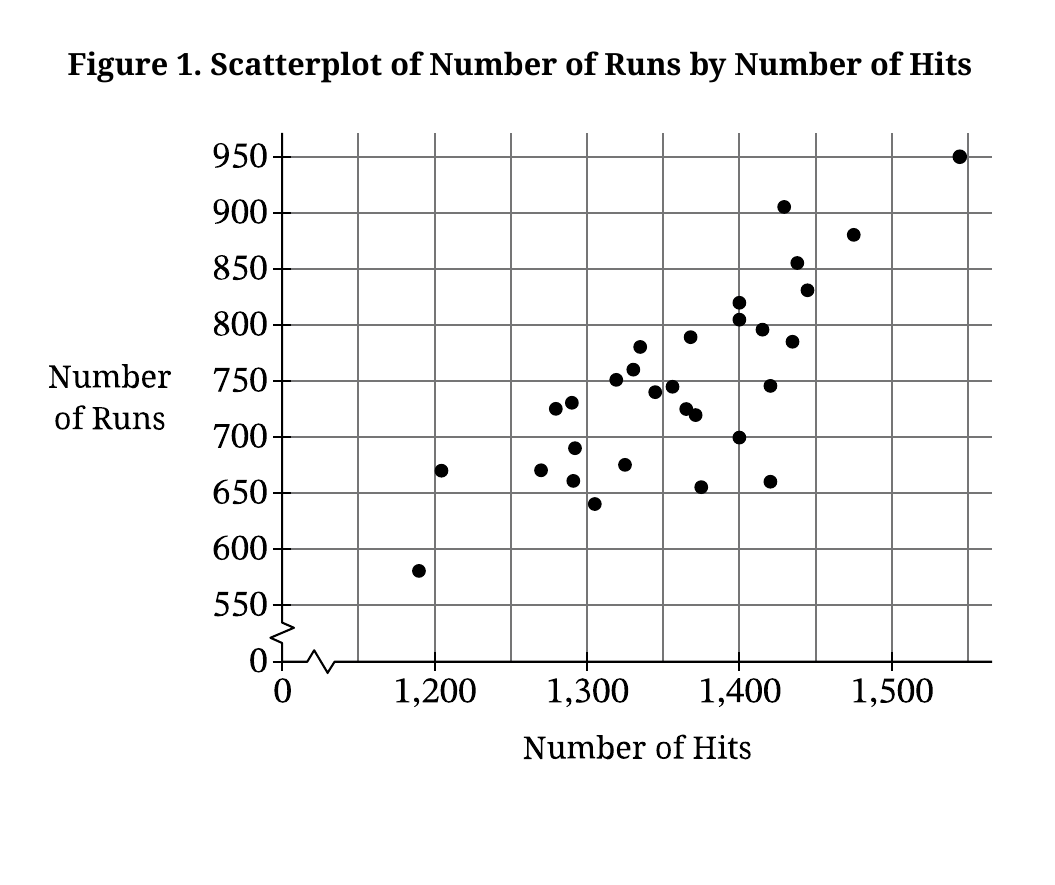
Part A(i): Describe the relationship
The association is positive, roughly linear, and moderately strong to strong. Teams with more hits tend to score more runs. The points show noticeable but not excessive scatter around an increasing line, with no clear curve and no point completely isolated from the pattern.
A few teams near 1,400 hits and 650-700 runs fall below the main trend. The high-hits, high-runs point has leverage but remains consistent with the positive direction.
Part A(ii): Predict runs for a team with 1,250 hits
The regression equation is \(\hat{y}=-372.2+0.823x\). Substitute \(x=1250\):
Part B: Compare the salary classifications
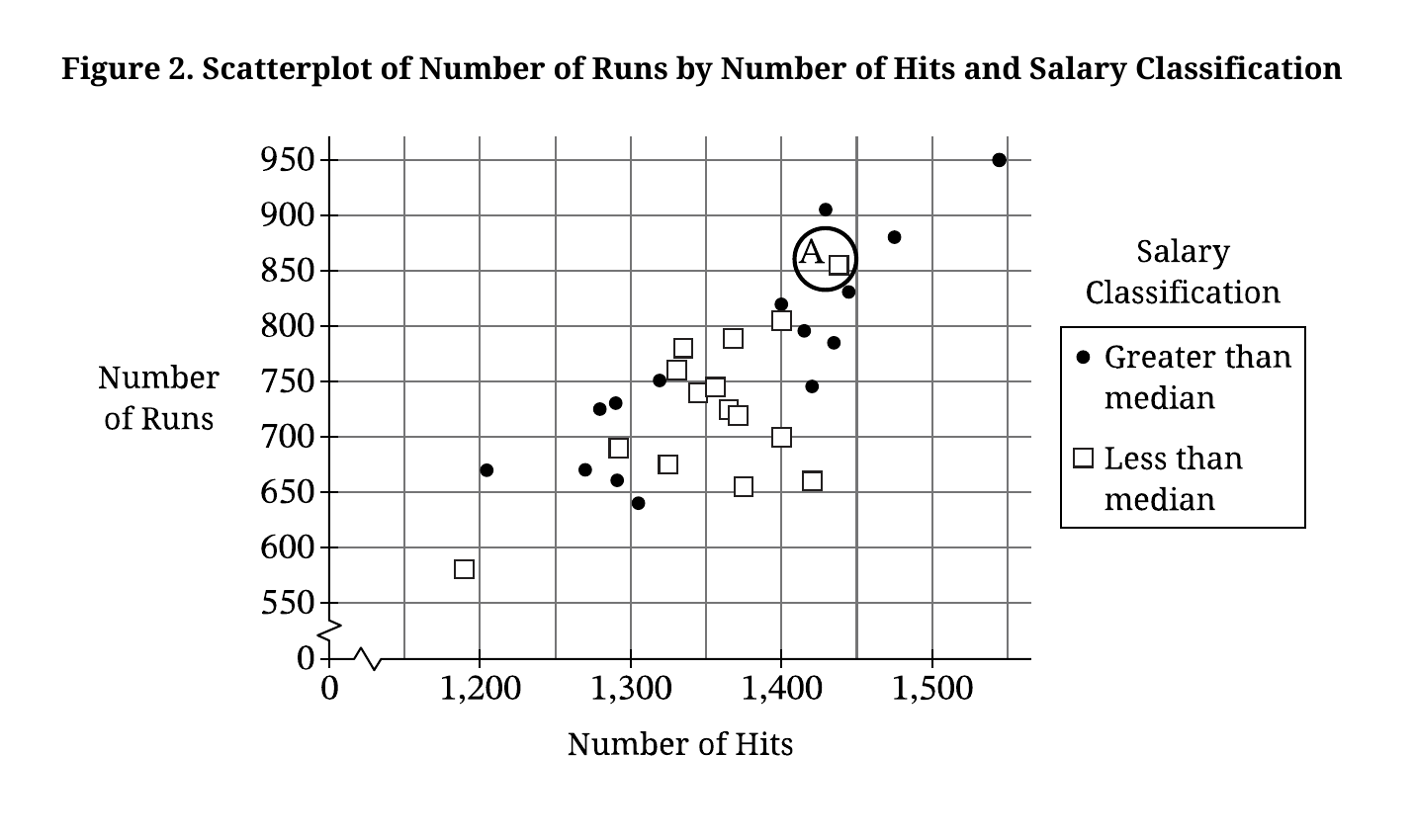
Part B(i): Compare point A with its salary group
Point A is a square, so it represents a below-median-salary team. It is near 1,440 hits and 850 runs. Within the below-median group, it has the greatest run total and one of the greatest hit totals. It also lies above most square points and above the group's central pattern, so it produced unusually many runs for its number of hits compared with most lower-salary teams.
Part B(ii): Compare the strength of the two relationships
The above-median-salary dots follow a more tightly clustered increasing linear pattern. The below-median-salary squares show more vertical scatter at similar hit totals; around 1,350-1,450 hits, for example, their run totals range from roughly the mid-600s to about 850.
Part C: Construct confidence and prediction intervals at 1,250 hits
The sample size is \(n=30\), so the regression intervals use \(df=n-2=28\). The point estimate is \(\hat{y}=656.55\) runs.
Part C(i): Critical value
Part C(ii): 95% confidence interval for the mean response
The standard error for the mean response is \(17.48\) runs:
Part C(iii): 95% prediction interval for one team
The prediction standard error is \(56.78\) runs:
Part D: Explain why the prediction interval is wider
Part D(i): Means vary less than individuals
A distribution of sample means has less variability than a distribution of individual observations because averaging smooths individual-to-individual variation. In the simplest setting,
Part D(ii): Compare the standard-error formulas
For the mean response at \(x_0\),
For one future response,
The prediction formula contains an additional \(1\) under the square root. That term represents the natural residual variation of one team's run total around the regression line. A mean-response interval includes uncertainty in estimating the mean at \(x_0\); a prediction interval includes that uncertainty plus individual-team variation.
Final AP Statistics FRQ checklist
- Identify the population parameter or random variable.
- Name the probability model and its parameters for normal, binomial, or geometric calculations.
- Show the formula or calculator-ready setup, not only the final number.
- For inference, state hypotheses, verify conditions, report the test statistic and p-value, make a decision, and conclude in context.
- Never describe a p-value as the probability that the null hypothesis is true.
- Include the variable and units in interpretations.
- For scatterplots, discuss direction, form, strength, and unusual features.
- For confidence and prediction intervals, identify the target and use the correct standard error.
For more practice after reviewing these solutions, continue with the verified AP Statistics free-response question archive.