
Early Solutions to the 2026 AP Calculus AB FRQs | Step by Step
Work through all six 2026 AP Calculus AB free-response questions, including every subpart, setup, calculation, theorem justification, unit, and final answer contained in the uploaded solution guide.
Quick answer summary
Use this section to check a result, then open the corresponding worked solution to see why it is correct.
FRQ 1
- A: \(M'(7.5)\approx 1.8\) birds per day squared.
- B(i): \(150\) birds.
- B(ii): Total male birds arriving from day \(0\) through day \(30\).
- C: \(540+\frac{320}{\pi}\approx641.859\), so \(642\) birds.
- D: Yes, by the Intermediate Value Theorem.
FRQ 2
- A: \(14-156\ln(13/12)\approx1.513\) square units.
- B: \(\frac13\int_0^1\left(\frac{14x+12}{x+12}\right)^2dx\).
- C: \(a\approx3.256\); area \(\approx0.632\) square units.
- D: \(\pi\int_1^{3.5}\left(\frac{12y-12}{14-y}\right)^2dy\).
FRQ 3
- A: The shown slopes have the wrong sign.
- B: \(H'(0)=-\frac{11}{3}\) °C/min.
- C: Underestimate because \(H''(t)\gt0\).
- D: \(H(t)=20+55e^{-t/15}\).
FRQ 4
- A: \(g'(2)=1\).
- B: Point of inflection at \(x=1\).
- C: Increasing and concave down on \((1,3)\).
- D: Absolute minimum at \(x=-2\); maximum at \(x=4\).
FRQ 5
- A: \(a(1)=12\) ft/s².
- B: Speeding up.
- C: Distance \(=\frac{512}{15}\) ft.
- D: Average velocity \(=-10\) ft/s.
FRQ 6
- A: \(\frac32\).
- B: \(g'(2)=36\).
- C: \(h(2)=12\).
- D(i): \(k'(x)=x^2f(x)\).
- D(ii): \(k''(3)=129\).
Bird arrival rates
Calculator sectionThe male-bird arrival rate \(M(t)\) is given at selected times.
| \(t\) (days) | 0 | 5 | 10 | 15 | 20 | 25 | 30 |
|---|---|---|---|---|---|---|---|
| \(M(t)\) (birds/day) | 2 | 7 | 16 | 6 | 5 | 2 | 0 |
Part A: Approximate \(M'(7.5)\)
Task. Use the table to approximate the derivative at \(t=7.5\), then state its units.
-
Choose the centered secant interval.
The interval \([5,10]\) is centered at \(7.5\). Its average rate of change is therefore the natural table-based approximation to the instantaneous rate \(M'(7.5)\).
\[ M'(7.5)\approx\frac{M(10)-M(5)}{10-5}. \] -
Substitute the table values.
\[ M'(7.5)\approx\frac{16-7}{5}=\frac95=1.8. \] -
Determine the units.
\(M\) is measured in birds per day and \(t\) in days, so differentiating the rate with respect to time gives
\[ \frac{\text{birds/day}}{\text{day}}=\text{birds per day}^2. \]
Part B(i): Midpoint Riemann-sum estimate
Task. Estimate the total number of male birds arriving from day \(0\) to day \(30\) with three midpoint subintervals.
-
Identify widths and midpoints.
The subintervals are \([0,10]\), \([10,20]\), and \([20,30]\). Each width is \(10\), and the midpoints are \(5\), \(15\), and \(25\).
-
Multiply each width by the rate at its midpoint.
\[ \begin{aligned} \int_0^{30}M(t)\,dt &\approx 10M(5)+10M(15)+10M(25)\\ &=10(7)+10(6)+10(2)\\ &=10(15)=150. \end{aligned} \] -
Attach the accumulated-quantity unit.
\((\text{birds/day})(\text{days})=\text{birds}\).
Part B(ii): Interpret the definite integral
Task. Explain the meaning of \(\int_0^{30}M(t)\,dt\) in context.
\(M(t)\) is an arrival rate. Integrating a rate over a time interval accumulates the total amount that arrived during that interval.
Part C: Total female birds from day 15 to day 45
Task. For \(15\le t\le45\), use \(F(t)=18+16\sin\left(\frac{\pi}{20}(t+15)\right)\) to find the number of arriving female birds.
-
Integrate the arrival rate over the requested time interval.
\[ \begin{aligned} N &=\int_{15}^{45}\left[18+16\sin\left(\frac{\pi}{20}(t+15)\right)\right]dt\\ &=18(45-15)-\frac{320}{\pi} \left[\cos\left(\frac{\pi}{20}(t+15)\right)\right]_{15}^{45}. \end{aligned} \]The factor \(\frac{320}{\pi}\) comes from reversing the chain rule when integrating the sine term.
-
Evaluate the two angles.
\[ \frac{\pi}{20}(45+15)=3\pi, \qquad \frac{\pi}{20}(15+15)=\frac{3\pi}{2}. \] -
Simplify and round only at the end.
\[ \begin{aligned} N &=540-\frac{320}{\pi}\left(\cos3\pi-\cos\frac{3\pi}{2}\right)\\ &=540-\frac{320}{\pi}(-1-0)\\ &=540+\frac{320}{\pi}\\ &\approx641.859. \end{aligned} \]A number of birds must be a whole number, so round to the nearest integer.
Part D: Show the two arrival rates are equal at some time
Task. Decide whether there is a time in \((15,20)\) when \(M(t)=F(t)\), and justify the conclusion.
-
Define a difference function.
\[ D(t)=M(t)-F(t). \]Because \(M\) is differentiable and \(F\) is continuous, \(D\) is continuous on \([15,20]\). Continuity is required before applying the Intermediate Value Theorem.
-
Check the sign at \(t=15\).
\[ \begin{aligned} F(15)&=18+16\sin\left(\frac{3\pi}{2}\right)=18-16=2,\\ D(15)&=M(15)-F(15)=6-2=4\gt0. \end{aligned} \] -
Check the sign at \(t=20\).
\[ \begin{aligned} F(20)&=18+16\sin\left(\frac{7\pi}{4}\right)=18-8\sqrt2,\\ D(20)&=5-(18-8\sqrt2)=8\sqrt2-13\approx-1.686\lt0. \end{aligned} \] -
Apply the Intermediate Value Theorem.
Since the continuous function \(D\) changes sign between \(15\) and \(20\), there is at least one \(c\) with \(15\lt c\lt20\) for which \(D(c)=0\). That equation means \(M(c)=F(c)\).
Areas, cross sections, and solids of revolution
Calculator sectionThe functions are
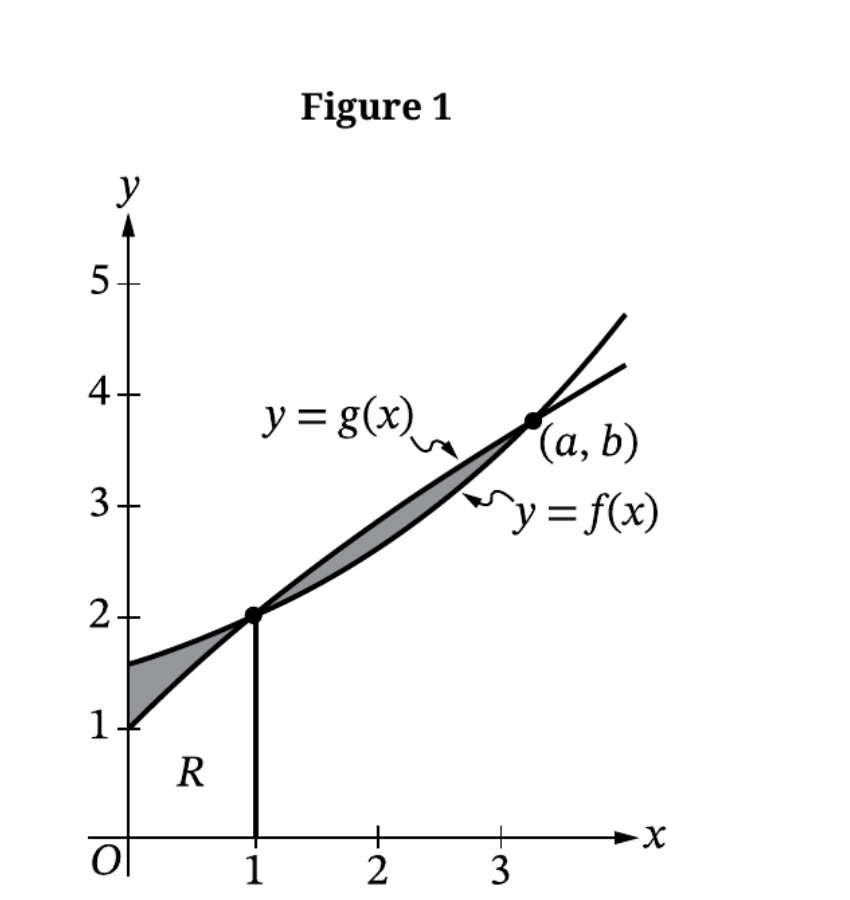
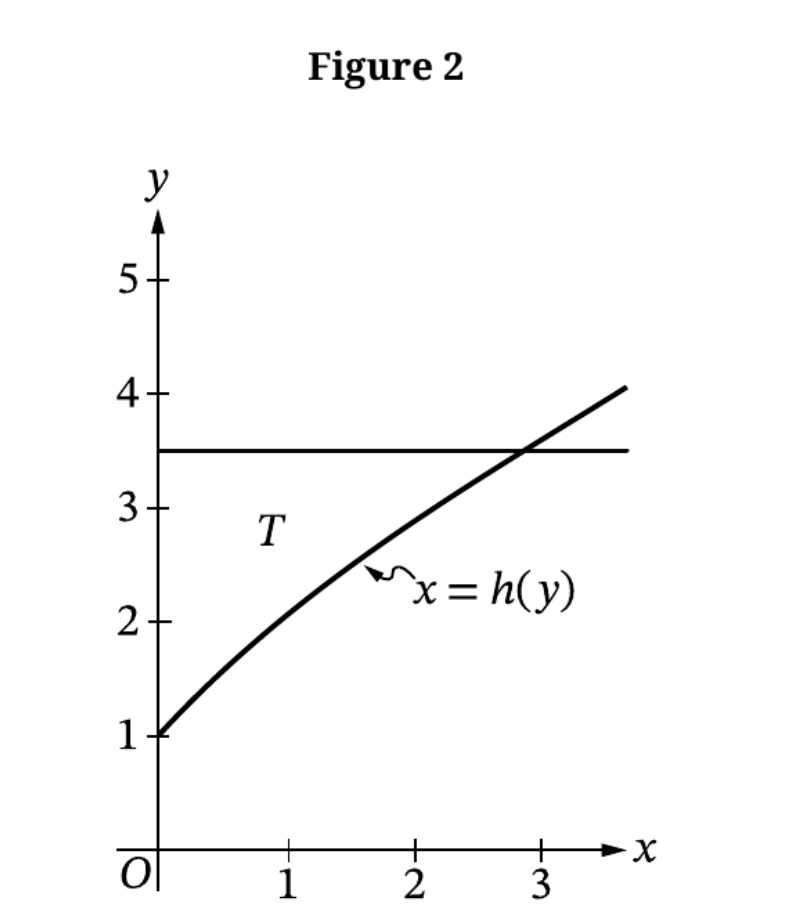
Part A: Area of region \(R\)
Task. Find the area under \(g(x)\) and above the \(x\)-axis from \(x=0\) to \(x=1\).
-
Write the area integral.
\[ A_R=\int_0^1g(x)\,dx=\int_0^1\frac{14x+12}{x+12}\,dx. \] -
Rewrite the rational function.
This creates a constant term plus a logarithmic derivative that can be integrated directly.
\[ \frac{14x+12}{x+12} =\frac{14(x+12)-156}{x+12} =14-\frac{156}{x+12}. \] -
Integrate and evaluate.
\[ \begin{aligned} A_R &=\int_0^1\left(14-\frac{156}{x+12}\right)dx\\ &=[14x-156\ln(x+12)]_0^1\\ &=14-156\ln\left(\frac{13}{12}\right)\\ &\approx1.513. \end{aligned} \]
Part B: Volume with rectangular cross sections
Task. Set up the volume integral when cross sections perpendicular to the \(x\)-axis are rectangles whose height is one-third of the base in region \(R\).
-
Express the base and height.
For \(x\in[0,1]\), the vertical base segment runs from \(y=0\) to \(y=g(x)\), so
\[ \text{base}=g(x),\qquad \text{height}=\frac13g(x). \] -
Build the cross-sectional area.
\[ A(x)=\bigl(g(x)\bigr)\left(\frac13g(x)\right)=\frac13\bigl(g(x)\bigr)^2. \] -
Integrate the area from \(x=0\) to \(x=1\).
\[ V=\int_0^1A(x)\,dx. \]
Part C: Area between \(f\) and \(g\)
Task. Find the shaded area between the two curves across both intersections.
-
Find the second intersection with a calculator.
The curves meet at \(x=1\) and again at \(x=a\). Solve
\[ 1.43^x+0.57=\frac{14x+12}{x+12}. \]\[ a\approx3.255816474,\qquad b=f(a)=g(a)\approx3.774392. \] -
Identify the upper curve on each interval.
- On \(0\le x\le1\), \(f(x)\ge g(x)\).
- On \(1\le x\le a\), \(g(x)\ge f(x)\).
The upper curve changes at \(x=1\), so one signed integral would cancel part of the geometric area.
-
Split the area integral at \(x=1\).
\[ \begin{aligned} A &=\int_0^1\bigl(f(x)-g(x)\bigr)\,dx +\int_1^a\bigl(g(x)-f(x)\bigr)\,dx\\ &=\int_0^1\left(1.43^x+0.57-\frac{14x+12}{x+12}\right)dx\\ &\quad+\int_1^{3.255816474} \left(\frac{14x+12}{x+12}-1.43^x-0.57\right)dx. \end{aligned} \] -
Evaluate both pieces with a calculator.
\[ \int_0^1(f-g)\,dx\approx0.258873, \qquad \int_1^a(g-f)\,dx\approx0.372911. \]\[ A\approx0.258873+0.372911=0.631784. \]
Part D: Rotate region \(T\) about the \(y\)-axis
Task. Set up the volume integral for the solid formed by revolving region \(T\) around the \(y\)-axis.
-
Use horizontal slices.
Horizontal slices rotate into disks. Their radius is the horizontal distance from the \(y\)-axis to \(x=h(y)\).
-
Find the lower \(y\)-bound.
The curve meets the \(y\)-axis when \(x=h(y)=0\).
\[ \frac{12y-12}{14-y}=0 \Longrightarrow 12y-12=0 \Longrightarrow y=1. \]The upper bound is \(y=3.5\).
-
Write the disk area and volume.
\[ r(y)=h(y)=\frac{12y-12}{14-y}, \qquad A(y)=\pi[r(y)]^2. \]
Differential equation and Newton’s law of cooling
No-calculator sectionThe temperature \(H(t)\) satisfies
Part A: Explain why the proposed slope field is incorrect
Task. Compare the displayed field with the sign and structure required by the differential equation.
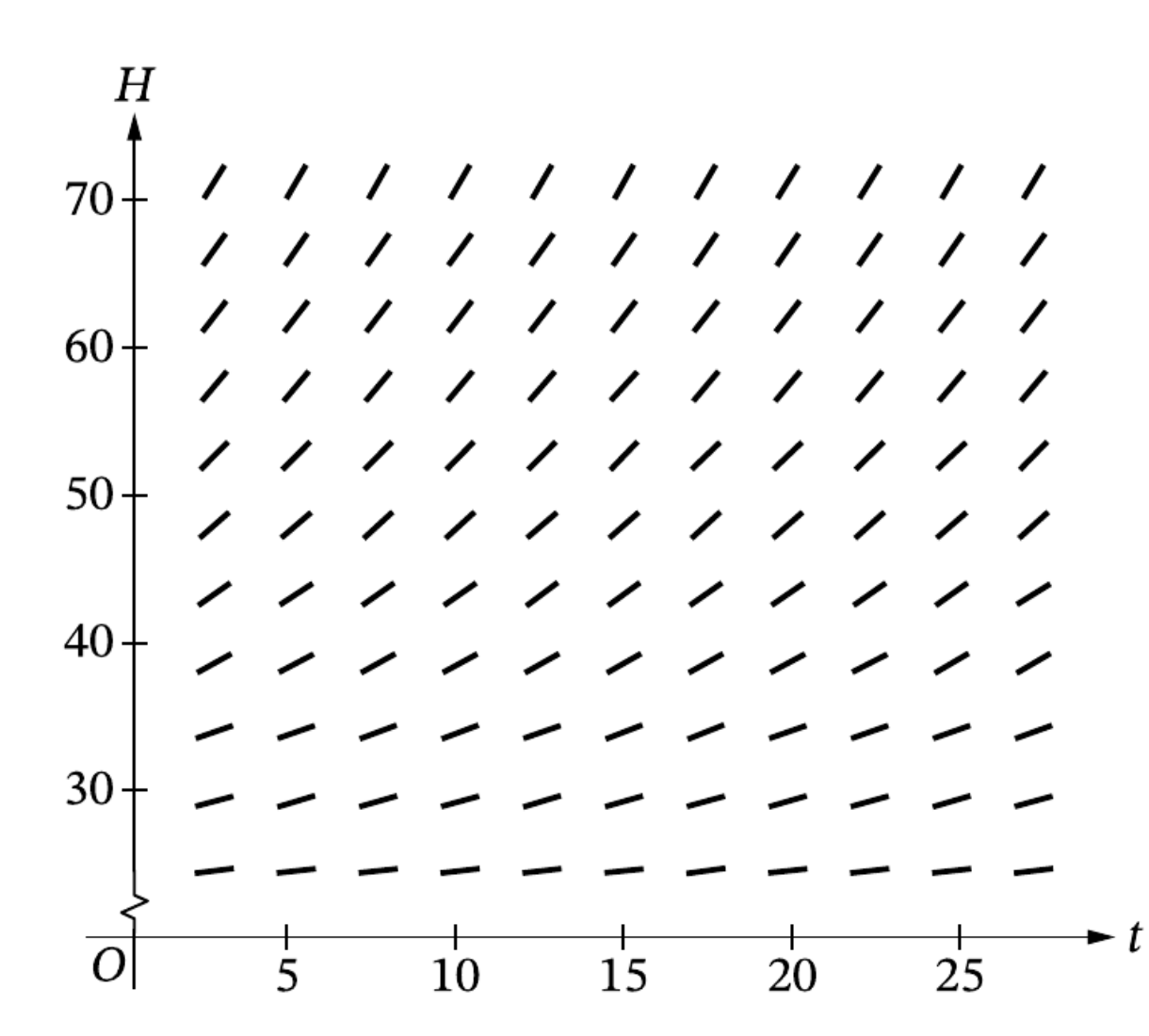
-
Determine the required sign.
Every displayed value has \(H\gt20\), so
\[ H-20\gt0 \Longrightarrow -\frac1{15}(H-20)\lt0. \]The correct segments must therefore tilt downward from left to right.
-
Check how slopes vary across the field.
The right-hand side depends only on \(H\), so every point on a common horizontal row should have the same slope. The proposed field has that row-by-row property, but the slopes have the wrong sign.
Part B: Find the tangent-line slope at \(t=0\)
Task. Calculate \(H'(0)\) from the differential equation and initial condition.
Substitute \(H(0)=75\):
Part C: Underestimate or overestimate?
Task. Decide whether the tangent-line approximation at \(t=0\) underestimates or overestimates \(H(5)\).
-
Use the second derivative to determine concavity.
\[ H''(t)=\frac1{225}\bigl(H(t)-20\bigr). \]Because \(H(t)\gt20\) for \(t\gt0\), \(H''(t)\gt0\). Thus \(H\) is concave up.
-
Relate concavity to the tangent line.
Near the point of tangency, a tangent line to a concave-up graph lies below the graph. Therefore, the tangent-line value at \(t=5\) is less than the actual \(H(5)\).
-
Write the tangent line for reference.
\[ L(t)=75-\frac{11}{3}t, \qquad L(5)=75-\frac{55}{3}=\frac{170}{3}. \]
Part D: Solve the differential equation
Task. Find the particular solution satisfying \(H(0)=75\).
-
Separate the variables.
\[ \frac{dH}{dt}=-\frac1{15}(H-20) \quad\Longrightarrow\quad \frac1{H-20}\,dH=-\frac1{15}\,dt. \] -
Integrate both sides.
\[ \int\frac1{H-20}\,dH=\int-\frac1{15}\,dt, \qquad \ln|H-20|=-\frac{t}{15}+C. \] -
Exponentiate.
\[ |H-20|=e^Ce^{-t/15}. \]Since \(H(t)\gt20\), the difference \(H-20\) is positive. Absorb the positive constant into \(C_1\):
\[ H-20=C_1e^{-t/15}. \] -
Apply \(H(0)=75\).
\[ 75-20=C_1e^0 \Longrightarrow C_1=55. \]\[ H(t)-20=55e^{-t/15}. \]
Using the graph of \(f'\)
No-calculator section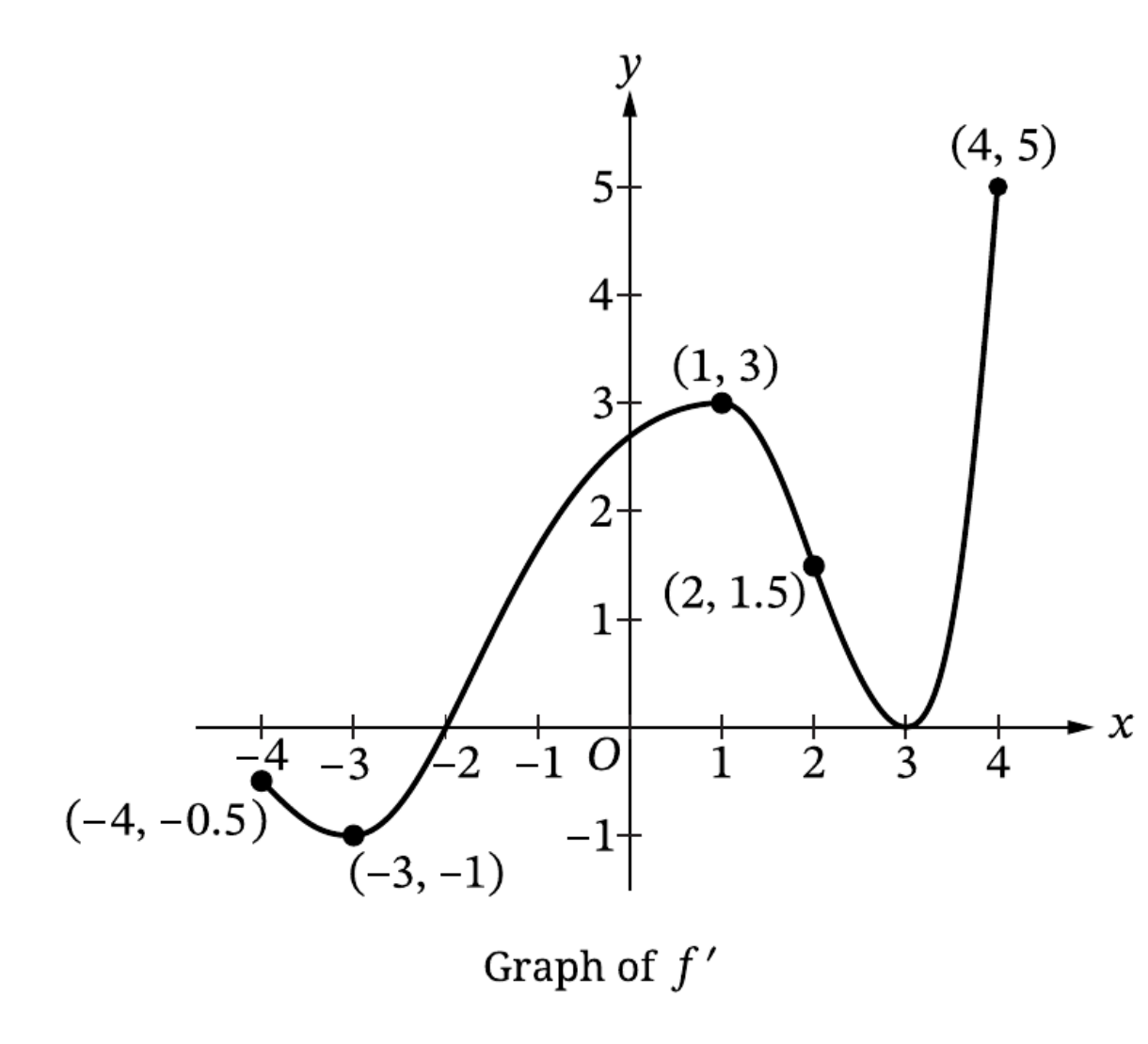
Part A: Find \(g'(2)\)
Task. For \(x\gt0\), \(g(x)=f(x)-\ln x\). Find \(g'(2)\).
-
Differentiate \(g\).
\[ g'(x)=f'(x)-\frac1x. \] -
Read \(f'(2)\) from the graph and substitute.
\[ g'(2)=f'(2)-\frac12=1.5-0.5=1. \]
Part B: Point of inflection of \(f\)
Task. Find the point where the concavity of \(f\) changes on \(0\lt x\lt3\).
-
Connect \(f''\) to the behavior of \(f'\).
\[ f''(x)=\bigl(f'(x)\bigr)'. \]\(f\) is concave up where \(f'\) increases and concave down where \(f'\) decreases.
-
Read the change from the graph.
- \(f'\) increases on \((0,1)\), so \(f\) is concave up there.
- \(f'\) decreases on \((1,3)\), so \(f\) is concave down there.
The concavity changes at \(x=1\). Although \(f'\) changes from decreasing to increasing at \(x=3\), that endpoint is excluded from \(0\lt x\lt3\).
Part C: Increasing and concave down
Task. Find where \(f\) is both increasing and concave down.
-
Find where \(f\) is increasing.
\(f\) increases where \(f'(x)\gt0\). From the graph, this occurs on \((-2,3)\) and \((3,4)\).
-
Find where \(f\) is concave down.
\(f\) is concave down where \(f'\) is decreasing. From the graph, that occurs on \((-4,-3)\) and \((1,3)\).
-
Intersect the two conditions.
The common interval is \((1,3)\).
Part D: Absolute extrema of \(f\)
Task. Given \(f(2)=3\), identify the absolute minimum and maximum of \(f\) on \([-4,4]\).
-
Use the sign of \(f'\) to locate candidates.
\[ f'(x)\lt0\text{ on }(-4,-2), \qquad f'(x)\gt0\text{ on }(-2,3)\cup(3,4). \]Thus \(f\) decreases until \(x=-2\) and increases afterward. At \(x=3\), \(f'(3)=0\), but \(f'\) does not change sign. Therefore \(x=-2\) is the absolute-minimum candidate, and the absolute maximum must be at \(x=-4\) or \(x=4\).
-
Compare the endpoint values using accumulated change.
\[ f(-4)=3-\int_{-4}^{2}f'(x)\,dx, \qquad f(4)=3+\int_{2}^{4}f'(x)\,dx. \]On \([-4,2]\), the positive area above the \(x\)-axis from \(-2\) to \(2\) exceeds the small negative area from \(-4\) to \(-2\). Therefore
\[ \int_{-4}^{2}f'(x)\,dx\gt0 \quad\Longrightarrow\quad f(-4)\lt3. \]Also, \(f'(x)\ge0\) on \([2,4]\) and is positive except at \(x=3\), so
\[ \int_2^4f'(x)\,dx\gt0 \quad\Longrightarrow\quad f(4)\gt3. \]Hence \(f(4)\gt f(-4)\).
Motion along a line
No-calculator sectionThe velocity is
Part A: Acceleration at \(t=1\)
Task. Find \(a(1)\).
-
Differentiate the relevant velocity piece.
Because \(1\in[0,4]\), use the first piece:
\[ a(t)=v'(t)=4t^3-24t^2+32t. \] -
Evaluate at \(t=1\).
\[ a(1)=4(1)^3-24(1)^2+32(1)=4-24+32=12. \]
Part B: Is the car speeding up or slowing down?
Task. Determine what happens to the speed at \(t=1\).
-
Check the velocity sign.
\[ v(1)=1-8+16=9\gt0. \] -
Compare it with the acceleration sign.
\[ a(1)=12\gt0. \]Velocity and acceleration have the same sign, so the magnitude \(|v|\) is increasing.
Part C: Distance traveled from \(t=0\) to \(t=4\)
Task. Find the total distance traveled on \([0,4]\).
-
Start with the distance formula.
\[ \text{distance}=\int_0^4|v(t)|\,dt. \] -
Determine whether the absolute value is needed.
\[ v(t)=t^4-8t^3+16t^2=t^2(t-4)^2\ge0 \quad\text{on }[0,4]. \]Because \(v(t)\) is nonnegative, \(|v(t)|=v(t)\) throughout this interval.
-
Integrate.
\[ \begin{aligned} \text{distance} &=\int_0^4(t^4-8t^3+16t^2)\,dt\\ &=\left[\frac{t^5}{5}-2t^4+\frac{16}{3}t^3\right]_0^4\\ &=\frac{1024}{5}-512+\frac{1024}{3}\\ &=\frac{3072-7680+5120}{15}\\ &=\frac{512}{15}. \end{aligned} \]
Part D: Average velocity from \(t=6\) to \(t=12\)
Task. Find the average value of the velocity on \([6,12]\).
-
Use the average-value formula.
\[ \bar v=\frac1{12-6}\int_6^{12}v(t)\,dt. \] -
Substitute the third velocity piece and integrate.
\[ \begin{aligned} \bar v &=\frac16\int_6^{12}\left[10\cos\left(\frac{\pi}{3}t\right)-10\right]dt\\ &=\frac16\left[\frac{30}{\pi}\sin\left(\frac{\pi}{3}t\right)-10t\right]_6^{12}. \end{aligned} \] -
Evaluate the endpoint angles.
\[ \begin{aligned} \bar v &=\frac16\left[ \left(\frac{30}{\pi}\sin4\pi-120\right) -\left(\frac{30}{\pi}\sin2\pi-60\right) \right]\\ &=\frac16(-120+60)=-10. \end{aligned} \]
Table values, the chain rule, and the Fundamental Theorem
No-calculator section| \(x\) | 0 | 2 | 3 | 6 |
|---|---|---|---|---|
| \(f(x)\) | \(-1\) | \(3\) | \(8\) | \(5\) |
| \(f'(x)\) | \(-5\) | \(4\) | \(9\) | \(-2\) |
Part A: Evaluate a limit
Task. Evaluate \(\displaystyle\lim_{x\to2}\frac{f(x)}{x}\).
Because \(f\) is twice differentiable, it is continuous. The denominator approaches \(2\ne0\), so direct substitution is valid:
Part B: Differentiate a composition
Task. If \(g(x)=f(f(x))\), find \(g'(2)\).
-
Apply the chain rule.
\[ g'(x)=f'(f(x))\cdot f'(x). \] -
Read each required value from the table.
\(f(2)=3\), \(f'(3)=9\), and \(f'(2)=4\).
\[ g'(2)=f'(f(2))f'(2)=f'(3)(4)=9\cdot4=36. \]
Part C: Recover \(h(2)\) from \(h'\)
Task. Given \(h(0)=10\) and \(h'(x)=f'(3x)\), find \(h(2)\).
-
Use accumulated change.
\[ h(2)-h(0)=\int_0^2h'(x)\,dx=\int_0^2f'(3x)\,dx. \] -
Substitute \(u=3x\).
Since \(du=3\,dx\), \(dx=\frac13\,du\). The bounds change from \(x=0,2\) to \(u=0,6\).
\[ h(2)=10+\frac13\int_0^6f'(u)\,du. \] -
Apply the Fundamental Theorem of Calculus.
\[ \begin{aligned} h(2) &=10+\frac13\bigl(f(6)-f(0)\bigr)\\ &=10+\frac13\bigl(5-(-1)\bigr)\\ &=10+2=12. \end{aligned} \]
Part D(i): Differentiate an integral with a variable upper bound
Task. If \(\displaystyle k(x)=\int_0^x t^2f(t)\,dt\), find \(k'(x)\).
By the Fundamental Theorem of Calculus, differentiate by evaluating the integrand at the upper limit:
Part D(ii): Find \(k''(3)\)
Task. Differentiate again and use the table.
-
Use the product rule.
\[ k''(x)=2xf(x)+x^2f'(x). \] -
Substitute \(x=3\), \(f(3)=8\), and \(f'(3)=9\).
\[ k''(3)=2(3)(8)+(3)^2(9)=48+81=129. \]
Final checklist for AP free-response work
- Show the setup before a calculator value. Write the equation, derivative, or definite integral being evaluated.
- Include units for rates, acceleration, accumulated quantities, areas, and volumes.
- Verify theorem conditions. For the Intermediate Value Theorem, state continuity and a sign change.
- Distinguish displacement from distance. Displacement uses \(\int v(t)\,dt\); distance uses \(\int|v(t)|\,dt\).
- Read a graph of \(f'\) correctly. The sign of \(f'\) controls whether \(f\) increases or decreases; the behavior of \(f'\) controls the concavity of \(f\).
- Round only at the end unless the question says otherwise.