
UNIT 1.2 · BIOLOGICAL BASES OF BEHAVIOR
Overview of the Nervous System — AP Psychology Study Notes
Trace sensory and motor pathways, compare nervous-system divisions, and explain everyday stress responses and reflexes.
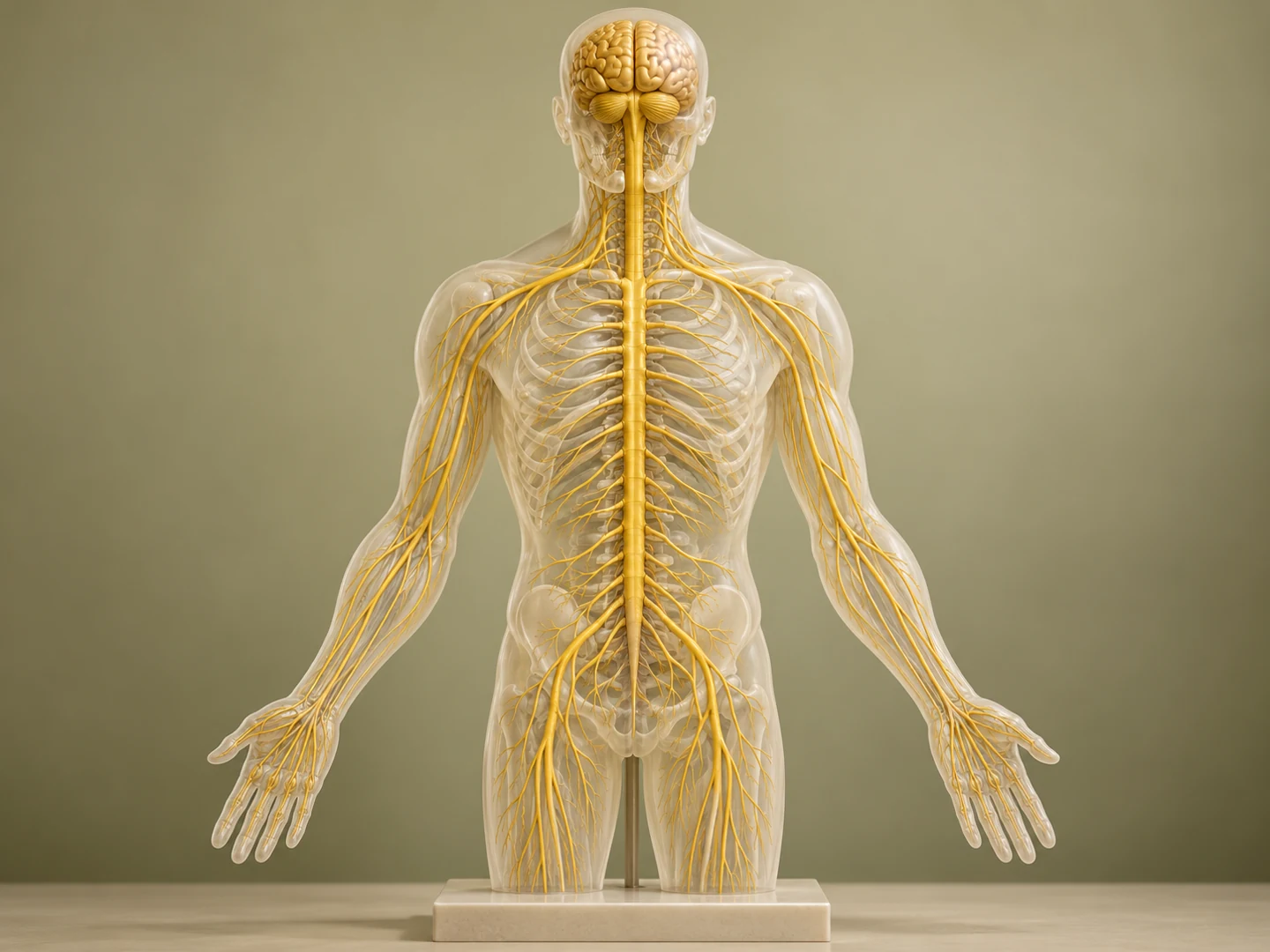
Topic overview
The nervous system is a complex network of nerve cells and fibers that serves as the body's communication hub, coordinating all bodily functions, thoughts, emotions, and behaviors.
It coordinates voluntary actions such as writing and automatic processes such as cardiovascular regulation through extensive networks of neurons. Breathing also involves automatic brainstem rhythms and somatic motor control of respiratory muscles.
Understanding how the nervous system is organized helps explain how humans process information, coordinate movements, respond to threats, and maintain homeostasis (internal balance).
Major Divisions of the Nervous System
Central nervous system
Brain and spinal cord
Processing, integration and coordinationPeripheral nervous system
Communication with the rest of the body
- Sympathetic
- Parasympathetic
The nervous system is divided into two primary parts: the Central Nervous System (CNS) and the Peripheral Nervous System (PNS), each with distinct structures and functions.
Nervous System Organization
Central Nervous System (CNS)
- 🧠 Brain
- 🦴 Spinal Cord
Peripheral Nervous System (PNS)
Somatic Nervous System
Voluntary movements
Autonomic Nervous System
→ Sympathetic (Fight-or-Flight)
→ Parasympathetic (Rest-and-Digest)
Central Nervous System (CNS)
Definition & Components
The Central Nervous System (CNS) consists of the brain and spinal cord and serves as the command center that processes information, makes decisions, and coordinates all body systems.
The brain handles higher-level functions like thinking, memory, emotion, and awareness, while the spinal cord acts as a superhighway carrying messages between the brain and the rest of the body.
Key Functions of the CNS
- Receives and interprets sensory information from eyes, ears, skin, muscles, and internal organs
- Processes information to make decisions about appropriate responses
- Sends motor commands to muscles and glands throughout the body
- Coordinates reflexes and automatic reactions for rapid responses
- Manages thought, memory, emotion, and conscious awareness
Example: Touching a Hot Stove (Reflex Arc)
This example demonstrates how the CNS processes information rapidly:
- Detection: Heat-detecting sensory receptors in the hand detect high temperature
- Transmission: Sensory neurons send electrical signals through peripheral nerves to the spinal cord
- Processing: The spinal cord can initiate a reflex response immediately, even before the brain becomes fully aware
- Response: Motor neurons send commands back to hand muscles
- Action: Muscles contract, pulling the hand away from danger
Key Point: Reflex arcs allow the spinal cord to produce fast, involuntary responses without waiting for the brain, demonstrating the CNS's efficiency in protecting the body.
Peripheral Nervous System (PNS)
Definition & Function
The Peripheral Nervous System (PNS) includes all nerves extending beyond the brain and spinal cord.
It serves as the messenger network that relays information between the CNS and the rest of the body, ensuring every muscle, organ, and tissue can communicate effectively.
The PNS is divided into two main subsystems with distinct roles: the Somatic Nervous System and the Autonomic Nervous System.
Somatic Nervous System
Voluntary Control System
The Somatic Nervous System (SNS) controls voluntary movements and carries sensory information that individuals consciously perceive.
This system enables purposeful actions like walking, talking, writing, playing sports, and any task requiring conscious control of skeletal muscles.
Key Functions
- Carries sensory information from sensory receptors (skin, muscles, joints) to the CNS
- Transmits motor signals from the CNS to skeletal muscles to produce voluntary movement
- Enables conscious perception of touch, temperature, pain, and body position
- Allows fine-tuned muscle coordination for complex actions and skilled movements
Example: Raising Your Hand
When a student decides to raise their hand to answer a question:
- Decision: The brain consciously decides to lift the arm
- Signal transmission: Motor commands travel from the brain down the spinal cord
- Peripheral relay: Signals pass through peripheral nerves to arm muscles
- Muscle contraction: Arm muscles receive the signal and contract
- Sensory feedback: Sensory neurons report arm position back to the brain for adjustment
Autonomic Nervous System (ANS)
Involuntary Control System
The Autonomic Nervous System (ANS) controls involuntary processes that occur automatically without conscious thought, managing internal organs and maintaining homeostasis.
The ANS regulates critical life-sustaining functions like heart rate, breathing, digestion, blood pressure, pupil dilation, and glandular secretions.
For these notes, the autonomic nervous system is organized into sympathetic and parasympathetic branches. They often have complementary effects, but do not oppose one another at every organ or switch fully on and off.
Sympathetic Nervous System: "Fight-or-Flight"
The sympathetic division activates during stressful, exciting, or dangerous situations, preparing the body for action by mobilizing energy and resources.
Sympathetic Activation Effects:
- Increases heart rate and blood pressure — pumps more blood to muscles
- Dilates pupils — allows more light for better vision
- Widens airways — increases oxygen intake
- Inhibits digestion — conserves energy for immediate action
- Redirects blood flow — away from digestive organs to skeletal muscles
- Stimulates sweat glands — cools the body
- Releases adrenaline (epinephrine) — from adrenal glands for sustained arousal
Real-Life Examples: Heart racing before a presentation, sweating during an exam, pupils dilating in a dark alley, increased alertness when startled by a loud noise.
Parasympathetic Nervous System: "Rest-and-Digest"
The parasympathetic division activates during calm, relaxed states, promoting recovery, energy conservation, and bodily maintenance.
Parasympathetic Activation Effects:
- Decreases heart rate and blood pressure — returns to baseline
- Constricts pupils — adjusts to normal light conditions
- Stimulates digestion — activates salivation and intestinal activity
- Promotes nutrient absorption — increases blood flow to digestive organs
- Conserves energy — supports growth, repair, and recovery
- Slows breathing rate — returns to relaxed rhythm
Real-Life Examples: Heart rate slowing after exercise, digestion resuming after a meal, feeling sleepy after eating, breathing easing while reading in bed.
Memory Aid: PARA = Parachute
Think of the parasympathetic system like a parachute that helps slow down and return to a calm, balanced state.
- Sympathetic = Speed up (stress, action, alertness)
- Parasympathetic = Parachute = slow down (relaxation, recovery, rest)
Comparison Tables
Somatic vs. Autonomic Nervous Systems
| Feature | Somatic Nervous System | Autonomic Nervous System |
|---|---|---|
| Control Type | Voluntary (conscious) | Involuntary (automatic) |
| Controls... | Skeletal muscles and sensory information | Internal organs and automatic processes |
| Example Actions | Kicking a ball, typing, dancing, waving | Heart rate, digestion, breathing, sweating |
Sympathetic vs. Parasympathetic Divisions
| Body Function | Sympathetic (Fight-or-Flight) | Parasympathetic (Rest-and-Digest) |
|---|---|---|
| Heart Rate | Increases ↑ | Decreases ↓ |
| Pupils | Dilate (widen) | Constrict (narrow) |
| Digestion | Inhibits/slows | Stimulates/activates |
| Breathing Rate | Arousal can accompany faster breathing and wider airways | Airway effects differ from control of breathing rhythm |
| Blood Pressure | Often rises with sympathetic cardiovascular activation | Indirect effects vary; not a universal direct decrease |
| Salivation | Decreases (dry mouth) | Increases |
| Energy Use | Mobilizes energy (burns) | Conserves energy (stores) |
Complete Nervous System Overview
| System | Function | Components |
|---|---|---|
| Central Nervous System | Processes info, sends commands | Brain and spinal cord |
| Peripheral Nervous System | Communicates between CNS and body | Nerves and ganglia |
| Somatic Nervous System | Voluntary movements & sensory input | Skeletal muscles, skin, joints |
| Autonomic Nervous System | Involuntary control of internal organs | Heart, lungs, stomach, glands |
| Sympathetic Division | Prepares body for action (arousal) | Increases heart rate, slows digestion |
| Parasympathetic Division | Calms body (rest and recovery) | Slows heart rate, restores digestion |
Homeostasis & Balance
Why Two Opposing Systems?
The sympathetic and parasympathetic divisions contribute to homeostasis: regulation of internal conditions within functional ranges. Their activity changes with context; some targets, including most blood vessels and sweat glands, do not have equal opposing innervation.
Having both systems allows the body to rapidly shift into emergency mode when needed (sympathetic) and then return to baseline for recovery and maintenance (parasympathetic).
This balance ensures quick reactions to sudden changes followed by restoration of calm, enabling survival and efficient functioning in changing environments.
AP Exam Strategy
Multiple Choice Tips
- Distinguish between CNS and PNS components and functions
- Identify whether behaviors are voluntary (somatic) or involuntary (autonomic)
- Recognize sympathetic vs. parasympathetic effects on specific body systems
- Understand reflex arcs and how the spinal cord processes rapid responses
- Apply concepts to real-life scenarios (exam questions, sports performance, stress responses)
Free Response Question (FRQ) Tips
- Use precise terminology: CNS, PNS, somatic, autonomic, sympathetic, parasympathetic
- Explain the pathway: sensory neurons → CNS → motor neurons for complete responses
- Provide concrete examples of how each system affects specific behaviors or bodily functions
- Contrast sympathetic and parasympathetic effects clearly (don't just list — compare)
- Describe homeostasis as the balance between opposing autonomic divisions
Essential Vocabulary
Central Nervous System (CNS)
Brain and spinal cord; command center for processing information and coordinating responses
Peripheral Nervous System (PNS)
All nerves outside the CNS; messenger network relaying information between CNS and body
Somatic Nervous System
Subdivision of PNS controlling voluntary movements and transmitting sensory information
Autonomic Nervous System
Subdivision of PNS controlling involuntary functions like heart rate and digestion
Sympathetic Nervous System
ANS division that activates fight-or-flight response; increases arousal and mobilizes energy
Parasympathetic Nervous System
ANS division that promotes rest-and-digest; calms body and conserves energy
Homeostasis
Balanced internal environment maintained by opposing autonomic systems
Reflex Arc
Rapid, involuntary response coordinated by the spinal cord without waiting for conscious awareness; the brain also receives sensory information and can modulate reflexes
Quick Review Summary
The Big Picture
The nervous system is divided into the Central Nervous System (brain + spinal cord) that processes information and the Peripheral Nervous System that relays messages between the CNS and body. The PNS includes the Somatic System (voluntary) and Autonomic System (involuntary). The Autonomic System balances Sympathetic (fight-or-flight arousal) with Parasympathetic (rest-and-digest calm) to maintain homeostasis.
Remember for the Exam
- CNS = Brain + Spinal Cord
- PNS = All nerves outside CNS
- Somatic = Voluntary movement
- Autonomic = Involuntary organs
- Sympathetic = Speed up
- Parasympathetic = Slow down
- Spinal withdrawal reflexes can begin before conscious awareness; information also reaches the brain
- Homeostasis = Balance
Overview of the Nervous System FAQs
Is the spinal cord part of the CNS?
Yes. The CNS consists of the brain and spinal cord. Peripheral nerves connect those structures with the rest of the body.
Does every reflex wait for conscious awareness?
No. A spinal withdrawal response can begin before conscious awareness, while sensory information also travels toward the brain.