
Complete Three-Dimensional Coordinates Notes
A clear, step-by-step guide to locating points in space, measuring distances, working with vectors, and describing lines, planes, and spheres. Start with the basics, then move into the advanced sections when you are ready.
1What Are Three-Dimensional Coordinates?
A point on a flat sheet needs two numbers, such as (x, y). A point in space needs a third number for height or depth. Its ordered triple is written . The x-, y-, and z-values are measured along three perpendicular directions.
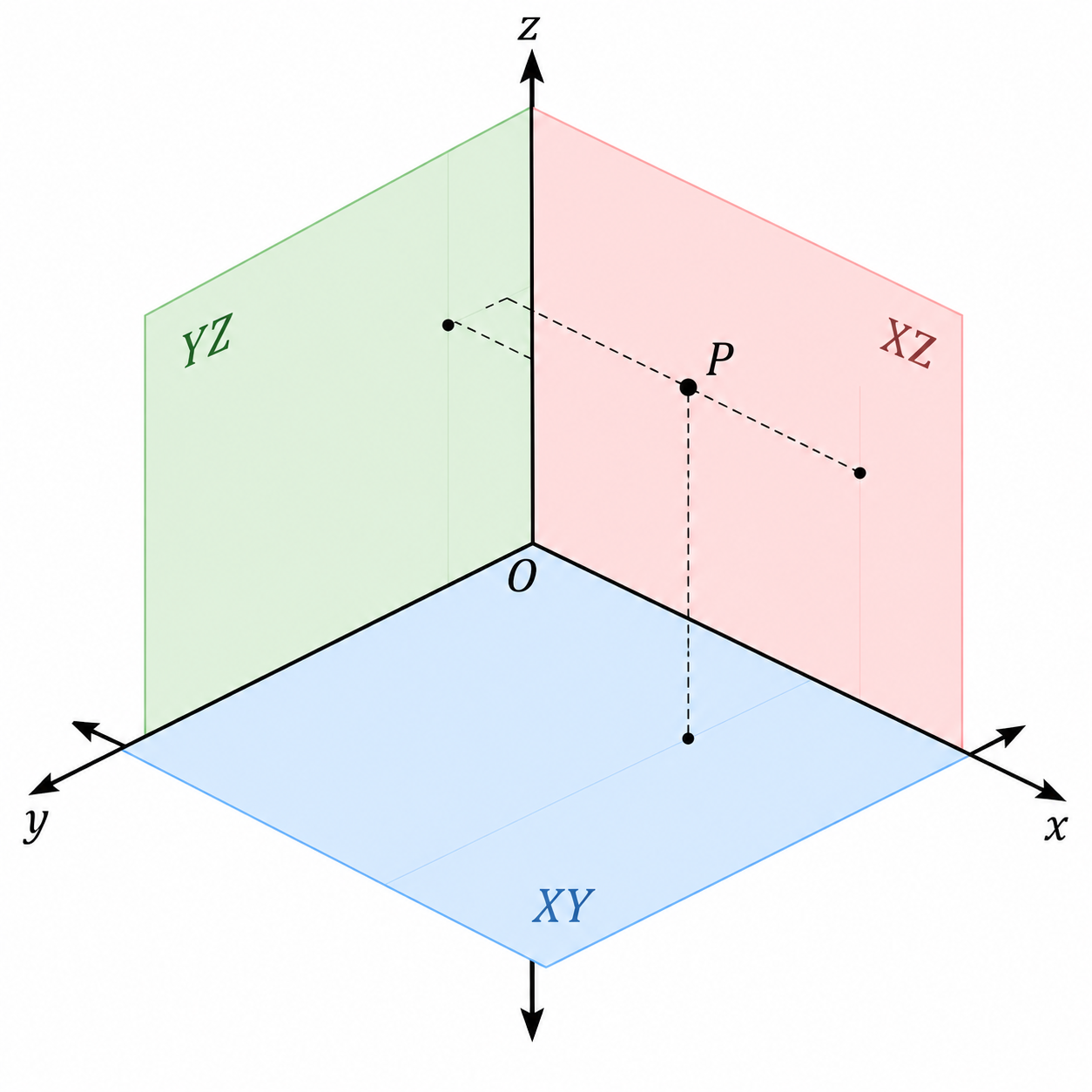
- Start at the origin
- Move along all three directions
- Arrive at
2The Three Coordinate Axes
The x-axis, y-axis, and z-axis are three number lines that meet at right angles. In a typical sketch, z points up; x and y are drawn diagonally so a flat page can suggest depth. The actual axes are perpendicular even when their drawing does not look like three 90° angles.
Each axis extends in both positive and negative directions. The axes are the reference lines from which every 3D coordinate is measured.
- Read the zero coordinates
- Only y changes
- So this point lies on
3The Origin
The origin is where all three axes meet. Its coordinates are O = . It is the starting point for measuring x, y, and z.
- Begin
- Only height changes
- The final point is
4Coordinate Planes
Every pair of axes forms a flat coordinate plane. The xy-plane contains the x- and y-axes, so everywhere on it. Likewise, the xz-plane has , and the yz-plane has .
- Check the third coordinate
- Apply the plane rule
- Therefore
5Points on the Coordinate Axes
A point on an axis has two zero coordinates. On the x-axis its form is ; on the y-axis, ; on the z-axis, . Here a, b, and c may be positive, negative, or zero.
- Check the zeros
- The changing coordinate is
- Answer
6Understanding a Point (x, y, z)
The order matters: the first entry is x, the second y, and the third z. So and are different points. A coordinate is a signed position along an axis; it is not always a distance. Distances are never negative.
- Compare the x entries
- The ordered triples differ
7Plotting a Point in 3D
- Begin at O = .
- Move x units parallel to the x-axis, following the sign of x.
- From there, move y units parallel to the y-axis.
- Finally, move z units parallel to the z-axis.
For , move +2 in x, −1 in y, then +3 in z. You can change the order of these three parallel moves and reach the same point. In a drawing, dotted guide lines can show each move.
- First movement
- Second movement
- Third movement
8Positive and Negative Directions
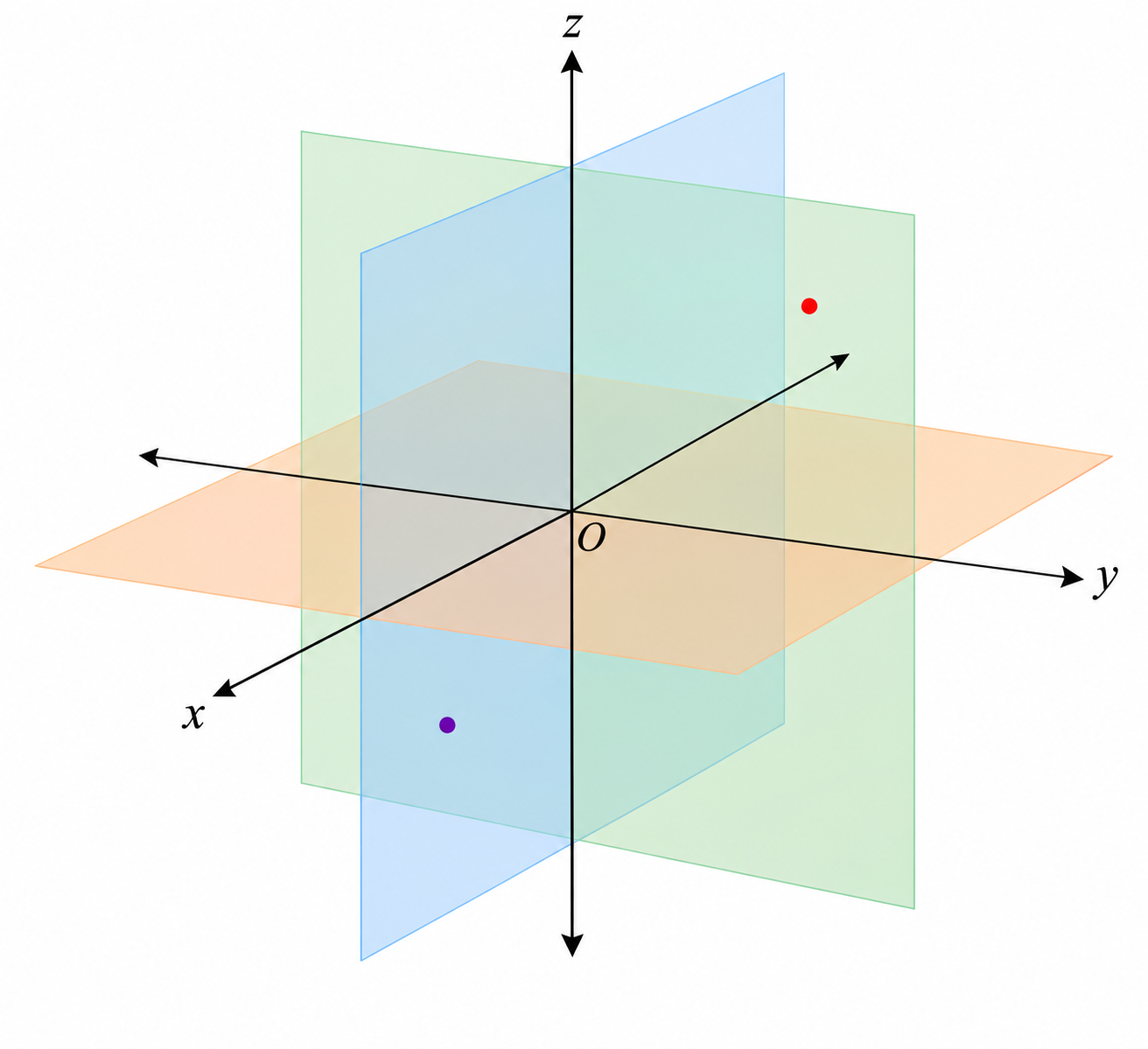
Signs tell you which side of a coordinate plane contains the point. Positive x and negative x lie on opposite sides of the yz-plane; positive y and negative y lie on opposite sides of the xz-plane; positive z and negative z lie above and below the xy-plane in the usual orientation.
- Write the sign pattern
- Distance below the xy-plane
9Octants
The three coordinate planes split space into eight octants. Each octant has one sign pattern: , , , , , , , or . For instance, lies in the octant.
Points with a zero coordinate lie on a boundary plane, so they are not strictly inside any octant. Textbooks do not always number octants in the same order; identifying the sign pattern is more reliable.
- Check each sign in order
- Its sign pattern is
10Projection of a Point onto Coordinate Planes
A perpendicular projection drops a point straight onto a plane. To project P = onto a coordinate plane, replace the coordinate perpendicular to that plane with zero.
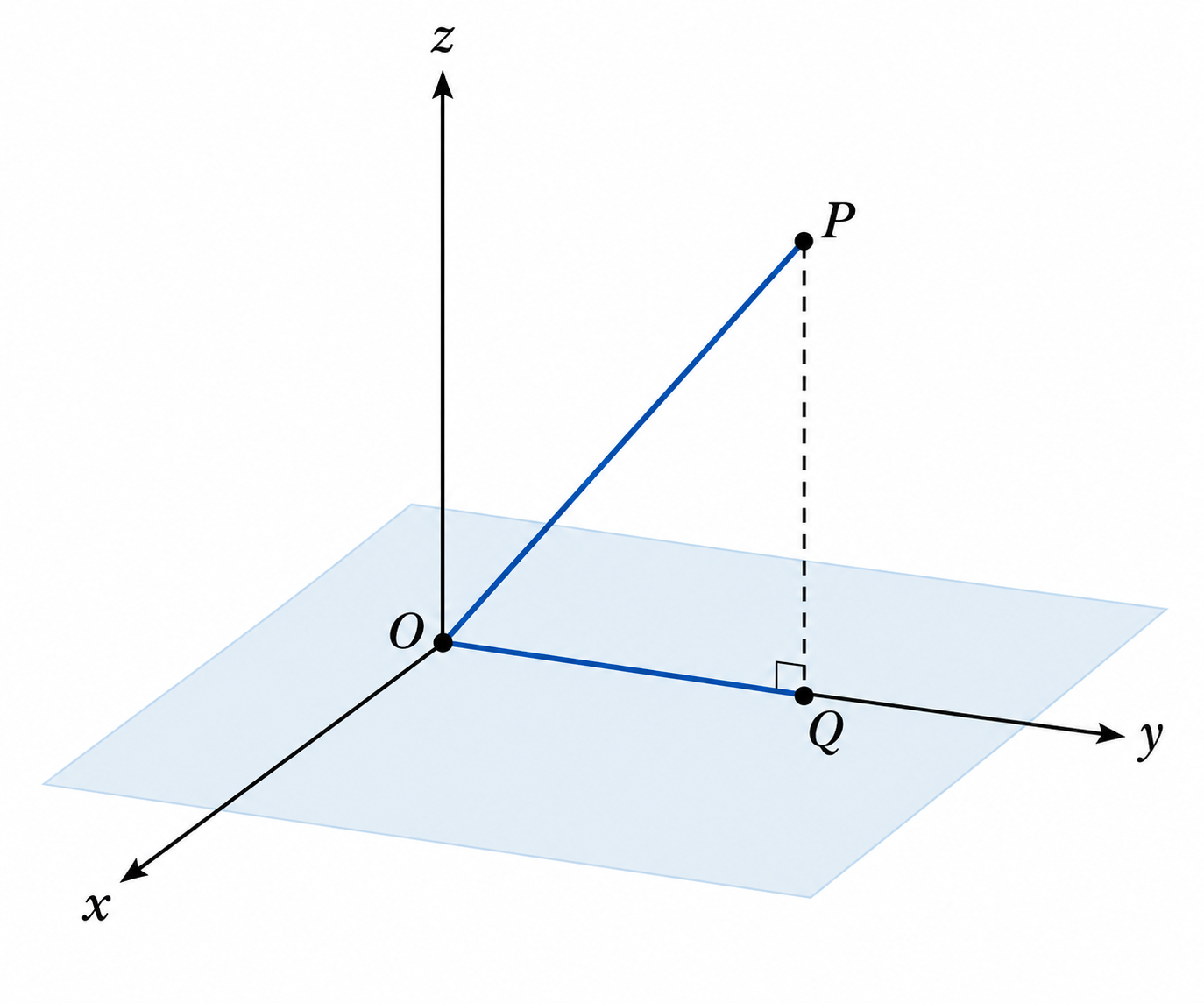
- For xy, erase z
- For xz, erase y
- For yz, erase x
11Distance from a Point to a Coordinate Plane
The shortest route to a plane is perpendicular to it. For P = , the distances to the xy-, xz-, and yz-planes are the absolute values of z, y, and x respectively.
- To xy: use z
- To xz: use y
- To yz: use x
12Distance from a Point to an Axis
To find the shortest distance from P = to the x-axis, keep the x-coordinate fixed and move y and z to zero. The perpendicular segment has legs and . Apply the Pythagorean theorem.
- Ignore the x-coordinate
- Use the perpendicular legs
- Simplify
13Distance from the Origin
The straight-line distance from O = to P = comes from the Pythagorean theorem twice: first combine x and y, then combine that result with z.
- Square all coordinates
- Take the positive square root
14Distance Between Two Points in 3D
Subtract corresponding coordinates to find the three changes from A = to B = . Then use the 3D Pythagorean theorem.
- Find the three changes
- Square and add
- Simplify
15Midpoint of a Line Segment
The midpoint is halfway between two endpoints. Average each pair of matching coordinates independently.
- Average x
- Average y and z
- Write the point
16Finding a Missing Endpoint
If A is one endpoint and M is the midpoint, solve the midpoint equation for the other endpoint B. Double each midpoint coordinate, then subtract the corresponding coordinate of A.
- Double the midpoint
- Subtract the known endpoint
- Result
17Section Formula Extension
Suppose P divides segment AB internally in the ratio AP : PB = m : n, where m and n are positive. P is of the way from A to B. The endpoint farther from P gets the larger weight.
- Fraction of the journey
- Move one third from A
- Evaluate
18Reflections in Three Dimensions
Reflecting across a coordinate plane reverses just the coordinate perpendicular to that plane. The other two coordinates stay the same.
- xy means z changes sign
- x and y stay fixed
- Check equal distances
19Reflection Across an Axis
In 3D, the map commonly called “reflection across an axis” keeps the coordinate along that axis and reverses the other two. Geometrically, it is also a half-turn (180° rotation) about the axis.
- Keep the x-coordinate
- Reverse y and z
- Answer
20Reflection Through the Origin
The origin is the midpoint between a point and its image under a reflection through O. Change the sign of all three coordinates.
- Reverse all three signs
- Check the midpoint
21Vectors in Three Dimensions Extension
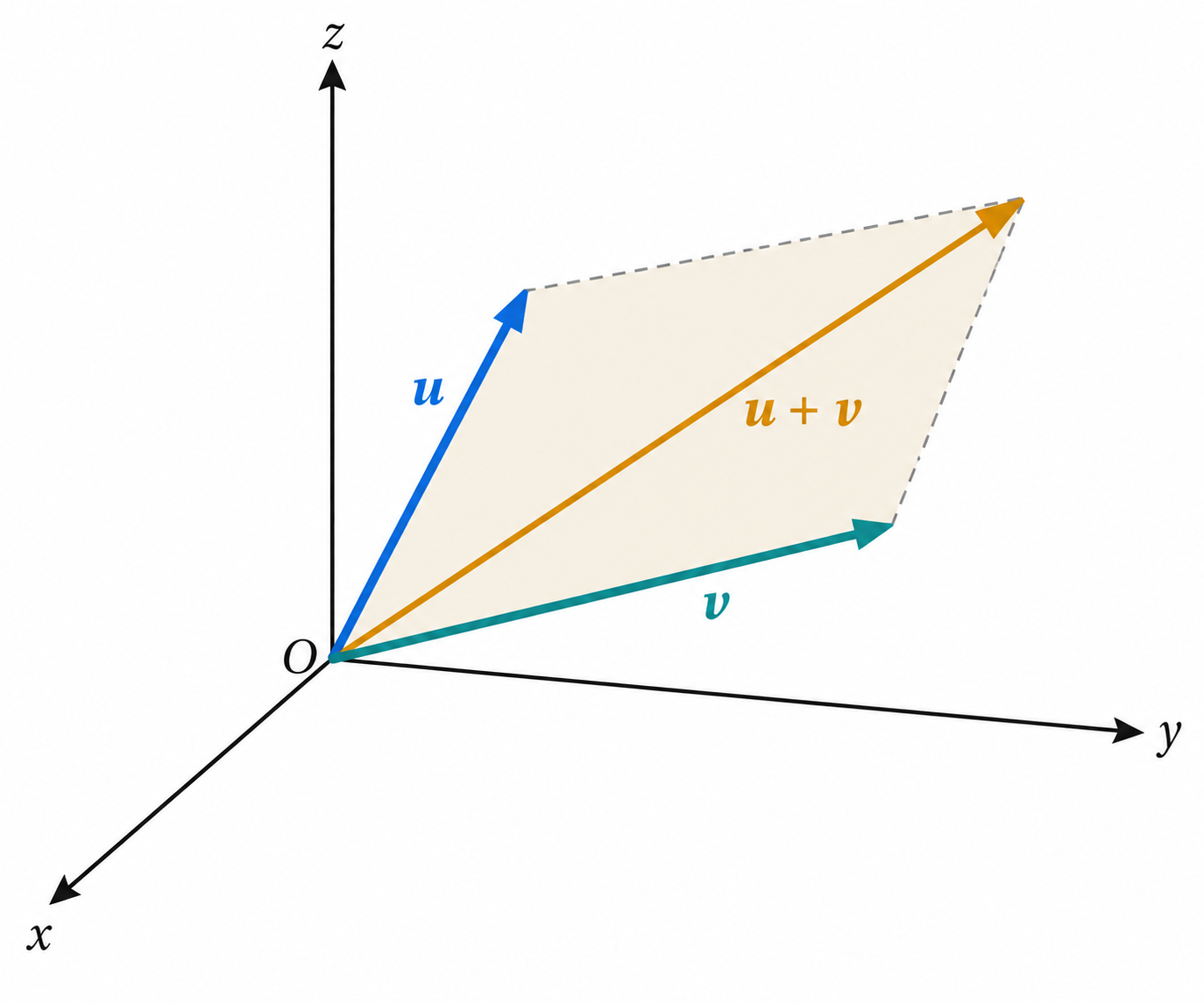
A 3D vector represents a displacement with direction and length. Write v = . Its three components tell how much x, y, and z change. A vector is not tied to one starting point: parallel arrows with the same length and direction represent the same vector.
The zero vector has length zero and no specific direction. Coordinate triples for points use parentheses; angle brackets help distinguish vectors.
- Break it into component moves
- Read the direction
22Vector Between Two Points
The displacement from A to B is found by subtracting the starting point from the ending point, coordinate by coordinate.
- End minus start
- Subtract matching entries
- Result
23Magnitude of a Vector
The magnitude (length) of v = is the straight-line distance represented by its arrow.
- Square the components
- Take the square root
24Unit Vectors
A unit vector has magnitude 1. The standard unit vectors are i = , j = , and k = . Any vector equals ai + bj + ck.
- Find its length
- Divide every component by 5
25Adding and Subtracting 3D Vectors
Add or subtract matching components. For u = and v = , u + v = while u − v = .
- Add matching components
- Result
26Scalar Multiplication
Multiply each component of a vector by the same real number k: k⟨a,b,c⟩ = . Its length becomes times the original length. A negative k also reverses direction.
- Multiply each component
- Result
27Dot Product
The dot product multiplies corresponding components and adds the results. It produces a number, not a vector.
- Multiply matching entries
- Add
28Perpendicular Vectors
Two nonzero vectors are perpendicular exactly when their dot product is zero. For u = and v = , u · v = 2 − 2 + 0 = 0, so they meet at 90°.
- Compute the dot product
- Both vectors are nonzero, so
29Angle Between Two Vectors
For nonzero vectors, rearrange to find the smaller angle 0° ≤ θ ≤ 180°.
- Dot product
- Magnitudes
- Solve for the angle
30Equation of a Line in 3D Extension
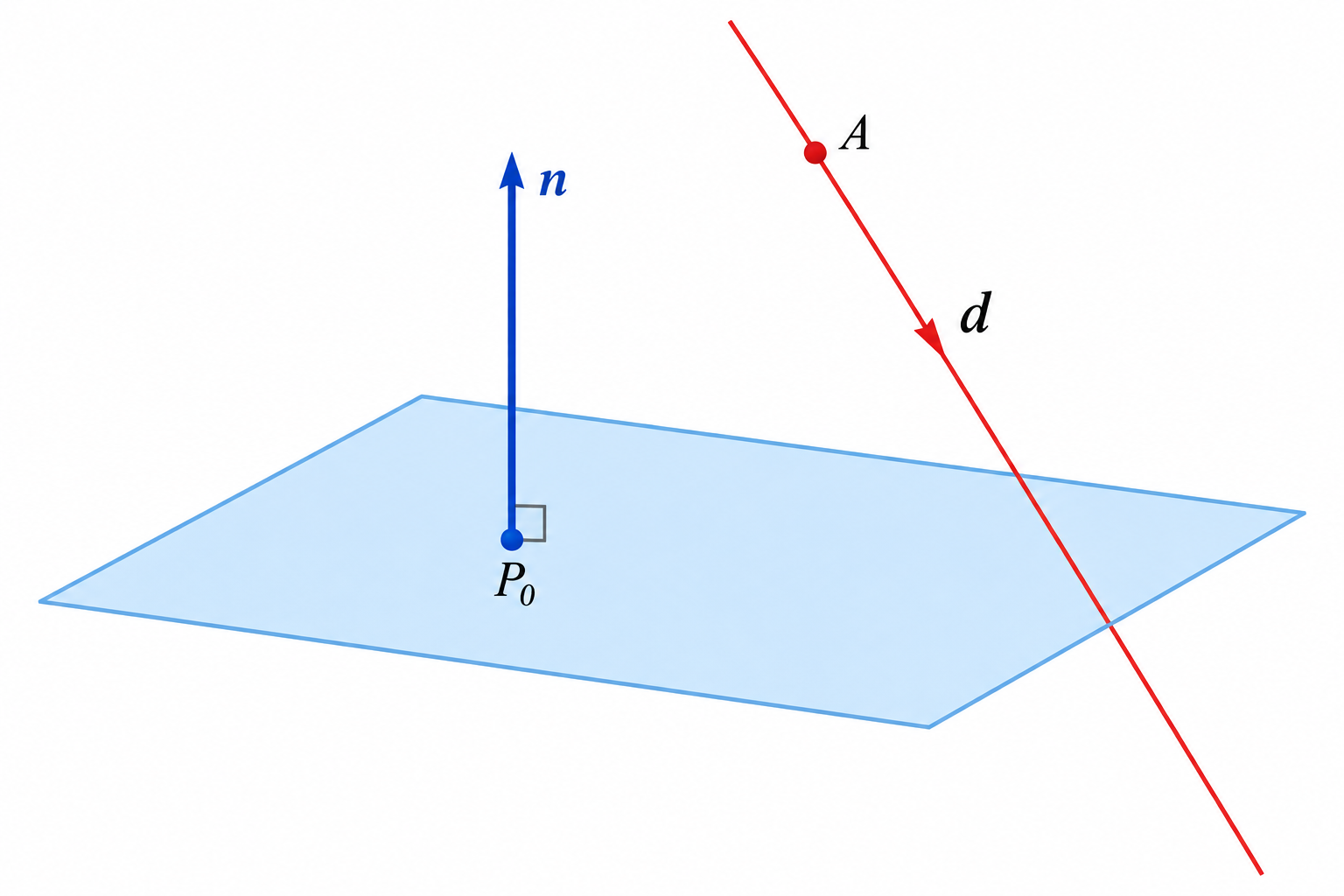
A line needs a point P₀ = and a nonzero direction vector d = . Every point on the line is reached by moving t copies of d from P₀, where t is any real number.
- Use point plus parameter times direction
- Read component equations
31Symmetric Equation of a Line
If all three direction components a, b, c are nonzero, eliminate t from the parametric equations:
- Solve each component for t
- Drop the repeated parameter
32Equation of a Plane
A plane is determined by a point P₀ = and a nonzero normal vector n = , which points straight out from the plane. A point lies on the plane when its displacement from P₀ is perpendicular to n.
Here . At least one of a,b,c must be nonzero.
- Use the point-normal rule
- Collect constants
33Coordinate Planes as Equations
The coordinate planes are simple plane equations: xy is ; xz is ; yz is . Their normal vectors are k, j, and i respectively.
A plane parallel to xy has equation for a constant c; parallel to xz, ; parallel to yz, . For example, is a horizontal plane 4 units above the xy-plane.
- The z-coordinate is fixed
- x and y are free
- It is parallel to
34Plane Through a Given Point
Substitute the given point and normal into the point-normal form. Suppose a plane passes through and has normal . Then:
- Substitute point and normal
- Expand and collect
- Check the given point
35Parallel Planes
Two planes are parallel when their normal vectors are nonzero scalar multiples. The planes and have proportional normals and , so they are parallel.
They are distinct because multiplying the first entire equation by 2 gives a right side of 8, not 9. If every coefficient including the constant has the same scale factor, the equations describe the same plane.
- Compare normal vectors
- Compare constants
- Conclusion
36Perpendicular Planes
Two planes meet at right angles when their nonzero normal vectors are perpendicular. Test the dot product of the normals.
- Read their normals
- Test the dot product
- Conclusion
37Distance from a Point to a Plane
For P = and a plane , substitute the point into the left side, take the absolute value, and divide by the normal vector’s magnitude.
- Evaluate the plane expression
- Find normal length
- Divide
38Equation of a Sphere
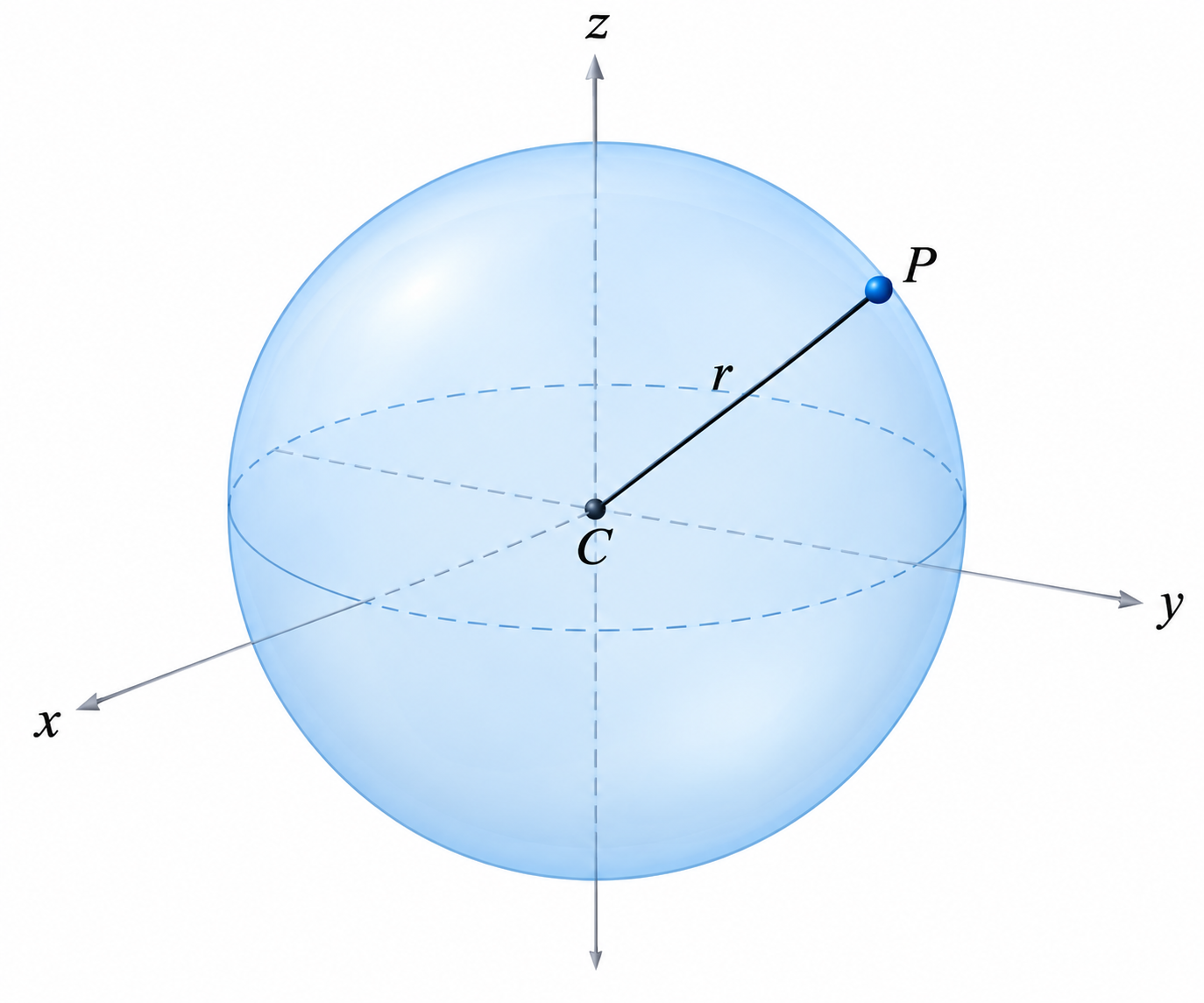
A sphere is the set of all points a fixed distance r from its center C = . Apply the 3D distance formula and square both sides.
- Write the center in standard form
- Square the radius
- Equation
39Finding the Center and Radius of a Sphere
In standard form, read the center from the values subtracted inside each bracket, and take the positive square root of the right side for the radius. Be careful: means the center’s y-coordinate is −2.
If the equation is expanded, complete the square in x, y, and z. For , group terms and add 4, 1, and 9:
- Group and move the constant
- Complete three squares
- Read center and radius
40Three-Dimensional Pythagorean Theorem
For three mutually perpendicular lengths a, b, c, the space diagonal d satisfies . First the diagonal of the a-by-b base has square a²+b²; then combine that base diagonal with height c.
- Diagonal across its base
- Combine with height
41Collinear Points in 3D Extension
Points are collinear if they lie on one line. For distinct A and B, compute AB⃗ and AC⃗. If for some real t, then C lies on line AB. Equivalently, .
- Compute two displacements
- Compare
- Conclusion
42Coplanar Points Extension
Points are coplanar if one plane contains all of them. Any three points are coplanar; three noncollinear points determine a unique plane. To check four points A, B, C, D, use the scalar triple product:
The absolute value of this product is the volume of the parallelepiped built from the three vectors. Zero volume means the vectors lie in one plane. If AB⃗ and AC⃗ are parallel, the test is still zero, but choose three noncollinear points to find a unique plane equation.
- Check the last coordinate
- A common plane contains them
43Direction Cosines Extension
For a nonzero vector v=, let α, β, γ be its angles with the positive x-, y-, and z-axes. Their cosines are the components of the unit vector in v’s direction.
- Magnitude
- Divide each component
- Check
44Cross Product Extension
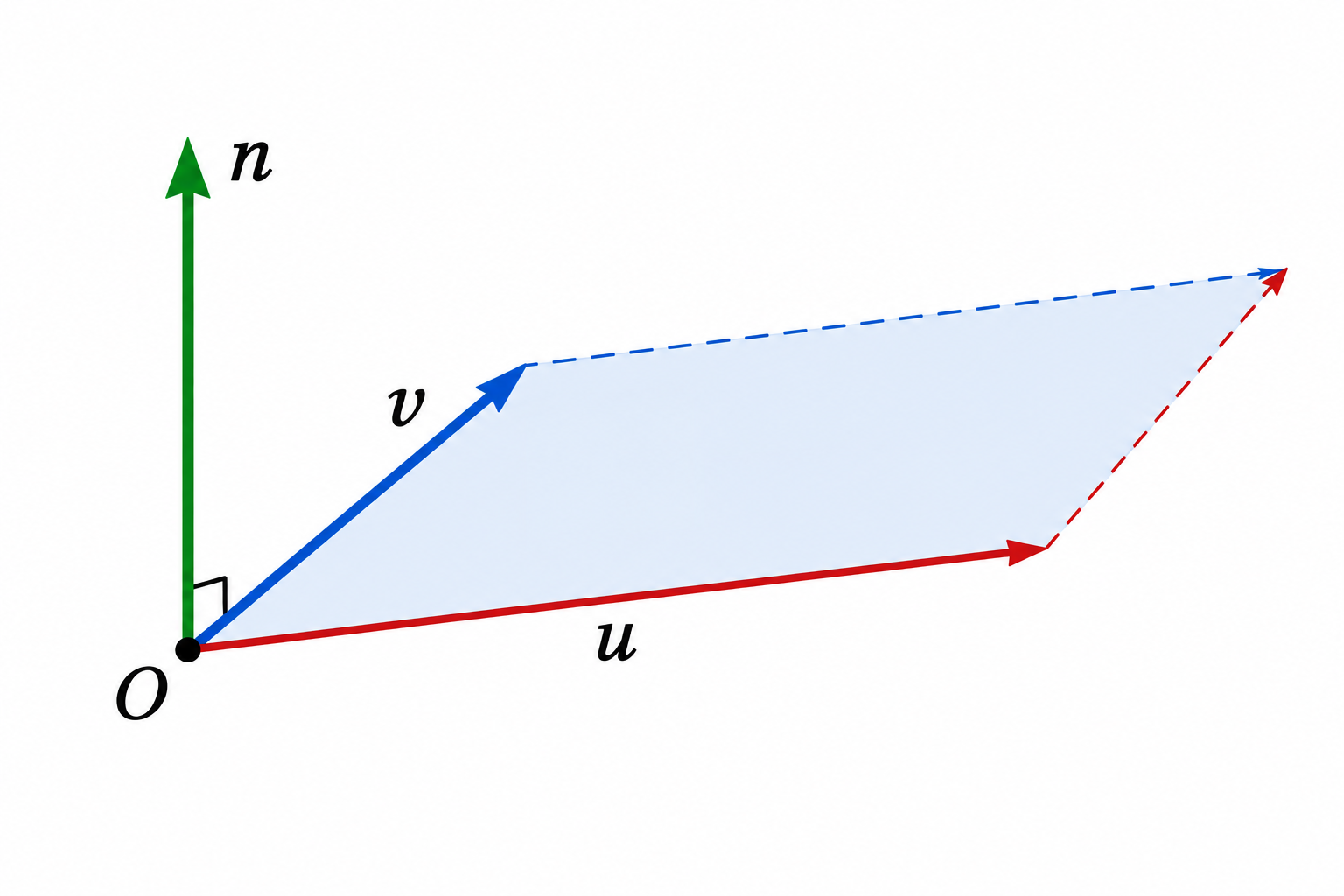
The cross product of u= and v= is a new vector perpendicular to both. Its direction follows the right-hand rule; reversing the order reverses the result.
- Read components
- Apply the component rule
- Simplify and check direction
45Area Using the Cross Product
If u and v are adjacent sides of a parallelogram, its area is . A triangle made from the same two side vectors has half that area.
- Cross product
- Parallelogram area
- Triangle area
46Common Mistakes
- Swapping y and z: Always read or subtract coordinates in x, y, z order.
- Negative distance: Plane distances use absolute values; all lengths use nonnegative square roots.
- Projection confusion: Set the coordinate perpendicular to the target plane to zero.
- Axis versus plane reflection: A coordinate plane changes one sign; a coordinate axis changes two.
- Midpoint versus endpoint: The midpoint averages; a missing endpoint is .
- Undefined angle: Do not use the angle formula with a zero vector.
- Symmetric line division: A zero direction component means a fixed coordinate, not a denominator of zero.
- Sphere radius: The right side of standard form is r², not r.
47Formula Summary
| Task | Formula or rule |
|---|---|
| Point distance | |
| Origin distance / vector magnitude | |
| Midpoint | |
| Missing endpoint | |
| Distance to xy, xz, yz | |
| Distance to x-, y-, z-axis | |
| Vector A to B | |
| Dot product | |
| Line | |
| Plane | |
| Point-to-plane distance | |
| Sphere | |
| Parallelogram / triangle area |
48Quick Identification Rules
| What you see | What it means |
|---|---|
| One coordinate is zero | Point lies on the corresponding coordinate plane. |
| Two coordinates are zero | Point lies on the remaining axis. |
| Three coordinates are zero | Origin. |
| z=c | Plane parallel to xy. |
| Same plane normals up to scale | Parallel or coincident planes. |
| Normal dot product zero | Perpendicular planes. |
| Vector dot product zero | Nonzero vectors are perpendicular. |
| Vector cross product zero | Nonzero vectors are parallel. |
| Sum of three squared coordinate differences = r² | Sphere in standard form. |
49Worked Example
Let A= and B=. Find the vector from A to B, the length AB, midpoint M, missing endpoint if A and M are known, the projection of B onto xy, and a line through A and B.
- Subtract the endpoints
- Use the 3D distance rule
- Average matching coordinates
- Check the missing endpoint
- Erase z for the xy-projection
- Write the line
50Practice Questions
Try these without looking at the next section. Questions 1–9 build the foundation; 10–16 are extensions.
- Which coordinate plane contains P=? Which octant contains Q=?
- Plot T= by describing three parallel moves from the origin.
- Find all three coordinate-plane projections of P=.
- Find P=‘s distances to the xy-plane, the x-axis, and the origin.
- Find the distance between A= and B=.
- Find the midpoint of A=, B=.
- A= and midpoint M=. Find B.
- Reflect P= across the xz-plane, about the x-axis, and through O.
- Find a unit vector in the direction of v=.
- Let u= and v=. Are they perpendicular?
- Give parametric and symmetric equations of the line through with direction .
- Find the plane through with normal .
- Find the distance from to .
- Find the center and radius of .
- For u= and v=, find u×v and the triangle area.
- A=, B=. Find P such that AP:PB=1:2.
51Practice Answers
Answer 1 · show steps
- A zero z puts P on
- Signs of Q
Answer 2 · show steps
- x movement
- y movement
- z movement
Answer 3 · show steps
- Set z to zero
- Set y to zero
- Set x to zero
Answer 4 · show steps
- Distance to xy
- Distance to x-axis
- Distance to O
Answer 5 · show steps
- Coordinate changes
- Square, add, and root
Answer 6 · show steps
- Average x
- Average y and z
- Midpoint
Answer 7 · show steps
- Double M
- Subtract A
Answer 8 · show steps
- Across xz: change y
- About x-axis: change y and z
- Through O: change all signs
Answer 9 · show steps
- Find magnitude
- Divide components
Answer 10 · show steps
- Dot product
- Nonzero vectors, so
Answer 11 · show steps
- Parametric form
- Solve all for t
Answer 12 · show steps
- Substitute point and normal
- Simplify
Answer 13 · show steps
- Plane expression
- Normal length
- Distance
Answer 14 · show steps
- Complete x, y, and z squares
- Read center and radius
Answer 15 · show steps
- Compute cross product
- Triangle is half the parallelogram
Answer 16 · show steps
- Fraction from A to B
- Use the section rule
52Final Memory Guide
Position: Three coordinates tell where; signs tell which side of the planes.
Plane: One coordinate zero. Axis: Two coordinates zero. Origin: Three zeros.
Distance: Subtract, square, add, square-root. Midpoint: Average. Projection: Set one coordinate to zero.
Vectors: Subtract endpoints for displacement; dot for angle and perpendicularity; cross for a normal and area.
Equations: A line uses a point and a direction. A plane uses a point and a normal. A sphere uses a center and a radius.
53Key Vocabulary
| Term | Meaning |
|---|---|
| Ordered triple | Three coordinates in a fixed order. |
| Origin | The point where the axes meet. |
| Coordinate plane | A plane formed by a pair of coordinate axes. |
| Octant | One of eight open regions cut out by the three coordinate planes. |
| Projection | The perpendicular image of a point on a plane or line. |
| Magnitude | The length of a vector. |
| Unit vector | A vector of length 1. |
| Direction vector | A nonzero vector pointing along a line. |
| Normal vector | A nonzero vector perpendicular to a plane. |
| Dot product | A scalar computed from matching vector components. |
| Cross product | A vector perpendicular to two given vectors. |
| Collinear / coplanar | On one line / on one plane. |
| Sphere | All points at one fixed distance from a center. |