
NUM8ERS · BIOLOGY STUDY NOTES
How Mitochondria Make ATP | Cellular Respiration Explained
How does energy from food help your cells make ATP? Follow the process step by step, then test your understanding with worked examples and practice questions.
Watch the lesson ↓ Explore the notes ↓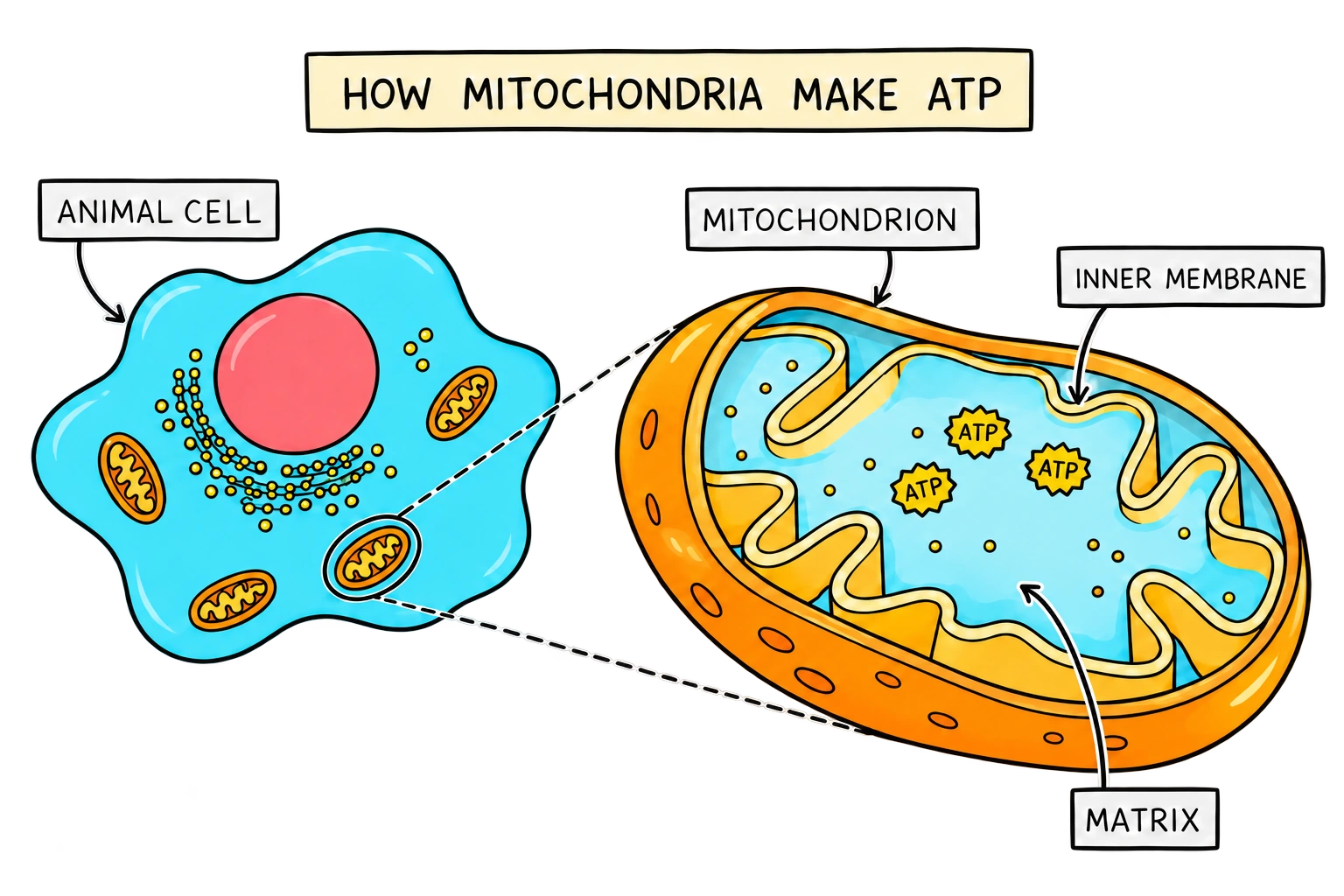
WATCH AND LEARN
How Mitochondria Make ATP
Watch the lesson, then use the notes below to revise each step. Watch on YouTube ↗
Jump to electron transport · 3:20, ATP synthase · 4:48, or oxygen · 5:30.
1. ATP and ADP: the cell’s reusable energy carrier
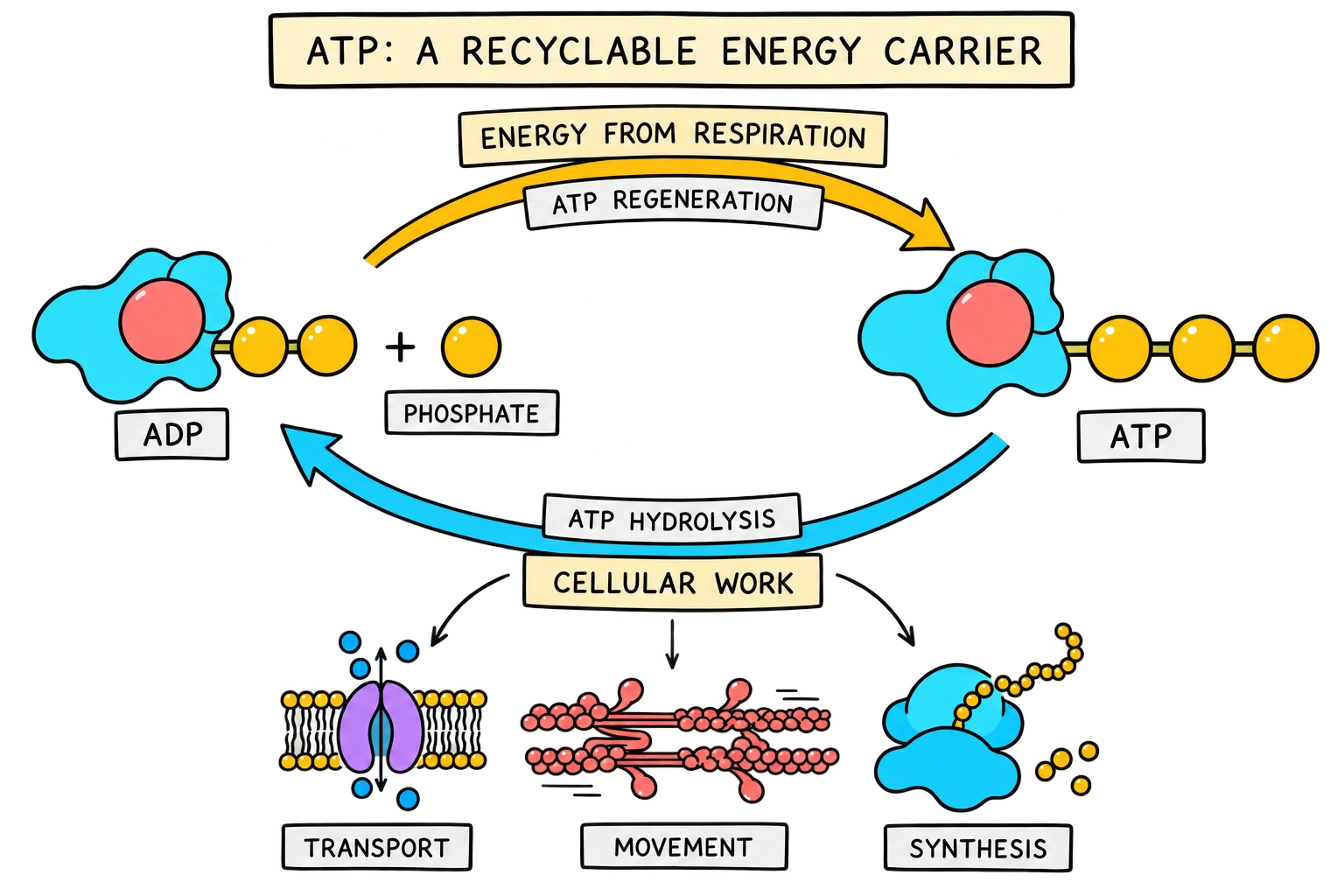
Every time a muscle contracts, a cell moves substances across its membrane or a new molecule is assembled, energy has to be transferred. Food contains chemical energy, but a cell cannot use a piece of glucose directly for every job. ATP helps connect energy-releasing reactions to the processes that need energy. Understanding this connection is the first step towards understanding mitochondria.
ATP stands for adenosine triphosphate. It contains adenine, a sugar called ribose and three phosphate groups. ADP stands for adenosine diphosphate and has two phosphate groups. Cells can rebuild ATP from ADP and inorganic phosphate. They then use ATP in reactions that help power cellular work. Think of this as a reusable chemical cycle: ATP is made, used and made again.
What happens when ATP is used?
In a common ATP reaction, water takes part in converting ATP to ADP and inorganic phosphate. This is called hydrolysis. The overall reaction releases free energy that can be coupled to another process. Inorganic phosphate is written with the symbol shown in the equation below. The equation is a useful summary; it leaves out some details about charges and protons that depend on the conditions.
Be careful with the phrase “breaking ATP releases energy.” Breaking a chemical bond takes energy. ATP hydrolysis releases energy overall, after you consider the complete reaction and its products. The products are more stable under the relevant conditions. A better exam answer says that the hydrolysis reaction releases free energy, rather than claiming that breaking one bond creates energy. [1]
How ATP helps a cell do work
Imagine a membrane pump moving ions from one side of a membrane to the other against their electrochemical gradient. That movement needs an energy input. The pump can use an ATP-dependent cycle of changes in its shape to move the ions. In muscles, myosin uses an ATP-dependent cycle to interact with actin. ATP is involved in a particular molecular process each time; energy is not simply poured into the cell as an invisible fuel.
You may find it useful to picture ATP as a rechargeable carrier. Use the comparison to remember that ATP is repeatedly regenerated. However, ATP is a molecule, not a tiny electrical battery. Cells transfer energy between chemical reactions, ion gradients and movement. They do not create energy from nothing, and some of the energy is released as heat.
Two ways cells make ATP
In substrate-level phosphorylation, an enzyme transfers a phosphate group from a suitable substrate to ADP. This happens during glycolysis and at one stage of the citric acid cycle. In oxidative phosphorylation, electron transfer builds a proton gradient, and ATP synthase uses that gradient to make ATP. You will meet both methods in these notes. Keeping them separate explains why cells can still make some ATP when mitochondrial oxidative phosphorylation is unavailable. [2]
Check your understanding: ADP has two phosphate groups. What must be added to rebuild ATP? A phosphate group must be added, and the process needs an energy input. Simply putting ADP and phosphate together does not provide a continuous supply of ATP.
2. Mitochondrial structure: learn the spaces first
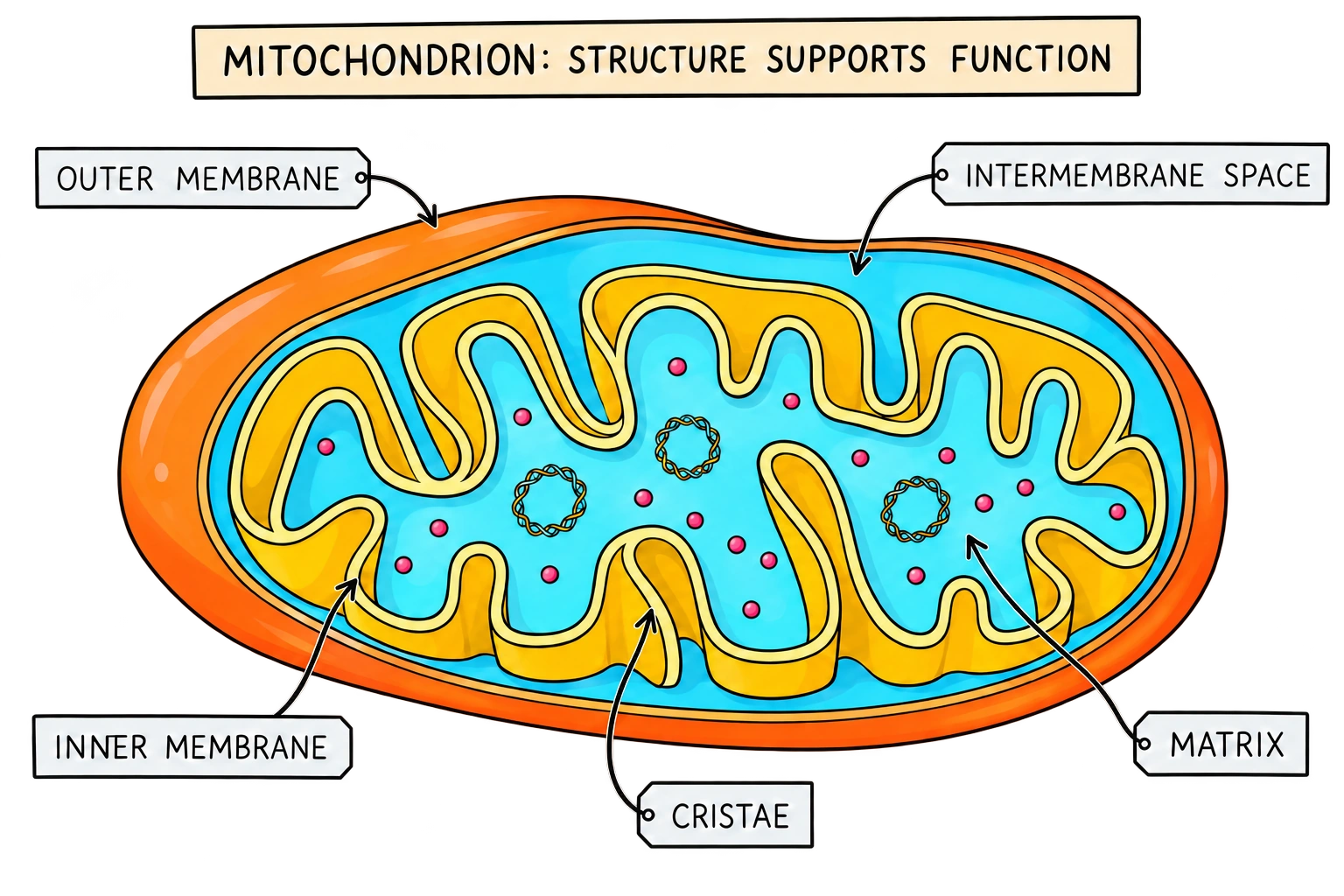
A mitochondrion has two membranes. The outer membrane forms its outer boundary. The inner membrane lies inside it and folds inward. These folds are called cristae. The liquid-filled region inside the inner membrane is the matrix, while the space between the two membranes is the intermembrane space.
Start by finding these boundaries in the drawing. The inner membrane separates the matrix from the intermembrane space. A crista is a fold of that membrane, not a separate floating structure. The space within a crista connects to the intermembrane space. This is easy to miss when you look at a two-dimensional diagram of a three-dimensional organelle.
Why the inner membrane matters
The inner membrane contains the respiratory-chain proteins and ATP synthase. During aerobic respiration, respiratory complexes move protons from the matrix towards the intermembrane space. Protons can then return to the matrix through ATP synthase. This return movement helps drive ATP formation. The ATP-making head of ATP synthase faces the matrix. [3]
The folds provide space for many membrane proteins. But extra surface area is only part of the explanation. The inner membrane also needs to limit uncontrolled proton movement. If protons could freely move back everywhere, the cell would struggle to maintain the gradient needed for ATP synthesis. Structure and function work together: the membrane holds the machinery and keeps the two sides different.
What happens in the matrix?
The matrix contains many enzymes used in mitochondrial metabolism. Pyruvate is converted to acetyl-CoA there, and most reactions of the citric acid cycle take place there. Mitochondrial DNA and ribosomes are also present. These features help mitochondria carry out their functions, but they do not make mitochondria independent cells. Many mitochondrial proteins are encoded by nuclear genes and imported from elsewhere in the cell.
Think of the matrix as one working compartment and the inner membrane as another important working location. Fuel-processing reactions in the matrix supply reduced electron carriers. The membrane system uses electron transfer to maintain a gradient. The two locations are closely connected, but they are not interchangeable. Saying that every reaction “happens in the cristae” loses these important differences.
A quick way to check any diagram
First label the matrix. Then draw an arrow carrying protons across the inner membrane towards the intermembrane space. Finally, draw a return arrow through ATP synthase towards the matrix. If both arrows point in the same direction, something is wrong. If the ATP-making head sits on the intermembrane-space side, its orientation needs correcting.
Remember: “Outside the matrix” does not necessarily mean “outside the mitochondrion.” Protons pumped across the inner membrane remain within the outer membrane. In an exam, naming both compartments is clearer than writing only “inside” or “outside.”
3. Cellular respiration: follow carbon, electrons and ATP
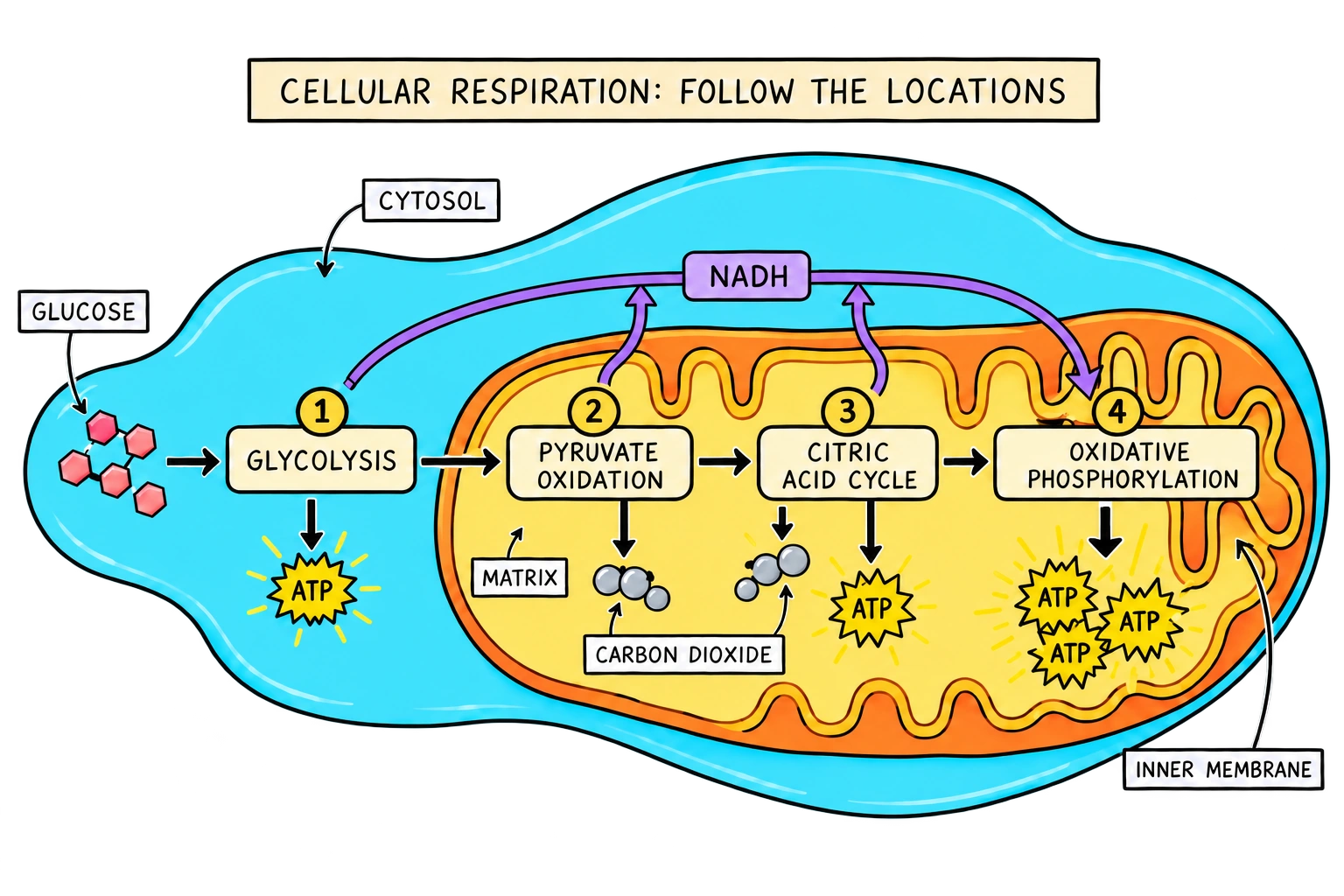
Cellular respiration is easier to understand when you follow three things separately: carbon atoms, electrons and ATP. Carbon from glucose passes through different molecules and is eventually released as carbon dioxide during complete oxidation. Electrons are transferred to carriers and then towards oxygen. ATP is made at certain stages and used to support cellular work.
These three journeys are connected, but they are not the same journey. Glucose carbon does not simply turn into an ATP molecule. An electron does not become a proton. Keeping the three stories separate helps you explain the links between stages without mixing up their reactants and products.
The overall glucose equation
The equation below summarizes the complete oxidation of glucose. Energy released during this overall change can support ATP regeneration, and some is released as heat. A fixed ATP total is not included in the equation because the actual yield depends on the conditions and the assumptions used in a calculation.
This is an overall summary, not one giant reaction inside a cell. Glucose is broken down through a sequence of enzyme-catalyzed steps. The separate steps allow the cell to control how energy is transferred. When a question asks you to explain respiration, the equation is a starting point; you still need to explain the stages and how they connect. [2]
The four main stages
Glycolysis happens in the cytosol. One glucose molecule is converted into two pyruvate molecules. Pyruvate oxidation happens in the mitochondrial matrix and prepares acetyl groups for the next stage. The citric acid cycle, also called the Krebs cycle or TCA cycle, processes those acetyl groups. Oxidative phosphorylation uses the inner membrane, the respiratory chain and ATP synthase.
| Stage | Location | ATP per glucose | Electron carriers |
|---|---|---|---|
| Glycolysis | Cytosol | 2 net ATP | 2 NADH made |
| Pyruvate oxidation | Matrix | 0 | 2 NADH made |
| Citric acid cycle | Matrix, with one enzyme in the inner membrane | 2 ATP equivalents | 6 NADH and 2 FAD-linked pairs made |
| Oxidative phosphorylation | Inner membrane; ATP is made on the matrix side | About 26–28 ATP | Reduced carriers are recycled; electrons reach oxygen |
Notice that pyruvate oxidation makes no ATP directly. It still matters because it makes NADH and supplies acetyl-CoA. Similarly, the citric acid cycle makes only a small amount of ATP directly, but it supplies many reduced electron carriers. A stage can therefore contribute strongly to later ATP formation without making much ATP at the moment it happens. [4] [5]
Turn a list of stages into an explanation
Try joining the stages with verbs. Glycolysis splits glucose. Pyruvate oxidation prepares acetyl-CoA. The cycle transfers electrons to carriers. The respiratory chain pumps protons while transferring electrons towards oxygen. ATP synthase uses proton return to make ATP. These links are more useful than memorizing four names without knowing why one stage leads to another.
Mitochondria do not make every ATP molecule in every cell. Glycolysis makes ATP outside mitochondria. Mature mammalian red blood cells have no mitochondria and depend on glycolytic ATP. Plants have mitochondria too, even though they also have chloroplasts. Use the pathway in these notes as a guide to common aerobic eukaryotic respiration, while remembering that cells differ.
Check your understanding: Which stage happens outside the mitochondrion? Glycolysis. Which stage uses a membrane gradient to make most of the ATP in this pathway? Oxidative phosphorylation.
4. Glycolysis and pyruvate: getting fuel ready
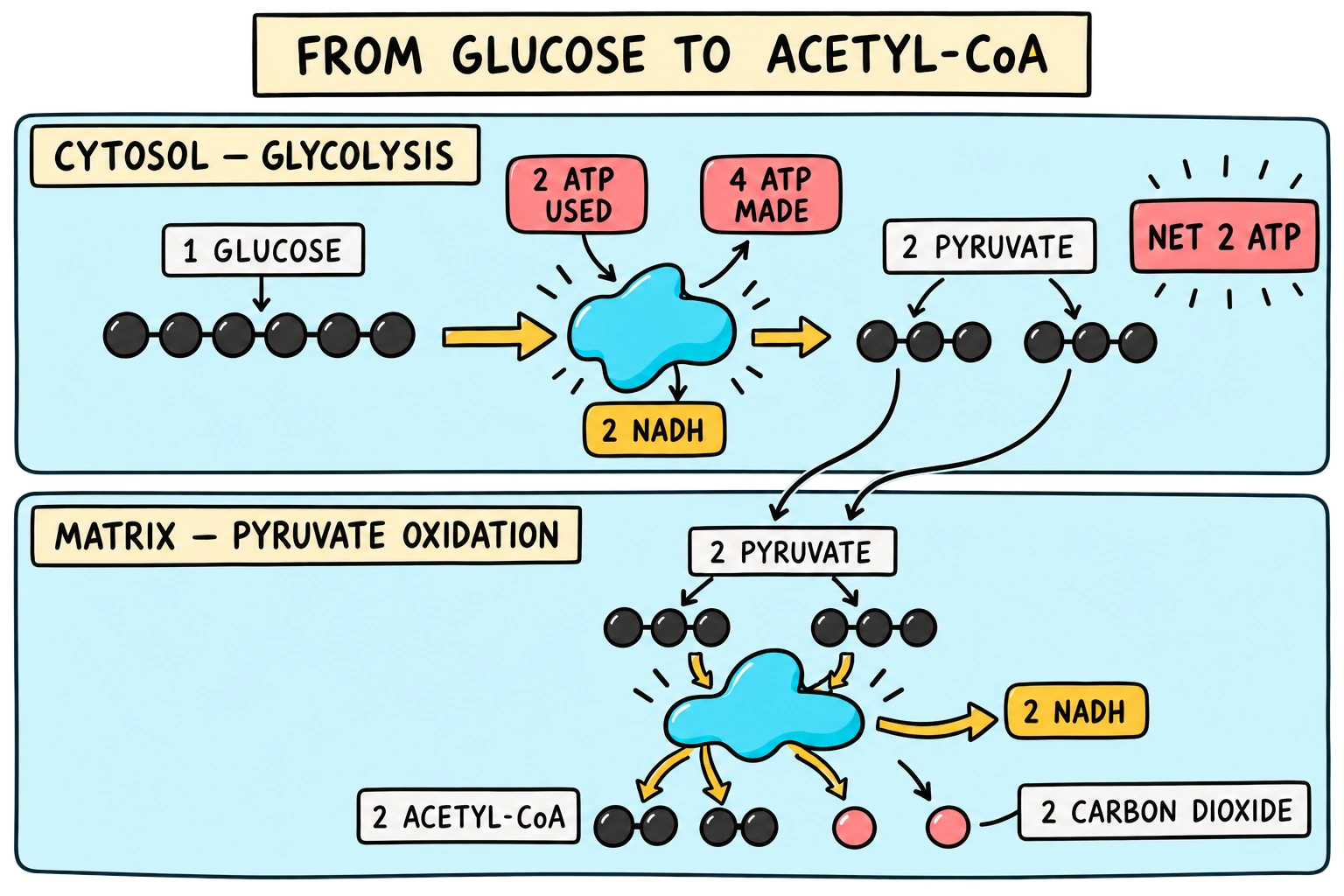
Glycolysis begins with a six-carbon glucose molecule and ends with two three-carbon pyruvate molecules. It takes place in the cytosol, not the mitochondrial matrix. Its early reactions use ATP, while later reactions make ATP by substrate-level phosphorylation. The pathway also produces NADH, an electron carrier that becomes important later.
Gross ATP and net ATP are different
For one glucose, the usual glycolysis calculation starts with two ATP used and four ATP made. The net gain is therefore two ATP. Gross production means the total made during the payoff reactions. Net gain means what remains after the ATP investment has been taken into account. If you report four as the net yield, you have counted the payoff and forgotten the investment.
Two NADH are also made per glucose. During one of the oxidation steps, NAD+ accepts reducing equivalents and becomes NADH. The cell must later regenerate NAD+ so that glycolysis can continue. This is a recycling problem as well as an energy-transfer problem: an oxidation pathway cannot keep using an oxidized carrier if that carrier never becomes available again. [4]
How do glycolysis and mitochondria connect?
Glycolysis does not directly use oxygen gas. Under aerobic conditions, the reducing equivalents from its NADH can be transferred to the mitochondrial respiratory system through shuttle systems. A shuttle is a linked set of reactions that transfers the reducing equivalents across a membrane boundary. Cytosolic NADH does not simply diffuse through the inner membrane as an intact molecule.
Pyruvate also needs to enter the matrix. The inner membrane contains a mitochondrial pyruvate carrier that helps make this transport possible. Identifying the carrier proteins gave scientists a molecular explanation for a step that pathway diagrams often represent with just one arrow. When you see that arrow, remember that a membrane transport process is involved. [6]
From pyruvate to acetyl-CoA
Inside the matrix, the pyruvate dehydrogenase complex removes one carbon from each three-carbon pyruvate as carbon dioxide. The remaining two-carbon acetyl group is attached to coenzyme A. At the same time, NAD+ is reduced to NADH. Because one glucose produced two pyruvates, this stage produces two acetyl-CoA, two carbon dioxide and two NADH per glucose. It makes no ATP directly.
When you read “two-carbon acetyl-CoA,” the two-carbon description refers to the acetyl group being carried. The whole coenzyme A molecule contains other atoms as well. This distinction helps you track the glucose-derived carbon without accidentally treating a large carrier molecule as if it contained only two carbon atoms. [5]
Try the carbon check: Start with six glucose carbons. Glycolysis distributes them between two pyruvates. Pyruvate oxidation releases two carbons in total as carbon dioxide and leaves two two-carbon acetyl groups. The carbon count still balances. ATP is not one of those carbon products.
5. The Krebs cycle: collect electrons and start again
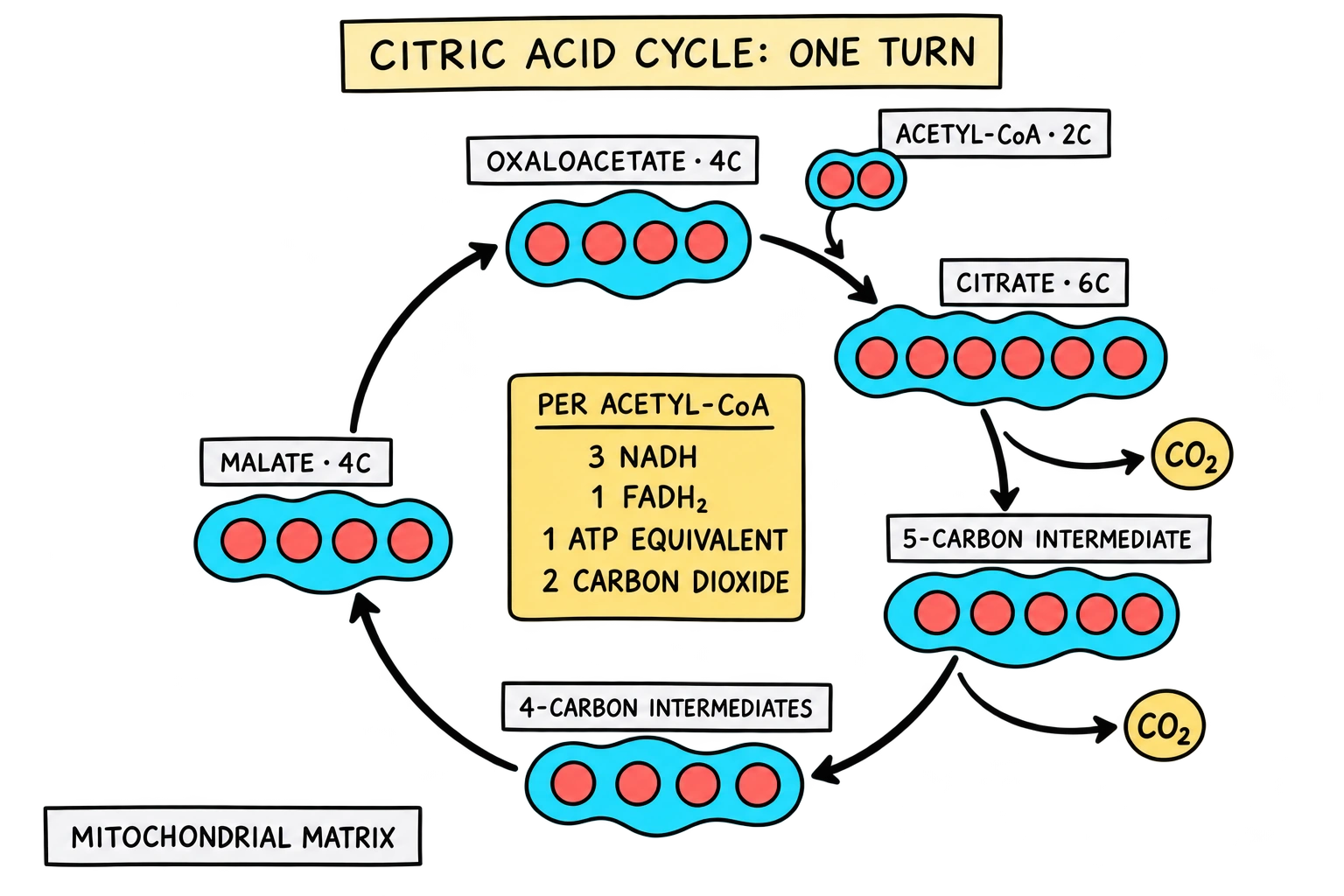
The Krebs cycle, citric acid cycle and TCA cycle are three names for the same pathway. It begins when a two-carbon acetyl group joins a four-carbon molecule called oxaloacetate. Together they form six-carbon citrate. Later reactions change the molecule, release carbon dioxide and regenerate oxaloacetate, ready to accept another acetyl group.
This return to the starting acceptor is what makes the pathway a cycle. Oxaloacetate is used at the beginning and regenerated by the end. It is not used up once and then discarded. The cell can keep the pathway operating as long as the necessary reactants and oxidized carriers remain available.
Learn the yield for one turn first
For each acetyl group entering the cycle, the usual products are three NADH, one FAD-linked pair of reducing equivalents, one ATP equivalent and two carbon dioxide. One ATP equivalent may be formed as GTP, depending on the relevant enzyme and setting. For a basic respiration calculation, it contributes one ATP equivalent to the energy total. [5]
One glucose supplies two acetyl groups, so the cycle contribution per glucose is twice the contribution per turn. That gives six NADH, two FAD-linked pairs, two ATP equivalents and four carbon dioxide. Write “per turn” or “per glucose” next to your answer. Many mistakes in this topic come from remembering the right numbers but using them for the wrong starting amount.
Carbon numbers do not tell you every atom’s identity
The diagram shows six-carbon, five-carbon and four-carbon stages. It is helpful for counting carbons, but it does not tell you that the two carbon atoms entering with an acetyl group must leave during that same turn. Carbon atoms become part of the cycle’s intermediates and pass through later reactions. Questions involving labelled carbon atoms need a more detailed tracing diagram.
You do not need to follow every individual carbon atom to explain the cycle’s main energy role. Focus on the oxidation reactions and carrier production. The cycle transfers reducing equivalents to carriers, which connect fuel breakdown to the respiratory system. Its small direct ATP yield is only one part of its contribution.
Why the cycle depends on carrier recycling
The cycle does not directly consume oxygen gas in its listed reactions. However, aerobic respiration uses oxygen downstream to keep electron transfer and carrier recycling going. If reduced carriers cannot be reoxidized efficiently, fewer oxidized carriers are available for the cycle. Its oxidation reactions are then constrained. Oxygen can therefore affect a pathway without being a direct reactant in every reaction of that pathway.
Succinate dehydrogenase is a useful link to remember. It takes part in the cycle and is also complex II of the respiratory chain. Its flavin carrier remains attached to the enzyme. Although FADH2 is convenient shorthand in ATP calculations, you should not always imagine it floating freely around the matrix in exactly the same way as NADH.
Remember: One glucose means two acetyl groups and two cycle turns. The main link to later ATP production is the supply of reduced electron carriers. The cycle also provides intermediates for making other molecules, so it is part of a wider metabolic network.
6. The electron transport chain: electrons move, protons are pumped
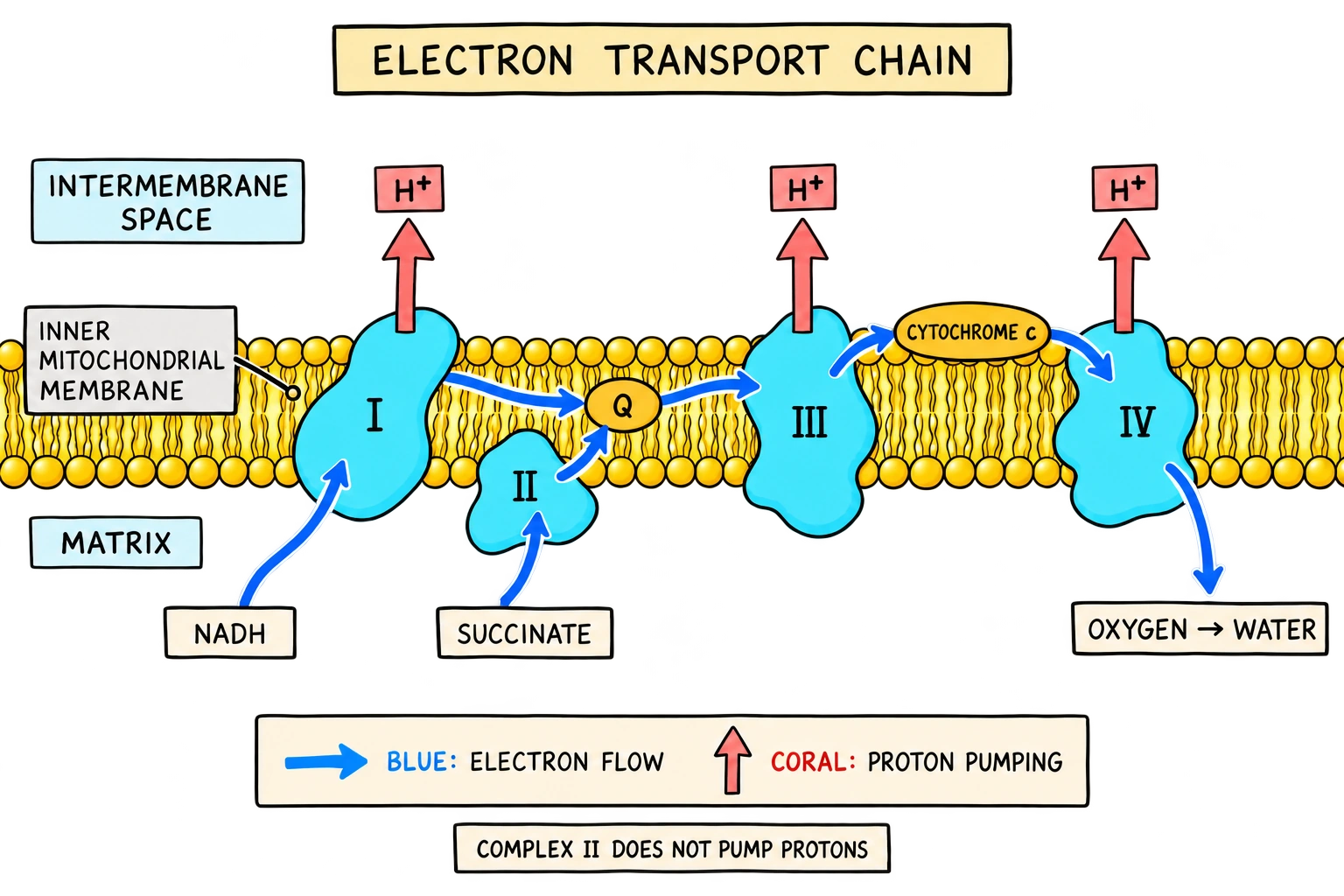
The electron transport chain, also called the respiratory chain, contains protein complexes and mobile electron carriers associated with the inner mitochondrial membrane. NADH supplies electrons through complex I. Electrons from succinate enter through complex II. Both routes connect to ubiquinone, also called coenzyme Q. Electrons then move through complex III, cytochrome c and complex IV towards oxygen.
Read the arrows carefully. The Roman numerals do not mean that every electron must travel through I, then II, then III and IV. The NADH route does not have to pass through complex II. Complexes I and II provide different entry routes that meet at Q. Drawing the two routes separately makes the later difference in ATP yield easier to understand. [7]
Electrons and protons have different jobs
An electron carries negative charge. A proton, written as a hydrogen ion with a positive charge, is different. Electron transfer towards oxygen helps drive proton movement across the inner membrane. In the diagram, blue arrows show electron flow, while coral arrows show proton pumping. Do not swap the two labels when describing what the chain does.
Complexes I, III and IV contribute to moving protons from the matrix towards the intermembrane space during forward respiratory electron transfer. Complex II does not pump protons. Electrons entering at complex II therefore miss the proton-pumping contribution of complex I. This is an important reason why the two entry routes support different ATP yields under comparable conditions.
A useful proton-counting example
In a common idealized mitochondrial calculation, one pair of NADH-linked electrons is associated with a total of ten protons moved across the membrane. The contributions are four at complex I, four associated with complex III and two at complex IV. Entry through complex II gives a total of six because complex II adds no proton-pumping contribution. [8]
These are proton-translocation counts, not ATP counts. They also do not include every proton used chemically to form water. Keeping these quantities separate will help you avoid adding unrelated numbers together. The chain builds a gradient; a separate enzyme uses that gradient to make ATP.
Why use a chain of carriers?
Electron transfer towards oxygen is energetically favorable under the relevant conditions. The respiratory complexes couple parts of that transfer to the otherwise unfavorable task of separating protons across a membrane. The proteins and their cofactors control the route of electron transfer. Complex III uses the Q cycle, so the individual complexes do not all work as identical pumps.
Q moves within the membrane, while cytochrome c transfers electrons on the intermembrane-space side. Together they connect the larger complexes. The important overall result is a difference in electrochemical potential across the inner membrane. This stored driving force connects electron transfer to the next stage.
Check your understanding: Does the chain directly make most of the ATP? Its main coupling role is to maintain the proton gradient. ATP synthase then uses proton return to make ATP. ATP synthase is sometimes called complex V, but it is not another electron-transfer step between complex IV and oxygen.
7. Chemiosmosis and ATP synthase: turn a gradient into ATP
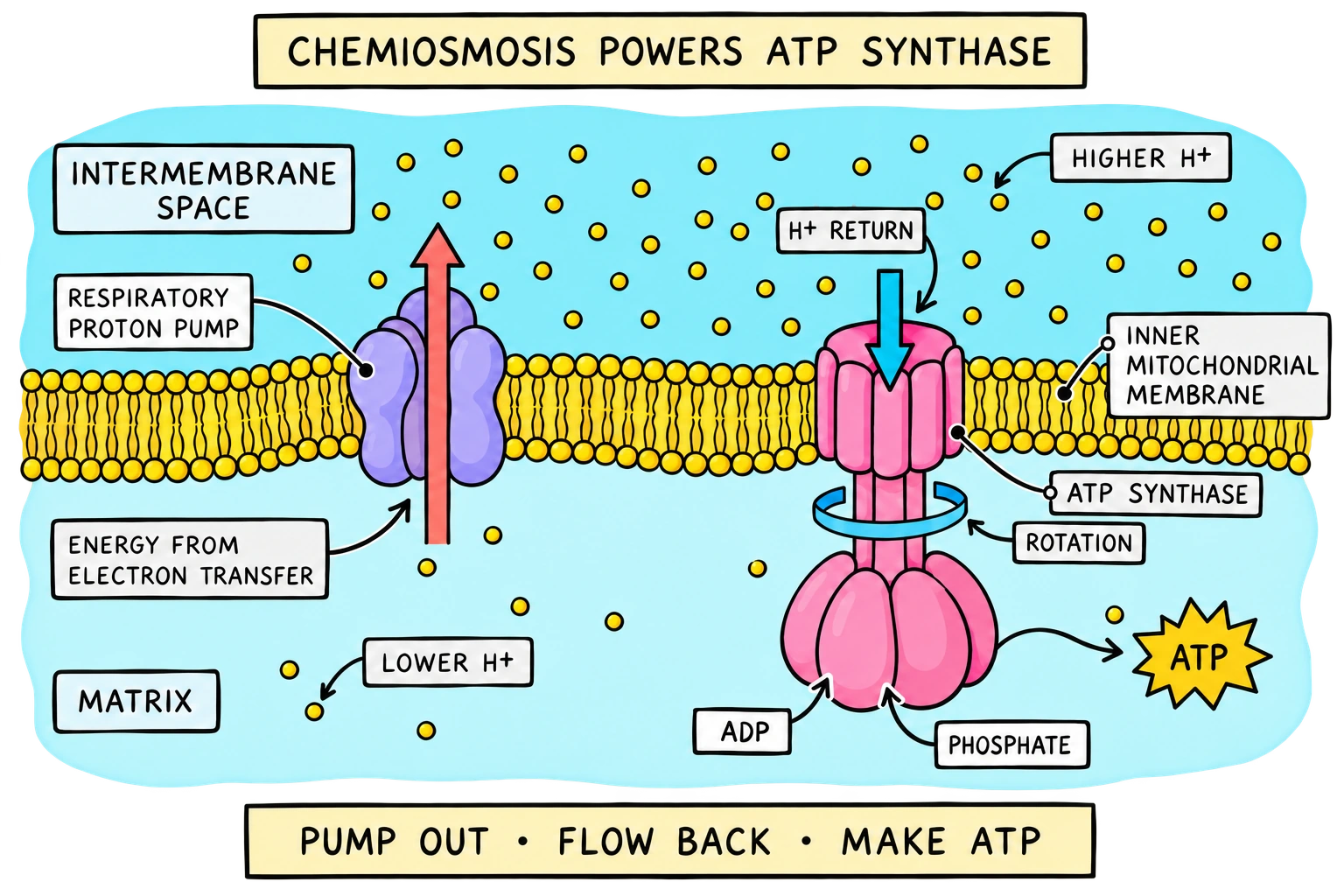
Chemiosmosis means using an ion gradient across a membrane to help drive a process. In mitochondria, the relevant driving force is the proton-motive force. It has two parts: a difference in proton concentration and a difference in electrical potential. During coupled respiration, the matrix is relatively negative and more alkaline than the intermembrane-space side.
Both differences help favor proton return towards the matrix under these conditions. The energy store is not simply a collection of protons. It is the difference between the two sides of a membrane that limits uncontrolled ion movement. You need that separation to understand how the respiratory chain and ATP synthase work together. Mitchell’s chemiosmotic explanation placed this membrane gradient at the center of ATP synthesis. [9]
Picture a dam, then return to the biology
Water held behind a dam can help you imagine stored potential and a controlled return route. In the mitochondrial system, respiratory complexes maintain a separation, while ATP synthase provides a return pathway that can perform useful work. The comparison helps you remember direction: pump protons away from the matrix, then allow them to return through ATP synthase.
The real mechanism involves ions and changing protein shapes, not a small hydroelectric power station with electrical wires. Use the comparison as a memory aid, then describe the molecular process. A strong explanation names the membrane, the compartments, the proton movement and the ATP-forming enzyme.
How the molecular motor works
ATP synthase has a membrane-embedded part called Fo and a catalytic head called F1. The head faces the matrix. Proton transfer through the membrane part is coupled to rotor movement. Rotation of a central shaft changes the shapes of catalytic sites in the head, helping them bind reactants, form ATP and release ATP in a coordinated cycle. A supporting structure helps stop the whole enzyme from rotating together. [10]
This is called the binding-change mechanism. The catalytic sites are not all doing the same thing at the same moment. As the shaft changes position, the sites change how tightly they bind molecules and what stage of the cycle they support. Boyer’s work showed why ATP release and coordinated changes in binding are important parts of the explanation. [11]
A closer look at the proton requirement
The size of the rotor ring affects how many protons pass through the synthase during a complete rotation. Structural work on bovine mitochondrial ATP synthase identified a ring with eight c subunits. In that example, one full rotation corresponds to three ATP produced at the catalytic head. The fraction below gives the synthase-only proton requirement for that example. [8]
This does not include all the energetic costs of supplying ATP outside the matrix. Phosphate has to enter, and ATP and ADP have to be exchanged across the inner membrane. Nor does every organism have the same rotor-ring size. Keep the example attached to its context rather than treating it as one exact rule for every ATP synthase.
Remember the sequence: electron transfer helps pump protons out of the matrix; the gradient favors their return; proton return through ATP synthase drives rotation and binding changes; ATP is regenerated from ADP and phosphate. ADP and phosphate must be available for the process to continue.
8. Oxygen and fermentation: keep electron carriers working
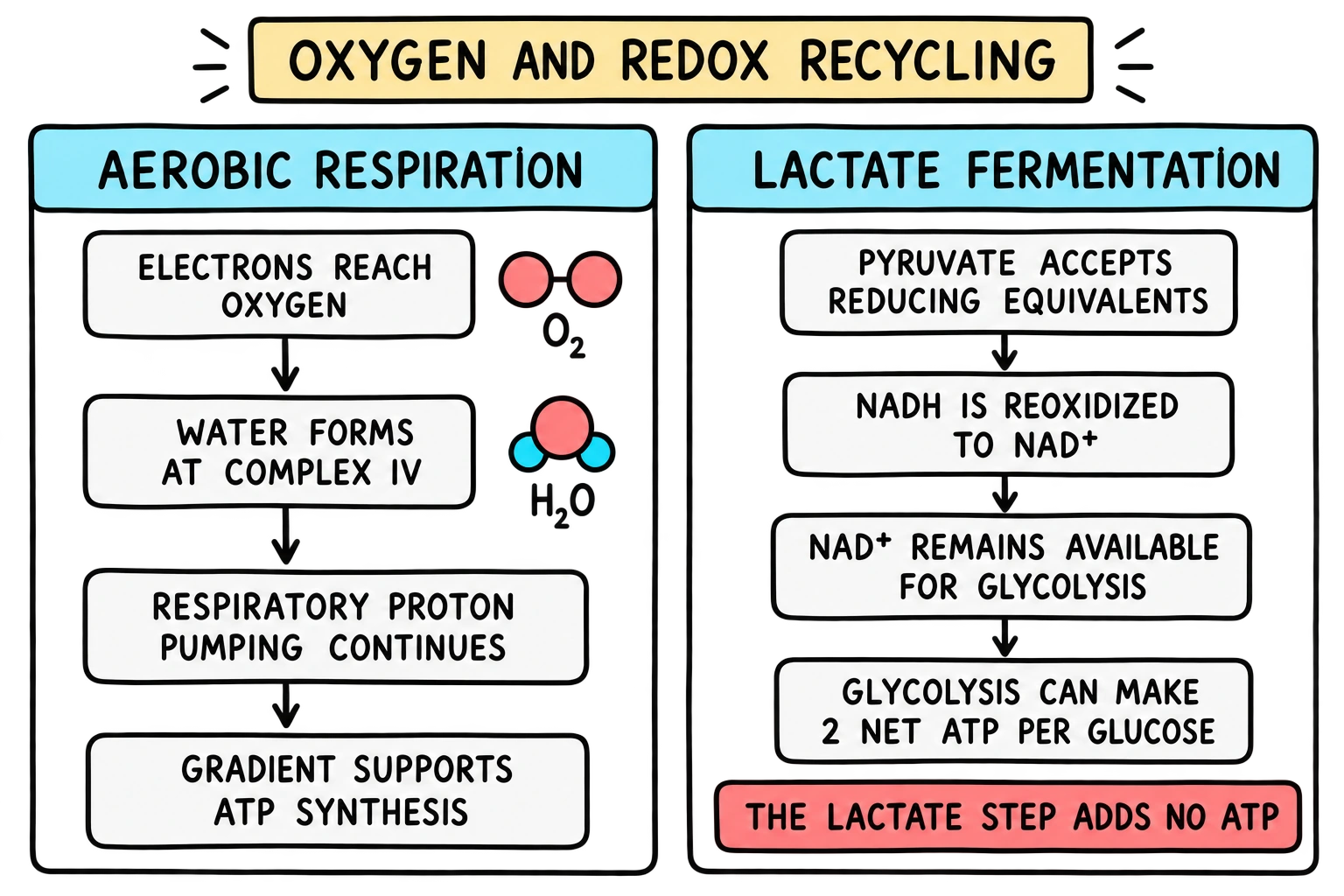
Oxygen is the final electron acceptor in the usual aerobic mitochondrial respiratory chain. At complex IV, oxygen accepts electrons and combines with protons to form water. This provides a terminal destination for the electrons, allowing forward electron transfer through the chain to continue. Oxygen does not supply the phosphate group of ATP. [12]
The equation describes oxygen reduction. The protons used chemically to make water are different from the protons counted as being pumped across the membrane. If a question asks for a proton-pumping total, do not add water-forming protons without explaining what you are counting. Naming the role of each number is part of using the equation correctly.
What if usable oxygen is unavailable?
Without its terminal electron acceptor, the aerobic chain cannot continue operating normally. Reduced components build up, carriers become harder to reoxidize and sustained respiratory proton pumping decreases. A gradient that already exists may remain for a short time, so the changes need not all occur at exactly the same instant. However, oxidative ATP production cannot be maintained by a chain that lacks its terminal acceptor.
This also affects earlier stages. The cycle and other oxidation reactions need oxidized carriers. If reduced carriers cannot be recycled, those pathways become constrained too. That is the link between oxygen use at complex IV and the upstream reactions that do not themselves consume oxygen gas.
How lactate formation helps glycolysis
Lactate dehydrogenase can transfer reducing equivalents from NADH to pyruvate. This forms lactate and regenerates NAD+. Glycolysis can then continue to use NAD+ in its oxidation step. The key purpose of the lactate-forming step is carrier recycling, not an extra ATP payoff. [13]
The standard net yield of the glucose-to-lactate route remains two ATP from glycolysis. Converting pyruvate to lactate adds no further ATP. If you write that fermentation “gives another two ATP,” you have counted the glycolytic ATP twice. Explain which reactions make the ATP and which reactions regenerate the carrier.
Lactate is also a usable metabolite, not simply a useless waste product. It can be formed in well-oxygenated tissue, and it can be transported and used in other metabolic processes. For that reason, finding lactate does not automatically prove that a cell had no oxygen at all. A simple oxygen-limitation example is helpful for learning carrier recycling, but it is not the whole story of lactate metabolism. [14]
Fermentation and anaerobic respiration are different
Some microorganisms use an electron transport chain with a terminal acceptor other than oxygen. That is anaerobic respiration. Fermentation regenerates carriers through metabolic reactions without the same respiratory arrangement involving an external terminal acceptor. Both can support metabolism without oxygen, but they are not interchangeable terms.
Check your understanding: Why can lactate formation help glycolysis continue even though it adds no ATP itself? It restores NAD+, which glycolysis needs. ATP formation and electron-carrier recycling are connected jobs, but they are different jobs.
9. ATP yield: understand where the total comes from
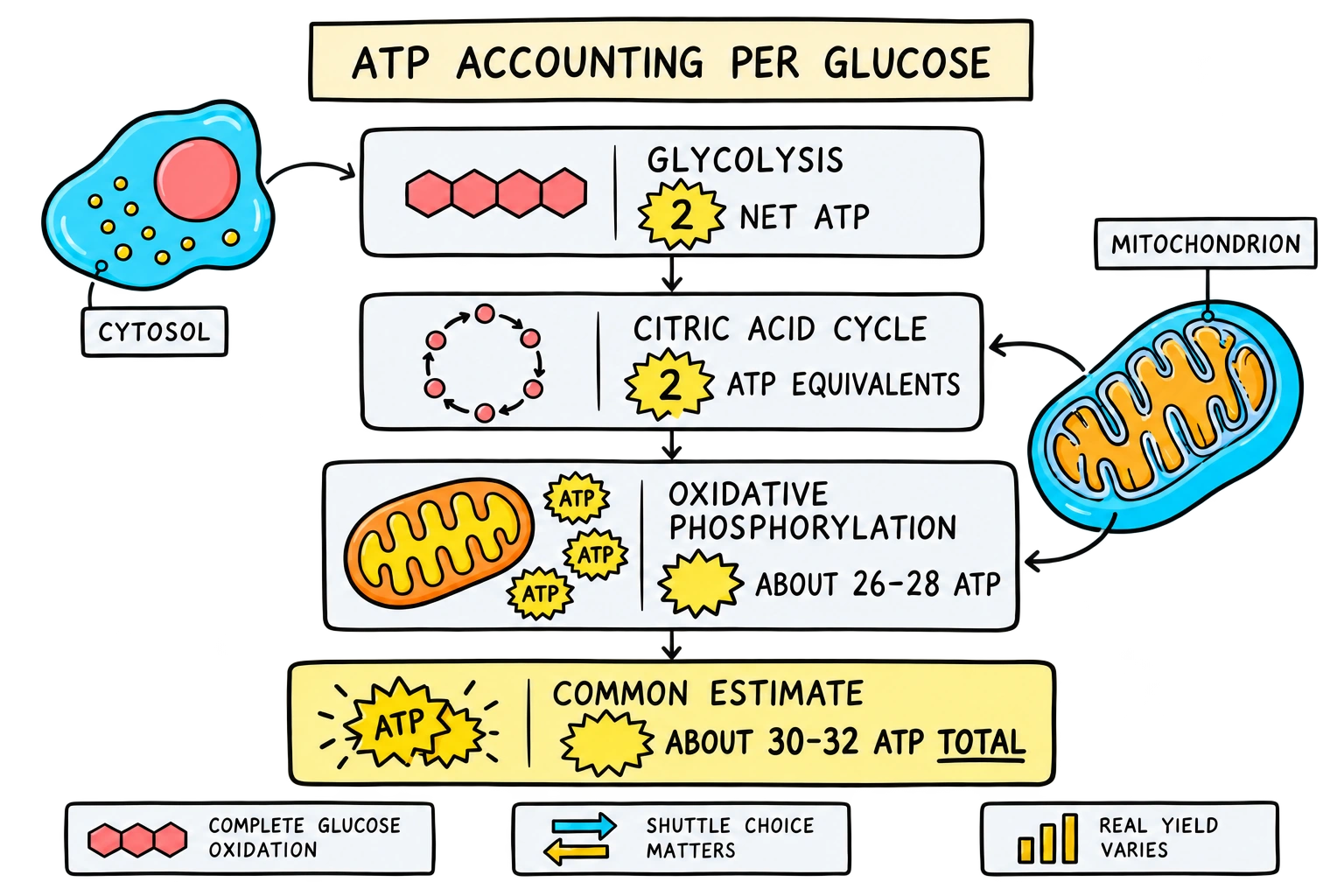
You will often see about 30–32 ATP per completely oxidized glucose in modern eukaryotic respiration calculations. This is a useful estimate, not a promise that every cell always makes exactly that number. To understand it, separate direct ATP formation from the ATP linked to reduced electron carriers, and state the assumptions you are using.
Start with ATP made by substrate-level phosphorylation
Glycolysis gives two net ATP per glucose. The citric acid cycle contributes two ATP equivalents per glucose. Together, those stages contribute four substrate-level ATP equivalents. Pyruvate oxidation contributes no ATP directly, so it should not appear as another direct ATP term in this part of the calculation.
For oxidative phosphorylation, a common approximation is about 2.5 ATP per matrix NADH-linked pair of electrons and about 1.5 ATP per pair entering at the ubiquinone level, as in succinate oxidation. Fractional yields describe average effective coupling. They do not mean that a catalytic site releases half an ATP molecule during one event. [15]
| Source | Amount to count | Estimated ATP |
|---|---|---|
| Glycolysis, substrate-level | 2 net ATP | 2 |
| Cycle, substrate-level | 2 ATP equivalents | 2 |
| Matrix NADH | 8 NADH at about 2.5 ATP each | 20 |
| Succinate-linked electron pairs | 2 pairs at about 1.5 ATP each | 3 |
| Cytosolic NADH, malate-aspartate account | 2 pairs at about 2.5 ATP each | 5 |
| Cytosolic NADH, glycerol-phosphate alternative | 2 pairs at about 1.5 ATP each | 3 instead of 5 |
Account for the reduced carriers
Pyruvate oxidation and the cycle together produce eight matrix NADH per glucose. Under the approximation above, their contribution is about twenty ATP. The two succinate-linked pairs contribute about three. The remaining contribution comes from the reducing equivalents of the two cytosolic NADH made in glycolysis. Depending on the shuttle route, their estimated contribution is about five or about three ATP.
Using the malate–aspartate shuttle:
Using the glycerol-phosphate shuttle:
Notice that the two calculations have the same direct ATP contribution and the same matrix-carrier contributions. The change is in the term for the cytosolic reducing equivalents. You do not need two unrelated lists of numbers to remember two totals. You need one explanation of why that final contribution can differ.
Why shuttle choice matters
The malate-aspartate shuttle transfers cytosolic reducing equivalents in a way that can be counted as matrix NADH in this calculation. The glycerol-phosphate shuttle supplies electrons at the ubiquinone level through a flavin-linked pathway. The latter route bypasses the complex I contribution. With two glycolytic NADH to account for, the usual approximate calculation differs by two ATP per glucose. [7]
A common mistake is counting NADH as if it were already ATP and then adding its oxidative ATP contribution again. Keep a carrier column and an ATP column separate. Once a carrier’s contribution has been included in the ATP total, it does not become another extra ATP term.
Why do older resources say 36 or 38?
Older simplified calculations often assigned three ATP to NADH and two to FAD-linked entry. Under their particular assumptions, these led to totals such as 36 or 38. You may still meet those numbers in older books. They come from different accounting conventions, so they should not be mixed with a calculation that uses 2.5 and 1.5.
Living cells also use mixed fuels, divert intermediates into biosynthesis and spend gradient energy on transport. Proton leak affects how efficiently respiratory energy is conserved as ATP. A glucose molecule entering a cell does not necessarily undergo complete oxidation straight away. In an exam, follow any assumptions supplied in the question. When explaining a real cell, avoid presenting a textbook total as a direct measurement of its ATP output.
Remember: Label the starting amount, identify the direct ATP yield, account for each carrier once, and state the shuttle assumption. Those steps make the total understandable instead of leaving it as a number to memorize.
10. Matching ATP supply to demand
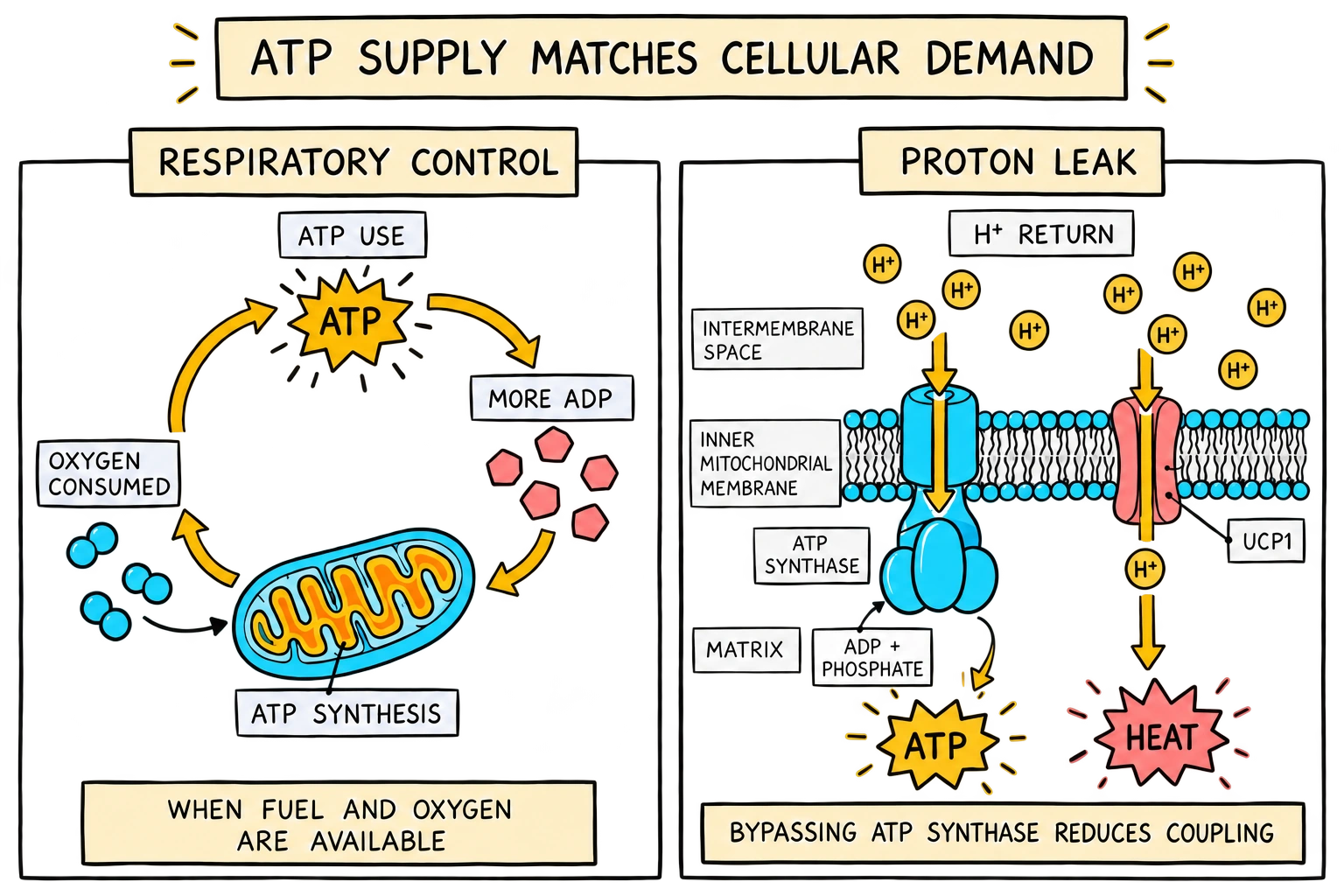
A cell does not need the same ATP-production rate at every moment. ATP-dependent processes use ATP and leave ADP and phosphate available for regeneration. In a coupled mitochondrial preparation with suitable fuel and oxygen, adding ADP can stimulate ATP synthesis and oxygen consumption. This connection is an important part of respiratory control. [16]
As protons return through ATP synthase, the electrochemical force opposing further pumping is reduced. The respiratory system can then support greater flux under the relevant conditions. This helps connect ATP use to ATP regeneration. It is more useful to picture a responsive system than a mitochondrion working at one fixed speed all day.
Ask what is limiting the rate
More ADP cannot solve every problem. If oxygen is unavailable, the usual aerobic chain still lacks its terminal acceptor. If a respiratory complex is blocked, extra glucose does not remove the block. If fuel is limited, additional demand alone does not provide that fuel. Before predicting a rate change, identify what is currently limiting the system.
For example, imagine a preparation with fuel and oxygen available but very little ADP. Adding ADP can increase the demand for phosphorylation. Now imagine a second preparation with no usable oxygen. Adding ADP to that preparation does not restore the normal terminal step. The same addition can produce different results because the starting conditions differ.
ATP also needs transport
ATP made in the matrix must reach processes elsewhere in the cell. The inner membrane contains an adenine nucleotide translocase, which exchanges matrix ATP for cytosolic ADP. A phosphate carrier helps provide phosphate. These transport steps are connected to membrane energetics and substrate availability. Making ATP at the synthase and supplying ATP outside the matrix are therefore linked but different parts of the overall job. [3]
What happens when protons bypass ATP synthase?
Not every returning proton contributes to ATP formation. A proton can return through a pathway that bypasses ATP synthase. This reduces the fraction of respiratory energy conserved as ATP. UCP1 in brown adipose tissue provides a physiological example associated with heat production. It is not present in every cell, but it shows why a gradient can be used differently in different settings. [7]
With a moderate increase in proton leak, an otherwise functional preparation supplied with fuel and oxygen may increase its electron-transfer rate and oxygen consumption. Yet it can conserve less ATP per unit of substrate oxidized. This is uncoupling: respiration and ATP formation are less tightly linked. High oxygen use alone is therefore not enough to prove that ATP output is high.
Control also occurs before electrons reach the respiratory chain. Fuel transport and the activity of particular glycolytic and cycle enzymes respond to metabolic conditions. Cells can direct intermediates into making other molecules instead of oxidizing every carbon completely. ATP production is part of this wider balance between energy demand, fuel availability and the need for cellular materials.
Check your understanding: Can lower ATP yield be accompanied by greater oxygen use? Yes, under some uncoupled conditions with fuel and oxygen available. That is different from an electron-transfer block, which prevents normal forward flow through the chain.
11. How scientists discovered the mechanism
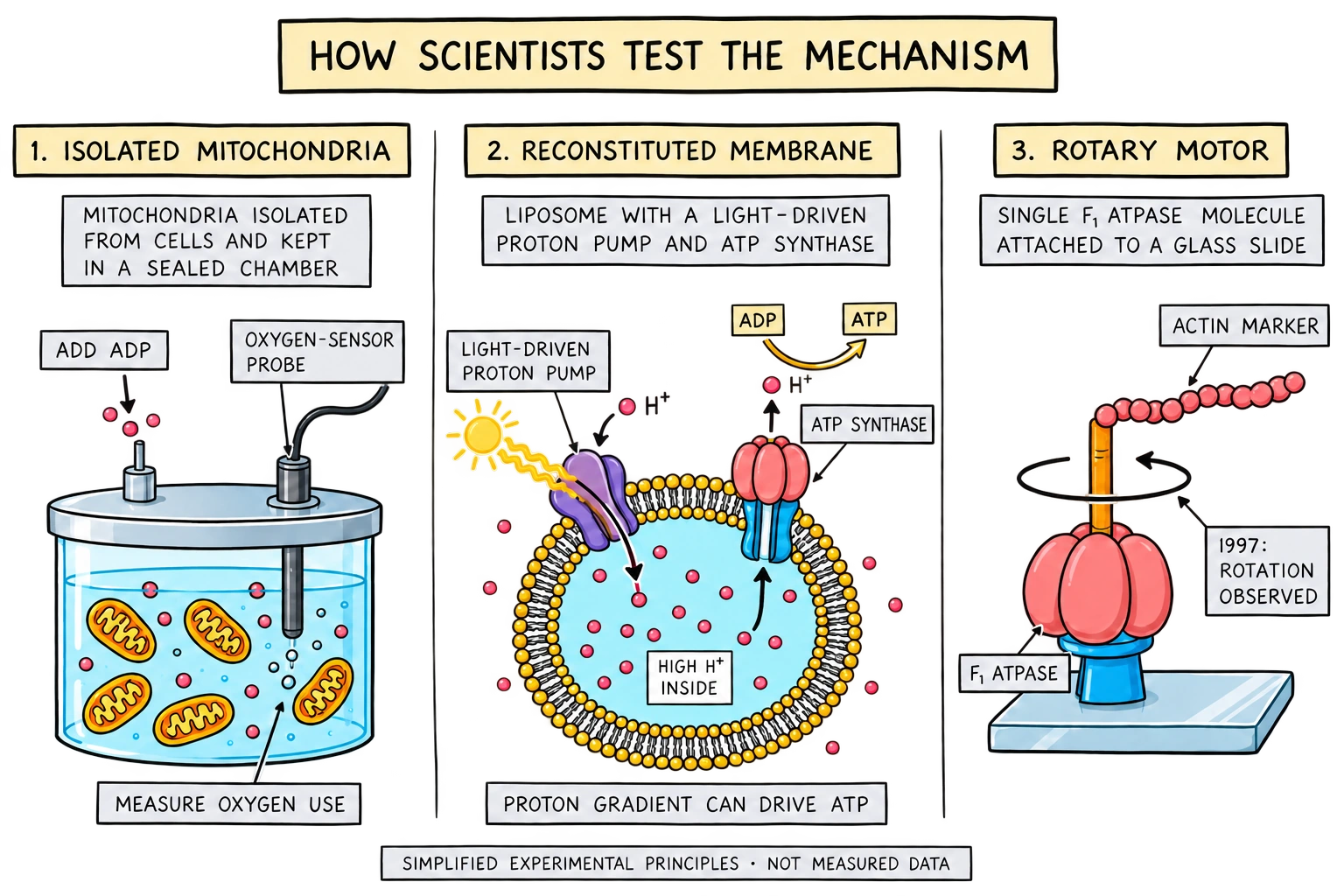
The explanation of mitochondrial ATP synthesis comes from experiments as well as diagrams. Different experiments answer different questions. Oxygen measurements tell scientists about respiration. Tests of membrane gradients help reveal energy coupling. Structural studies show where parts of the enzyme sit, and single-molecule observations can reveal movement. Together, these approaches build a stronger explanation than any one drawing can provide.
Measure oxygen use and ATP formation
Scientists can isolate mitochondria, provide particular substrates and monitor dissolved oxygen in a chamber. They can then add ADP or change another defined condition. An oxygen sensor tells them how quickly oxygen is being consumed. It does not directly count every ATP molecule, so ATP measurements provide useful additional information about coupling.
Controls are essential. Two preparations should not differ in temperature, available fuel or mitochondrial integrity if the question is about the effect of ADP. Damaged or leaky mitochondria may behave differently from well-coupled mitochondria. Before interpreting a result, ask what was changed, what was measured and what was kept the same.
Test a simpler membrane system
In a 1974 experiment, Racker and Stoeckenius used reconstituted membrane vesicles with a light-driven proton-pumping system and ATP-forming machinery. The important result was that a membrane-generated proton gradient could support ATP formation without reproducing the entire pathway of glucose breakdown. This helped show that the gradient itself was central to the coupling mechanism. [17]
The light-driven pump in that experiment was not a human respiratory complex. Mitochondria normally use respiratory electron transfer to maintain their gradient. The simpler experiment separated the source of the gradient from the process that used it. For the system to work as intended, the membrane needed to preserve the gradient and the proteins needed a suitable orientation.
Observe a rotary motor
In 1997, Noji and colleagues attached an actin-filament marker to the central shaft of an isolated F1-ATPase. They observed rotation driven by ATP hydrolysis. The marker made a molecular movement visible. This was evidence that the catalytic motor could rotate; it was not a film of glucose becoming ATP inside an intact human mitochondrion. [18]
That distinction helps you explain what an experiment actually demonstrates. During ATP synthesis, the larger membrane-coupled system uses the proton-motive force to drive the enzyme’s coordinated cycle. The isolated-motor experiment examined rotation in the ATP-hydrolysis direction. The two observations are connected, but they concern different experimental conditions.
Structural and biochemical work helped explain the enzyme’s organization and its changing binding sites. Boyer and Walker shared half of the 1997 Nobel Prize in Chemistry for elucidating the enzymatic mechanism of ATP synthesis. The other half went to Skou for the discovery of an ion-transporting enzyme. [19]
Think like a scientist: If a membrane becomes very leaky, would a proton pump by itself guarantee ATP formation? No. A maintained gradient, an appropriately functioning synthase and the required reactants are all important. This prediction follows from the mechanism you have learned.
12. Practise explaining respiration
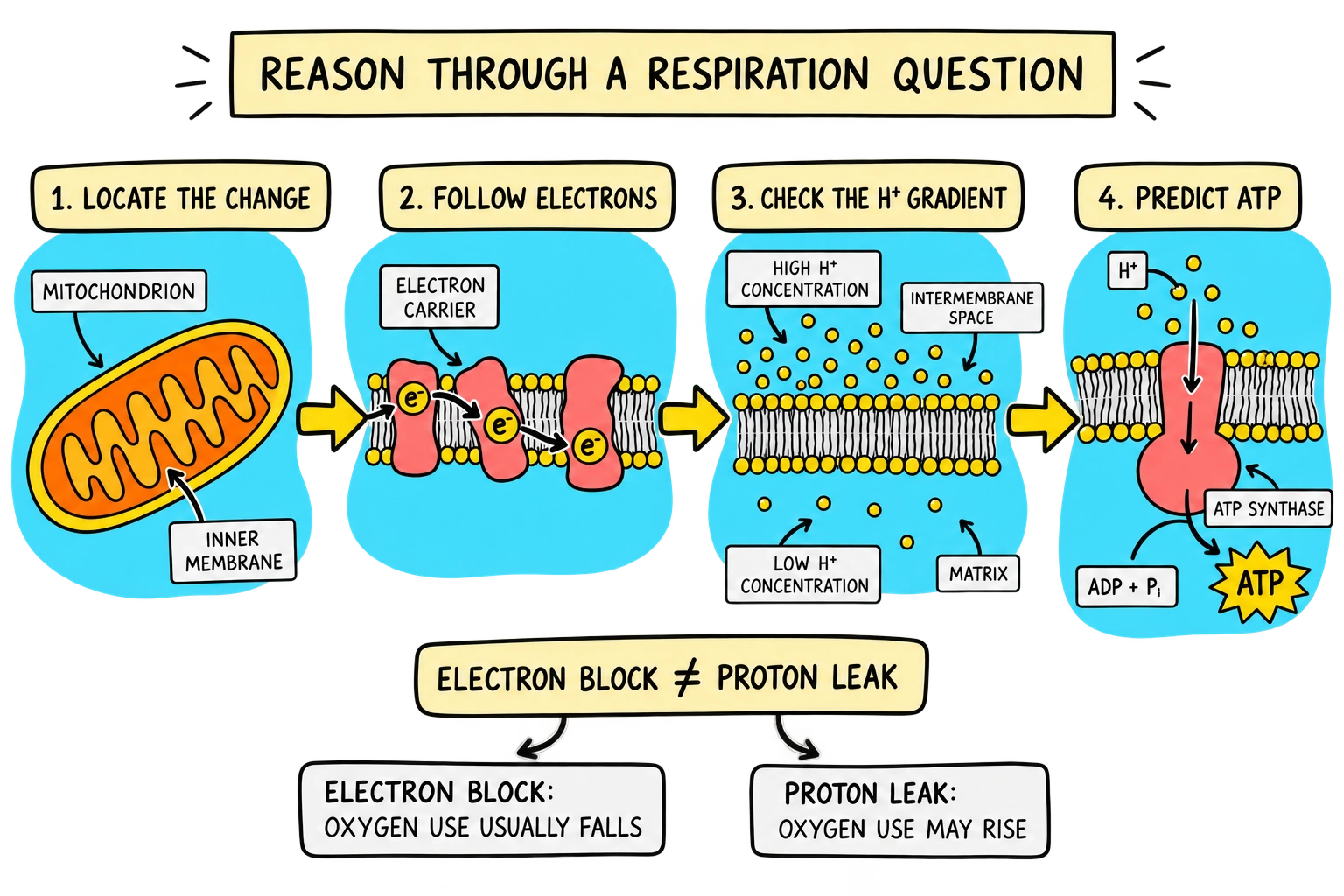
When a question changes one condition, begin with four questions of your own: Where is the change? What happens to electron transfer? What happens to the proton gradient? What happens to ATP synthesis? Work through them in order. If the question concerns a changing system, also ask whether you are predicting the immediate response or what can be sustained later.
Practice 1: complex IV is fully blocked
Imagine a preparation using the usual aerobic pathway, with no alternative terminal route. The question states that complex IV is fully inhibited. Locate the change at the end of the chain. Oxygen reduction falls, and upstream components become more reduced because forward electron transfer is constrained. Sustained respiratory proton pumping declines, so the gradient cannot be maintained normally as protons return or leak.
The resulting prediction is that oxidative ATP synthesis falls. Adding more glucose does not remove the specified block at complex IV. A complete answer connects the block to electron flow, then to the gradient, and finally to ATP formation. Writing only “less energy is produced” skips the mechanism the question is testing.
Do not automatically say that every source of ATP disappears at the same instant. Glycolytic ATP in an intact cell depends on conditions including carrier recycling. An isolated mitochondrial preparation also lacks the complete cytosolic glycolytic system of an intact cell. State which system you are discussing before extending your prediction beyond oxidative phosphorylation.
Practice 2: protons gain a bypass route
Now imagine an otherwise functional preparation with fuel and oxygen available. A moderate increase in proton conductance allows more protons to return without passing through ATP synthase. The gradient becomes harder to maintain. Electron transfer may accelerate because the opposing electrochemical force is smaller, so oxygen consumption may rise even though ATP is conserved less efficiently.
Compare this with the first practice question. Both changes can impair ATP conservation, but they interrupt different parts of the process. One blocks normal electron transfer to oxygen. The other dissipates the gradient while electron transfer remains possible. Using oxygen use, membrane potential and ATP measurements together gives more information than looking at only one of them.
Practice 3: find the ATP-counting mistake
A student includes two direct ATP from glycolysis, two from pyruvate oxidation and two from the cycle. Which contribution is wrong? The pyruvate-oxidation contribution is wrong because that stage produces NADH but no direct ATP. In the usual complete-oxidation calculation, substrate-level phosphorylation contributes four ATP equivalents per glucose in total.
To improve the student’s answer, draw separate columns for direct ATP and reduced carriers. Put each product in the correct column before calculating its later ATP contribution. This method also prevents counting a carrier twice. Return to the ATP-yield section if you want to check how the oxidative contributions produce the common approximate totals.
Questions students often ask
How do mitochondria make ATP in simple terms?
Electrons from fuel oxidation pass through the respiratory chain towards oxygen. This helps pump protons across the inner membrane. Protons then return through ATP synthase, driving the changes that rebuild ATP from ADP and phosphate.
Where exactly is ATP synthase located?
It sits in the inner mitochondrial membrane, including the cristae. Its catalytic head faces the matrix. That is where ATP is made. The outer membrane is not the membrane that maintains the respiratory proton gradient.
Does the electron transport chain make ATP directly?
The chain helps build and maintain the proton gradient. ATP synthase uses the gradient to make ATP. Together, these linked processes form oxidative phosphorylation. Explaining the gradient connects electron movement to ATP formation.
Why is oxygen needed if glycolysis does not use it?
Glycolysis does not directly use oxygen gas. The usual aerobic mitochondrial chain does: oxygen accepts electrons at complex IV and water forms. This helps reduced carriers be recycled, supporting earlier oxidation reactions.
Is the correct ATP yield 30, 32, 36 or 38?
About 30–32 ATP is a common modern estimate for complete glucose oxidation under specified assumptions. Shuttle choice explains the two usual alternatives. Older 36- or 38-ATP calculations used different simplified carrier yields. Use the assumptions given in your question and explain them.
Do plants and bacteria also use chemiosmosis?
Yes. Plants have respiring mitochondria, and chloroplasts use a light-driven membrane system to make ATP during photosynthesis. Many bacteria use ion gradients across their cell membranes without having mitochondria. The locations and detailed pathways differ.
Why does complex II entry support less ATP than complex I entry?
Complex II passes electrons from succinate towards Q without pumping protons. Its route bypasses the proton-pumping contribution of complex I. Under comparable conditions, fewer protons are moved per electron pair, supporting a smaller effective ATP yield.
Does lactate fermentation produce extra ATP?
The lactate-forming step regenerates NAD⁺ from NADH but makes no additional ATP. It helps glycolysis continue. The standard glucose-to-lactate pathway gives two net ATP from glycolysis. Lactate can also be used in metabolism and formed in oxygenated tissue.
Your final self-check
Explain the process aloud from beginning to end. Start with glycolysis in the cytosol. Follow pyruvate into the matrix and connect fuel oxidation to reduced electron carriers. Name the two sides of the inner membrane, describe proton pumping and then describe proton return through ATP synthase. Finish with oxygen’s role and the reason ATP yield depends on the conditions. If every arrow has a clear meaning and direction, you understand much more than the phrase “powerhouse of the cell.”
Further reading
Explore the explanations and experiments behind these notes.
- ATP and energy coupling · OpenStax Biology 2e
- Energy in Living Systems · OpenStax Biology 2e
- The Mitochondrion · Alberts et al., Molecular Biology of the Cell
- Glycolysis · OpenStax Biology 2e
- Pyruvate Oxidation and the Citric Acid Cycle · OpenStax Biology 2e
- Herzig et al. (2012) · Identification and functional expression of the mitochondrial pyruvate carrier
- Electron-Transport Chains and Their Proton Pumps · Alberts et al.
- Watt et al. (2010) · Bioenergetic cost of making an ATP molecule in animal mitochondria
- Mitchell (1961) · Chemiosmotic coupling proposal
- He et al. (2018) · Assembly of the membrane domain of ATP synthase in human mitochondria
- Paul D. Boyer · Binding-change mechanism, UCLA research description
- Oxidative Phosphorylation · OpenStax Biology 2e
- Metabolism without Oxygen · OpenStax Biology 2e
- Brooks (2020) · Lactate as a fulcrum of metabolism
- Hinkle (2005) · P/O ratios of mitochondrial oxidative phosphorylation
- Regulation of Cellular Respiration · OpenStax Biology 2e
- Racker and Stoeckenius (1974) · Reconstituted proton-pumping vesicles and ATP formation
- Noji et al. (1997) · Direct observation of the rotation of F1-ATPase
- The Nobel Prize in Chemistry 1997 · NobelPrize.org