
Early and unofficial 2026 solutions
Early Solutions to the 2026 AP Human Geography FRQs | Step by Step
Work through all three released FRQs and every part from A through G. Each response shows the geographic concept, the reasoning chain, the evidence to use, and an exam-ready final answer.
How to build a strong AP Human Geography FRQ response
The released section contains three questions. Question 1 has no stimulus, Question 2 uses one quantitative stimulus, and Question 3 uses two maps. A direct response is usually strongest when it follows one clear chain: name the correct concept, connect it to the geographic process, and finish with the specific outcome requested.
For more practice, use the verified NUM8ERS AP Human Geography FRQ archive, estimate a score with the AP Human Geography score calculator, or review resources in the AP Study Hub.
Question 1 - No stimulus
Population Change, Migration, and State Power
Countries face demographic change over time, and governments respond to its social and political effects. Parts A-D require a clear factor or effect; Parts E-G require a complete geographic mechanism.
AFactor influencing population distribution
Task: Identify a factor that influences the distribution of human populations.
- Read the verb. Because the prompt says identify, one precise factor is enough.
- Select a defensible factor. Fresh water is specific and directly affects where settlements can survive and grow.
- Keep the answer focused. Do not replace a named factor with a vague phrase such as "the environment."
Reasoning chain: Access to fresh water - reliable drinking water, irrigation, and transportation - settlement concentration near rivers, lakes, and coasts.
BDemographic factor that may cause decline
Task: Describe one demographic factor that may lead to population decline.
- Name the demographic variable. Use a total fertility rate below replacement level.
- Describe the population process. Smaller birth cohorts enter the population with every generation.
- State the outcome. Births can eventually fall below deaths, producing natural decrease.
Reasoning chain: Below-replacement fertility - smaller generations - births fall below deaths - total population declines.
CPopulation density and the environment
Task: Describe one effect of population density on the environment.
- Choose a density condition. Use high population density.
- Name the concentrated activities. Vehicles, energy use, sewage, and solid waste occur in a smaller area.
- Finish with a measurable environmental effect. Local air or water quality declines.
Reasoning chain: High density - concentrated emissions, sewage, and waste - greater local air and water pollution.
DPotential cause of migration
Task: Describe one potential cause of migration.
- Choose a cause. Uneven employment opportunities are an economic cause.
- Identify the push. Low wages or too few jobs make the origin less attractive.
- Identify the pull. Better employment and expected income attract migrants to another place.
Reasoning chain: Uneven economic opportunity - comparison of jobs and wages - movement toward the better employment market.
EPopulation policy and population size
Task: Explain how one type of population policy may affect a country's population size.
- Name a policy type. Choose a pronatalist policy.
- Give a policy mechanism. Child allowances, paid parental leave, or subsidized childcare reduce the cost of raising children.
- Connect the mechanism to size. Lower costs can increase fertility, accelerating growth or slowing decline.
Reasoning chain: Pronatalist incentives - lower cost of childbearing - higher fertility - faster growth or slower population decline.
FTechnology and state sovereignty
Task: Explain how technological changes may challenge state sovereignty.
- Choose the technology. Internet and social-media systems move information across borders.
- Explain the loss of control. Opposition groups and foreign actors can communicate and organize despite censorship.
- Connect to sovereignty. The state has less authority over political activity inside its territory.
Reasoning chain: Cross-border digital communication - information and organization bypass censorship - reduced state control - weakened sovereignty.
GCentrifugal forces and the country
Task: A change in population composition may be a centrifugal force. Explain how centrifugal forces may affect a country.
- Name the division. A linguistic or ethnic minority may develop a stronger regional identity or feel excluded.
- Explain the political response. The group may demand autonomy, secession, or devolution.
- State the national effect. Conflict and divided loyalty weaken national cohesion and central authority.
Reasoning chain: Changing population composition - regional identity or exclusion - separatism, conflict, or devolution - weaker state unity.
FRQ 1 complete exam-ready response
- Access to fresh water is a factor that influences the distribution of human populations.
- A total fertility rate below replacement level can cause population decline because each new generation is smaller, eventually causing deaths to exceed births.
- High population density can concentrate vehicle emissions, sewage, and solid waste in a small area, reducing local air and water quality.
- A shortage of jobs or low wages in an origin area can push people toward a destination with better employment opportunities.
- A pronatalist policy such as child allowances and subsidized childcare can lower the cost of raising children, increase fertility, and make the population grow faster or decline more slowly.
- Digital communication lets opposition groups and foreign actors spread information and organize across borders despite censorship, weakening state control over political activity.
- A politically excluded regional minority may demand autonomy or secession, producing conflict or devolution and weakening national unity and central authority.
Question 2 - One quantitative stimulus
Soybeans, Trade, and Sustainable Agriculture
Read the dollar and percentage columns separately. The dollar amount shows the value each country imported from Paraguay; the percentage shows Paraguay's share of that country's own soybean imports.
Stimulus: Leading destinations for soybeans imported from Paraguay, 2021
Paraguay was the world's third-largest exporter of raw soybeans in 2021 and accounted for 4 percent of global soybean exports. Soybeans are used for food, animal feed, plastics, ink, biodiesel, and other products.
| Destination | Value imported from Paraguay | Share of that country's total soybean imports |
|---|---|---|
| Argentina | $2.34 billion | 95% |
| Russia | $404 million | 41% |
| Brazil | $361 million | 92% |
| Peru | $36 million | 24% |
| Tunisia | $15 million | 5% |
Critical reading check: Argentina's 95 percent does not mean Argentina received 95 percent of Paraguay's exports. It means that 95 percent of Argentina's own soybean imports came from Paraguay.
ACountry importing the smallest amount
Task: Identify the country in the table that imports the smallest amount of soybeans from Paraguay.
- Use the correct column. "Amount" refers to the dollar-value column.
- Find the minimum. $15 million is smaller than $36 million, $361 million, $404 million, and $2.34 billion.
- Name the country. The $15 million value belongs to Tunisia.
Reasoning chain: Compare dollar values - find $15 million - identify Tunisia.
BSimilarity between Argentina and Brazil
Task: Using the table, describe a similarity between Argentina and Brazil in their soybean imports from Paraguay.
- Compare the relevant values. Argentina receives 95 percent and Brazil 92 percent of its soybean imports from Paraguay.
- State the similarity. Both percentages are greater than 90 percent.
- Interpret the pattern. Both countries depend heavily on Paraguay as an import source.
Reasoning chain: 95 percent and 92 percent - both exceed 90 percent - similar import-source dependence.
CEconomic influence on agricultural practices
Task: Explain how an economic factor may influence agricultural practices.
- Name an economic factor. Use rising soybean prices or market demand.
- Explain the incentive. Higher expected revenue makes soybean production more profitable.
- State the change in practice. Farmers may expand acreage, mechanize, increase chemical inputs, or replace mixed farming with monoculture.
Reasoning chain: Higher price or demand - greater expected profit - expanded commercial soybean production and altered farm practices.
DCommodity dependence
Task: Describe the concept of commodity dependence.
- Describe the concentration. A large share of export earnings, jobs, or government revenue comes from one or a few primary commodities.
- Name the exposure. The economy depends on external demand and world prices.
- State the vulnerability. A drought, price fall, or demand shock can sharply reduce income and employment.
Reasoning chain: Reliance on one or a few commodities - exposure to global shocks - economic vulnerability.
ESoybeans and world-economic interdependence
Task: Using the table, explain how soybeans illustrate interdependence in the world economy.
- Show Paraguay's dependence. It relies on foreign buyers for export income.
- Show buyers' dependence. Argentina and Brazil receive 95 percent and 92 percent of their soybean imports from Paraguay.
- Explain the two-way effect. A Paraguayan supply shock affects buyers, while falling foreign demand reduces Paraguayan farm income.
Reasoning chain: Paraguayan supply and export revenue - foreign buyer reliance - shocks cross borders through prices, supply, and income.
FEnvironmental consequence of commercial agriculture
Task: Describe one possible environmental consequence of large-scale commercial agriculture.
- Name the land-use change. Forest or grassland is cleared for extensive fields.
- Connect to production. Large areas are converted to commercial monoculture.
- State the environmental result. Habitat is fragmented or destroyed, reducing biodiversity.
Reasoning chain: Expansion of large fields - land clearing - habitat destruction and fragmentation - biodiversity loss.
GWhy governments implement sustainable development
Task: Explain why a government may implement sustainable development policies.
- State the present goal. Allow current economic activity and livelihoods to continue.
- Name the protected resources. Conserve soil, water, forests, and biodiversity.
- Explain the long-term benefit. Future agricultural productivity, food security, and public welfare remain viable.
Reasoning chain: Resource protection now - maintained productivity and welfare later - long-term development instead of short-term depletion.
FRQ 2 complete exam-ready response
- Tunisia imports the smallest amount of soybeans from Paraguay.
- Argentina and Brazil both obtain more than 90 percent of their soybean imports from Paraguay: 95 percent and 92 percent, respectively.
- Higher soybean prices or demand increase expected profit, encouraging expanded acreage, mechanization, and export-oriented monoculture.
- Commodity dependence is heavy reliance on one or a few primary commodities for earnings, jobs, or revenue, creating vulnerability to global price and demand changes.
- Paraguay depends on foreign demand, while buyers depend on Paraguayan supply. A supply shock would affect importers, and falling foreign demand would reduce Paraguayan income.
- Commercial agriculture can cause deforestation as land is cleared for monoculture, destroying habitat and reducing biodiversity.
- Sustainable policies can support present production while protecting resources so agriculture, food security, and livelihoods remain viable in the future.
Question 3 - Two map stimuli
Language, Regions, Cultural Landscapes, and Globalization
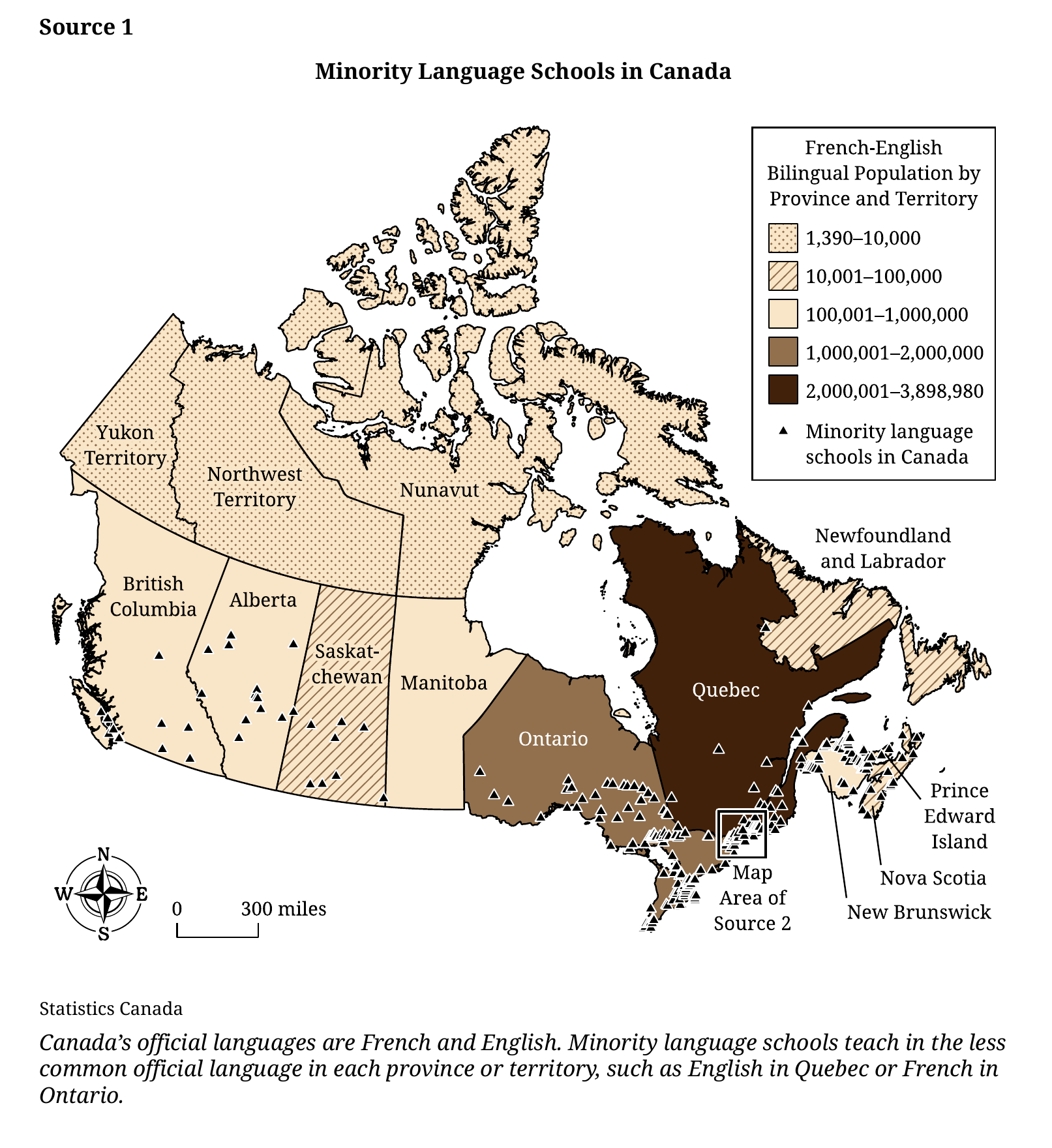
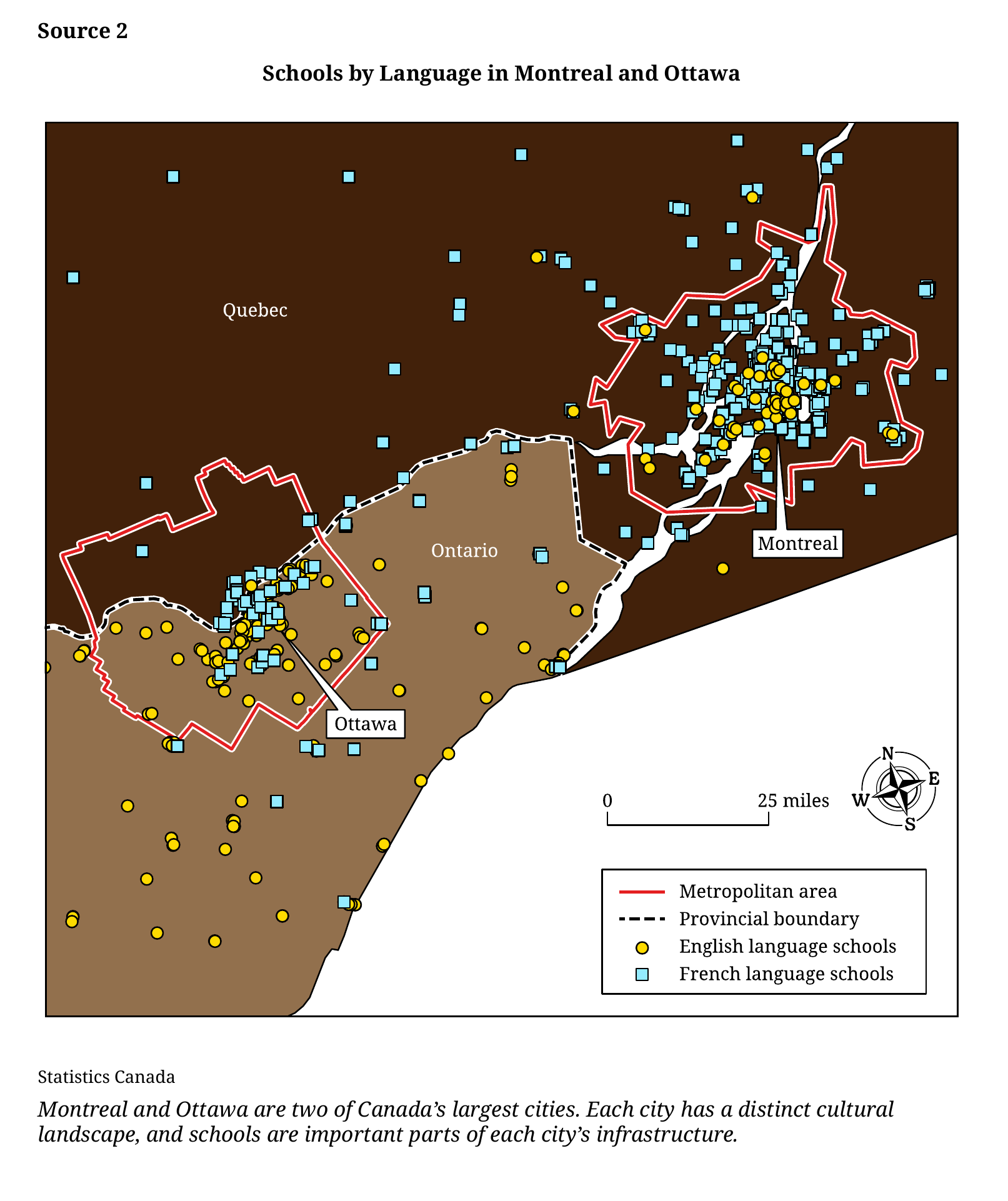
Source 1 uses a Canada-wide choropleth and point symbols. Source 2 changes scale to Montreal and Ottawa and maps English- and French-language schools. Strong answers name the legend class, boundary, symbol, and spatial pattern used as evidence.
Sources 1 and 2: Read the maps before answering
ALargest bilingual population
Task: Using Source 1, identify the province or territory with the largest bilingual population.
- Use the choropleth legend. The darkest class is 2,000,001-3,898,980 bilingual residents.
- Find the darkest province. Quebec is the only province shaded in that highest class.
- Answer with the place name. Because the verb is identify, Quebec is sufficient.
Reasoning chain: Highest legend class - Quebec shaded darkest - Quebec has the largest bilingual population.
BType of region in Source 2
Task: Describe one type of region shown in Source 2.
- Select a mapped boundary. Use the official provincial boundary between Ontario and Quebec.
- Name the region type. Provinces are formal regions.
- Describe why. Each has a legally recognized border and government authority within it.
Reasoning chain: Official provincial boundary - uniform legal jurisdiction - formal region.
CBilingual speakers and minority-language schools
Task: Using Source 1, describe the relationship between the number of bilingual speakers and the pattern of minority-language schools in Canada.
- Compare both variables. Shading shows bilingual totals; triangles show minority-language schools.
- Identify the general relationship. Higher bilingual totals generally align with more and denser school clusters.
- Support with contrasting places. Quebec and Ontario have high totals and many symbols; northern territories have low totals and few or none.
Reasoning chain: Darker shading plus denser points in Quebec and Ontario - lighter classes plus few points in the north - generally positive relationship.
DAnother cultural-landscape characteristic
Task: Language is a characteristic of the cultural landscape. Describe another characteristic.
- Name a visible cultural trait. Use religious architecture.
- Locate it in the built environment. Churches, mosques, temples, and symbols modify the visible landscape.
- Connect landscape to culture. These features make community beliefs visible.
Reasoning chain: Cultural belief and practice - built-environment modification - recognizable cultural-landscape feature.
EHistorical process and language patterns
Task: Explain how a historical process, such as technological change or colonialism, has affected language patterns.
- Name the historical process. Use French colonization followed by British conquest and migration.
- Explain diffusion. Settlement, government, schooling, and institutions established and maintained both languages.
- Connect to the present pattern. French remains concentrated in Quebec while English-French bilingualism appears across Canada.
Reasoning chain: Colonial settlement and political control - language diffusion through institutions - long-lasting spatial concentration and bilingualism.
FHow a city engages in globalization
Task: Explain how a city can engage in a process of globalization.
- Name concrete connections. Use international airports or ports, multinational firms, foreign investment, migrants, and tourism.
- Identify the flows. Goods, capital, people, and information cross national borders.
- State the urban outcome. The city becomes integrated into global economic and cultural networks.
Reasoning chain: International transport, firms, migration, and digital networks - cross-border flows - integration into global systems.
GSource 2 and multiculturalism
Task: Explain how the patterns shown in Source 2 illustrate multiculturalism.
- Read both school symbols. Montreal and Ottawa contain English-language and French-language schools.
- Interpret the institutional pattern. Parallel school systems serve distinct linguistic communities in the same metropolitan areas.
- Connect to the concept. The cities accommodate multiple cultural identities rather than requiring complete assimilation.
Reasoning chain: Two language-school systems in the same cities - institutional preservation of distinct identities - coexistence and accommodation - multiculturalism.
FRQ 3 complete exam-ready response
- Quebec has the largest bilingual population.
- Ontario and Quebec are formal regions because each has an officially recognized boundary and legal jurisdiction.
- Places with larger bilingual populations generally have more and denser minority-language school clusters; Quebec and Ontario contrast with the sparsely mapped northern territories.
- Religious architecture makes community beliefs visible through churches, mosques, temples, and related symbols in the built environment.
- French settlement established French in Quebec, while British conquest and migration spread English, creating the present language pattern.
- International transportation, firms, investment, migration, and tourism connect a city to global flows of goods, capital, people, and information.
- English- and French-language schools coexist in Montreal and Ottawa, preserving distinct linguistic communities and illustrating multiculturalism rather than complete assimilation.
Rapid scoring checklist for all 21 parts
Use this after writing. Each row identifies the minimum evidence or mechanism your response should contain.
| Part | Minimum evidence or mechanism |
|---|---|
| 1A | A specific population-distribution factor, such as fresh water. |
| 1B | Below-replacement fertility - fewer births - possible natural decrease. |
| 1C | A density condition plus a specific environmental consequence. |
| 1D | A migration cause, such as an economic push or pull. |
| 1E | A population policy - fertility change - population-size outcome. |
| 1F | Cross-border information, organization, or attack - reduced state control. |
| 1G | Centrifugal division - separatism, conflict, or devolution - weaker cohesion. |
| 2A | Tunisia, the $15 million minimum. |
| 2B | Argentina 95 percent and Brazil 92 percent. |
| 2C | Price or demand - profit incentive - changed agricultural practice. |
| 2D | Reliance on one or a few commodities plus vulnerability to shocks. |
| 2E | Two-way reliance supported with table data. |
| 2F | One specific consequence and its agricultural pathway. |
| 2G | Protect resources now to sustain future production and welfare. |
| 3A | Quebec, read from the highest choropleth class. |
| 3B | A standard region type plus the feature that defines it. |
| 3C | A relationship between shading and school-symbol density with place evidence. |
| 3D | A visible cultural-landscape trait. |
| 3E | A historical process - language diffusion and persistence - current pattern. |
| 3F | Cross-border flows of capital, goods, people, or information. |
| 3G | Two school systems - institutional coexistence - multiculturalism. |
Focused concept glossary
These definitions are written for fast FRQ use. In an explanation, apply the term to a process or outcome rather than giving only the definition.
- Population distribution
- The spatial arrangement of people across Earth's surface.
- Population density
- The number of people per unit of area.
- Replacement-level fertility
- The fertility level at which one generation replaces itself; sustained fertility below it can lead to natural decrease.
- Push factor
- A condition that encourages people to leave an origin, such as conflict, unemployment, or environmental stress.
- Pull factor
- A condition that attracts people to a destination, such as jobs, safety, services, or family.
- Pronatalist policy
- A policy intended to increase births or fertility.
- Antinatalist policy
- A policy intended to reduce births or fertility.
- State sovereignty
- A state's authority to govern its territory and population independently.
- Centrifugal force
- A force that divides a state or weakens national unity.
- Devolution
- Transfer of power from a central government to regional or local governments.
- Commodity dependence
- Heavy economic reliance on one or a few primary commodities.
- Interdependence
- Mutual reliance in which changes in one place affect people, firms, or states elsewhere.
- Commercial agriculture
- Farm production intended mainly for sale in markets rather than direct household consumption.
- Monoculture
- Large-scale cultivation of a single crop, often for commercial sale.
- Sustainable development
- Development that meets present needs while preserving future generations' ability to meet theirs.
- Biodiversity
- The variety of living organisms, genes, and ecosystems in an area.
- Formal region
- An area defined by an official boundary or a shared measurable trait.
- Functional region
- An area organized around a node and linked by flows such as commuting, trade, or communication.
- Cultural landscape
- The visible imprint of human culture on the physical and built environment.
- Colonialism
- Control and settlement of territory by an outside power, often spreading language and institutions.
- Globalization
- Increasing worldwide integration through flows of goods, capital, people, information, and culture.
- Multiculturalism
- The coexistence and institutional accommodation of multiple cultural groups in one society or place.
- Assimilation
- The process by which a group adopts the dominant culture and loses some distinct cultural traits.
Final takeaway
A strong AP Human Geography FRQ response is direct, geographically specific, source-aware, and causal. Name the concept, show the mechanism, use only the evidence requested, and finish with the geographic outcome.
Source note: The uploaded AP Human Geography 2026 FRQ Step-by-Step Solutions PDF is the primary source for the reasoning, model responses, alternatives, and pitfalls on this page. Prompt wording and stimulus details were checked against the released 2026 College Board question paper. This page remains an independent study guide, not an official scoring key.