
Early 2026 AP Precalculus worked solutions
Early Solutions to the 2026 AP Precalculus FRQs | Step by Step
Work through all four free-response questions with every function value, equation, model, graph interpretation, domain check, justification, and final answer explained.
Important: These are early, unofficial solutions based on the uploaded independent educational solution guide. They are not official College Board scoring guidelines. Decimal answers are rounded only after the full-precision calculation shown in the source.
What each 2026 AP Precalculus FRQ tests
For broader preparation, use the verified AP Precalculus guide or browse the AP Precalculus FRQ archive.
Calculator section • Question 1
FRQ 1: Function Composition, Logarithms, and Invertibility
Functions and logarithms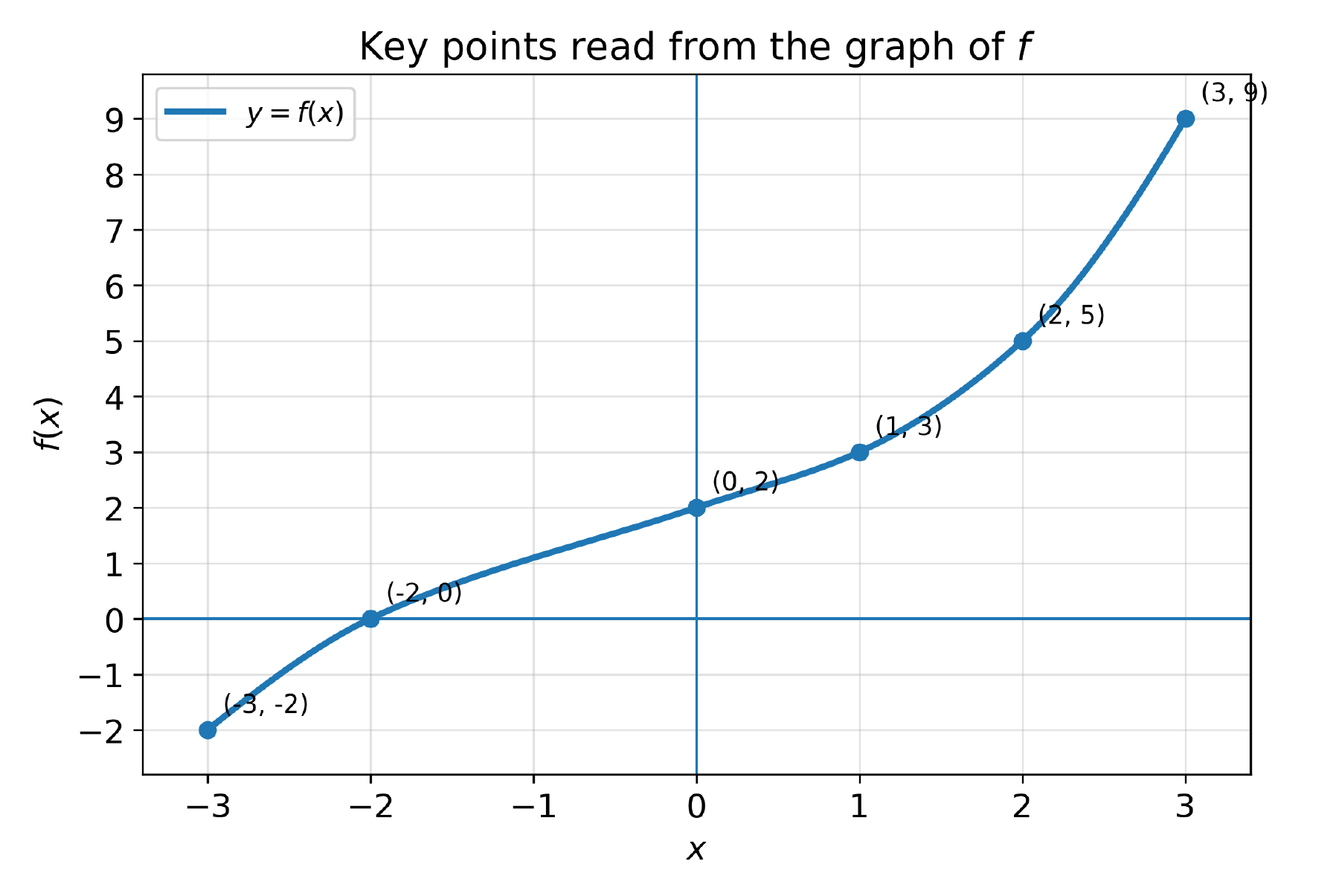
Part A(i): Evaluate \(h(2)\) for \(h=g\circ f\)
Read \(f(2)\) from the graph.
The point \((2,5)\) means \(f(2)=5\).
Check the outer function's domain.
The input \(5\) is valid because \(5\gt1\), the domain requirement for \(g\).
Substitute into \(g\).
\[h(2)=g(f(2))=g(5)=-4.792+\ln(6(5)-6)=-4.792+\ln(24).\]Evaluate and round to three decimals.
\[-4.792+\ln(24)\approx-1.613946170.\]
Part A(ii): Solve \(f(x)=3\)
Locate height \(y=3\).
The graph contains the point \((1,3)\), so \(f(1)=3\).
Justify uniqueness.
The graph is strictly increasing, so no second input can produce the same output.
Part B(i): Solve \(g(x)=-1.5\)
Write the equation.
\[-4.792+\ln(6x-6)=-1.5.\]Isolate the logarithm.
\[\ln(6x-6)=3.292.\]Undo the natural logarithm.
\[6x-6=e^{3.292}.\]Solve and evaluate.
\[x=\frac{e^{3.292}+6}{6}\approx5.482767184.\]Check validity.
The result is greater than \(1\), so it belongs to the domain. Because \(g\) is increasing, the solution is unique.
Part B(ii): Describe \(g(x)\) as \(x\) approaches \(1\) from the right
Examine the inside of the logarithm.
As \(x\to1^+\), \(6x-6\to0^+\).
Use the logarithmic end behavior.
When a positive input approaches zero, its natural logarithm decreases without bound: \(\ln(6x-6)\to-\infty\).
Include the vertical shift.
Subtracting \(4.792\) does not change the infinite behavior.
Part C: Explain why \(f\) has an inverse
Identify the key property.
The graph of \(f\) is strictly increasing.
Connect that property to one-to-one behavior.
As \(x\) increases, \(f(x)\) never repeats an output. Every horizontal line intersects the graph at most once.
State the conclusion.
Thus \(f\) passes the horizontal line test and is one-to-one, so its inverse is a function on the range of \(f\).
Calculator section • Question 2
FRQ 2: Exponential Car-Value Model
Exponential modelingPart A(i): Write equations for \(a\) and \(b\)
Use \(V(1)=27.2\).
\[a b^1=27.2\quad\Longrightarrow\quad ab=27.2.\]Use \(V(6)=14.8\).
\[a b^6=14.8.\]
Part A(ii): Find \(a\) and \(b\), then interpret \(a\)
Divide the second equation by the first.
\[\frac{ab^6}{ab}=\frac{14.8}{27.2}\quad\Longrightarrow\quad b^5=\frac{14.8}{27.2}=\frac{37}{68}.\]Take the positive fifth root.
\[b=\left(\frac{14.8}{27.2}\right)^{1/5}\approx0.8853980523.\]The positive root is required for an exponential model, and the value below \(1\) matches depreciation.
Use \(ab=27.2\) to find \(a\).
\[a=\frac{27.2}{b}\approx30.72064585.\]Interpret \(a\).
Because \(a=V(0)\), it estimates the car's value at the end of 2019. The units are thousands of dollars.
Part B(i): Find the average rate of change from \(t=1\) to \(t=6\)
Apply the average-rate formula.
\[\frac{V(6)-V(1)}{6-1}=\frac{14.8-27.2}{5}.\]Simplify.
\[\frac{-12.4}{5}=-2.48.\]Interpret the sign and units.
The negative sign means value is lost. Because \(V\) is in thousands of dollars and \(t\) is in years, the rate is thousands of dollars per year.
Part B(ii): Use the secant line to estimate the value at \(t=3\)
Write point-slope form.
\[A(t)-27.2=-2.48(t-1).\]Solve for \(A(t)\).
\[A(t)=27.2-2.48(t-1).\]Evaluate at \(t=3\).
\[A(3)=27.2-2.48(3-1)=27.2-4.96=22.24.\]
Part B(iii): Compare the secant estimate with the exponential model
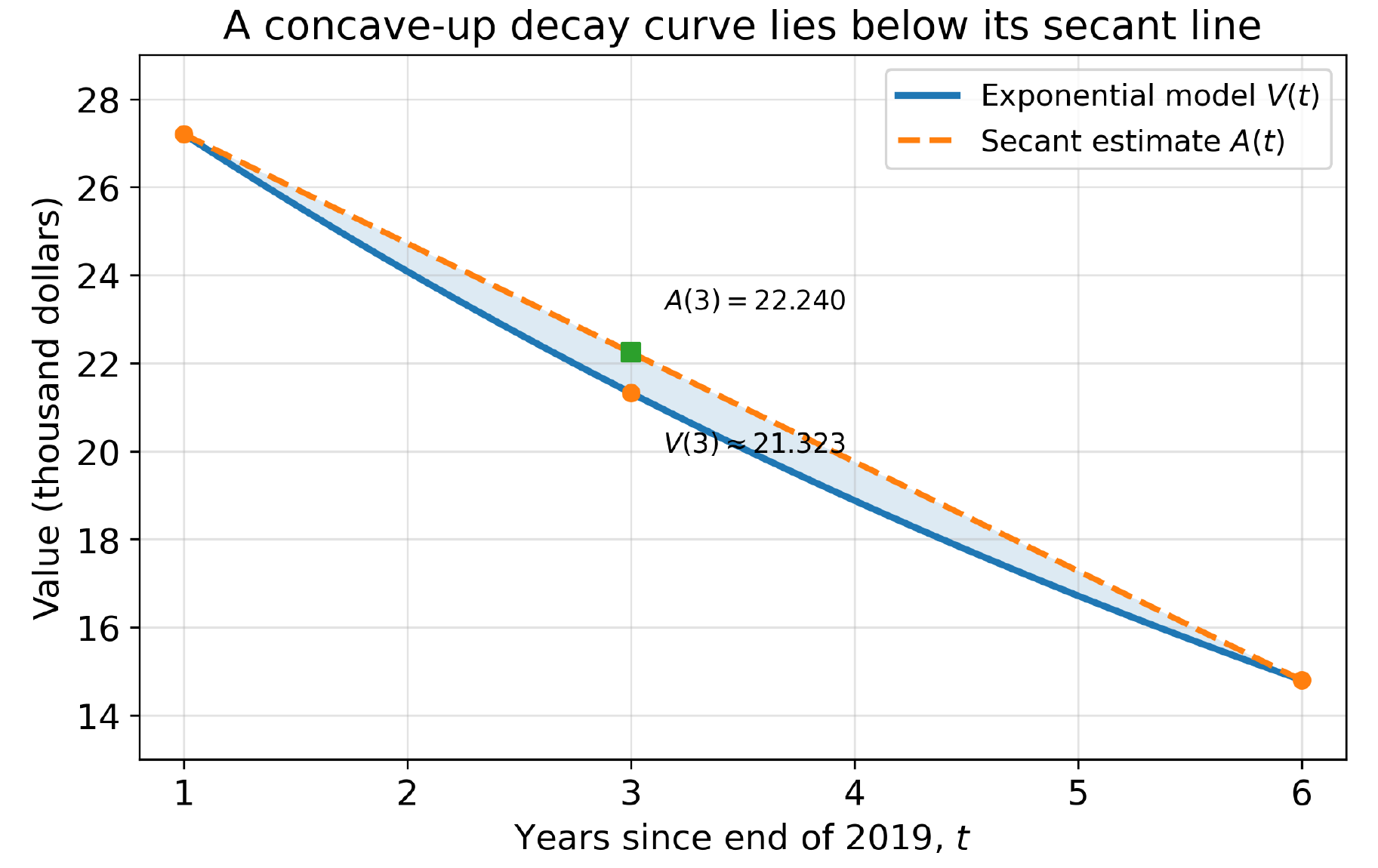
Identify the curve's shape.
For \(0\lt b\lt1\), \(V(t)=ab^t\) is decreasing and concave up.
Use the secant-line property.
A concave-up graph lies below the secant line joining two points on the graph.
Apply it on the interval.
The models agree at \(t=1\) and \(t=6\), but the secant line is above the exponential curve for \(1\lt t\lt6\). For reference, the source graph reports \(A(3)=22.240\) while \(V(3)\approx21.323\).
Part C: State a realistic domain for the model
Find the start of the context.
Time is measured since the end of 2019, so the model begins at \(t=0\).
Solve for the donation time.
\[ab^{t_d}=2\quad\Longrightarrow\quad b^{t_d}=\frac{2}{a}.\]Take natural logarithms.
\[t_d=\frac{\ln(2/a)}{\ln b}\approx22.44358831.\]Respect the real-world event.
After donation, the owner's value becomes \(0\), so the exponential ownership model should not continue beyond this time.
No-calculator section • Question 3
FRQ 3: Sinusoidal Waterwheel Model
Trigonometric functions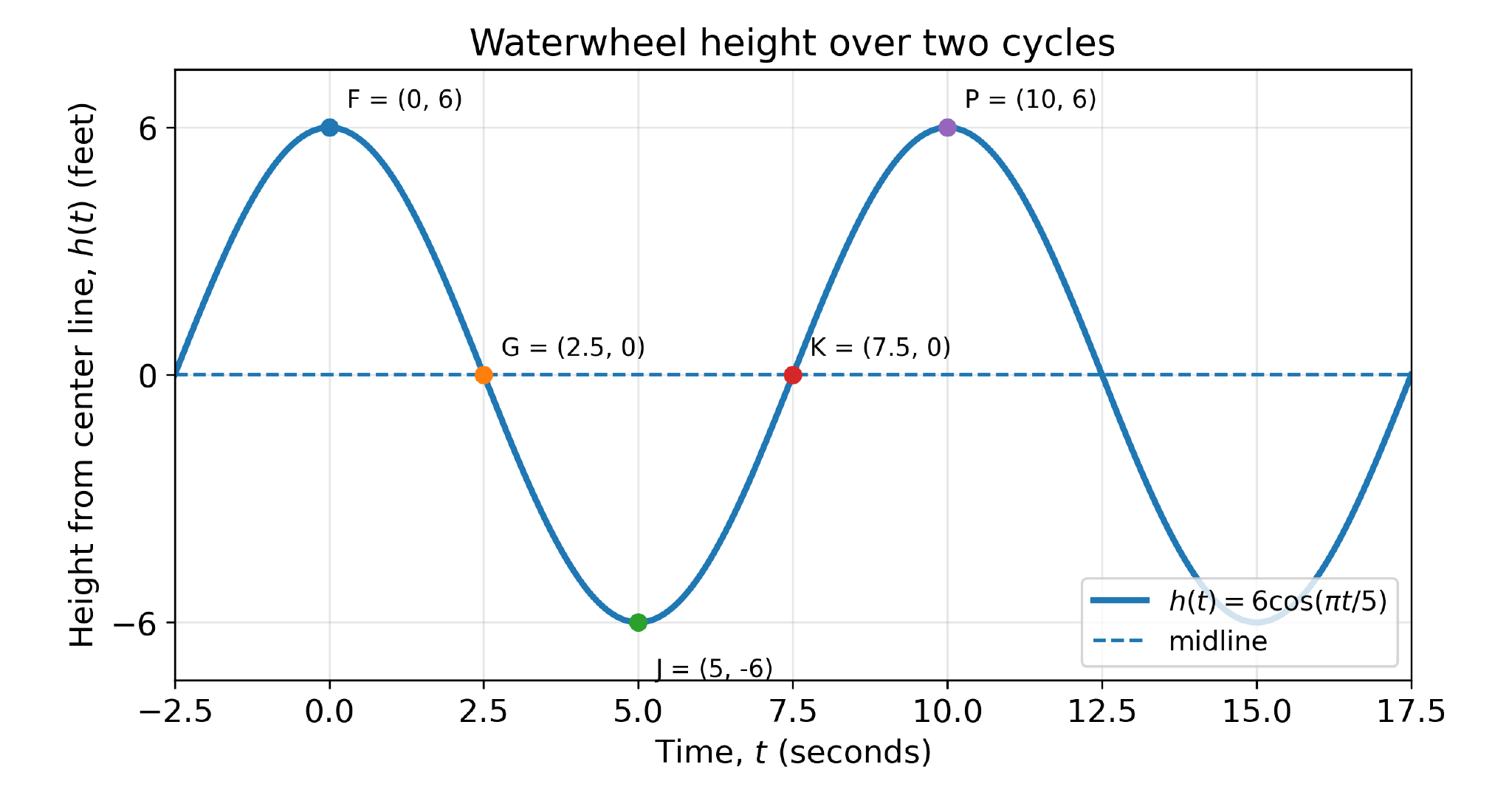
Part A: Give coordinates for \(F,G,J,K,\) and \(P\)
Start at the maximum.
At \(t=0\), the point is \(6\) feet above the center, so \(F=(0,6)\).
Advance by one quarter-period at a time.
At \(t=2.5\), the height is at the midline; at \(t=5\), it is at the minimum; at \(t=7.5\), it returns to the midline; and at \(t=10\), it returns to the maximum.
| Point | Time \(t\) (seconds) | Height \(h(t)\) (feet) | Position |
|---|---|---|---|
| \(F\) | \(0\) | \(6\) | Maximum |
| \(G\) | \(5/2\) | \(0\) | Midline, moving down |
| \(J\) | \(5\) | \(-6\) | Minimum |
| \(K\) | \(15/2\) | \(0\) | Midline, moving up |
| \(P\) | \(10\) | \(6\) | Next maximum |
Part B: Find \(a,b,c,d\) in \(h(t)=a\sin(b(t+c))+d\)
Find amplitude and vertical shift.
The maximum is \(6\) and the minimum is \(-6\), so the amplitude is \(a=6\) and the midline is \(d=0\).
Use the period to find \(b\).
\[10=\frac{2\pi}{|b|}\quad\Longrightarrow\quad |b|=\frac{\pi}{5}.\]Choose the positive value \(b=\pi/5\).
Shift sine so it starts at a maximum.
Positive sine reaches a maximum when its angle is \(\pi/2\). At \(t=0\), require
\[\frac{\pi}{5}(0+c)=\frac{\pi}{2}\quad\Longrightarrow\quad c=\frac{5}{2}.\]Check the model.
\[h(0)=6\sin\left(\frac{\pi}{5}\cdot\frac{5}{2}\right)=6\sin\left(\frac{\pi}{2}\right)=6.\]The graph also decreases immediately after \(t=0\), matching motion from the top of the wheel.
Part C(i): Describe \(h\) on \((t_1,t_2)\)
Determine the sign.
Between \(J\) and \(K\), the graph is below the midline \(h=0\), so \(h(t)\) is negative.
Determine the direction.
The height rises from \(-6\) toward \(0\), so \(h(t)\) is increasing.
Part C(ii): Describe concavity and the rate of change on \((t_1,t_2)\)
Look at the shape.
From the minimum to the next midline crossing, the curve bends upward, so it is concave up.
Track the slopes.
The tangent slope begins at \(0\) at the minimum and becomes more positive as the graph approaches \(K\). Therefore the rate of change is increasing.
No-calculator section • Question 4
FRQ 4: Exponential, Logarithmic, and Trigonometric Algebra
Algebraic reasoningPart A(i): Solve \(g(x)=1/e^6\) for \(g(x)=e^{2x}\)
Use a negative exponent.
\[\frac{1}{e^6}=e^{-6}.\]Equate the exponents.
\[e^{2x}=e^{-6}\quad\Longrightarrow\quad2x=-6.\]Solve.
\[x=-3.\]The exponential function is defined for every real input, so no domain value is excluded.
Part A(ii): Solve \(h(x)=3\) for \(h(x)=\log_2(5x)\)
Rewrite the equation.
\[\log_2(5x)=3\quad\Longrightarrow\quad5x=2^3.\]Solve for \(x\).
\[5x=8\quad\Longrightarrow\quad x=\frac85.\]Check the logarithm's domain.
The original input must satisfy \(5x\gt0\), or \(x\gt0\). Since \(8/5\gt0\), the solution is valid.
Part B(i): Rewrite \(j(x)=7^{3x+1}\cdot7^x\)
Apply the product-of-powers rule.
For the same base, \(a^m\cdot a^n=a^{m+n}\).
Add the exponents.
\[j(x)=7^{(3x+1)+x}=7^{4x+1}.\]
Part B(ii): Rewrite \(k(x)=\sin(2x)\sec x\)
Expand the double angle.
\[\sin(2x)=2\sin x\cos x.\]Rewrite secant.
\[\sec x=\frac{1}{\cos x}.\]Multiply and simplify.
\[k(x)=2\sin x\cos x\left(\frac1{\cos x}\right)=2\sin x.\]Keep the original exclusions.
The cancellation is valid only where \(\cos x\ne0\). Therefore \(x=\pi/2+n\pi\), \(n\in\mathbb Z\), remain excluded.
Part C: Solve \(m(x)=1\) for \(m(x)=\tan^2(3x)\) on \([0,\pi/2]\)
Remove the square carefully.
\[\tan^2(3x)=1\quad\Longrightarrow\quad\tan(3x)=\pm1.\]Write one combined angle family.
\[3x=\frac\pi4+k\frac\pi2,\qquad k\in\mathbb Z.\]Restrict the angle.
Because \(0\le x\le\pi/2\), multiplying by \(3\) gives \(0\le3x\le3\pi/2\). The valid angles are \(\pi/4\), \(3\pi/4\), and \(5\pi/4\).
Divide by \(3\).
\[x=\frac\pi{12},\qquad x=\frac\pi4,\qquad x=\frac{5\pi}{12}.\]Check tangent's domain.
At each solution, \(\cos(3x)\ne0\), so \(\tan(3x)\) is defined.
Final AP Precalculus free-response checklist
- Show the setup before calculating. A correct calculator result without the defining equation does not preserve the mathematical reasoning.
- Keep intermediate precision. Store the full values of \(a\) and \(b\) in an exponential model, then round the requested answer.
- Check every domain. Logarithm inputs must be positive, and canceled reciprocal-trig factors still create exclusions.
- Include units. The car's value is in thousands of dollars, and its average rate is in thousands of dollars per year.
- Separate graph ideas. Increasing or decreasing describes direction; positive or negative describes position; concavity describes how slope changes.
- Justify inverses. State that the function is one-to-one or passes the horizontal line test.
- Limit models to the context. A formula may be defined for more inputs than the real situation allows.