
Early Solutions to the 2026 AP Calculus BC FRQs | Step by Step
Work through all six 2026 AP Calculus BC free-response questions, including every subpart, setup, calculation, theorem justification, polar method, series argument, error bound, and final answer contained in the uploaded solution guide.
Quick answer summary
Use this section to check a result, then open the corresponding worked solution to see why it is correct.
FRQ 1
- A: \(M'(7.5)\approx 1.8\) birds per day squared.
- B(i): \(150\) birds.
- B(ii): Total male birds arriving from day \(0\) through day \(30\).
- C: \(540+\frac{320}{\pi}\approx641.859\), so \(642\) birds.
- D: Yes, by the Intermediate Value Theorem.
FRQ 2
- A: \(\frac{23\pi}{4}\approx18.064\) square units.
- B: \(\frac{dx}{d\theta}=-\frac{7\sqrt2}{2}\).
- C(i): \(\theta=\frac12\tan^{-1}(2)\approx0.554\).
- C(ii): The critical point is a relative maximum of \(r\).
- D: \(3-\frac4\pi\approx1.727\) units.
FRQ 3
- A: The shown slopes have the wrong sign.
- B: \(H'(0)=-\frac{11}{3}\) °C/min.
- C: Underestimate because \(H''(t)\gt0\).
- D: \(H(t)=20+55e^{-t/15}\).
FRQ 4
- A: \(g'(2)=1\).
- B: Point of inflection at \(x=1\).
- C: Increasing and concave down on \((1,3)\).
- D: Absolute minimum at \(x=-2\); maximum at \(x=4\).
FRQ 5
- A: \(\frac34\).
- B: \(V=\pi\int_1^2(x-1)^{2/3}\,dx\).
- C: \(P=2+\int_0^1\sqrt{1+9y^4}\,dy\).
- D: \(\frac12\).
FRQ 6
- A: \(g(3)=\frac54\).
- B: \(f(x)=-\frac25+\frac4{25}x-\frac6{125}x^2+\frac8{625}x^3+\cdots\).
- C: \(\left|f\left(\frac52\right)+\frac3{10}\right|\le\frac15\).
- D(i): \(1+x+\frac{x^2}{2}\).
- D(ii): \(h(x)=48-12x+x^2+\cdots\).
Bird arrival rates
Calculator sectionThe male-bird arrival rate \(M(t)\) is given at selected times.
| \(t\) (days) | 0 | 5 | 10 | 15 | 20 | 25 | 30 |
|---|---|---|---|---|---|---|---|
| \(M(t)\) (birds/day) | 2 | 7 | 16 | 6 | 5 | 2 | 0 |
Part A: Approximate \(M'(7.5)\)
Task. Use the table to approximate the derivative at \(t=7.5\), then state its units.
-
Choose the centered secant interval.
The interval \([5,10]\) is centered at \(7.5\). Its average rate of change is therefore the natural table-based approximation to the instantaneous rate \(M'(7.5)\).
\[ M'(7.5)\approx\frac{M(10)-M(5)}{10-5}. \] -
Substitute the table values.
\[ M'(7.5)\approx\frac{16-7}{5}=\frac95=1.8. \] -
Determine the units.
\(M\) is measured in birds per day and \(t\) in days, so differentiating the rate with respect to time gives
\[ \frac{\text{birds/day}}{\text{day}}=\text{birds per day}^2. \]
Part B(i): Midpoint Riemann-sum estimate
Task. Estimate the total number of male birds arriving from day \(0\) to day \(30\) with three midpoint subintervals.
-
Identify widths and midpoints.
The subintervals are \([0,10]\), \([10,20]\), and \([20,30]\). Each width is \(10\), and the midpoints are \(5\), \(15\), and \(25\).
-
Multiply each width by the rate at its midpoint.
\[ \begin{aligned} \int_0^{30}M(t)\,dt &\approx 10M(5)+10M(15)+10M(25)\\ &=10(7)+10(6)+10(2)\\ &=10(15)=150. \end{aligned} \] -
Attach the accumulated-quantity unit.
\((\text{birds/day})(\text{days})=\text{birds}\).
Part B(ii): Interpret the definite integral
Task. Explain the meaning of \(\int_0^{30}M(t)\,dt\) in context.
\(M(t)\) is an arrival rate. Integrating a rate over a time interval accumulates the total amount that arrived during that interval.
Part C: Total female birds from day 15 to day 45
Task. For \(15\le t\le45\), use \(F(t)=18+16\sin\left(\frac{\pi}{20}(t+15)\right)\) to find the number of arriving female birds.
-
Integrate the arrival rate over the requested time interval.
\[ \begin{aligned} N &=\int_{15}^{45}\left[18+16\sin\left(\frac{\pi}{20}(t+15)\right)\right]dt\\ &=18(45-15)-\frac{320}{\pi} \left[\cos\left(\frac{\pi}{20}(t+15)\right)\right]_{15}^{45}. \end{aligned} \]The factor \(\frac{320}{\pi}\) comes from reversing the chain rule when integrating the sine term.
-
Evaluate the two angles.
\[ \frac{\pi}{20}(45+15)=3\pi, \qquad \frac{\pi}{20}(15+15)=\frac{3\pi}{2}. \] -
Simplify and round only at the end.
\[ \begin{aligned} N &=540-\frac{320}{\pi}\left(\cos3\pi-\cos\frac{3\pi}{2}\right)\\ &=540-\frac{320}{\pi}(-1-0)\\ &=540+\frac{320}{\pi}\\ &\approx641.859. \end{aligned} \]A number of birds must be a whole number, so round to the nearest integer.
Part D: Show the two arrival rates are equal at some time
Task. Decide whether there is a time in \((15,20)\) when \(M(t)=F(t)\), and justify the conclusion.
-
Define a difference function.
\[ D(t)=M(t)-F(t). \]Because \(M\) is differentiable and \(F\) is continuous, \(D\) is continuous on \([15,20]\). Continuity is required before applying the Intermediate Value Theorem.
-
Check the sign at \(t=15\).
\[ \begin{aligned} F(15)&=18+16\sin\left(\frac{3\pi}{2}\right)=18-16=2,\\ D(15)&=M(15)-F(15)=6-2=4\gt0. \end{aligned} \] -
Check the sign at \(t=20\).
\[ \begin{aligned} F(20)&=18+16\sin\left(\frac{7\pi}{4}\right)=18-8\sqrt2,\\ D(20)&=5-(18-8\sqrt2)=8\sqrt2-13\approx-1.686\lt0. \end{aligned} \] -
Apply the Intermediate Value Theorem.
Since the continuous function \(D\) changes sign between \(15\) and \(20\), there is at least one \(c\) with \(15\lt c\lt20\) for which \(D(c)=0\). That equation means \(M(c)=F(c)\).
Polar area, tangent rates, extrema, and average distance
Calculator sectionThe polar curve is
with
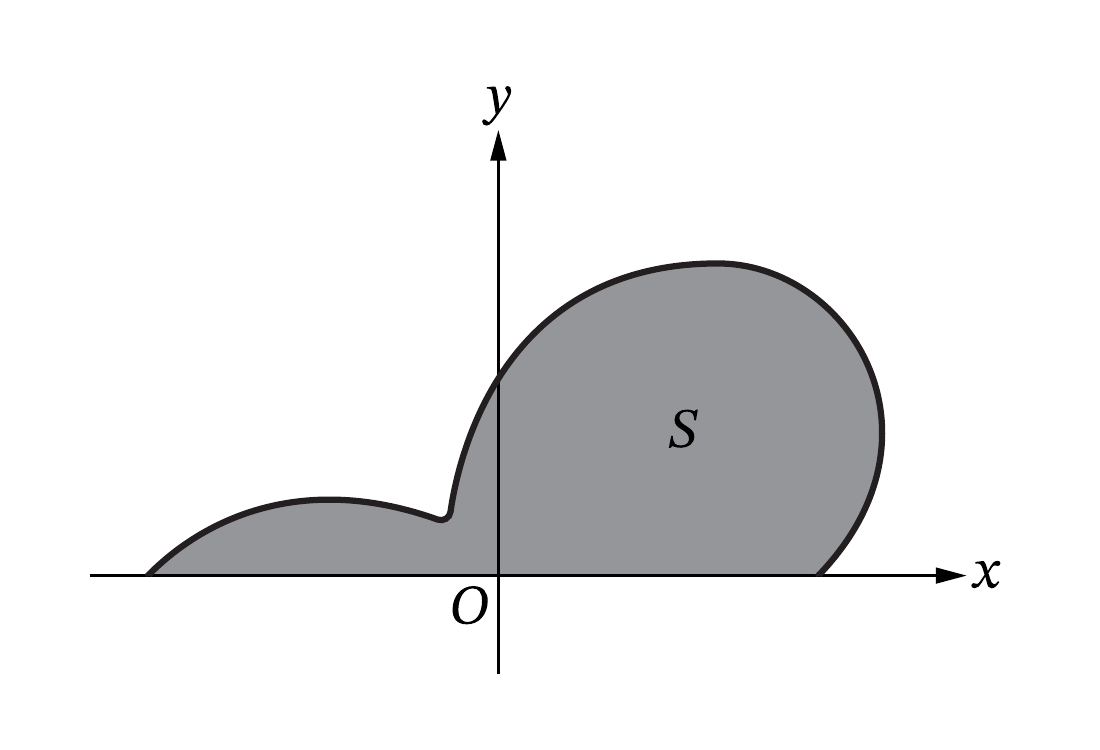
Part A: Area swept by the polar curve
Task. Find the area swept as \(\theta\) runs from \(0\) to \(\pi\).
-
Use the polar-area formula.
A polar radius sweeps small sectors, so the area formula includes the factor \(\frac12\):
\[ A=\frac12\int_a^b[r(\theta)]^2\,d\theta. \]\[ A=\frac12\int_0^\pi [3+2\sin(2\theta)+\cos(2\theta)]^2\,d\theta. \] -
Expand the square.
Let \(s=\sin(2\theta)\) and \(c=\cos(2\theta)\). Then
\[ (3+2s+c)^2=9+4s^2+c^2+12s+6c+4sc. \] -
Use the full-period integral values.
\[ \begin{aligned} \int_0^\pi\sin(2\theta)\,d\theta&=0,\\ \int_0^\pi\cos(2\theta)\,d\theta&=0,\\ \int_0^\pi\sin^2(2\theta)\,d\theta&=\frac\pi2,\\ \int_0^\pi\cos^2(2\theta)\,d\theta&=\frac\pi2,\\ \int_0^\pi\sin(2\theta)\cos(2\theta)\,d\theta&=0. \end{aligned} \]The linear sine, linear cosine, and mixed terms cancel over the interval.
-
Combine the remaining terms.
\[ \begin{aligned} A &=\frac12\left(9\pi+4\cdot\frac\pi2+\frac\pi2\right)\\ &=\frac12\left(\frac{23\pi}{2}\right)\\ &=\frac{23\pi}{4}\\ &\approx18.064. \end{aligned} \]
Part B: Find \(\frac{dx}{d\theta}\)
Task. Use the given slope \(\frac{dy}{dx}=-\frac37\) and \(\frac{dy}{d\theta}=\frac{3\sqrt2}{2}\) at the specified point.
-
Use the parametric slope relationship.
A polar curve is parametrized by \(\theta\), so
\[ \frac{dy}{dx}= \frac{dy/d\theta}{dx/d\theta}. \] -
Substitute the two given rates.
\[ -\frac37= \frac{\frac{3\sqrt2}{2}}{dx/d\theta}. \] -
Solve algebraically for \(dx/d\theta\).
\[ \begin{aligned} \frac{dx}{d\theta} &=\frac{\frac{3\sqrt2}{2}}{-\frac37}\\ &=\frac{3\sqrt2}{2}\left(-\frac73\right)\\ &=-\frac{7\sqrt2}{2}. \end{aligned} \]
Part C(i): Locate the critical point of \(r\)
Task. Find the critical value of \(\theta\) in \(0\lt\theta\lt\frac\pi2\).
-
Set the radial derivative equal to zero.
The derivative exists everywhere, so critical points occur where \(r'(\theta)=0\):
\[ \begin{aligned} 4\cos(2\theta)-2\sin(2\theta)&=0,\\ 2\cos(2\theta)&=\sin(2\theta),\\ \tan(2\theta)&=2. \end{aligned} \] -
Select the solution in the required interval.
Since \(0\lt\theta\lt\frac\pi2\), we have \(0\lt2\theta\lt\pi\). The only solution in that interval is
\[ 2\theta=\tan^{-1}(2). \] -
Solve for \(\theta\) and approximate.
\[ \theta_c=\frac12\tan^{-1}(2)\approx0.554. \]
Part C(ii): Classify the critical point
Task. Determine whether the critical point is a relative maximum or minimum of \(r\).
-
Differentiate \(r'\) again.
\[ r''(\theta)=-8\sin(2\theta)-4\cos(2\theta). \] -
Determine the sign at \(\theta_c\).
Because \(2\theta_c=\tan^{-1}(2)\) is in the first quadrant, \(\sin(2\theta_c)\gt0\) and \(\cos(2\theta_c)\gt0\). Therefore,
\[ r''(\theta_c)\lt0. \] -
Apply the second derivative test.
A negative second derivative at a critical point means the graph of \(r\) is concave down there.
Part D: Average distance from the origin
Task. Find the average distance from the origin for \(\frac\pi2\le\theta\le\pi\).
-
Show that the radial function stays positive.
The distance from the origin is \(|r(\theta)|\). The oscillating part satisfies
\[ 2\sin(2\theta)+\cos(2\theta) \ge-\sqrt{2^2+1^2}=-\sqrt5. \]\[ r(\theta)\ge3-\sqrt5\gt0. \]Therefore \(|r(\theta)|=r(\theta)\) throughout the interval.
-
Set up the average-value integral.
\[ \begin{aligned} \text{Average distance} &=\frac{1}{\pi-\pi/2}\int_{\pi/2}^{\pi}r(\theta)\,d\theta\\ &=\frac2\pi\int_{\pi/2}^{\pi} [3+2\sin(2\theta)+\cos(2\theta)]\,d\theta. \end{aligned} \] -
Integrate and evaluate.
An antiderivative is \(3\theta-\cos(2\theta)+\frac12\sin(2\theta)\).
\[ \begin{aligned} \text{Average distance} &=\frac2\pi \left[3\theta-\cos(2\theta)+\frac12\sin(2\theta)\right]_{\pi/2}^{\pi}\\ &=\frac2\pi\left(\frac{3\pi}{2}-2\right)\\ &=3-\frac4\pi\\ &\approx1.727. \end{aligned} \]
Differential equation and Newton’s law of cooling
No-calculator sectionThe pie temperature \(H(t)\) satisfies
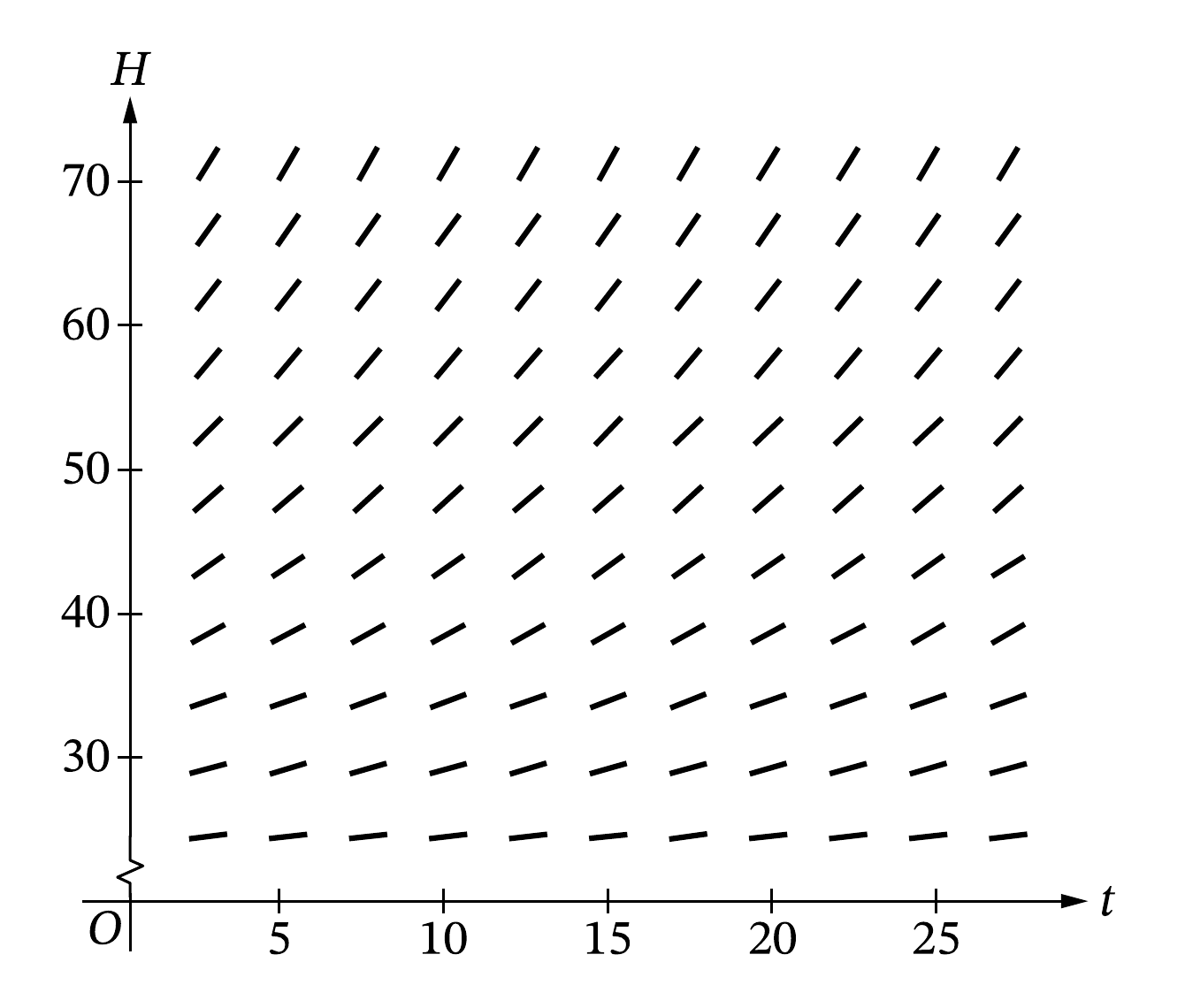
Part A: Explain why the proposed slope field is incorrect
Task. Compare the displayed field with the sign and structure required by the differential equation.
-
Determine the required sign.
Every displayed value has \(H\gt20\), so
\[ H-20\gt0 \Longrightarrow -\frac1{15}(H-20)\lt0. \]The correct segments must therefore tilt downward from left to right.
-
Check how slopes vary across the field.
The right-hand side depends only on \(H\), so every point on a common horizontal row should have the same slope. The proposed field has that row-by-row property, but the slopes have the wrong sign.
Part B: Find the tangent-line slope at \(t=0\)
Task. Calculate \(H'(0)\) from the differential equation and initial condition.
Substitute \(H(0)=75\):
Part C: Underestimate or overestimate?
Task. Decide whether the tangent-line approximation at \(t=0\) underestimates or overestimates \(H(5)\).
-
Use the second derivative to determine concavity.
\[ H''(t)=\frac1{225}\bigl(H(t)-20\bigr). \]Because \(H(t)\gt20\) for \(t\gt0\), \(H''(t)\gt0\). Thus \(H\) is concave up.
-
Relate concavity to the tangent line.
Near the point of tangency, a tangent line to a concave-up graph lies below the graph. Therefore, the tangent-line value at \(t=5\) is less than the actual \(H(5)\).
-
Write the tangent line for reference.
\[ L(t)=75-\frac{11}{3}t, \qquad L(5)=75-\frac{55}{3}=\frac{170}{3}. \]
Part D: Solve the differential equation
Task. Find the particular solution satisfying \(H(0)=75\).
-
Separate the variables.
\[ \frac{dH}{dt}=-\frac1{15}(H-20) \quad\Longrightarrow\quad \frac1{H-20}\,dH=-\frac1{15}\,dt. \] -
Integrate both sides.
\[ \int\frac1{H-20}\,dH=\int-\frac1{15}\,dt, \qquad \ln|H-20|=-\frac{t}{15}+C. \] -
Exponentiate.
\[ |H-20|=e^Ce^{-t/15}. \]Since \(H(t)\gt20\), the difference \(H-20\) is positive. Absorb the positive constant into \(C_1\):
\[ H-20=C_1e^{-t/15}. \] -
Apply \(H(0)=75\).
\[ 75-20=C_1e^0 \Longrightarrow C_1=55. \]\[ H(t)-20=55e^{-t/15}. \]
Reasoning from the graph of \(f'\)
No-calculator section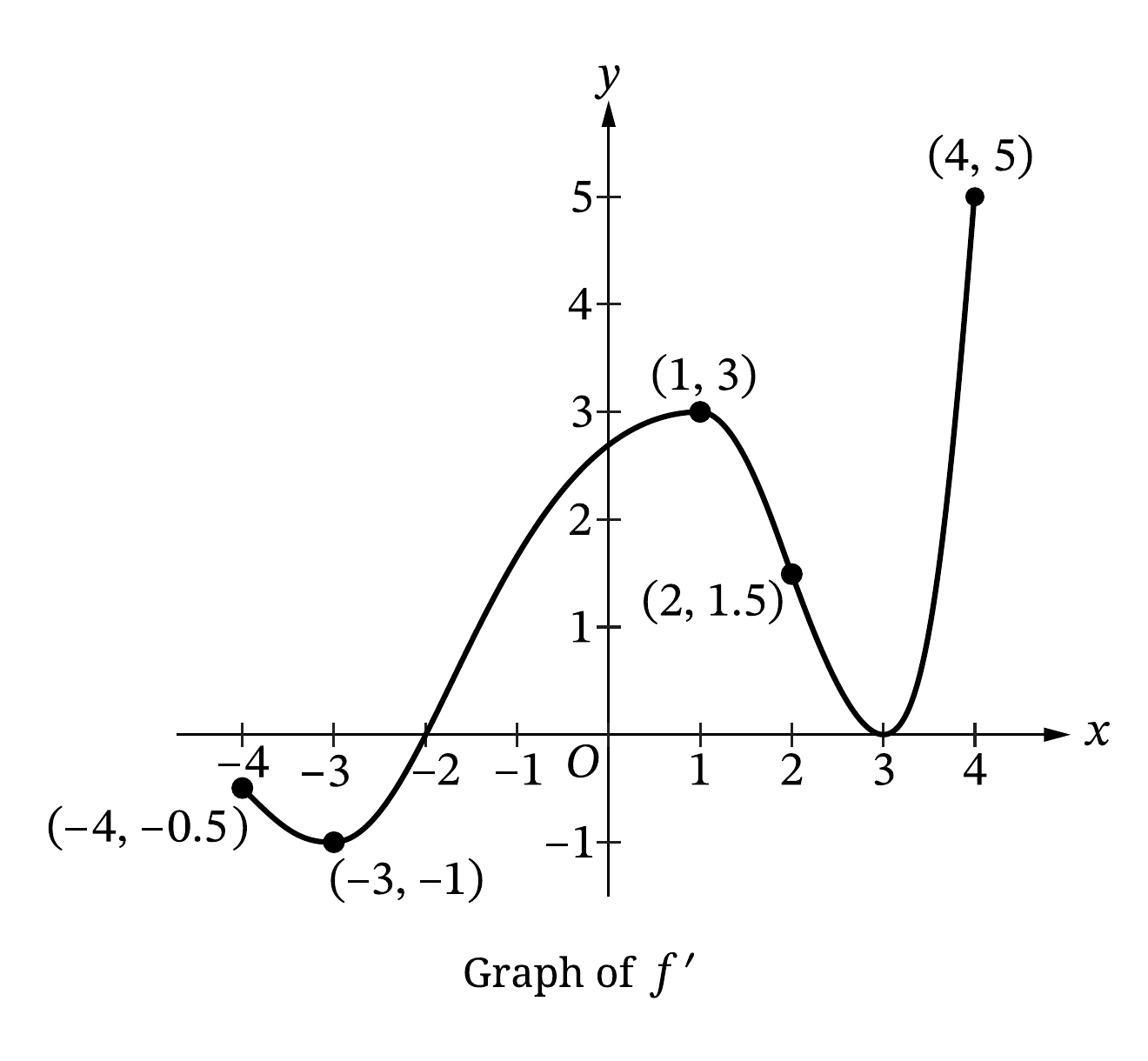
Part A: Find \(g'(2)\)
Task. For \(x\gt0\), \(g(x)=f(x)-\ln x\). Find \(g'(2)\).
-
Differentiate \(g\).
\[ g'(x)=f'(x)-\frac1x. \] -
Read \(f'(2)\) from the graph and substitute.
\[ g'(2)=f'(2)-\frac12=1.5-0.5=1. \]
Part B: Point of inflection of \(f\)
Task. Find the point where the concavity of \(f\) changes on \(0\lt x\lt3\).
-
Connect \(f''\) to the behavior of \(f'\).
\[ f''(x)=\bigl(f'(x)\bigr)'. \]\(f\) is concave up where \(f'\) increases and concave down where \(f'\) decreases.
-
Read the change from the graph.
- \(f'\) increases on \((0,1)\), so \(f\) is concave up there.
- \(f'\) decreases on \((1,3)\), so \(f\) is concave down there.
The concavity changes at \(x=1\). Although \(f'\) changes from decreasing to increasing at \(x=3\), that endpoint is excluded from \(0\lt x\lt3\).
Part C: Increasing and concave down
Task. Find where \(f\) is both increasing and concave down.
-
Find where \(f\) is increasing.
\(f\) increases where \(f'(x)\gt0\). From the graph, this occurs on \((-2,3)\) and \((3,4)\).
-
Find where \(f\) is concave down.
\(f\) is concave down where \(f'\) is decreasing. From the graph, that occurs on \((-4,-3)\) and \((1,3)\).
-
Intersect the two conditions.
The common interval is \((1,3)\).
Part D: Absolute extrema of \(f\)
Task. Given \(f(2)=3\), identify the absolute minimum and maximum of \(f\) on \([-4,4]\).
-
Use the sign of \(f'\) to locate candidates.
\[ f'(x)\lt0\text{ on }(-4,-2), \qquad f'(x)\gt0\text{ on }(-2,3)\cup(3,4). \]Thus \(f\) decreases until \(x=-2\) and increases afterward. At \(x=3\), \(f'(3)=0\), but \(f'\) does not change sign. Therefore \(x=-2\) is the absolute-minimum candidate, and the absolute maximum must be at \(x=-4\) or \(x=4\).
-
Compare the endpoint values using accumulated change.
\[ f(-4)=3-\int_{-4}^{2}f'(x)\,dx, \qquad f(4)=3+\int_{2}^{4}f'(x)\,dx. \]On \([-4,-2]\), the graph of \(f'\) lies between \(-1\) and \(0\), so the magnitude of the negative area is at most \(2\). On \([0,1]\), the graph lies above \(y=2\), so the positive area on that one-unit interval alone is greater than \(2\). The additional positive area on \([-2,0]\) and \([1,2]\) makes the total accumulated change positive:
\[ \int_{-4}^{2}f'(x)\,dx\gt0 \quad\Longrightarrow\quad f(-4)\lt3. \]Also, \(f'(x)\ge0\) on \([2,4]\) and is positive except at \(x=3\), so
\[ \int_2^4f'(x)\,dx\gt0 \quad\Longrightarrow\quad f(4)\gt3. \]Hence \(f(4)\gt f(-4)\).
Integration, volume, arc length, and an improper integral
No-calculator sectionThe functions are
Region \(R\) lies below \(f\) and above the \(x\)-axis for \(1\le x\le2\).
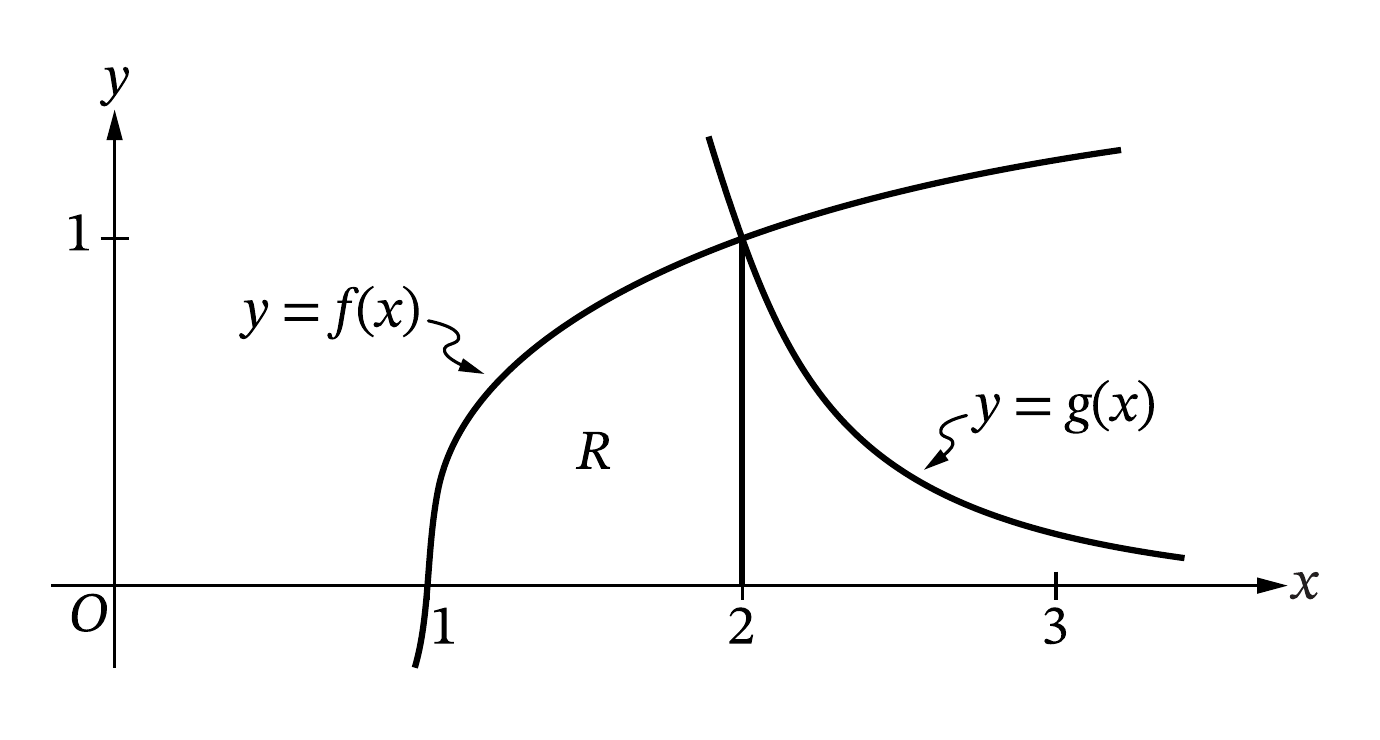
Part A: Evaluate the definite integral
Task. Evaluate \(\displaystyle\int_1^2(x-1)^{1/3}\,dx\).
-
Shift the variable.
Let \(u=x-1\), so \(du=dx\). The bounds become \(u=0\) and \(u=1\).
-
Integrate the power.
\[ \begin{aligned} \int_1^2(x-1)^{1/3}\,dx &=\int_0^1u^{1/3}\,du\\ &=\left[\frac34u^{4/3}\right]_0^1\\ &=\frac34. \end{aligned} \]
Part B: Volume when \(R\) is rotated about the \(x\)-axis
Task. Set up the disk-method integral for the volume.
-
Identify the disk radii.
The outer radius is the function value and the inner radius is zero:
\[ R(x)=f(x)=(x-1)^{1/3}, \qquad r(x)=0. \] -
Square the outer radius in the disk formula.
\[ \begin{aligned} V &=\pi\int_1^2[R(x)]^2\,dx\\ &=\pi\int_1^2\left[(x-1)^{1/3}\right]^2\,dx. \end{aligned} \]
Part C: Perimeter of region \(R\)
Task. Express the perimeter using line-segment lengths and an arc-length integral.
-
Account for the two straight sides.
- The horizontal segment on the \(x\)-axis from \(x=1\) to \(x=2\) has length \(1\).
- The vertical segment at \(x=2\) from \(y=0\) to \(y=1\) has length \(1\).
Together, the straight sides contribute \(2\).
-
Parameterize the curved boundary by \(y\).
Using \(x\) directly would create an improper arc-length integral because \(f'(x)\) is unbounded at \(x=1\). Solve instead for \(x\):
\[ y=(x-1)^{1/3} \Longrightarrow x=y^3+1, \qquad \frac{dx}{dy}=3y^2. \] -
Use the arc-length formula in terms of \(y\).
\[ \begin{aligned} L &=\int_0^1\sqrt{1+\left(\frac{dx}{dy}\right)^2}\,dy\\ &=\int_0^1\sqrt{1+9y^4}\,dy. \end{aligned} \] -
Add all three boundary pieces.
The two line segments contribute \(2\), and the curved side contributes \(L\).
Part D: Evaluate an improper integral
Task. Evaluate \(\displaystyle\int_2^\infty e^{-2x+4}\,dx\).
-
Replace the infinite endpoint with a limit.
\[ \int_2^\infty e^{-2x+4}\,dx = \lim_{b\to\infty}\int_2^b e^{-2x+4}\,dx. \]This limit is required because infinity is not a finite integration bound.
-
Integrate and evaluate the finite-bound expression.
An antiderivative is \(-\frac12e^{-2x+4}\).
\[ \begin{aligned} \int_2^\infty e^{-2x+4}\,dx &=\lim_{b\to\infty} \left[-\frac12e^{-2x+4}\right]_2^b\\ &=\lim_{b\to\infty} \left(-\frac12e^{-2b+4}+\frac12e^0\right)\\ &=0+\frac12\\ &=\frac12. \end{aligned} \]
Maclaurin series and alternating-series error
No-calculator sectionThe Maclaurin series is
for \(\lvert x\rvert\lt5\).
Part A: Evaluate \(g(3)\)
Task. Use the geometric-series sum.
-
Substitute \(x=3\).
\[ g(3)=\sum_{n=0}^{\infty}2\left(-\frac35\right)^n. \] -
Identify the geometric-series parameters.
The first term is \(a=2\) and the common ratio is \(r=-\frac35\). Since \(\lvert r\rvert\lt1\), the series converges.
-
Apply \(a/(1-r)\).
\[ \begin{aligned} g(3) &=\frac{a}{1-r}\\ &=\frac{2}{1-(-3/5)}\\ &=\frac{2}{8/5}\\ &=\frac54. \end{aligned} \]
Part B: Find the Maclaurin series for \(f=g'\)
Task. Differentiate the power series term by term.
-
Differentiate inside the interval of convergence.
Term-by-term differentiation is valid for \(\lvert x\rvert\lt5\):
\[ \begin{aligned} f(x)=g'(x) &=\frac{d}{dx}\left( 2-\frac25x+\frac2{25}x^2-\frac2{125}x^3+\frac2{625}x^4-\cdots \right)\\ &=-\frac25+\frac4{25}x-\frac6{125}x^2+\frac8{625}x^3-\cdots. \end{aligned} \]
Part C: Bound the second-degree approximation error
Task. Use the second-degree Taylor polynomial for \(f\) at \(x=\frac52\) and the Alternating Series Estimation Theorem.
-
Write and evaluate the second-degree polynomial.
\[ T_2(x)=-\frac25+\frac4{25}x-\frac6{125}x^2. \]\[ \begin{aligned} T_2\left(\frac52\right) &=-\frac25+\frac4{25}\left(\frac52\right) -\frac6{125}\left(\frac52\right)^2\\ &=-\frac25+\frac25-\frac3{10}\\ &=-\frac3{10}. \end{aligned} \] -
Check the alternating-series structure.
\[ f\left(\frac52\right) =-\frac25+\frac25-\frac3{10}+\frac15-\frac18+\cdots. \]The terms alternate. The magnitude of the term from index \(n\) is
\[ a_n=\frac{2n}{5^n}\left(\frac52\right)^{n-1}, \]and
\[ \frac{a_{n+1}}{a_n}=\frac{n+1}{2n}\le1, \]with strict inequality for \(n\gt1\). Thus the magnitudes decrease to zero.
-
Use the first omitted term as the error bound.
The first omitted term after the \(x^2\) term is \(\frac8{625}x^3\).
\[ \begin{aligned} \left| f\left(\frac52\right)-T_2\left(\frac52\right) \right| &\le \left|\frac8{625}\left(\frac52\right)^3\right|\\ &=\frac15. \end{aligned} \]
Part D(i): First three nonzero terms of \(e^x\)
Task. State the first three nonzero terms of the exponential Maclaurin series.
Part D(ii): First three nonzero terms of \(h(x)=25g(x)-2e^x\)
Task. Scale the two known series and subtract term by term.
-
Multiply the series for \(g\) by \(25\).
\[ 25g(x)=50-10x+2x^2-\frac25x^3+\cdots. \] -
Multiply the exponential series by \(2\).
\[ 2e^x=2+2x+x^2+\frac13x^3+\cdots. \] -
Subtract corresponding powers.
\[ \begin{aligned} h(x) &=(50-2)+(-10x-2x)+(2x^2-x^2)+\cdots\\ &=48-12x+x^2+\cdots. \end{aligned} \]
Final checklist for AP free-response work
- Include the quotient and units for a derivative estimate. A numerical answer alone does not show how the average rate of change was obtained.
- Show every Riemann-sum ingredient. Include each subinterval width, the required sample point, and the function value.
- Interpret definite integrals in context. Identify the accumulated quantity and the time interval, not only the numerical value.
- Verify theorem conditions. For the Intermediate Value Theorem, state continuity and exhibit values with opposite signs.
- Use the correct polar factor. Polar area requires \(\frac12\int r^2\,d\theta\), while an average value also requires division by the interval length.
- Justify concavity with derivatives. Connect the sign of a second derivative, or the increase and decrease of \(f'\), to the claimed concavity.
- Write improper integrals as limits. Replace an infinite endpoint with a finite bound and then take the limit.
- Check alternating-series hypotheses. Verify decreasing term magnitudes and convergence to zero before applying the first-omitted-term error bound.