
AP U.S. Government and Politics 2026 FRQ Answers: Score 5, 4 and 3 Models
Use this educator-style guide to compare how a high-scoring, mid-scoring, and basic-scoring response would answer the 2026 AP U.S. Government and Politics free-response questions. Each question is summarized in student-friendly wording, followed by score 5, score 4, and score 3 model responses.
Official 2026 AP U.S. Government FRQ Paper
View the official College Board free-response question paper below, then use the score 5, score 4, and score 3 model answers in this guide to compare response quality.
If the PDF does not load inside the page, use the “Open Official PDF” button above. Some browsers or source websites may restrict embedded PDF viewing.
How the Three Score Levels Work
Precise claim, correct AP Gov vocabulary, specific evidence, clear explanation, and complete reasoning. Best for publishing as the final model answer.
Mostly correct and clear, but one explanation may be less developed, less specific, or missing a stronger connection to the prompt.
Basic credit response. It answers part of the question but may lack depth, precise evidence, or complete AP-level reasoning.
2026 AP U.S. Government FRQ Question Overview
Question 1: Scenario Analysis — Third-Party Candidate in the 1992 Election
The scenario describes the 1992 presidential election, including economic concerns, Ross Perot’s independent candidacy, and the responses of Bill Clinton and George H. W. Bush.
- Part A: Describe one impact Ross Perot had on the 1992 presidential election.
- Part B: Explain how structural barriers limited the impact of Perot’s third-party candidacy.
- Part C: Explain how a model of voting behavior can be used to understand how citizens voted in this election.
Question 2: Quantitative Analysis — State Individual Income Tax Rates
The question uses a map showing state individual income tax rates in 2023. Students must interpret regional tax-rate differences and connect the data to participatory democracy and federalism.
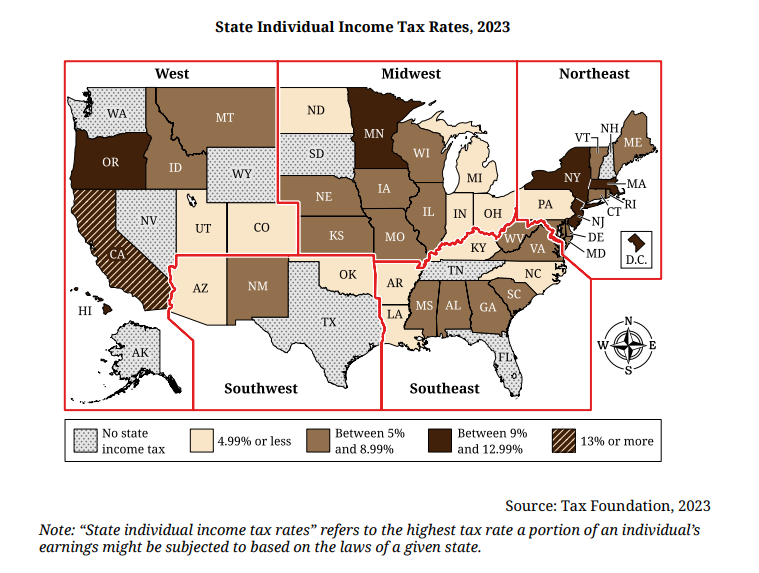
- Part A: Identify the state with the highest individual income tax rate.
- Part B: Describe one difference between income tax rates in the Northeast and Southeast regions.
- Part C: Draw a conclusion about participatory democracy based on the map.
- Part D: Explain how state income tax differences demonstrate federalism.
Question 3: SCOTUS Comparison — McCulloch v. Maryland and Bonito Boats
The question asks students to compare the required Supreme Court case McCulloch v. Maryland with the non-required case Bonito Boats, Inc. v. Thunder Craft Boats, Inc.. Both cases involve conflict between state action and federal authority.
- Part A: Identify the constitutional clause common to both cases.
- Part B: Explain how the facts of both cases led to similar holdings.
- Part C: Explain how Bonito Boats illustrates stare decisis.
Question 4: Argument Essay — Expansion of Voting Access
The essay asks students to develop an argument about whether social movements or congressional actions have done more to expand opportunities for voting in the United States.
- Make a defensible claim or thesis.
- Use at least one required foundational document: Article I, the First Amendment, or “Letter from a Birmingham Jail.”
- Use a second piece of relevant evidence from course knowledge or another foundational document.
- Explain how the evidence supports the thesis.
- Respond to an opposing or alternative perspective with rebuttal or refutation.
How to Write a High-Scoring AP Gov FRQ Answer
- Identify the command verb. For “identify,” give the answer directly. For “describe,” state a feature or impact. For “explain,” connect cause and effect.
- Use AP Gov vocabulary. Terms such as Electoral College, federalism, Supremacy Clause, stare decisis, retrospective voting, participatory democracy, and voting rights strengthen the answer.
- Use the source material. Scenario and data questions require details from the passage, case summary, or map.
- Explain why the evidence matters. A score 5 answer does not just name evidence; it connects the evidence to the constitutional principle, political process, or voting behavior.
- For the argument essay, include a rebuttal. The strongest response acknowledges an opposing perspective and explains why the thesis is still stronger.
Choose a Model Answer Level
Question 1: Third-Party Candidate in the 1992 Presidential Election
Question Summary
Explain how Ross Perot’s independent campaign affected the 1992 election, why structural barriers limited his success, and how a voting behavior model explains voter choices.
Part A
Answer: Ross Perot affected the 1992 presidential election by forcing the major-party candidates to respond to his economic message. Because Perot gained major media attention and appealed to voters concerned about the recession, slow job growth, and national debt, both Bill Clinton and George H. W. Bush adjusted their campaign messages. Clinton emphasized deficit reduction and middle-class concerns, while Bush promised major federal budget cuts.
Part B
Answer: Structural barriers limited Perot’s impact because the Electoral College and winner-take-all state allocation rules make it very difficult for third-party candidates to win electoral votes. Perot won a significant share of the popular vote, but his support was spread across the country rather than concentrated enough to win state pluralities. As a result, he earned no electoral votes, showing how the presidential election system favors the two major parties.
Part C
Answer: The retrospective voting model explains the election because many voters judged the incumbent president based on prior economic conditions. Since the country had recently experienced a recession, slow job growth, and concerns about the national debt, some voters blamed the incumbent Republican administration and supported Clinton or Perot instead. This model shows that voters often reward or punish candidates based on the perceived performance of the party in power.
Question 2: State Individual Income Tax Rates, 2023
Question Summary
Use the 2023 state individual income tax map to identify the highest-tax state, compare regional tax patterns, and explain how the map connects to participatory democracy and federalism.
Part A
Answer: California had the highest individual income tax rate because it was shown in the map’s highest category, 13 percent or more.
Part B
Answer: The Northeast generally had higher individual income tax rates than the Southeast. For example, states such as New York and New Jersey were in high tax-rate categories, while several Southeastern states, including Florida and Tennessee, had no state income tax. This shows a regional difference in state tax policy.
Part C
Answer: The data suggest that participatory democracy can lead to different policy outcomes across states because voters influence state governments through elections, public opinion, and political participation. Citizens in some states may support higher income taxes to fund public services, while citizens in other states may prefer lower taxes or no income tax. The map’s variation shows that state policy can reflect different voter preferences.
Part D
Answer: State income taxes demonstrate federalism because power is divided between national and state governments. States have the authority to create their own tax systems, so one state may impose no income tax while another may impose a high income tax. The map shows this division of authority because tax rates differ widely from state to state.
Question 3: Supreme Court Comparison
Question Summary
Compare McCulloch v. Maryland and Bonito Boats v. Thunder Craft Boats by identifying the shared constitutional clause, explaining similar holdings, and connecting the case to stare decisis.
Part A
Answer: The constitutional clause common to both McCulloch v. Maryland and Bonito Boats, Inc. v. Thunder Craft Boats, Inc. is the Supremacy Clause.
Part B
Answer: In McCulloch v. Maryland, Maryland tried to tax the national bank, but the Supreme Court held that a state could not interfere with a valid federal institution. In Bonito Boats, Florida tried to create patent-like protection for an unpatented boat-hull design, but the Supreme Court held that the state law conflicted with federal patent law. Both cases reached similar holdings because state action was invalid when it interfered with or conflicted with federal authority.
Part C
Answer: Bonito Boats illustrates stare decisis because the Supreme Court relied on earlier precedent when deciding the case. Justice Sandra Day O’Connor explained that prior Supreme Court decisions had already established that states may not provide patent-like protections for intellectual creations left unprotected by federal law. By following earlier decisions, the Court applied the principle that similar legal questions should be decided consistently over time.
Question 4: Argument Essay
Question Summary
Develop an argument about whether social movements or congressional actions have done more to expand voting access in the United States. Use a required foundational document, a second piece of evidence, reasoning, and a rebuttal.
Thesis
Answer: Social movements have done more than congressional actions to expand opportunities for voting because social movements created the public pressure, moral urgency, and political momentum that forced formal legal change. Congressional action was necessary, but it often occurred only after sustained activism made voting-rights reform unavoidable.
Evidence 1: “Letter from a Birmingham Jail”
Martin Luther King Jr.’s “Letter from a Birmingham Jail” supports this argument because King defended nonviolent direct action as a way to expose injustice and force negotiation. This connects to voting rights because civil rights activists used marches, protests, boycotts, and voter-registration efforts to challenge barriers that prevented Black citizens from fully participating in democracy.
Evidence 2: Civil Rights Movement and Voting Rights Act of 1965
The Voting Rights Act of 1965 banned discriminatory practices such as literacy tests and strengthened federal protection of voting rights. However, this congressional action followed years of civil rights activism, including voter-registration campaigns and the Selma marches. These actions changed public opinion and pressured Congress and the president to act.
Reasoning
This evidence supports the thesis because it shows that social movements were the driving force behind expanded voting access. Activists made discrimination visible, mobilized public support, and created political costs for inaction. Congress had the formal lawmaking power, but social movements pushed voting rights onto the national agenda.
Opposing Perspective and Rebuttal
An opposing view is that congressional actions did more because amendments and laws such as the 15th Amendment, 19th Amendment, 24th Amendment, and Voting Rights Act formally expanded voting rights. This view is partly correct because legal protections are essential. However, it is incomplete because many of those legal changes were produced by social movements, including abolitionist activism, women’s suffrage activism, and civil rights activism. Therefore, social movements did more because they created the pressure that made congressional action possible.
Question 1: Third-Party Candidate in the 1992 Presidential Election
Question Summary
Explain Perot’s effect on the election, why the election system limited his success, and how voters may have used economic conditions when choosing candidates.
Part A
Ross Perot affected the election by bringing more attention to economic issues such as the national debt, jobs, and the federal budget. His campaign forced Clinton and Bush to talk more about deficit reduction and budget cuts.
Part B
The Electoral College limited Perot’s impact because third-party candidates usually have difficulty winning states. Even though Perot won many popular votes, he did not win electoral votes because his support was not strong enough in particular states.
Part C
Retrospective voting explains the election because voters may have judged Bush based on the weak economy. Since voters were worried about recession and jobs, they may have voted for Clinton or Perot instead of the incumbent.
Question 2: State Individual Income Tax Rates, 2023
Question Summary
Read the map, identify the highest-tax state, compare Northeast and Southeast tax patterns, and connect the data to democracy and federalism.
Part A
California had the highest individual income tax rate.
Part B
The Northeast generally had higher income tax rates than the Southeast. Some Southeastern states had no income tax, while several Northeastern states had higher rates.
Part C
The map shows that participatory democracy can create different tax policies because people in different states vote for different leaders and policies.
Part D
State income taxes demonstrate federalism because states can make their own tax laws. This is why some states have no income tax and others have higher income tax rates.
Question 3: Supreme Court Comparison
Question Summary
Compare McCulloch and Bonito Boats using the Supremacy Clause, federal authority, and precedent.
Part A
The common constitutional clause is the Supremacy Clause.
Part B
Both cases involved state laws that conflicted with federal power. Maryland tried to tax the national bank in McCulloch, and Florida tried to protect an unpatented boat design in Bonito Boats. In both cases, the Supreme Court sided with federal authority over state law.
Part C
Bonito Boats shows stare decisis because the Court followed earlier decisions about states not being allowed to create patent-like protections that conflict with federal law.
Question 4: Argument Essay
Question Summary
Argue whether social movements or congressional actions did more to expand voting access, using required evidence, reasoning, and rebuttal.
Thesis
Social movements have done more to expand voting opportunities because they pressured the government to pass voting-rights laws.
Evidence and Reasoning
In “Letter from a Birmingham Jail,” Martin Luther King Jr. defended direct action against injustice. This supports the argument because civil rights activists used protests and marches to push for equal rights, including voting rights. The Voting Rights Act of 1965 also expanded voting access by banning unfair voting barriers. This law shows that Congress acted, but it acted after pressure from the civil rights movement.
Opposing View
Some people may argue that Congress did more because it passed the laws and amendments that legally protected voting rights. However, social movements were still more important because they pushed Congress to make those changes.
Question 1: Third-Party Candidate in the 1992 Presidential Election
Question Summary
Explain Perot’s impact, the Electoral College barrier, and how the economy shaped voter behavior.
Part A
Ross Perot affected the election by getting attention and making the candidates talk about the economy.
Part B
The Electoral College made it hard for Perot to win because third-party candidates usually cannot get many electoral votes.
Part C
Voters may have voted based on the economy. Since the economy was not strong, some voters did not support Bush.
Question 2: State Individual Income Tax Rates, 2023
Question Summary
Use the map to answer questions about state tax rates, regional differences, democracy, and federalism.
Part A
California.
Part B
The Northeast had higher taxes than the Southeast.
Part C
People in different states can vote for different policies, so tax rates are different.
Part D
This shows federalism because states can have different tax laws.
Question 3: Supreme Court Comparison
Question Summary
Compare two Supreme Court cases about conflict between state action and federal power.
Part A
The Supremacy Clause.
Part B
Both cases show that federal law is stronger than state law when they conflict.
Part C
Bonito Boats shows stare decisis because the Court used past decisions.
Question 4: Argument Essay
Question Summary
Write an argument about whether movements or Congress did more to expand voting rights.
Basic Response
Social movements have done more to expand voting rights because people protested and demanded change. Martin Luther King Jr. supported direct action in “Letter from a Birmingham Jail.” The civil rights movement helped lead to the Voting Rights Act. Some people say Congress did more because it passed laws, but Congress acted because people demanded change.
Quick Comparison: Why Score 5 Is Stronger
| Skill | Score 5 Response | Score 4 Response | Score 3 Response |
|---|---|---|---|
| Prompt coverage | Answers every part completely. | Answers most parts, but one explanation may be thin. | Answers the basic idea but lacks detail. |
| AP Gov vocabulary | Uses terms such as Electoral College, retrospective voting, federalism, Supremacy Clause, and stare decisis accurately. | Uses some correct terms but with less precision. | Uses simple language with limited academic vocabulary. |
| Evidence | Includes specific evidence from the scenario, map, court case summary, and foundational document. | Includes evidence, but it may be less developed. | Mentions evidence briefly without full explanation. |
| Reasoning | Explains why the evidence supports the answer. | Some reasoning is present, but not always complete. | Reasoning is basic or implied. |
| Argument essay | Includes thesis, two pieces of evidence, reasoning, and rebuttal. | Includes the major parts but less detailed reasoning. | Has a basic claim and evidence but limited development. |
FAQ
Do students need a diagram for this AP Gov FRQ?
No. AP U.S. Government and Politics FRQs are written-response questions. Students only need to interpret the provided map in Question 2; they do not need to draw a new diagram.
Why are the questions summarized instead of copied word for word?
The questions are summarized to make the page useful for study while avoiding unnecessary reproduction of copyrighted exam text. Students should use the official College Board paper for the original wording.
Which model should I publish as the final answer?
Publish the score 5 model as the main answer. The score 4 and score 3 models are useful for teaching students how answer quality changes based on evidence, vocabulary, and reasoning.
What makes the score 5 argument essay stronger?
The score 5 essay has a defensible thesis, uses evidence from a required foundational document, adds a second relevant piece of evidence, explains the reasoning, and responds to an opposing perspective.
Where can students view the official 2026 AP U.S. Government FRQ paper?
Students can view the official College Board PDF embedded near the top of this guide or open it directly using the “Open Official PDF” button.