
Polar Equation Visualizer
Interactively explore rose curves, cardioids, limaçons & more
📌 The General Form
All curves here follow r = a + b·trig(kθ). The radius r is a function of the angle
θ — this is the essence of polar coordinates.
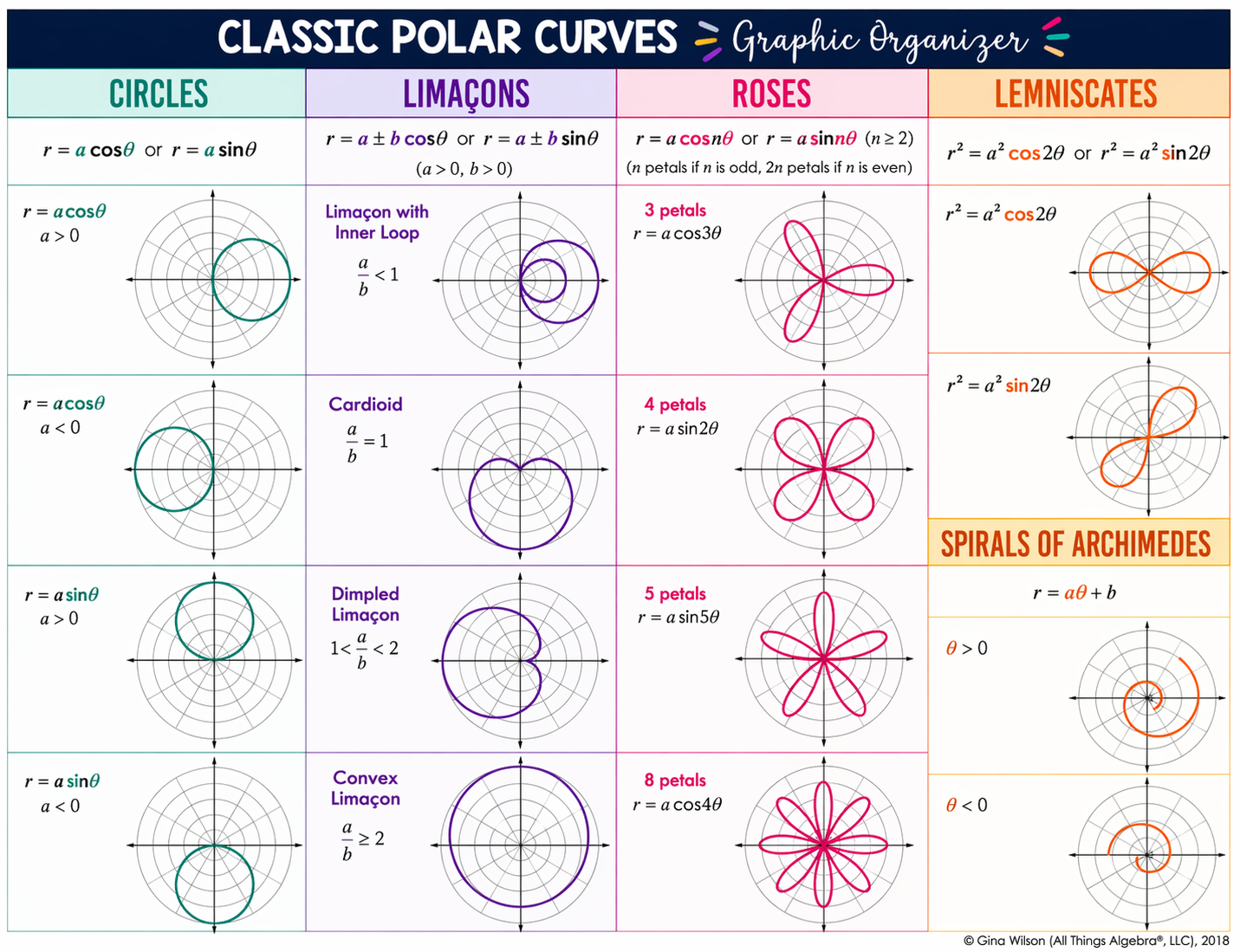
❤️ Cardioid
When |a| = |b| and k = 1, you get a cardioid — a heart‑shaped
curve. It passes through the origin exactly once.
🌸 Rose Curves
- Set
a = 0,b ≠ 0, varyk. - k odd → k petals
- k even → 2k petals
- Fractional k → exotic shapes!
🔵 Limaçons
|a/b| < 1→ inner loop|a/b| = 1→ cardioid1 < |a/b| < 2→ dimpled|a/b| ≥ 2→ convex
🔄 sin vs cos
Switching from sin to cos rotates the curve by 90°. The shape
stays identical — only its orientation changes.
⭕ Simple Circle
Set a = 0, k = 1: you get r = b·sin(θ) — a circle of
diameter |b| centred on the y‑axis.
📐 Polar ↔ Cartesian
x = r·cos(θ)y = r·sin(θ)r² = x² + y²
Use these to convert
between systems.
📏 Symmetry Rules
- sin → symmetric about y‑axis
- cos → symmetric about x‑axis
- k even → extra symmetry
What Are Polar Coordinates?
In standard Cartesian coordinates every point is described by two distances — how far right (x) and how far up (y). Polar coordinates take a completely different approach: every point is described by a distance from the origin called the radius (r) and an angle from the positive x‑axis called theta (θ). This makes polar coordinates the natural language for anything that rotates, spins, or radiates — from radar screens and sound waves to planetary orbits and electrical fields.
The conversion between the two systems is straightforward: \(x = r\cos\theta\) and \(y = r\sin\theta\). Going the other way, \(r = \sqrt{x^2+y^2}\) and \(\theta = \arctan(y/x)\). Mastering this conversion is essential for calculus, physics, and engineering.
The General Polar Equation: \(r = a + b\cdot\text{trig}(k\theta)\)
This visualizer uses the family \(r = a + b\sin(k\theta)\) (or cos). Each parameter plays a distinct role:
- a — the offset. It shifts the entire curve away from the origin. When a = 0 you get pure rose curves or circles. As |a| grows the curve becomes more loop‑like.
- b — the amplitude. It controls the maximum radius the curve can reach. The overall size of the shape scales with |b|.
- k — the frequency. It determines how many times the trigonometric function completes a cycle as θ goes from 0 to 2π. This is what creates petals on rose curves and inner loops on limaçons.
Types of Polar Curves
❤️ Cardioid
Condition: \(|a| = |b|\), \(k = 1\). The cardioid is the most famous polar curve — it looks like a heart. It is traced exactly once as \(\theta\) goes from \(0\) to \(2\pi\) and passes through the origin at \(\theta = \tfrac{3\pi}{2}\) (for sin). Area \(= 6\pi b^2\). Cardioids appear in microphone polar patterns and acoustic engineering.
🌸 Rose Curves \(r = b\sin(k\theta)\)
Set \(a = 0\). The number of petals depends on \(k\): if \(k\) is odd, you get \(k\) petals; if \(k\) is even, you get \(2k\) petals. Fractional values of \(k\) produce incomplete or overlapping petals creating exotic shapes. Each petal has length equal to \(|b|\).
🔵 Limaçons
When \(k = 1\) and \(a \neq 0\), \(b \neq 0\): the ratio \(|a/b|\) determines the shape: \(<1\) → inner loop, \(=1\) → cardioid, \(1<|a/b|<2\) → dimpled, \(\geq 2\) → convex (no dimple). Named after the French word for snail.
⭕ Circles
\(r = b\sin\theta\) (with \(a=0,\,k=1\)) gives a circle of diameter \(|b|\) centred on the \(y\)-axis. \(r = b\cos\theta\) gives the same circle on the \(x\)-axis. The equation \(r = c\) (constant) is the simplest polar curve — a circle of radius \(c\) centred at the origin.
Symmetry in Polar Curves
Symmetry tests save enormous effort when graphing polar curves by hand:
- Polar axis (\(x\)-axis) symmetry: Replace \(\theta\) with \(-\theta\). If the equation is unchanged, the curve is symmetric about the \(x\)-axis. Cosine functions naturally satisfy this.
- Line \(\theta = \pi/2\) (\(y\)-axis) symmetry: Replace \(\theta\) with \(\pi-\theta\). Sine functions naturally produce \(y\)-axis symmetry.
- Origin symmetry: Replace \(r\) with \(-r\). If unchanged, the curve is symmetric about the origin. Even values of \(k\) always produce this extra symmetry.
Key Formulas for Calculus
📐 Arc Length
\[L = \int\sqrt{r^2 + \left(\frac{dr}{d\theta}\right)^2}\,d\theta\]Integrate over the full range of \(\theta\) that traces the curve once.
📏 Area Enclosed
\[A = \frac{1}{2}\int r^2\,d\theta\]For a full curve integrate from \(0\) to \(2\pi\). For one petal, find the angles where \(r=0\).
📉 Slope (dy/dx)
\[\frac{dy}{dx} = \frac{\dfrac{dr}{d\theta}\sin\theta + r\cos\theta}{\dfrac{dr}{d\theta}\cos\theta - r\sin\theta}\]
🔁 Period
For \(r = f(k\theta)\), the period in \(\theta\) is \(\dfrac{2\pi}{k}\). A fractional \(k\) may need multiple full revolutions to close the curve.
Real‑World Applications
- Antenna & Microphone Design: Cardioid patterns describe directional pickup zones for mics and transmitters.
- Astronomy: Planetary orbits are ellipses expressed simply as polar equations: \(r = \dfrac{l}{1 + e\cos\theta}\), where \(e\) is eccentricity.
- Engineering: Stress distributions around circular holes in plates follow rose‑like polar patterns.
- Computer Graphics: Polar parametric equations generate organic, naturally‑looking shapes impossible to describe efficiently in Cartesian form.
- Signal Processing: Fourier analysis in polar form underpins MRI imaging and radar systems.
Frequently Asked Questions
Q: Why does sin give a different orientation than cos?
Because \(\sin\theta = \cos(\theta - \pi/2)\). Swapping sin for cos effectively rotates every point by \(90°\). The shape is identical — only its alignment with the axes changes.
Q: What happens when r is negative?
A negative \(r\) means the point is plotted in the opposite direction of \(\theta\). This is why limaçons with inner loops are traced — the curve passes through negative \(r\) values as \(\theta\) varies, creating the inner loop on the opposite side.
Q: How do I find where two polar curves intersect?
Set the two equations equal and solve for \(\theta\). Also check the origin separately — both curves may pass through \((0,\,0)\) at different \(\theta\) values, making it an intersection point that the algebraic method misses.
Q: Can k be a fraction?
Yes! Fractional \(k\) creates curves that require more than one full revolution to close. For example \(k = \tfrac{3}{2}\) closes after two revolutions (\(0\) to \(4\pi\)), producing a 3‑petal rose with overlapping loops.