
Exponential Decay - Complete Study Guide
Last updated: March 2026 | Mathematics & Science
Quick Navigation
- Introduction to Decay
- Understanding the Meaning
- The Decay Formula
- Linear vs Exponential Decrease
- Decay vs Growth
- Solving Basic Problems
- Rates vs Factors
- Tables and Graphs
- Real-Life Applications
- Half-Life Equations
- Finding Missing Values
- Continuous Decay (e)
- Common Mistakes
- Exam Strategies
- Practice Problems
- Interactive Decay Calculator
1. Introduction to Exponential Decay
Every time you snap a photograph with a bright flash, the light slowly fades into darkness. Every time you buy a new car and drive it off the lot, it immediately begins losing its financial value. Every time a doctor prescribes antibiotics, the concentration of the medicine in your bloodstream gradually shrinks until it is gone.
None of these things disappear instantly, nor do they lose a flat, constant amount every minute. Instead, they fade away fraction by fraction, losing a percentage of whatever is currently left. This mathematical phenomenon—the gradual, curving fade into nothingness—is called exponential decay.
What is Exponential Decay?
Exponential decay occurs when a quantity decreases over time at a rate that is proportional to its current value. In simple, beginner-friendly terms: it means a quantity shrinks by the same percentage (or is multiplied by the same fraction) during every single time interval. It does not subtract the same number; it multiplies by a decimal smaller than 1.
How does it differ from Linear Decrease?
Linear decrease is like paying exactly $50 toward a debt every month. You subtract a hard, rigid number every time. Exponential decay is like losing 10% of your remaining battery life every hour. Because the battery life gets smaller, the 10% chunk you lose also gets smaller. As time goes on, the amount you are losing decreases.
How does it differ from Exponential Growth?
Exponential growth builds upward, multiplying by a number larger than 1 (like 1.05 or 2), aggressively speeding up as time passes. Exponential decay swoops downward, multiplying by a fraction or decimal (like 0.90 or 0.5), aggressively slowing down as time passes.
Students often confuse these patterns because the formulas look nearly identical on exams. They both use exponents, and they both involve percentages. But mistaking one for the other will give you wildly incorrect answers—like predicting a car will be worth a million dollars in ten years, rather than a few thousand.
2. Understanding the Meaning of Exponential Decay
To master exponential decay, you must wrap your head around the idea of repeated multiplication by a fraction. Let's define the core vocabulary:
- Initial Value: The starting amount at time zero (the price of the brand new car, the starting mg of the medicine).
- Decay Rate: The percentage by which the value decreases each time period (e.g., losing 20% value each year).
- Decay Factor: The actual multiplier you use. If you lose 20%, you keep 80%. So your decay factor is 80%, or 0.80.
- Repeated Multiplication: Taking the previous answer and multiplying it by the decay factor again and again.
Why Does it Decrease Quickly at First, and Slowly Later?
Because you are taking a percentage of the remaining amount. If you have $100 and lose 20%, you lose $20. But if you only have $10 left and lose 20%, you only lose $2. The "damage" gets smaller as the total gets smaller.
Example A: Losing 20% (Decay Factor = 0.80)
Imagine you have 100 grams of a chemical that evaporates, losing 20% of its mass each day. Losing 20% means 80% remains. We multiply by 0.80.
- Day 0: 100
- Day 1: 80 (which is 100 * 0.80. We lost 20g)
- Day 2: 64 (which is 80 * 0.80. We lost 16g)
- Day 3: 51.2 (which is 64 * 0.80. We lost 12.8g)
- Day 4: 40.96 (which is 51.2 * 0.80. We lost 10.24g)
Notice how the number goes down every time, but the amount it goes down shrinks. The drop from Day 0 to 1 was big (20). The drop from Day 3 to 4 was small (10.24).
Example B: Losing 10% (Decay Factor = 0.90)
Let's say a school's population of 500 students drops by 10% each year due to families moving away. Dropping 10% means 90% stays. Multiply by 0.90.
- Year 0: 500
- Year 1: 450 (which is 500 * 0.90. Lost 50)
- Year 2: 405 (which is 450 * 0.90. Lost 45)
- Year 3: 364.5 (which is 405 * 0.90. Lost 40.5)
3. The Exponential Decay Formula
We do not want to calculate Day 50 by hitting multiply on a calculator 50 times. We use standard algebraic formulas to jump straight to the answer.
Every piece of this formula has a specific physical meaning:
- y = The final amount (or future value) left over.
- a = The initial amount (how much you started with).
- r = The decay rate, expressed as a decimal. (If it leaks 5%, r = 0.05).
- (1 - r) = The decay factor (the base of the exponent). The "1" represents 100% of your starting amount, and the "- r" represents subtracting the portion that decays. The result is what remains.
- t = Time elapsed. The exponent tells the formula how many times to repeat the subtraction of that percentage.
Related Forms You Might See
- Finance Depreciation: A = P(1 - r)t. Used for calculating the depreciating value of assets like cars or machinery.
- General Math: y = abt (where 0 < b < 1). They compress "(1 - r)" into the letter "b". The crucial rule for decay is that "b" MUST be a fraction or decimal between 0 and 1.
Beginner Examples
Example 1: Setting up the formula
A new computer is purchased for $2,000. It loses 18% of its value every year. Write the formula for its value after t years.
Step 1: Identify the initial amount: a = 2000.
Step 2: Identify the rate as a decimal: 18% means r = 0.18.
Step 3: Build the decay factor: 1 - r = 1 - 0.18 = 0.82. (Meaning the computer keeps 82% of its value).
Step 4: Write the equation: y = 2000(0.82)t
Example 2: Reading the formula backwards
A scientist is tracking an endangered bird population using the model P = 850(0.96)t. What does this tell us?
Answer: First, because the number inside the parentheses (0.96) is less than 1, we know the population is decreasing (decaying). The initial population was 850 birds. Because the factor is 0.96, the equation represents 1 - r = 0.96. Solving for r gives us 0.04. Therefore, the population is decreasing by 4% per year.
4. Exponential Decay vs. Linear Decrease
It is vital to distinguish between dropping by a set amount (linear) and dropping by a percentage (exponential).
| Linear Decrease | Exponential Decay |
|---|---|
| Action: Subtracts the exact same constant number each time period. | Action: Multiplies by the exact same constant fraction (keeps the same percentage) each time period. |
| Formula Tool: Subtraction (-) | Formula Tool: Multiplication (×) and Exponents |
| Graph Shape: A perfectly straight line angling downward. Will safely cross below zero into negative numbers. | Graph Shape: A swooping curve that levels off horizontally. Will never reach zero or become negative. |
The Water Tank Analogy
Imagine two 100-gallon water tanks. Tank A has a small hole that drains exactly 10 gallons every hour (Linear). Tank B has a magic filter that drains exactly 10% of the remaining water every hour (Exponential).
| Hour | Tank A (Subtract 10 gal) - Linear | Tank B (Keep 90%) - Exponential |
|---|---|---|
| 0 | 100 gal | 100 gal |
| 1 | 90 gal | 90.0 gal |
| 2 | 80 gal | 81.0 gal |
| 3 | 70 gal | 72.9 gal |
| 4 | 60 gal | 65.61 gal |
| 10 | 0 gal (Completely Empty!) | 34.87 gal |
| 20 | Empty | 12.16 gal |
| 50 | Empty | 0.52 gal (Still not empty!) |
Notice that the Linear tank hits zero and stops. The Exponential tank slows down its leaking as the water level drops, meaning it creates an infinitely long "tail" of tiny water amounts, constantly approaching empty but never mathematically hitting exactly zero.
5. Exponential Decay vs Exponential Growth
How do you tell the two exponential siblings apart? Look at the base (the factor inside the parentheses).
| Feature | Exponential Growth | Exponential Decay |
|---|---|---|
| Factor (Base) magnitude | b > 1 (Greater than 1) | 0 < b < 1 (Between 0 and 1) |
| What the factor looks like | 1 + r (e.g., 1.05, 1.30, 2, 4) | 1 - r (e.g., 0.95, 0.70, 0.5, 0.1) |
| Visual Graph | Starts flat, shoots upward to infinity. | Starts high, swoops downward, flattens out near zero. |
| Example Equation | y = 50(1.12)t | y = 50(0.88)t |
The 100% Rule
To differentiate them instantly, ask yourself: "Am I returning more than 100% of my money, or less than 100%?" Over 100% (or 1.0) is growth. Under 100% (or 1.0) is decay. If the factor is exactly 1.0, nothing happens at all—it stays permanently flat.
6. Solving Basic Exponential Decay Problems
When you solve an exponential decay word problem, you follow the same core steps as exponential growth, but you subtract the rate from 1 instead of adding it.
- Identify the initial value (a): What are we starting with?
- Identify the decay rate (r): What percentage is it decreasing by? Convert this to a decimal.
- Build the decay factor (1 - r): Subtract your decimal rate from exactly 1.
- Identify the time (t): How long is it decaying for?
- Substitute into y = a(1 - r)t and calculate.
Example 1: Population Decline
Problem:
A mining town has a population of 12,500 people. Since the mine closed, the population has been declining at a rate of 6% each year. What will the population be in 5 years?
Solution:
- Initial value (a) = 12,500
- Decay rate (r) = 6% = 0.06
- Decay factor (1 - r) = 1 - 0.06 = 0.94
- Time (t) = 5
Equation: y = 12500(0.94)5
Calculate: y ≈ 12500(0.7339)
Answer: y ≈ 9,174 people. (Round to the nearest whole person).
Interpretation: The town will lose over 3,000 residents, settling at roughly 9,174 people.
Example 2: Car Value Depreciation
Problem:
You buy a brand new sedan for $35,000. It depreciates (loses value) at a rate of 15% per year. How much is the car worth after 4 years?
Solution:
- Initial value (a) = 35,000
- Decay rate (r) = 15% = 0.15
- Decay factor (1 - r) = 1 - 0.15 = 0.85
- Time (t) = 4
Equation: y = 35000(0.85)4
Calculate: y ≈ 35000(0.5220)
Answer: y = $18,270.22.
Interpretation: In just 4 years, the car has lost nearly half its original value!
Example 3: Radioactive Decay (Percentage)
Problem:
A laboratory has 500 grams of a radioactive isotope. It decays seamlessly by 8% every hour. How many grams remain after 24 hours?
Solution:
- Initial value (a) = 500
- Decay rate (r) = 8% = 0.08
- Decay factor (1 - r) = 0.92
- Time (t) = 24
Equation: y = 500(0.92)24
Calculate: y ≈ 500(0.1352)
Answer: y ≈ 67.6 grams remain.
Example 4: Cooling Process (Newton's Basics)
Problem:
A cup of coffee sits in a cold room. The difference between the coffee's temperature and the room temperature starts at 150°F. This temperature difference decays by 20% every 10 minutes. What will the difference be after 30 minutes?
Solution:
- Initial value (a) = 150
- Decay rate (r) = 20% = 0.20
- Decay factor (1 - r) = 0.80
- Time (t): The rate happens every 10 minutes. We have 30 minutes total. 30 / 10 = 3 time cycles. So t = 3.
Equation: y = 150(0.80)3
Calculate: y = 150(0.512)
Answer: y = 76.8°F.
Example 5: Product Value Decreasing
Problem:
A high-end smartphone costs $1,200 when it launches in January 2025. Due to new models coming out, its resale value drops by 25% each year. What will it be worth in January 2028?
Solution:
- Initial value (a) = 1200
- Decay rate (r) = 25% = 0.25
- Decay factor (1 - r) = 0.75
- Time (t) = 2028 - 2025 = 3 years
Equation: y = 1200(0.75)3
Calculate: y = 1200(0.421875)
Answer: y = $506.25.
7. Decay Factor and Percentage Decrease
The single most dangerous trap for students is putting the percentage lost into the parenthesis instead of the percentage retained. You must mathematically convert the loss into what remains.
The Rules of Conversion for Decay
- Percentage to Decimal Rate (r): Divide the percentage drop by 100. (e.g., losing 5% means r = 0.05).
- Decimal Rate (r) to Decay Factor (Base): Subtract from precisely 1. (e.g., 1 - 0.05 = 0.95).
The number 0.95 goes inside the parenthesis, meaning "We are intentionally keeping 95% of whatever we had a second ago."
Conversion Examples
| Percentage Lost (Decay) | Decimal Rate (r) | Math (1 - r) | Decay Factor (The Base) |
|---|---|---|---|
| 5% leak | 0.05 | 1 - 0.05 | 0.95 |
| 12% drop | 0.12 | 1 - 0.12 | 0.88 |
| 30% shrink | 0.30 | 1 - 0.30 | 0.70 |
| 0.5% trickle | 0.005 | 1 - 0.005 | 0.995 |
| 75% plummet | 0.75 | 1 - 0.75 | 0.25 |
Common percentage calculation mistake
A problem says: "A chemical decays by 8% daily."
Wrong: y = 50(0.08)t. This means the chemical ONLY keeps 8% a day (meaning it loses 92%!).
Right: y = 50(0.92)t. It loses 8%, so it keeps 92%.
8. Tables and Graphs of Exponential Decay
Just like exponential growth swoops upward, exponential decay swoops downward forming a very satisfying visible slide.
Building a Value Table
Let's build a table for the equation y = 100(0.5)x. This represents something starting at 100 and cutting in half every time step.
| x (Time) | Calculation | y (Amount) |
|---|---|---|
| 0 | 100(0.5)0 | 100 |
| 1 | 100(0.5)1 | 50 |
| 2 | 100(0.5)2 | 25 |
| 3 | 100(0.5)3 | 12.5 |
| 4 | 100(0.5)4 | 6.25 |
Notice the pattern in the 'y' column: 100 → 50 → 25 → 12.5 → 6.25. The gap between the first two numbers is huge (50 points). The gap between the last two numbers is small (6.25 points). The decay rate slows down over time.
Graphing the Curve
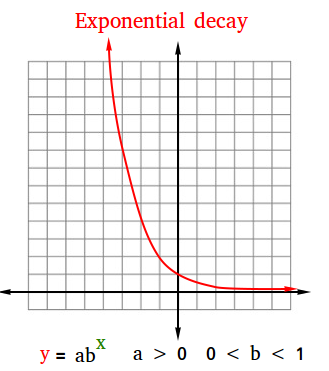
If you plot the points from the table above on an X-Y coordinate plane, you get a "water slide" curve. Here are the defining features of an exponential decay graph:
- The y-intercept: The graph crosses the vertical y-axis exactly at the initial value. In
y=100(0.5)x, it hits the axis at (0, 100). - Decreasing Curve: From left to right, the graph constantly falls downward.
- Rate of Decrease: The slope is incredibly steep on the left side (it is crashing downward rapidly). As you move to the right, the slope gets flatter and flatter.
- The Horizontal Asymptote: Assuming your initial amount was positive, the graph approaches the x-axis but never mathematically touches it. If you take half of 6.25, you get 3.125. Take half again, you get 1.56. Take half forever, you will get microscopic numbers like 0.00000001, but you can never actually hit zero just by multiplying by smaller fractions. The x-axis acts as an invisible electric fence called an asymptote.
9. Exponential Decay in Real Life
Exponential decay governs how things break down, disappear, cool off, and lose value in the physical world.
Depreciation (Cars and Electronics)
When you buy a brand new smartphone for $1,000, it does not drop by a flat $100 every year forever. If it did, it would be worth exactly $0 in ten years, and then next year it would be worth negative $100. Instead, used electronics drop by a percentage (say, 30% a year). It drops quickly from $1,000 to $700, but dropping another 30% from the $700 mark only loses $210.
Medicine Concentration
When you take a 400mg dose of Ibuprofen, your kidneys and liver begin filtering it out. They filter a percentage every hour. If your body filters 25% an hour, after one hour you have 300mg left. After two hours, you have 225mg left. The kidneys filter proportionally to what is in your blood.
Cooling (Newton's Law of Cooling)
A hot cup of tea cools down rapidly when it is boiling hot. But when it gets closer to room temperature, the cooling slows down dramatically to a crawl. The difference in temperature decays exponentially until the tea is exactly aligned with the room.
Radioactive Decay (Carbon Dating)
Unstable atoms (like Carbon-14) randomly decay into stable atoms. Because it is random, physics tells us that a perfectly consistent percentage of the remaining atoms will decay in any given chunk of time. Scientists use this exact math to figure out how old dinosaur bones and ancient artifacts are.
Financial Reducing Balances
Unlike compound interest that builds your savings up, paying off a massive mortgage loan means the interest you owe the bank decays over time. As the overall debt gets smaller, the percentage the bank charges you shrinks into smaller and smaller dollar amounts.
10. Half-Life and Exponential Decay
The most famous concept in exponential decay is Half-Life. Half-life is a very specific measurement of time.
Definition of Half-Life
Half-life is the exact amount of time required for a decaying quantity to reduce to half of its current value. Because the proportion of decay is constant, the time it takes to lose exactly 50% is also entirely constant everywhere on the timeline.
If you have 100 grams of a substance with a half-life of 5 days, how much is left after 5 days? Exactly 50 grams. How much is left after another 5 days? Half of the 50... which is 25 grams.
The Half-Life Formula
Where:
- a = Initial amount
- (1/2) = Our decay factor, because we are halving.
- t = Total time elapsed.
- h = The length of one half-life.
- t/h = The number of half-life "cycles" we have gone through. (e.g., If 15 years pass, and the half-life is 5 years, then 15/5 = 3 cycles).
Example 1: Basic Half-Life Calculation
Iodine-131 has a half-life of 8 days. If a hospital receives a shipment of 40 grams, how much will remain active after 24 days?
- Initial (a) = 40
- Total time (t) = 24
- Half-life period (h) = 8
Step 1 (Cycles): Calculate t/h. 24 / 8 = 3. The material cuts in half 3 separate times.
Equation: y = 40(0.5)3
Calculate: y = 40(0.125)
Answer: 5 grams remain.
11. Finding Missing Values in Exponential Decay
Exams frequently ask you to work the formula backward.
Finding the Initial Amount (a)
Problem:
After 3 years of depreciating at 20% per year, a company's delivery truck is now worth exactly $12,800. What was its original purchase price?
Set up the equation: y = 12800, r = 0.20, t = 3. We find a.
12800 = a(1 - 0.20)3
Calculate the factor: 1 - 0.20 = 0.80. Then 0.803 = 0.512.
12800 = a(0.512)
Solve algebraically: Divide both sides by 0.512.
a = 12800 / 0.512
Answer: a = $25,000. It originally cost $25,000.
Finding the Decay Rate (r)
Problem:
A rare stamp collection was valued at $3,000. Four years later, it is valued at $1,920 due to damage. Assuming an exponential model, what was the average yearly decay rate?
Set up the equation: y = 1920, a = 3000, t = 4. Find r.
1920 = 3000(1 - r)4
Step 1 (Isolate the base): Divide by 3000.
0.64 = (1 - r)4
Step 2 (Undo the exponent): Take the 4th root (or power of 1/4) of both sides.
(0.64)1/4 = 1 - r
0.8944 = 1 - r
Step 3 (Solve for r): Swap the r and the 0.8944.
r = 1 - 0.8944
r = 0.1056
Answer: The value decays by approximately 10.56% per year.
Finding the Time (t) using Logarithms
When time (t) is the unknown variable, it is trapped up in the exponent. To pull it down, we must use logarithms. Advanced exams love testing this.
Problem:
A population of 8,000 frogs is decreasing by 4% each year due to pollution. How many exact years will it take for the population to drop to 5,000 frogs?
Set up the equation: y = 5000, a = 8000, r = 0.04.
5000 = 8000(0.96)t
Step 1 (Isolate the base): Divide by 8000.
0.625 = 0.96t
Step 2 (Use Logarithms): Take the natural log (ln) of both sides.
ln(0.625) = ln(0.96t)
ln(0.625) = t * ln(0.96) (Log rule: Exponents pull to the front)
Step 3 (Solve for t): Divide by ln(0.96).
t = ln(0.625) / ln(0.96)
t = -0.4700 / -0.0408
Answer: t ≈ 11.5 years.
12. Exponential Decay and Continuous Decay
Most textbook decay problems are discrete. That means the math calculates the decay in "chunks" (once a year, once an hour, etc.). But in the real physical world, things like a hot cup of coffee don't wait an hour, calculate a new 10% drop, and suddenly change temperature. The coffee cools every single microscopic fraction of a second.
This is called continuous decay. The drops are infinitely small, happening infinitely often.
The Continuous Decay Formula
This introduces the magic mathematical constant e (approx 2.718), known as Euler's number. It acts as the ultimate "speed limit" for continuous compounding or continuous loss.
- A = Final amount
- P = Initial principal amount
- e = The constant 2.718...
- r = The continuous decay rate (as a decimal). (Notice the negative sign! The negative exponent makes it decay, shrinking the fraction instead of growing it).
- t = Time elapsed
Comparing Discrete vs Continuous
A radioactive substance starts with 200g. It drops at a rate of 5% a year. Let's calculate exactly 1 year of decay both ways.
Discrete Method (y = a(1-r)t):
y = 200(1 - 0.05)1 = 200(0.95) = 190 grams.
Continuous Method (A = Pe-rt):
A = 200(e)-0.05(1)
A = 200(0.951229) = 190.246 grams.
They are extremely close! The continuous formula gives a slightly higher number because the substance loses an infinitely tiny slice right away at 0.01 seconds, making the "remaining amount" smaller earlier, slowing the total rate of decay just barely.
13. Common Student Mistakes
Exponential decay is famously tricky on exams because it relies heavily on percentage manipulation. Watch out for these traps.
Mistake 1: Confusing Decay Rate with Decay Factor
Wrong: The computer depreciates by 15%. The student writes y = 1200(0.15)t.
Correct: Multiplying by 0.15 is finding 15% of a number (meaning the computer lost 85% of its value instantly!). To DECAY by 15%, you must keep the remaining 85%. The factor is 1 - 0.15 = 0.85. The correct equation is y = 1200(0.85)t.
Mistake 2: Mixing up Growth and Decay Formulas
Wrong: A chemical decays 8% a day. Student writes y = a(1 + 0.08)t.
Correct: Growth is 1 + r. Decay is 1 - r. A factor over 1 means it is growing infinitely. A factor under 1 means it is shrinking to zero.
Mistake 3: Treating Exponential Decay like Linear Decrease
Wrong: Dropping 10% in Year 1, and 10% in Year 2, means dropping a total of 20% over two years.
Correct: Decrementing by 10% twice means you multiplied by 0.90 twice. (0.90 * 0.90 = 0.81). This means you have exactly 81% left. You dropped a total of 19%, not 20%.
Mistake 4: Calculator Order of Operations
Wrong: Typing 500 * 0.5 ^ 4 and the calculator does (500 * 0.5) ^ 4.
Correct: Exponents ALWAYS execute before multiplication. Make sure you calculate 0.5^4 first, hit equals, and THEN multiply by 500. Some smartphones do this poorly, so use a real scientific calculator.
14. Exam Tips and Problem-Solving Strategies
Strategy 1: Sniff Test for Reasonability
Always pause and check if your final answer makes physical sense. If a hospital patient takes 500mg of medicine, and your formula says an hour later they have 1,200mg in their blood... you accidentally used the exponential growth formula. If the answer is negative, you incorrectly assumed it was linear subtraction.
Strategy 2: Identify Growth, Decay, or Linear Keywords
- Linear Decrease: "Loses exactly $50 per month", "drops 5 degrees per hour", "constant flat fee". → Use `y = -mx + b`.
- Exponential Growth: "Increases 6% annually", "doubles every day", "appreciates in value". → Factor > 1.
- Exponential Decay: "Drops by 6% annually", "depreciates over time", "half-life is 10 days", "filters out 15%". → Factor between 0 and 1.
Strategy 3: Do Not Round Too Early
If you calculate a decay factor raised to a large power (like 0.9820), do not round that tiny decimal off too early to 0.6. Keep it exactly intact in your calculator (0.667608...) and multiply it by the initial amount immediately. Early rounding destroys accuracy.
15. Practice Problems
Work these problems on scratch paper before clicking "Show Solution". They progress from easy identification to advanced time-finding.
Question 1 (Identify Decay Factor)
A population of wolves drops by 12% every year. What is the decay factor you should use in the equation?
Rate (r) = 12% = 0.12.
Decay Factor = 1 - r = 1 - 0.12 = 0.88.
Answer: The decay factor is 0.88
Question 2 (Evaluate Basic Equation)
Evaluate the car's value after 6 years using the model: V = 24000(0.85)6.
Calculate exponents first: (0.85)6 ≈ 0.37715
Multiply: 24000 * 0.37715 = 9051.6
Answer: $9,051.60
Question 3 (Linear vs Exponential)
Which situation represents exponential decay?
- A student pays $25 off their monthly debt bill.
- A company's profits decrease by 5% every quarter due to a recession.
Option A subtracts a constant amount (-$25). That is linear decrease.
Option B loses a percentage every quarter, meaning it multiplies by a constant factor (0.95). Percentage decreases are exponential decay.
Answer: B
Question 4 (Write the Equation)
A patient takes 800mg of headache medicine. Their liver filters it out, causing it to decay by 30% every hour. Write the equation representing the amount of medicine 'y' left after 't' hours.
Initial (a) = 800. Rate (r) = 0.30. Factor = 1 - 0.30 = 0.70.
Formula: y = a(1-r)t
Answer: y = 800(0.70)t
Question 5 (Reading an Equation)
A scientist models a radioactive substance with the equation A = 450(0.92)t, where t is in years. What was the initial mass, and what is the yearly decay rate percentage?
The number in front is the initial amount (a = 450).
The base is the decay factor (1 - r = 0.92). Therefore, r = 0.08.
Answer: Initial mass is 450g. The decay rate is 8% per year.
Question 6 (Depreciation)
A tractor costs $80,000. It depreciates 18% a year. How much is it worth in 5 years?
y = 80000(1 - 0.18)5
y = 80000(0.82)5
y = 80000(0.37074)
Answer: $29,659.18
Question 7 (Half-Life Calculation)
A radioactive gas has a half-life of 4 hours. If there are 200 grams to start, how much will remain after exactly 12 hours?
Total time = 12. Half-life = 4.
Cycles: 12 / 4 = 3 half-life cycles.
y = 200(0.5)3
y = 200(0.125)
Answer: 25 grams.
Question 8 (High Percentage Rate)
A chemical leaks from a tank rapidly. It loses 80% of its volume every minute. If it starts with 5,000 liters, how much remains after 4 minutes?
r = 80% = 0.80. Decay factor = 1 - 0.80 = 0.20.
y = 5000(0.20)4
y = 5000(0.0016)
Answer: 8 liters.
Question 9 (Table Interpretation)
Does this table represent linear or exponential decay?
x = 0, y = 100
x = 1, y = 50
x = 2, y = 25
x = 3, y = 12.5
Check differences (Linear check): It drops 50, then 25, then 12.5. Not perfectly linear (subtraction changes).
Check ratios (Exponential check): 50 / 100 = 0.5. 25 / 50 = 0.5. 12.5 / 25 = 0.5.
Answer: Exponential decay (Factor of 0.5).
Question 10 (Finding Missing Value - Initial Amount)
After 2 years of dropping at 15% annually, a stock portfolio is worth $14,450. How much was originally invested?
14450 = P(0.85)2
14450 = P(0.7225)
P = 14450 / 0.7225
Answer: $20,000.00
Question 11 (Finding Missing Value - Rate)
An antique vase worth $3,000 is damaged. Three years later it is appraised at only $1,536. Assuming exponential decay, what was the average annual decay rate?
1536 = 3000(1 - r)3
0.512 = (1 - r)3
(0.512)1/3 = 1 - r
0.80 = 1 - r → r = 0.20
Answer: The decay rate is roughly 20% per year.
Question 12 (Fractional Time Period)
A population drops at 6% per year. The initial population is 10,000. What is the population after exactly 3 years and 6 months?
3 years and 6 months is t = 3.5 years.
y = 10000(0.94)3.5
y = 10000(0.8052)
Answer: ≈ 8,052 people.
Question 13 (Comparing Functions)
If Function A is y = 100(1.05)t and Function B is y = 100(0.95)t, which graph will eventually approach the x-axis?
Function A has a base greater than 1, so it represents growth and swings upward away from the x-axis.
Function B has a base less than 1, so it represents decay and swings downward, flattening out as a horizontal asymptote on the x-axis.
Answer: Function B.
Question 14 (Mixed Application)
In 2020, a forum had 45,000 active users. Because a newer competitor site opened, the number of users decreases by 5% each year. Assuming this model holds true, what formula predicts users in 2035?
Initial: 45000. Factor: 0.95. Time: 2035 - 2020 = 15 years.
Answer: y = 45000(0.95)15
Question 15 (Advanced: Find Time)
You have 800mg of a medicine in your bloodstream. It decays by 15% every hour. Set up the logarithmic equation you would need to use to find how many hours (t) until you only have 200mg left.
200 = 800(0.85)t
0.25 = 0.85t
Apply natural log: ln(0.25) = t * ln(0.85)
Isolate t: t = ln(0.25) / ln(0.85)
Answer: t = ln(0.25) / ln(0.85)
Interactive Exponential Decay Calculator
Decay Simulator
Test the formula! Enter an initial amount, the percentage it loses perfectly every time step, and the number of time steps.
16. Summary of Key Points
| Concept / Term | Key Takeaway / Formula |
|---|---|
| Exponential Decay | A quantity that strictly decreases over time by losing a consistent percentage. Follows a swooping "water slide" curve graph downward. |
| Decay Rate (r) | The percentage of loss written as a decimal (e.g., losing 8% = 0.08). |
| Decay Factor (1 - r) | The flat multiplier showing what percentage is kept (e.g., 1 - 0.08 = 0.92). This is the base of the exponent. |
| Standard Formula | y = a(1 - r)t Where a=initial amount, r=decimal decay rate, t=time. |
| Growth vs Decay | Growth multiplies by a factor > 1. Decay multiplies by a factor between 0 and 1. |
| Linear Decrease | Subtracts a constant fixed dollar amount or number, rather than multiplying by a percentage factor. |
| Half-Life | The exact, constant time it takes for a substance to perfectly lose 50% of its current mass. Used mostly in nuclear physics and pharmacology. |
You have conquered the Exponential Decay Study Guide!
You are now ready to tackle half-life equations, financial depreciation, and algebra exams with confidence.