
Exponential Growth - Complete Study Guide
Last updated: March 2026 | Mathematics & Finance
Quick Navigation
1. Introduction to Exponential Growth
There is a famous mathematical legend about the inventor of chess. When asked by the emperor what reward he wanted, the inventor asked for one grain of wheat on the first square of the chessboard, two grains on the second, four on the third, eight on the fourth, and so on, doubling each time. The emperor agreed, thinking it was a cheap prize. By the 64th square, the amount of wheat required was more than all the wheat that existed in the world.
That story is the perfect introduction to exponential growth. It starts off deceptively slow and small, but because it multiplies upon itself, it eventually explodes into overwhelmingly large numbers.
What is Exponential Growth?
In mathematics, exponential growth occurs when a quantity increases over time at a rate that is proportional to its current value. In simple, beginner-friendly language: it means something grows by the same percentage or multiplies by the same factor during every time step. Instead of simply adding a fixed amount, it multiplies.
Why is it Important?
Understanding exponential growth is one of the most useful mathematical skills you can develop for your real life. Why? Because the most important systems in our world do not grow in a straight line—they grow exponentially. Money in a savings account, bacteria dividing in a petri dish, the spread of a viral video on social media, the rise of computing power, and the inflation of prices in an economy all follow rules of exponential growth.
Why Do We Confuse It?
The human brain is naturally wired to think in linear terms—if I walk 3 miles in one hour, I'll walk 6 miles in two hours, and 9 miles in three hours (adding 3 every time). Our brains have a very hard time grasping how incredibly fast multiplication starts to stack up. This cognitive bias is why people underestimate credit card debt and are surprised by how quickly a small local disease outbreak can become a global epidemic.
2. Understanding the Meaning of Exponential Growth
To truly understand exponential growth, you need to understand that it is built on repeated multiplication. Let's look at the basic vocabulary first.
- Initial Value: The amount you start with at time zero. (Often called the principal in finance).
- Growth Rate: The percentage by which the value increases each time period (e.g., growing by 10% each year).
- Growth Factor: The multiplier that you actually use to calculate the next step. If you grow by 10%, you keep 100% of what you had, plus a new 10%. So your growth factor is 110%, or 1.10.
- Repeated Multiplication: Taking the previous answer and multiplying it by the growth factor again, and again, and again.
Example A: Doubling (Growth Factor = 2)
Let's say we start with 2 bacteria cells, and they double every hour. That means our growth factor is 2. The sequence looks like this:
- Hour 0: 2
- Hour 1: 4 (which is 2 * 2)
- Hour 2: 8 (which is 4 * 2)
- Hour 3: 16 (which is 8 * 2)
- Hour 4: 32 (which is 16 * 2)
- Hour 5: 64 (which is 32 * 2)
Notice how the gap between the numbers keeps getting wider. From Hour 0 to 1, we only added 2 cells. But from Hour 4 to 5, we added 32 cells in the same amount of time. Exponential growth becomes faster over time because you are growing the new growth, not just the original amount.
Example B: Growing by 10% (Growth Factor = 1.10)
Let's say you invest $100, and it earns 10% interest every year. Earning 10% means you end the year with 110% of what you started with. As a decimal, we multiply by 1.10.
- Year 0: $100.00
- Year 1: $110.00 (which is 100 * 1.10)
- Year 2: $121.00 (which is 110 * 1.10)
- Year 3: $133.10 (which is 121 * 1.10)
- Year 4: $146.41 (which is 133.1 * 1.10)
Notice year 1 made you exactly $10 in profit. But year 4 made you $13.31 in profit. The base amount you are calculating the 10% from keeps getting bigger, so the 10% chunk gets bigger too.
3. The Exponential Growth Formula
Instead of manually multiplying step-by-step for 50 years (which would take forever), mathematicians use an elegant formula. Repeated multiplication is exactly what exponents were invented to do!
Let's break down where every single piece of this formula comes from:
- y = The final amount (or future value). This is what you are calculating.
- a = The initial amount (starting value). This is the multiplier sitting on the outside.
- r = The growth rate, expressed as a decimal. (If growth is 5%, r = 0.05).
- (1 + r) = The growth factor (the base of the exponent). The "1" represents keeping 100% of your current amount, and the "+ r" represents adding the new growth.
- t = The time elapsed. This is the exponent because it represents how many times you are hitting "multiply" on the calculator.
Related Forms You Might See
Depending on your textbook, or whether you are in a math class or a finance class, the letters might change, but the math is identical:
- Finance Context: A = P(1 + r)t. Focuses on money. A is Amount, P is Principal (starting cash).
- General Math Context: y = abx or y = abt. Here, they just squished the "(1 + r)" part into a single letter "b" which stands for base or growth multiplier.
Beginner Examples
Example 1: Setting up the formula
A town starts with 5,000 residents and grows at a rate of 3% per year. Write the formula for its population after t years.
Step 1: Identify the initial amount: a = 5000.
Step 2: Identify the rate as a decimal: 3% means r = 0.03.
Step 3: Build the growth factor: 1 + r = 1 + 0.03 = 1.03.
Step 4: Write the equation: y = 5000(1.03)t
Example 2: Reading the formula backwards
An antique car's value is modeled by y = 25000(1.08)t. What does this mean?
Answer: By looking at the equation, we can instantly tell the car was originally bought for $25,000 (because a = 25000). We also see the growth factor is 1.08. Since 1.08 is the same as 1 + 0.08, the growth rate is 0.08, meaning the car increases in value by 8% every year.
4. Exponential Growth vs. Linear Growth
The difference between linear and exponential growth comes down to a fundamental arithmetic difference: Adding vs. Multiplying.
| Linear Growth | Exponential Growth |
|---|---|
| Action: Adds the exact same constant amount each time period. | Action: Multiplies by the exact same constant factor each time period. |
| Formula: y = mx + b | Formula: y = a(1 + r)t |
| Graph Shape: A perfectly straight line. | Graph Shape: A curve that starts somewhat flat and shoots upwards aggressively ("hockey stick" shape). |
| Example Concept: Earning $15 per hour at a job. You make another $15 every single hour, guaranteed. | Example Concept: An investment earning 10% per year. The dollar amount you earn gets bigger every year. |
The Tale of Two Job Offers
Imagine you have two job offers. They both last for 15 days.
- Offer A (Linear): You get paid $1,000 the first day, and your pay increases by $1,000 every single day.
- Offer B (Exponential): You get paid a single penny ($0.01) the first day, but your pay doubles every single day.
Let's map out what you make on specific days:
| Day | Offer A (Add $1,000) | Offer B (Multiply by 2) |
|---|---|---|
| 1 | $1,000.00 | $0.01 |
| 2 | $2,000.00 | $0.02 |
| 5 | $5,000.00 | $0.16 |
| 10 | $10,000.00 | $5.12 |
| 15 | $15,000.00 | $163.84 |
| 20 | $20,000.00 (Wait, let's keep going...) | $5,242.88 |
| 30 | $30,000.00 | $5,368,709.12 (Over 5 Million!) |
This is the magic and terrifying reality of exponential growth. Linear growth feels better early on, but exponential growth will always overtake linear growth eventually, and once it does, it leaves the linear line in the dust.
5. Solving Basic Exponential Growth Problems
When you solve an exponential word problem, you always follow the same core steps.
- Identify the initial value (a): What are we starting with?
- Identify the growth rate (r): What percentage is it increasing by? Convert this to a decimal.
- Build the growth factor (1 + r): Add 1 to your decimal rate.
- Identify the time (t): How long is it growing for?
- Substitute into y = a(1 + r)t and calculate.
Example 1: Population Growth
Problem:
A small city has a population of 45,000 people. It is growing at a rate of 2.5% each year. What will the population be in 12 years?
Solution:
- Initial value (a) = 45,000
- Growth rate (r) = 2.5% = 0.025
- Growth factor (1 + r) = 1 + 0.025 = 1.025
- Time (t) = 12
Equation: y = 45000(1.025)12
Calculate: y ≈ 45000(1.34489)
Answer: y ≈ 60,520 people. (Note: We round to the nearest whole person because you cannot have a fraction of a human).
Example 2: Money in a Savings Account
Problem:
You deposit $1,500 into a high-yield savings account that guarantees a 4% annual return. If you leave the money alone, how much will you have in 5 years?
Solution:
- Initial value (a) = 1,500
- Growth rate (r) = 4% = 0.04
- Growth factor (1 + r) = 1.04
- Time (t) = 5
Equation: y = 1500(1.04)5
Calculate: y ≈ 1500(1.21665)
Answer: y = $1,824.98. (Note: We round money to exactly two decimal places for cents).
Example 3: Bacteria Growth (Rapid Rate)
Problem:
A biology class starts an experiment with 300 bacteria cells. The bacteria grow by 45% every hour. How many bacteria will be present after 6 hours?
Solution:
- Initial value (a) = 300
- Growth rate (r) = 45% = 0.45
- Growth factor (1 + r) = 1.45
- Time (t) = 6
Equation: y = 300(1.45)6
Calculate: y ≈ 300(9.293)
Answer: y ≈ 2,788 bacteria cells.
Example 4: Social Media Influencer
Problem:
A local bakery creates a viral pastry. Their Instagram followers jump from 1,200 and begin increasing by 15% every week. If this trend continues for 8 weeks, how many followers will they have?
Solution:
- Initial value (a) = 1,200
- Growth rate (r) = 15% = 0.15
- Growth factor (1 + r) = 1.15
- Time (t) = 8
Equation: y = 1200(1.15)8
Calculate: y ≈ 1200(3.059)
Answer: y ≈ 3,671 followers.
Example 5: Appreciating Value of a Collectible
Problem:
A rare comic book was valued at $500 in 2010. Its value has been increasing by 7% per year. What will the comic book be worth in 2030?
Solution:
- Initial value (a) = 500
- Growth rate (r) = 7% = 0.07
- Growth factor (1 + r) = 1.07
- Time (t) = 2030 - 2010 = 20 years. (Careful: You have to calculate the total time elapsed!)
Equation: y = 500(1.07)20
Calculate: y ≈ 500(3.8697)
Answer: y = $1,934.84.
6. Growth Factor and Percentage Growth
The number one mistake students make in exponential growth is confusing the growth rate with the growth factor. Mastering the conversion between percentage, decimal rate, and growth factor is non-negotiable.
The Rules of Conversion
- Percentage to Decimal Rate (r): Divide the percentage by 100 (move the decimal point two spots to the left).
- Decimal Rate (r) to Growth Factor (Base): Add exactly 1. (This mathematically represents keeping 100% of your current value plus the new growth).
Conversion Examples
| Percentage Growth | Decimal Rate (r) | Growth Factor (1 + r) |
|---|---|---|
| 5% | 0.05 | 1.05 |
| 12% | 0.12 | 1.12 |
| 8.5% | 0.085 | 1.085 |
| 0.5% (Half a percent) | 0.005 | 1.005 |
| 150% | 1.50 | 2.50 |
Understanding High Percentages (>100%)
What happens if something grows by 150%? Let's say you have $100.
If it grows by 150%, the new growth amount is $150. You add that new growth to your original $100. So you now have $250.
This is why the growth factor is 2.50. (100 * 2.50 = 250). Never forget to add the 1, even if the percentage itself is over 100%.
7. Tables and Graphs of Exponential Growth
Exponential functions have entirely unique visual signatures compared to lines or parabolas. Let's look at how to build and read them.
Building a Value Table
To build a table for an equation like y = 3(2)x, we choose values for the exponent 'x' (usually time) and calculate the output 'y'.
| x (Time) | Calculation | y (Amount) |
|---|---|---|
| 0 | 3(2)0 = 3 * 1 | 3 |
| 1 | 3(2)1 = 3 * 2 | 6 |
| 2 | 3(2)2 = 3 * 4 | 12 |
| 3 | 3(2)3 = 3 * 8 | 24 |
| 4 | 3(2)4 = 3 * 16 | 48 |
Notice the pattern in the 'y' column: 3 → 6 → 12 → 24 → 48. To get from one step to the next, we simply multiply by 2 (our growth factor). This is the hallmark signature of exponential data in a table.
Graphing the Curve
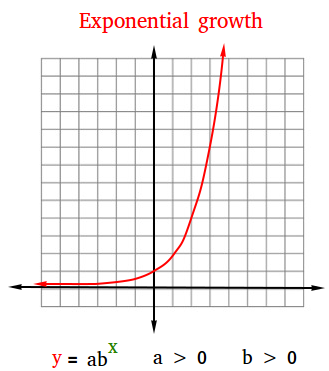
If you plot the points from the table above on an X-Y coordinate plane, you get a distinct "hockey stick" curve. Here are the key features you must know for exams:
- The y-intercept: The graph crosses the y-axis (where x=0) exactly at the initial value (a). In our example
y=3(2)x, it crosses at (0, 3). In a word problem, this is your starting amount at time zero. - The shape: The curve sweeps upwards from left to right. Because positive things are multiplying, it never dips down.
- The rate of increase: The slope gets steeper and steeper as you move to the right. It accelerates.
- The asymptote (the floor): Assuming your initial amount was positive, the graph never touches or crosses the x-axis. If you look at negative time values (x = -1, -2, -3), the fractions get smaller and smaller (like 3/2, 3/4, 3/8) closer to zero, but they never hit zero or turn negative. Think about it: you can take half of a pizza forever, and you'll always have a microscopic crumb left.
8. Exponential Growth in Real Life
Where does this math actually happen outside of a textbook? Everywhere.
Population Growth
If a city has 100,000 people and a 2% growth rate, there are 2,000 new babies. Next year, those 2,000 new babies will eventually grow up and have their own babies. The new additions themselves contribute to future growth. This is the definition of a compounding, exponential system.
Compound Interest and Finance
When you put money in a bank, the bank pays you interest. Next year, they pay you interest on your original money and on the interest they paid you last year. Your money makes "babies," and then those babies make babies. This is why investing early in life is so incredibly powerful.
Bacteria and Cell Growth
A single bacteria cell splits into 2. Those 2 split into 4. Those 4 split into 8. In just 24 hours (if splitting every hour), one single cell becomes 16.7 million cells. This is why food spoils so quickly if left out of the fridge.
Spread of Information (Viral Content)
If you share a funny video with 5 friends, and each of them shares it with 5 friends, and each of them shares it with 5 friends... within just 6 "shares," the video has reached over 15,000 people. This is the mathematical mechanism behind internet virality.
Computer Science (Moore's Law)
Historically, the number of transistors that can fit on a microchip has doubled approximately every two years. This exponential growth curve is why the smartphone in your pocket has millions of times more computing power than the computers that sent humans to the moon.
9. Compound Interest as Exponential Growth
Compound interest is the most famous and tested application of exponential growth. It is so important that it gets its own special version of the formula.
This looks scary, but it is exactly the same as y = a(1 + r)t, just sliced into smaller pieces.
- A (Amount): The final future value in the account. (This is y).
- P (Principal): The initial amount deposited. (This is a).
- r (Annual Interest Rate): The yearly rate as a decimal (e.g., 5% = 0.05).
- n (Compounding Frequency): How many times per year the bank calculates and gives you interest.
- Annually: n = 1
- Semi-annually: n = 2
- Quarterly: n = 4
- Monthly: n = 12
- Daily: n = 365
- t (Time): The number of years the money is invested.
Why do we divide by n and multiply by n?
If a bank offers "12% annual interest compounded monthly," they do NOT give you 12% every single month. They take that 12% and slice it into 12 equal pieces. They give you 1% each month (r / n). Over the course of 5 years, they will pay you interest 60 separate times (n * t). That is why the formula adjusts the rate down and the time up.
Example A: Compounding Quarterly
You invest $2,000 in an account paying 6% annual interest, compounded quarterly. How much is in the account after 8 years?
- P = 2000
- r = 0.06
- n = 4 (quarterly means 4 times a year)
- t = 8
Equation: A = 2000(1 + 0.06/4)(4 * 8)
Simplify inside: A = 2000(1 + 0.015)32
Simplify exponents: A = 2000(1.015)32
Calculate: A = 2000(1.6103)
Answer: $3,220.65
Example B: Compounding Monthly
You invest $5,000 at 4.5% annual interest, compounded monthly. What is the value after 10 years?
- P = 5000
- r = 0.045
- n = 12
- t = 10
Equation: A = 5000(1 + 0.045/12)(12 * 10)
Simplify inside: A = 5000(1 + 0.00375)120
Calculate: A = 5000(1.00375)120 = 5000(1.56699)
Answer: $7,834.97
10. Finding Missing Values in Exponential Growth
You will not always be solving for the final amount. Sometimes, exams will give you the final amount and ask you to work backwards to find a missing piece of the puzzle.
Finding the Initial Amount (a)
Problem:
A specific breed of rabbit has a population that grows at 12% per year. After 4 years, there are 850 rabbits. How many rabbits were there initially?
Set up the equation: We know y = 850, r = 0.12, and t = 4. We need to find a.
850 = a(1.12)4
Calculate the factor: 1.124 ≈ 1.5735
850 = a(1.5735)
Solve algebraically: Divide both sides by 1.5735.
a = 850 / 1.5735
Answer: a ≈ 540. There were exactly 540 rabbits initially.
Finding the Growth Rate (r)
Problem:
A vintage guitar was purchased for $1,200. Three years later, it was appraised at $1,600. Assuming exponential growth, what was the annual percentage growth rate?
Set up the equation: y = 1600, a = 1200, t = 3. Find r.
1600 = 1200(1 + r)3
Step 1 (Isolate the base): Divide by 1200.
1.3333 = (1 + r)3
Step 2 (Undo the exponent): Take the cube root (or power of 1/3) of both sides.
(1.3333)1/3 = 1 + r
1.1006 = 1 + r
Step 3 (Solve for r): Subtract 1.
r = 0.1006
Answer: The guitar's value grew by approximately 10.06% per year.
Finding the Time (t) using Logarithms
If the unknown variable is in the exponent (time), you cannot isolate it using basic algebra like division or roots. You must use logarithms. (Note: Some lower-level classes allow you to solve this by graphing or guessing-and-checking. This is the algebraic method).
Problem:
You invest $4,000 at 5% annual interest. How long will it take for the account to reach $6,000?
Set up the equation: y = 6000, a = 4000, r = 0.05. Find t.
6000 = 4000(1.05)t
Step 1 (Isolate the base): Divide by 4000.
1.5 = 1.05t
Step 2 (Use Logarithms): Take the natural log (ln) of both sides to bring the 't' down.
ln(1.5) = ln(1.05t)
ln(1.5) = t * ln(1.05)
Step 3 (Solve for t): Divide by ln(1.05).
t = ln(1.5) / ln(1.05)
t = 0.4055 / 0.0488
Answer: t ≈ 8.31 years.
11. Exponential Growth and Doubling Time
One of the most fascinating features of exponential growth is the concept of doubling time. This is a simple question: "How long does it take for my stuff to multiply by 2?"
Because the growth rate is constant, the time it takes to double is also constant, regardless of how much you start with. If it takes 10 years for $1,000 to become $2,000, it also takes exactly 10 years for $1 million to become $2 million.
The "Rule of 72" (Finance Shortcut)
In finance, there is a famous shortcut for estimating doubling time. Divide 72 by your percentage interest rate. The result is roughly how many years it will take your money to double.
- If you earn 6% interest:
72 / 6 = 12 yearsto double. - If you earn 9% interest:
72 / 9 = 8 yearsto double.
Standard Doubling Time Problems
Problem:
A bacteria culture doubles every 3 hours. If you start with 50 bacteria, how many will you have after 15 hours?
Solution Strategy: Instead of using the 1+r formula, use the doubling logic. How many times does it double? If 15 hours pass, and it doubles every 3 hours, then it doubles 5 times (15/3).
Equation: y = a(2)number of doublings
y = 50(2)5
Calculate: y = 50(32) = 1600
Answer: 1,600 bacteria.
12. Common Student Mistakes
Exponential growth is unforgiving. If you set up the equation slightly wrong, the final numbers will be completely incorrect by thousands of dollars or millions of bacteria. Watch out for these traps.
Mistake 1: Confusing Growth Rate with Growth Factor
Wrong: The population grows by 6%. The student writes y = 500(0.06)t.
Correct: Multiplying by 0.06 is finding 6% of a number (meaning 94% of the population died). To GROW by 6%, you must keep the original 100% and add 6%. The factor is 1 + 0.06 = 1.06. The correct equation is y = 500(1.06)t.
Mistake 2: Bad Percentage Conversions
Wrong: 5% growth → r = 0.5 (Wait, 0.5 means 50%!).
Correct: Always divide the percentage by 100 on your calculator. 5 / 100 = 0.05. The growth factor is 1.05.
Mistake 3: Treating Exponential Growth like Linear Growth
Wrong: If my money grows 10% in Year 1, and 10% in Year 2, then after two years it grew by 20%.
Correct: Growth builds upon growth. It grew by 10% of the original amount, plus 10% of the newly added amount. The actual total growth is (1.10)2 = 1.21, which is 21%, not 20%.
Mistake 4: Order of Operations Errors on the Calculator
Wrong: Typing 500 * 1.05 ^ 5 and the calculator does (500 * 1.05) ^ 5.
Correct: Exponents ALWAYS come before multiplication. You must calculate 1.05^5 first, hit equals, and THEN multiply by 500.
13. Exam Tips and Problem-Solving Strategies
Strategy 1: Sniff Test for Reasonability
Always pause and look at your final answer. Does it make logical physical sense? If a town of 4,000 people grows by 2% a year for 5 years, and your calculator says they now have 38.6 billion people... you definitely missed a decimal point or multiplied instead of adding 1 to the rate.
Strategy 2: Identify Linear vs Exponential Keywords
- Linear Keywords: "Adds $50 per month", "increases by 12 people per hour", "constant amount". → Use `y = mx + b`.
- Exponential Keywords: "Grows by 6% annually", "doubles every day", "increases by a factor of 1.5". → Use `y = a(1 + r)^t`.
Strategy 3: Don't Round Too Early
If you are calculating a growth factor raised to a large power (like 1.0320), do not round that intermediate number to 1.8. Keep it exactly as 1.8061112... in your calculator and multiply the initial amount immediately. Rounding too early will snowball into a huge final error.
14. Practice Problems
Try these problems on scratch paper before revealing the solutions. They progress from easy to advanced.
Question 1 (Identify Growth Factor)
A population of deer increases by 8% every year. What is the growth factor you should use in the equation?
Rate (r) = 8% = 0.08.
Growth Factor = 1 + r = 1 + 0.08 = 1.08.
Answer: The growth factor is 1.08
Question 2 (Evaluate Basic Equation)
Evaluate the population after 5 years using the model: P = 12000(1.04)5.
Calculate exponents first: (1.04)5 ≈ 1.21665
Multiply: 12000 * 1.21665 = 14599.8
Answer: 14,600 people
Question 3 (Linear vs Exponential)
Which situation represents exponential growth?
- A student adds $25 to their savings account every week.
- A company's profits increase by 5% every quarter.
Option A adds a constant amount (+$25). That is linear.
Option B multiplies by a constant factor every quarter (1.05). Percentage increases are exponential.
Answer: B
Question 4 (Write the Equation)
A startup company has 5,000 active users. Their user base is growing by 15% every month. Write the exponential growth equation representing the number of users 'y' after 'x' months.
Initial (a) = 5000. Rate (r) = 0.15. Factor = 1.15.
Formula: y = a(1+r)x
Answer: y = 5000(1.15)x
Question 5 (Investing)
You invest $2,500 in an index fund that averages a 7.5% annual return. How much will it be worth in 10 years?
y = 2500(1 + 0.075)10
y = 2500(1.075)10
y = 2500(2.06103)
Answer: $5,152.58
Question 6 (Reading an Equation)
A scientist models a bacteria colony with the equation B = 450(1.28)t, where t is in hours. What was the initial population, and what is the hourly growth rate?
The number in front is the initial amount (a = 450).
The base is the growth factor (1 + r = 1.28). Therefore, r = 0.28.
Answer: Initial population is 450 bacteria. The growth rate is 28% per hour.
Question 7 (Compound Interest)
You deposit $10,000 into a CD paying 4% annual interest compounded quarterly. How much is in the account after 5 years?
Formula: A = P(1 + r/n)nt
P = 10000, r = 0.04, n = 4, t = 5
A = 10000(1 + 0.04/4)(4*5) = 10000(1.01)20
A = 10000(1.22019)
Answer: $12,201.90
Question 8 (High Percentage Rate)
A particular species of algae increases its mass by 120% every week. If a pond currently has 15 kg of algae, how much will there be in 4 weeks?
r = 120% = 1.20. Growth factor = 1 + 1.20 = 2.20.
y = 15(2.20)4
y = 15(23.4256)
Answer: 351.38 kg
Question 9 (Table Interpretation)
Does this table represent linear or exponential growth? Prove it.
x = 0, y = 5
x = 1, y = 15
x = 2, y = 45
x = 3, y = 135
Check differences (Linear check): 15 - 5 = +10. 45 - 15 = +30. Not perfectly linear (differences change).
Check ratios (Exponential check): 15 / 5 = 3. 45 / 15 = 3. 135 / 45 = 3.
Answer: Exponential growth (Factor of 3).
Question 10 (Finding Missing Value - Initial Amount)
After 3 years of growing at 6% annually, an account has $5,955.08. How much was originally deposited?
5955.08 = P(1.06)3
5955.08 = P(1.191016)
P = 5955.08 / 1.191016
Answer: $5,000.00
Question 11 (Finding Missing Value - Rate)
A painting bought for $4,000 is sold 5 years later for $6,500. Assuming exponential growth, what was the average annual growth rate?
6500 = 4000(1 + r)5
1.625 = (1 + r)5
(1.625)1/5 = 1 + r
1.102 = 1 + r → r = 0.102
Answer: The growth rate is approximately 10.2% per year.
Question 12 (Fractional Time Period)
A population grows at 8% per year. The initial population is 2,000. What is the population after exactly 2 years and 6 months?
2 years and 6 months is t = 2.5 years.
y = 2000(1.08)2.5
y = 2000(1.212)
Answer: ≈ 2,424 people.
Question 13 (Doubling Logic)
The "Rule of 72" says roughly how long money takes to double. Using the rule, if you invest at a 9% interest rate, when will $500 become $1,000?
Rule of 72: Divide 72 by the percentage rate.
72 / 9 = 8.
Answer: Approximately 8 years.
Question 14 (Mixed Application)
In 2015, a town had 30,000 homes. The number of homes increases by 1.5% each year. Assuming this model holds true, what predicting formula should the mayor use to find the number of homes in the year 2040?
Initial: 30000. Factor: 1.015. Time: 2040 - 2015 = 25 years.
Answer: y = 30000(1.015)25
Question 15 (Advanced: Find Time)
You have $5,000 in an account earning 5% compounded annually. Set up the equation you would need to use to find how many years (t) until the account hits $10,000.
10000 = 5000(1.05)t
2 = (1.05)t
This asks: "What power do I raise 1.05 to in order to get 2?" You would solve this using logarithms.
Answer: 2 = (1.05)t
Interactive Exponential Growth Calculator
Growth Simulator
Test the formula instantly! Enter an initial amount, a growth rate, and how much time has passed.
15. Summary of Key Points
| Concept / Term | Key Takeaway / Formula |
|---|---|
| Exponential Growth | Growth that increases by multiplying by a constant factor every time period. Follows a hockey-stick curve on a graph. |
| Growth Rate (r) | The percentage increase written as a decimal (e.g., 6% = 0.06). Indicates how much new growth is added. |
| Growth Factor (1 + r) | The multiplier used to calculate the next value (e.g., 1.06). Includes the original 100% plus the new growth. |
| Standard Formula | y = a(1 + r)t Where a=initial amount, r=decimal rate, t=time. |
| Compound Interest Formula | A = P(1 + r/n)nt Used when banks pay interest multiple times a year (n = compounding frequency). |
| Linear vs Exponential | Linear ADDS a constant amount. Exponential MULTIPLIES by a constant amount. Exponential will always surpass linear eventually. |
| Rule of 72 | Mental math shortcut: 72 divided by the percentage interest rate equals the approximate number of years to double your initial money. |
You have completed the Exponential Growth Study Guide!
You are now ready to tackle real-world financial problems and exponential algebra exams with confidence.